
LES-201 · Lesson 9 of 12 · 19 min
Canvasses, video, informants and open sources
▶ Video coming soon A video version of this lesson is on the way.
On the morning after the robbery, while Ferreira interviewed Rao, four officers walked the streets around Northgate Convenience with clipboards and tablets. They knocked on every door on Harbour Road, Pine Street and the two side streets within two blocks, visited every business, noted every camera they could see on a house, a store or a parked car, and recorded every address where nobody answered so that they could return. By the end of the day they had spoken to 63 people, found nine cameras, and identified one witness who had not called the police: a teenager walking his dog who had seen a grey hatchback speed west on Pine Street just before ten. Desjardins tells the class that canvassing is unglamorous, slow and often fruitless, and that it solves cases.
The neighbourhood canvass
A canvass is a systematic search for witnesses and information in the area around a crime. It should be planned, not improvised. The investigator defines the area based on the offender's likely routes in and out, the time of day and the places people would have been. Officers use a standard form or app to record each address, the time of the visit, who was spoken to, whether they saw or heard anything, whether there is a camera, and whether a return visit is needed. Every address in the area should end up with a result, even if it is 'vacant' or 'no answer after three visits'. Canvasses are often repeated at the same time of day and day of the week as the crime, a week later, because the people who were there at that time, such as shift workers, bus drivers and regular dog walkers, may not be home during the first canvass.
Good canvassing questions are open and neutral: 'Were you home last night between nine and ten? Did you see or hear anything unusual? Do you have a camera that faces the street?' Officers should not describe a suspect in detail, because that can lead people to remember someone who fits, and should not speculate about the case. They should leave a card with a contact number and the file number, because people often remember something after the officer has gone. The Northgate canvass produced the dog walker's account, two cameras with useful video, and a neighbour who said that a grey hatchback with a dented bumper had been parked on her street 'a few times' in the previous weeks, which later became important.
The video canvass
Video is now one of the most important sources of evidence in investigations. Cameras are everywhere: stores, gas stations, banks, buses, traffic intersections, doorbell cameras, dashboard cameras and phones. A video canvass identifies every camera that might have recorded the offender, the vehicle or the route, and preserves the footage before it is overwritten. Many systems keep recordings for only a few days to a few weeks, so speed matters. Officers should ask the owner for permission to view and copy the footage, record the make and model of the system, and, most importantly, check the system's clock against an accurate time source, because recorder clocks are often minutes off and sometimes hours. Without that check, events on different cameras cannot be put in order.
Footage should be copied in its original, native format wherever possible, with the player software needed to view it, because exporting to a common format can reduce quality and remove the time stamps. The person who made the copy should record the date, time, the system's time offset, the cameras and time periods copied, and should calculate a digital fingerprint of the file, called a hash value, so that any later change can be detected. If the owner will not consent, or if the video is held by a company, police may need a production order or warrant, as lesson 10 explains.
# Correct each recorder's time stamps to true time and put events in order.
# offset = true time minus displayed time, measured when the footage was copied
offsets = {"store": -6 * 60 - 40, "gas bar": 2 * 60 + 15, "laundromat": 0, "doorbell 14 Pine": 58}
events = [
    ("store",       "21:54:31", "suspect enters store"),
    ("store",       "21:55:45", "suspect leaves store"),
    ("laundromat",  "21:49:10", "figure runs past toward rear lot"),
    ("gas bar",     "21:47:57", "hatchback passes west, dented bumper"),
    ("doorbell 14 Pine", "21:48:40", "hatchback passes west at speed"),
]
def secs(t):
    h, m, s = map(int, t.split(":")); return h * 3600 + m * 60 + s
def clock(n):
    return "{:02d}:{:02d}:{:02d}".format(n // 3600, n // 60 - 60 * (n // 3600), n - 60 * (n // 60))
fixed = []
for cam, shown, what in events:
    fixed.append((clock(secs(shown) + offsets[cam]), cam, what))
for t, cam, what in sorted(fixed):
print(t, f"{cam:17}", what)21:47:51 store suspect enters store 21:49:05 store suspect leaves store 21:49:10 laundromat figure runs past toward rear lot 21:49:38 doorbell 14 Pine hatchback passes west at speed 21:50:12 gas bar hatchback passes west, dented bumper
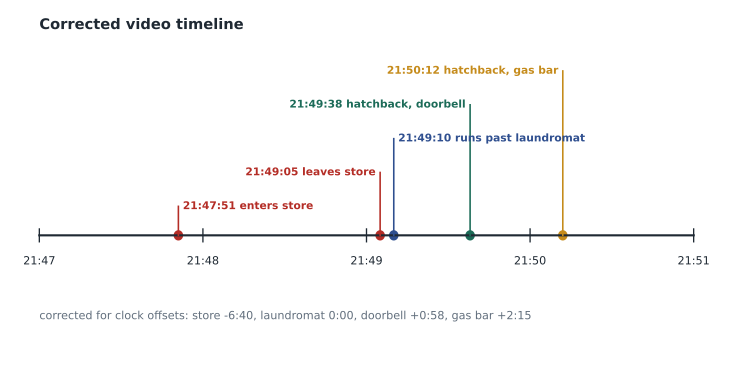
The store's recorder was six minutes and forty seconds fast, so its display showed the robber entering at 21:54:31 when the true time was 21:47:51. The gas bar camera on Pine Street was two minutes fifteen seconds slow. Once the offsets were applied, the sequence made sense: the robber entered the store at 21:47:51 and left 74 seconds later, a figure ran past the laundromat camera toward the rear lot a few seconds after that, and the grey hatchback passed the doorbell camera and then the gas bar heading west about a minute later. Without the corrections, the car appeared to have driven past the gas bar before the robbery began. The gas bar camera also captured three characters of the rear licence plate and the dent in the bumper.
Using the partial plate
Investigators can query licence plate and vehicle registration records through the Canadian Police Information Centre and the provincial registry for official purposes. A search for grey hatchbacks of the model seen on video, registered in Port Ardent and nearby communities, with those three characters in the plate, produced eleven vehicles. Officers checked each one: seven were the wrong shade or had no dent, two were registered to people with verified whereabouts, and one had been sold and scrapped. One was registered to Cody Marsh. Desjardins points out the order of events: Marsh's vehicle was one candidate among eleven, checked and recorded like the others, and it became significant only when the DNA hit arrived two days later. Had investigators focused on it first, they would have needed to be careful not to treat a common car as an identification.
Access to police databases is for official purposes only. Officers who query records out of curiosity, for a friend, or for any personal reason commit a serious disciplinary offence and may commit a crime, and database queries are audited.
Informants and tips
Information from people who know the offender is often what solves a case. It comes from several kinds of sources. Anonymous tips arrive through programs such as Crime Stoppers, which promise callers that their identity will never be known, even to police. Members of the public may give information openly. Confidential informants are people who provide information to police, often repeatedly and sometimes for payment or for consideration in their own cases, on the understanding that their identity will be protected. Each kind requires a different approach to assessing reliability.
A tip is a lead, not evidence. Its value depends on how much detail it contains, whether that detail could only be known by someone with inside knowledge, whether the source has a track record, and, above all, whether it can be corroborated independently. The Supreme Court of Canada in R. v. Debot (1989) set out three questions for assessing a tip as grounds for police action: was it compelling, was it credible, and was it corroborated? Weakness in one area can be offset by strength in another, but an anonymous tip with little detail and no corroboration is worth very little. The Pelletier tip gave a name, a prior conviction and a car colour, all of which could be found in public records or local gossip. It predicted nothing and contained no inside knowledge. Investigators checked it properly, found the alibi, and recorded it as unfounded.
The identity of a confidential informant is protected by a strong legal privilege. In Canada, informer privilege is nearly absolute: neither police nor the Crown nor the court may disclose information that could identify an informer, except under the innocence at stake exception, where disclosure is necessary to show that the accused is innocent, as R. v. Leipert (1997) and Named Person v. Vancouver Sun (2007) explain. Police services manage informants through formal programs: each informant is registered, assessed for reliability, handled by two officers, never promised immunity without the prosecutor's involvement, and paid only with documented approval. Officers must never let an informant commit crimes on the police's behalf, and must record everything the informant provides, including information that proved wrong.
Open-source information
Open-source information is information that anyone can access: public social media posts, online marketplaces, news reports, public records, business websites and mapping services. It can identify witnesses, locate suspects, trace stolen property and corroborate other evidence. Two days after the robbery, Erin Bose, a civilian crime analyst, searched online marketplaces for the brand of cigarettes stolen, which the store sold by the carton. She found a listing posted on February 9 offering 'six cartons, sealed, cheap, north end pickup' with a phone number. She captured the listing with the date, time, web address and a screen recording, and calculated a hash value of the capture. The number was later linked to Marsh.
Open-source work has limits. Viewing public information is generally lawful, but creating fake profiles, joining private groups, or communicating with people while posing as someone else is undercover work that requires authorization, supervision and policy compliance, and may engage privacy rights. In R. v. Mills (2019), the Supreme Court of Canada held that an undercover officer's online conversations with an adult offender who believed he was talking to a child did not engage a reasonable expectation of privacy, but the Court emphasized that the decision turned on its facts. Officers should also remember that online information can be false, outdated or posted by someone pretending to be another person, and must be corroborated like any other lead.
Worked problem
Planning a video canvass
A man's bicycle was stolen from a rack outside a library between 1:00 and 1:45 p.m. on a Thursday. The library has a camera over the front door. Across the street there is a coffee shop and a bank, and a city bus stop is at the corner. Plan the video canvass.
Show solution
- List every possible camera: the library door camera, the coffee shop, the bank's exterior cameras and ATM, the city bus's onboard cameras, and any doorbell or dashboard cameras on the block.
- Act quickly, starting with the systems most likely to overwrite footage, and ask each owner to preserve the 1:00 to 2:00 p.m. footage immediately.
- For each system, check and record the clock offset against an accurate time source before copying.
- Copy the footage in its native format with the player, record who copied it, when, the cameras and time periods, and calculate a hash value.
- Contact the transit authority for bus footage, which may require a formal request.
- Record every camera checked, including those with no useful footage or that had already overwritten it.
Answer: Identify every camera, preserve footage quickly, record clock offsets, copy natively with a hash, and record every result.
Common mistakes
MistakeA canvass only needs to cover houses where people answer the door.
InsteadEvery address needs a recorded result, with return visits, often at the same time and day as the crime.
MistakeVideo time stamps can be trusted as recorded.
InsteadRecorder clocks are often wrong; the offset must be measured and recorded when the footage is copied.
MistakeA detailed tip is reliable.
InsteadDetail that anyone could know adds little; reliability comes from inside knowledge, track record and corroboration.
MistakeAnything online can be collected in any way.
InsteadViewing public information is generally lawful, but undercover online work needs authorization and policy compliance.
Summary and key terms
- Canvasses are planned, recorded address by address, and repeated at the time and day of the crime.
- Video canvasses must be fast, record each recorder's clock offset, copy footage natively and calculate hash values.
- Clock corrections are essential to put events from different cameras in order.
- Database queries are for official purposes only and are audited.
- Tips are assessed as compelling, credible and corroborated under Debot, and informer privilege is nearly absolute.
- Open-source information is valuable but must be captured properly, corroborated and gathered within legal and policy limits.
- Canvass
- A systematic search for witnesses and information in the area around a crime.
- Clock offset
- The difference between a recorder's displayed time and the true time.
- Hash value
- A digital fingerprint of a file that changes if the file is altered.
- Confidential informant
- A person who gives information to police on the understanding that their identity will be protected.
- Informer privilege
- The legal rule protecting the identity of confidential informants.
- Open-source information
- Information that anyone can access, such as public posts and marketplaces.
Practice problems
Work each problem on paper first, then reveal the answer to check.
Why repeat a canvass a week later at the same time and day?
Show answer
People who are regularly there at that time, such as shift workers and dog walkers, may have been missed the first time.
In the code example, what was the true time the robber entered the store?
Show answer
21:54:31 minus 6 minutes 40 seconds, which is 21:47:51.
Why was the Pelletier tip weak?
Show answer
It contained only information anyone could know, predicted nothing and was not corroborated.
What should be recorded when capturing an online listing?
Show answer
The date, time, web address, a capture such as a screen recording, and a hash value.
Lesson quiz · 5 questions
Score 60% or more to complete this lesson.
Create a free account to save your progress, take quizzes and earn a certificate.