
LES-201 · Lesson 4 of 12 · 20 min
Physical evidence: recognition, collection and continuity
▶ Video coming soon A video version of this lesson is on the way.
Desjardins brings an evidence bag to class. It is a brown paper bag, folded twice at the top and sealed with red evidence tape, with a label filled in by hand: exhibit number, case number, date, time, location, description, the name of the officer who seized it, and four lines of signatures with dates and times underneath. 'This is a black knit glove from beside a dumpster on Harbour Road,' he says. 'It is worth nothing on its own. What makes it evidence is everything written on this bag and in the records behind it, which together prove that the glove the laboratory tested is the glove that lay in the snow at 9:55 that night, and that nobody added anything to it or took anything away.' This lesson is about recognizing physical evidence, collecting it properly, and proving its continuity from the scene to the courtroom.
What physical evidence can do
Physical evidence is any object or material that can help establish the facts of a case: fingerprints, DNA, footwear and tire impressions, tool marks, fibres, glass, paint, documents, weapons, clothing, stolen property, drugs, and digital devices. It can do several jobs. It can establish that a crime occurred, such as pry marks on a door. It can link a person to a place, an object or another person, such as a fingerprint on a till or a victim's blood on a jacket. It can corroborate or contradict a witness or a suspect's account. It can identify a person, as DNA and fingerprints can. And it can exclude a suspect, which is as important as including one. Unlike a witness, physical evidence does not forget or change its story, but it can be misread, mishandled or contaminated, and its meaning depends on careful interpretation.
Forensic scientists often describe evidence as having class characteristics or individual characteristics. Class characteristics are shared by a group of objects: a tread pattern found on every shoe of a particular model and size, or a type of fibre used in thousands of sweaters. Individual characteristics are features that can, in principle, distinguish one item from all others, such as the random cuts and wear marks that develop on one particular shoe sole over time. Desjardins warns that courts and scientific reviews, including the 2009 report of the United States National Academy of Sciences, which Canadian courts and commissions have also cited, and the 2016 report of the United States President's Council of Advisors on Science and Technology, have cautioned that many pattern-matching disciplines cannot prove that a mark came from one source to the exclusion of all others. Investigators should report what the examiner actually concluded, in the examiner's words.
Recognizing evidence
Officers can only collect evidence they notice. Recognition depends on knowing what to look for and where offenders leave traces: points of entry and exit, items the offender touched or moved, surfaces they leaned on, things they dropped or left behind, and the route they took. Locard's exchange principle, named after the French criminologist Edmond Locard, holds that every contact leaves a trace: an offender brings something to a scene and takes something away. The principle is a useful mindset rather than a guarantee, since some traces are too small to find or are lost, but it reminds investigators to think about what transfer might have happened.
At Northgate, Liu thought about what the robber had done. He had pushed the front door open, so the door's push plate and handle were processed for fingerprints. He had leaned over the counter, so the counter edge was examined. He had grabbed cigarette cartons from the rack, so the rack's front rail was processed. He had walked out across a floor wet with melted snow, leaving faint footwear marks. He had run along the side path, leaving impressions in the snow. And he had dropped, or lost, a glove. Each place was a hypothesis about where traces might be, and each was documented whether or not anything was found.
Collecting and packaging
Each item is photographed in place and its position recorded before it is touched. The person collecting it wears gloves, changes them between items to avoid carrying material from one to the next, and handles the item as little as possible, by edges or areas unlikely to hold traces. Each item is packaged separately so that items cannot transfer material to each other. The packaging must suit the material. Biological evidence such as blood, saliva or a damp glove goes into paper, not plastic, because plastic traps moisture and allows bacteria and mould to destroy DNA; wet items may need to be air-dried in a secure drying cabinet first. Liquids and volatile materials such as fire debris go into airtight metal cans or glass jars. Firearms are made safe by a trained officer and packaged in rigid boxes. Sharp items such as knives are packaged in rigid tubes or boxes so that nobody is cut. Digital devices are handled as described in lesson 10.
| Item | Packaging | Reason |
|---|---|---|
| Damp glove or clothing | Paper bag, after air-drying if wet | Plastic traps moisture and DNA degrades |
| Cigarette butt or drink can | Paper envelope or small box | Protects saliva traces and allows drying |
| Knife | Rigid tube or box, blade secured | Prevents injury and protects the surfaces |
| Fire debris | Clean, airtight metal can | Keeps volatile accelerants from escaping |
| Glass fragments | Rigid container with padding | Prevents further breakage and loss of edges |
| Fibres or hairs | Folded paper packet inside an envelope | Prevents loss of very small items |
Each package is sealed so that any opening would be visible, usually with tamper-evident tape signed or initialled across the seal, and labelled with the exhibit number, case number, description, location, date and time of seizure, and the name of the person who seized it. Liu collected eleven exhibits at Northgate, including the glove, two lifted fingerprints from the front door and rack rail, swabs from the counter edge, casts and photographs of two footwear impressions from the side path, and the store's video recorder hard drive, which the owner consented to release.
Known and control samples
Evidence from a scene, called questioned evidence, is often useful only when compared with known samples. Fingerprints on the door mean little until they are compared with known prints. A footwear impression can be compared with a suspect's shoes. DNA from the glove can be compared with a profile from a known person. Investigators also collect elimination samples from people who had legitimate access to the scene, such as the clerk, the owner and the first officers, so that their traces can be excluded. Rao and the store owner gave elimination fingerprints and DNA swabs voluntarily, with a written explanation of how the samples would be used and that they would not be kept in any database. Control samples, such as a swab of a clean area of the counter, help show whether the surface itself contributed material.
Continuity of evidence
Continuity of evidence, called chain of custody in the United States, is the documented record of who had control of an item from the moment it was seized until it is presented in court, where it was kept, and what was done to it. Its purpose is to show that the item in court is the same item that was seized, in substantially the same condition, and that nobody had an opportunity to alter, substitute or contaminate it without that being recorded. Every transfer is recorded with the date, time, the person handing over, the person receiving, and the purpose. Storage in a secure property room with controlled access, and an electronic tracking system, supports the record.
In Canadian law, the Crown must prove that an exhibit is what it claims to be, and gaps in continuity go mainly to the weight a court gives the evidence rather than to whether it is admissible, unless the gap raises a real doubt about the item's identity or integrity. Courts have said that continuity need not be proved beyond a reasonable doubt; what matters is whether the evidence as a whole shows the exhibit is reliable. In both countries, a weak record invites the defence to argue that the item might have been contaminated or confused with another, and a jury may give it little weight even if it is admitted.
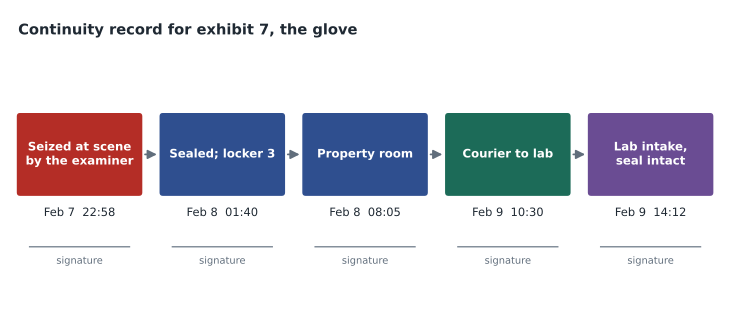
# Custody record for exhibit 7 (black knit glove).
# Each entry: (time, from, to, purpose). Check that each transfer starts
# with the person who last received the item.
record = [
    ("2026-02-07 22:58", "scene",      "Liu",        "seized"),
    ("2026-02-08 01:40", "Liu",        "locker 3",   "temporary storage"),
    ("2026-02-08 08:05", "locker 3",   "property",   "logged into property room"),
    ("2026-02-09 10:30", "property",   "courier",    "to laboratory"),
    ("2026-02-09 14:12", "courier",    "lab intake", "received sealed"),
]
holder = "scene"
problems = 0
for when, giver, taker, why in record:
    if giver != holder:
        print("GAP:", when, "handed over by", giver, "but last holder was", holder)
        problems += 1
    holder = taker
print("transfers:", len(record), "problems:", problems, "current holder:", holder)transfers: 5 problems: 0 current holder: lab intake
The record is clean: each transfer begins with the person who last held the glove, and the laboratory received it sealed. Desjardins asks what the code cannot check. Jesse Morningstar answers that it cannot tell whether the seal was really intact or whether the times are true; only the people involved, and the condition of the package, can show that. He also notes that the glove spent nearly three hours with Liu at the scene and in her vehicle before it went into the locker. Liu's notes explain that she kept it in her sight, in a sealed bag in a locked case, until she returned to the station, and her notes record the times.
Contamination and transfer
Modern DNA analysis can detect very small amounts of material, which makes contamination a real risk. DNA can transfer from an officer's skin to an exhibit, from one exhibit to another through gloves or a shared surface, or from a suspect to an exhibit if both are handled by the same officer or kept in the same room. Services reduce the risk with gloves and masks, separate packaging, changing gloves between items, keeping suspects and exhibits apart, cleaning surfaces and equipment, and keeping elimination DNA profiles from officers and laboratory staff. Investigators should never take a suspect to the scene, or carry exhibits in the car used to transport the suspect, without recording it and considering the risk. In a case Desjardins worked early in his career, a sweater seized from a suspect was transported in the same cruiser that had carried the victim an hour earlier. The laboratory found a fibre match, but the defence argued it could have been caused by the shared seat, and the evidence was given little weight.
Worked problem
Packaging a mixed set of exhibits
At a break-in, officers find a crowbar on the lawn, a damp baseball cap in a flower bed, a cigarette butt on the step and a shard of window glass with what looks like blood on it. How should each be collected and packaged, and what records are needed?
Show solution
- Photograph each item in place, with and without a scale, and record its position by measurement before moving anything.
- Crowbar: handle by the middle, away from likely contact areas at the ends; package in a rigid box or wrap the ends in paper, and keep it for tool-mark comparison with the door.
- Baseball cap: air-dry if damp, then package in a paper bag; it may hold hair and DNA from the wearer.
- Cigarette butt: pick up with clean forceps and place in a paper envelope; it may hold saliva DNA.
- Glass with blood: package in a rigid, padded container so the blood is not rubbed off, and keep it upright if possible.
- Change gloves between items, seal and label each package separately, and start the custody record for each with the time of seizure.
Answer: Separate, material-appropriate packaging for each item, with gloves changed between them and a custody record started at seizure.
Common mistakes
MistakeBiological evidence should be sealed in plastic to keep it clean.
InsteadBiological evidence goes in paper, after drying if wet, because plastic traps moisture and destroys DNA.
MistakeSeveral small items can share one bag if they came from the same spot.
InsteadEach item is packaged separately to prevent transfer between them.
MistakeA gap in continuity means the exhibit is automatically excluded.
InsteadMinor gaps usually go to weight, but a gap that raises a real doubt about identity or tampering can make the exhibit worthless.
MistakeElimination samples are only needed from suspects.
InsteadElimination samples are taken from people with legitimate access, such as staff and first officers, so their traces can be excluded.
Summary and key terms
- Physical evidence can show a crime occurred, link people and places, corroborate or contradict accounts, identify and exclude.
- Class characteristics are shared by a group; individual characteristics may distinguish one item, but many pattern disciplines have limits.
- Locard's exchange principle reminds investigators to think about what traces were transferred.
- Items are photographed in place, collected with gloves changed between them, and packaged separately in suitable materials.
- Known, elimination and control samples make questioned evidence meaningful.
- Continuity records every transfer from seizure to court and protects the exhibit's integrity.
- Physical evidence
- Any object or material that can help establish the facts of a case.
- Class characteristics
- Features shared by a group of objects, such as a shoe model's tread pattern.
- Individual characteristics
- Features that may distinguish one item from all others, such as random wear marks.
- Locard's exchange principle
- The idea that every contact leaves a trace.
- Elimination sample
- A known sample from a person with legitimate access, used to exclude their traces.
- Continuity or chain of custody
- The documented record of who had control of an exhibit, where and when, from seizure to court.
Practice problems
Work each problem on paper first, then reveal the answer to check.
Why does a damp glove go into a paper bag?
Show answer
Paper lets moisture escape; plastic traps it, allowing bacteria and mould to destroy DNA.
What does a photograph of an item without a scale add to one with a scale?
Show answer
It shows the scale did not hide or disturb anything.
In the code example, what would the output be if the courier entry listed 'Liu' as the giver?
Show answer
A GAP line, because the last holder was the property room, not Liu.
Why should a suspect not be transported in the same vehicle as exhibits?
Show answer
Material can transfer between them, giving the defence a reason to argue contamination.
Lesson quiz · 5 questions
Score 60% or more to complete this lesson.
Create a free account to save your progress, take quizzes and earn a certificate.