
LES-201 · Lesson 7 of 12 · 19 min
Eyewitness identification and lineups
▶ Video coming soon A video version of this lesson is on the way.
Two days after the Northgate robbery, an anonymous caller to Crime Stoppers said that the robber was Ryan Pelletier, a 27-year-old who lived near the north end, had served a sentence for a robbery in 2019, and drove a grey hatchback. Detective Whitlock, Ferreira's partner, pulled Pelletier's booking photograph and suggested showing it to the clerk at the Pine Street gas bar, where a similar robbery had happened on January 24. The clerk there, Arjun Mehta, had seen the robber's face for several seconds before the man pulled up his face covering. 'Just show him the picture and ask if that's the guy,' Whitlock said. Ferreira said no. Desjardins tells the class that her refusal may have saved an innocent man from being charged with robbery.
Mistaken eyewitness identification is the most common factor in wrongful convictions later proven by DNA evidence. Canadian inquiries into the wrongful convictions of Thomas Sophonow, convicted three times of a Winnipeg murder he did not commit, and others found that suggestive identification procedures had played a central role, and the 2001 Sophonow inquiry led by former Justice Peter Cory made detailed recommendations for how lineups should be run. Honest, confident witnesses can be wrong, and a poorly run identification procedure can create a memory that feels completely real to the witness. This lesson covers how to collect identification evidence in a way that protects both the witness's memory and the suspect's right to a fair investigation.
Why identification is fragile
A face seen for a few seconds under stress is encoded imperfectly, and the memory fades quickly. When a witness looks at a lineup, they compare each face with that memory and often choose the person who looks most like their memory relative to the others, even if the offender is not there. This is called relative judgement. If the suspect is the only person who fits the description, or stands out in some way, the witness may choose him because he is the best available match. Once a witness has chosen someone, the memory of that face can replace the original memory, so that a later identification in court is really an identification of the person from the lineup. A witness who receives confirming feedback, such as 'Good, that's our suspect,' becomes much more confident, and later remembers having had a better view than they did.
For these reasons, the identification procedure is the most important system variable police control. A single-photo showing, like the one Whitlock suggested, is highly suggestive: it tells the witness that the police think this person is the offender. Courts in both countries treat it as unreliable, and it can taint any later identification by the same witness. A procedure designed to test the witness's memory fairly gives the witness a real chance to say 'he isn't there'.
Best practices for photo lineups
The Sophonow inquiry and the federal, provincial and territorial heads of prosecutions committee reports on preventing wrongful convictions recommended several practices that most Canadian services now follow. The core practices are similar in both countries and are supported by research.
| Practice | Why it matters |
|---|---|
| Blind or blinded administration | An administrator who does not know which photo is the suspect cannot give cues, even unconsciously |
| Fillers who fit the description | The suspect should not stand out; fillers should match the witness's description, not just the suspect |
| One suspect per lineup | Every other photo is a known innocent filler, so a wrong pick is detectable |
| Unbiased instructions | The witness is told the offender may or may not be present and the investigation will continue either way |
| Immediate confidence statement | The witness's confidence in their own words, recorded before any feedback |
| No feedback | Nobody tells the witness whether they chose the suspect |
| Full recording | Video of the whole procedure, the photos used and the witness's words |
| One procedure per witness per suspect | Repeated viewings of the same suspect contaminate memory |
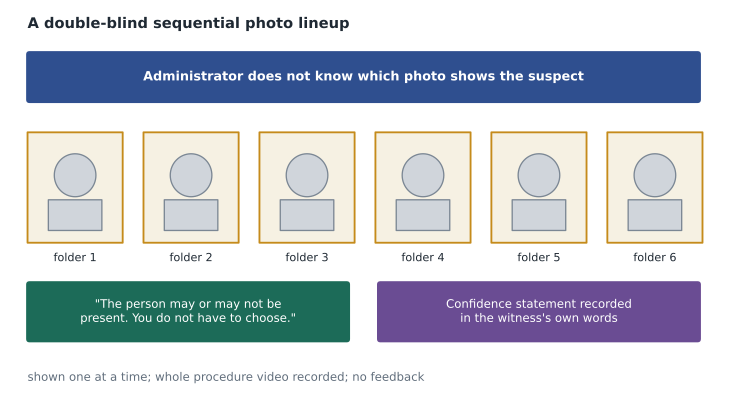
A blind administrator is an officer who does not know which photo shows the suspect. Where no such officer is available, a blinded procedure can be used, such as the folder shuffle method, where each photo is placed in a separate folder and shuffled so that the administrator cannot see which one the witness is viewing. Canadian practice generally favours sequential presentation, showing photos one at a time, as the Sophonow inquiry recommended, with at least ten photos where possible. Research comparing sequential and simultaneous lineups has produced mixed results; what matters most is that the procedure is double-blind, fair, properly instructed and recorded.
Choosing fillers
Fillers should be chosen so that the suspect does not stand out. Their photos should match the witness's description of the offender: age range, sex, build, hair, skin tone and any feature the witness mentioned. All photos should be similar in format, background and quality, and none should have features such as a booking number or a different style that draws attention. If the suspect has a distinctive feature that the witness did not mention, such as a scar, it can be covered or added to every photo in the same way. A lineup's fairness can be tested by showing it to mock witnesses, people who never saw the crime, along with the witness's description. If the description alone leads most mock witnesses to the suspect, the lineup is unfair.
# Mock witness test: people who did not see the crime are given the
# witness's description and asked to pick the person who fits it best.
lineups = {
    "Lineup 1 (Pelletier in position 4)": {"photos": 6, "mock": 30, "picked_suspect": 4},
    "Lineup 2 (Marsh in position 2)":     {"photos": 6, "mock": 30, "picked_suspect": 6},
}
for name, d in lineups.items():
    fair_rate = d["mock"] / d["photos"]          # expected picks if all fit equally
    functional_size = d["mock"] / d["picked_suspect"]
    print(name)
    print("   expected picks if fair:", fair_rate, " actual picks of suspect:", d["picked_suspect"])
print(" functional size:", round(functional_size, 1), "of", d["photos"])Lineup 1 (Pelletier in position 4) expected picks if fair: 5.0 actual picks of suspect: 4 functional size: 7.5 of 6 Lineup 2 (Marsh in position 2) expected picks if fair: 5.0 actual picks of suspect: 6 functional size: 5.0 of 6
Functional size is the number of mock witnesses divided by the number who chose the suspect. In a perfectly fair six-photo lineup, each photo would be chosen by about one mock witness in six, giving a functional size of six. Both lineups in the Northgate investigation were close to fair: in the first, only four of thirty mock witnesses chose Pelletier, fewer than the five expected by chance, and in the second, six of thirty chose Marsh, slightly more than expected. A functional size near two or lower would show that the suspect stood out and the lineup should be rebuilt. Port Ardent's identification unit runs a mock witness check on lineups for serious cases.
Running the procedure
On February 11, Constable Kim Tremblay, who had no involvement in the case and did not know who the suspect was, showed Mehta a sequential photo lineup of six photos in shuffled folders, with Pelletier's photo among five fillers chosen to match Mehta's description of a slim white man in his twenties with short brown hair. Before starting, she read the standard instructions: the person who committed the crime may or may not be in the photos; you do not have to choose anyone; the investigation will continue whether or not you choose someone; and if you do choose someone, tell me in your own words how sure you are. The procedure was video recorded.
Mehta looked at each photo. He paused at photo 4, which was Pelletier, and said, 'He's similar, but I don't think it's him. The guy's face was thinner.' He did not choose anyone. Tremblay recorded his words and thanked him without comment. When Desjardins asks the class what that result means, Amara Okafor says it does not prove Pelletier was innocent, because memory is imperfect, but it is evidence pointing away from him, and it must be disclosed. Desjardins agrees and adds that, two days later, records from Pelletier's employer showed he had swiped into a warehouse across town at 5:52 p.m. on February 7 and out at 2:03 a.m., and video from the warehouse showed him working throughout the evening. Pelletier was eliminated, and the anonymous tip was recorded as unfounded, with the steps that showed it.
After Marsh became a suspect through the DNA hit, a second lineup was prepared with his photo, taken from a 2022 identification photograph, among five new fillers. On February 23, a different blind administrator showed it to Mehta. Mehta chose photo 2, Marsh, and said, 'I think that's him. I'm fairly sure, not a hundred.' Those words, not a number or a paraphrase, went into the record. Desjardins points out that 'fairly sure' from a witness who saw a face for a few seconds a month earlier is meaningful but limited evidence. Its value came from the fact that it fitted the DNA, the car and the other evidence, not from the identification alone.
Show-ups and other procedures
A show-up is the presentation of a single suspect to a witness shortly after a crime, usually at or near the scene, for example when officers stop a person matching the description a few blocks away. Show-ups are inherently suggestive, and courts in both countries accept them only when they are done promptly, usually within an hour or two, when there is a good reason not to wait for a lineup, such as the need to release an innocent person quickly. Officers should give the same instructions as for a lineup, avoid showing the person in handcuffs or the back of a police car if possible, show the suspect to one witness at a time, and record the witness's exact words. If the witness has already seen the suspect in a show-up, a later lineup with the same suspect adds little.
Other identification evidence includes voice identification, which is even less reliable than visual identification; identification from video or photographs by people who know the suspect, such as a parole officer or relative, which courts treat carefully; and identification in court, often called dock identification, which on its own carries little weight because the accused is obviously the person charged. The Supreme Court of Canada in R. v. Hibbert (2002) warned that an in-court identification adds little to an earlier one and that juries must be cautioned about the dangers of eyewitness evidence.
Worked problem
Spotting problems in a lineup
A witness to a street robbery described the offender as a heavy-set man in his forties with a grey beard. The investigator builds a six-photo lineup with the suspect, who is heavy-set with a grey beard, and five fillers chosen to look like the suspect's face but who are all clean-shaven and in their twenties. The investigator runs the lineup himself, and when the witness hesitates between two photos, he says, 'Take your time, look carefully at number three.' Number three is the suspect. List the problems and how to fix them.
Show solution
- The fillers do not match the witness's description: they should be heavy-set men in their forties with grey beards, so the suspect does not stand out.
- The investigator knows the suspect and administered the lineup himself; a blind or blinded administrator should be used.
- His comment about number three is a cue that directs the witness to the suspect, and it taints any identification.
- The instructions are not recorded as given; the standard instructions should be read and the procedure video recorded.
- Because this witness has now been exposed to a suggestive procedure with this suspect, a new lineup with the same witness and suspect would have little value; the problem must be disclosed.
Answer: Fillers matching the description, blind administration, no cues, standard instructions and full recording; the tainted procedure must be disclosed.
Common mistakes
MistakeShowing one photo is a quick way to confirm a suspect.
InsteadA single-photo showing is highly suggestive and can taint any later identification.
MistakeFillers should look like the suspect.
InsteadFillers should match the witness's description so the suspect does not stand out.
MistakeTelling the witness they picked the right person reassures them.
InsteadConfirming feedback inflates confidence and distorts the witness's memory of the event.
MistakeA non-identification means the lineup failed.
InsteadA non-identification is evidence and must be recorded and disclosed.
Summary and key terms
- Mistaken identification is a leading cause of wrongful convictions, and honest witnesses can be confidently wrong.
- Witnesses tend to make relative judgements, choosing the person who looks most like their memory.
- Fair lineups use blind or blinded administration, matching fillers, one suspect, unbiased instructions, an immediate confidence statement and full recording.
- Mock witness tests and functional size check whether the suspect stands out.
- Show-ups are suggestive and justified only promptly and for good reason.
- Non-identifications and confidence statements in the witness's own words must be recorded and disclosed.
- Relative judgement
- Choosing the lineup member who looks most like the offender compared with the others.
- Blind administrator
- An officer who does not know which lineup member is the suspect.
- Filler
- A known innocent person included in a lineup.
- Confidence statement
- The witness's own words about how sure they are, recorded immediately.
- Functional size
- Mock witnesses divided by the number who chose the suspect; a measure of lineup fairness.
- Show-up
- Presentation of a single suspect to a witness shortly after the crime.
Practice problems
Work each problem on paper first, then reveal the answer to check.
Why did Ferreira refuse to show Mehta Pelletier's photo alone?
Show answer
A single-photo showing is highly suggestive and could create a false identification and taint later procedures.
In the code example, what is the functional size of lineup 1?
Show answer
30 divided by 4, which is 7.5.
What instruction tells the witness the offender may not be present?
Show answer
The person who committed the crime may or may not be in the photos, and you do not have to choose anyone.
Why does a dock identification carry little weight on its own?
Show answer
The accused is obviously the person charged, so pointing to them tests little.
Lesson quiz · 5 questions
Score 60% or more to complete this lesson.
Create a free account to save your progress, take quizzes and earn a certificate.