
LES-201 · Lesson 2 of 12 · 20 min
First response and securing the crime scene
▶ Video coming soon A video version of this lesson is on the way.
Constable Dev Malhotra was three blocks away when the call came in at 9:49 p.m.: robbery just occurred at Northgate Convenience, suspect fled on foot toward the rear lot, clerk not injured. He arrived at 9:52, three minutes later, with a second car close behind. Desjardins plays the audio of the dispatch and the first radio transmissions for the class. 'Listen to what he does in the first ninety seconds,' he says. Malhotra confirms the clerk is safe, asks whether anyone else is inside, broadcasts a description, asks the second unit to check the rear lot and side streets, and tells dispatch he is holding the scene. Only then does he take out his notebook. The order matters: life and safety first, then the suspect, then the scene.
Priorities on arrival
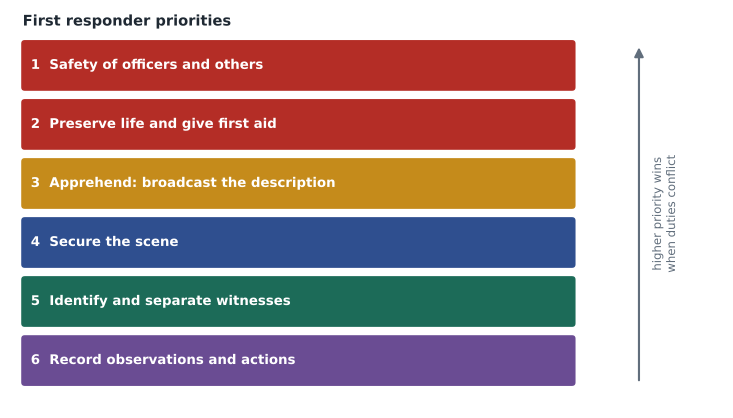
The first officer at a crime scene has several duties that compete for attention, and the order in which they are handled can decide the outcome of the case. Most police training sets the priorities in roughly this order. First, officer safety and the safety of others: is the offender still present, is there a weapon, are there hazards such as fire, traffic or chemicals? Second, preserving life: anyone injured receives first aid and medical help, even if that means disturbing evidence. Third, apprehending the offender if they are nearby: a quick, accurate broadcast of the description and direction of travel gives other officers the best chance. Fourth, securing the scene so that evidence is not lost, moved or contaminated. Fifth, identifying and separating witnesses before they leave or talk to each other. Sixth, recording everything.
These priorities are not a checklist to be completed one item at a time. A single officer may be giving first aid while watching the doorway and asking a bystander to stay. But when they conflict, the higher priority wins. Desjardins tells the story of a stabbing outside a bar early in his career, where paramedics moved the victim and his jacket across the sidewalk to treat him. The blood trail was disturbed and the jacket's position was lost, but the man lived. 'Nobody in that file ever suggested the paramedics should have waited,' he says. 'Our job was to record what they moved, where it had been, and who moved it.' Officers who must disturb a scene to save a life should note what they touched or moved as soon as they can.
The initial broadcast
A good suspect broadcast is short, accurate and structured so that other officers can use it while driving. It gives the offence, the time, the direction of travel and mode of escape, and then the description from the top down: sex, approximate age, race or skin tone as described by the witness, height and build, hair, clothing from head to foot, and any distinctive features such as a limp, tattoo, accent or item carried. It says whether a weapon was seen. It separates what was seen from what was assumed, and it is updated when new information arrives. Malhotra's first broadcast at 9:53 was: 'Robbery, Northgate Convenience, Harbour Road, two minutes ago. Male, possibly twenties, about five ten, slim, dark hoodie with the hood up, dark face covering, dark pants, white running shoes. Knife displayed. Last seen on foot out the front and around the north side toward the rear lot.'
Two minutes later, the second officer found a witness in the rear lot, Tom Beaulieu, who had been loading laundry into his car. Beaulieu said a grey hatchback had pulled out of the lot fast, heading west onto Pine Street, and that he thought it had a dented rear bumper. Malhotra updated the broadcast. Desjardins asks the class why this matters. Priya Sandhu answers that officers who were looking for a man on foot would now look for a car, and that if the first broadcast had said 'fled on foot' as a fact rather than 'last seen on foot', the update might have been missed. Desjardins adds a warning about descriptions: broad descriptions such as 'young man in a dark hoodie' match many innocent people, and officers who stop people on that basis alone may lack reasonable grounds and can damage community trust. The more specific the description, the fairer and more useful the search.
Securing the scene and setting perimeters
A crime scene is any place where evidence of a crime may be found, and a case may have several: the store, the rear lot where the car was parked, the route the offender took, the car itself, and later the offender's home. The first officer decides the boundaries, and the rule is to start large. It is always possible to shrink a perimeter once the scene has been examined, but evidence trampled outside a perimeter set too small cannot be recovered.
Many services use two or three perimeters. The inner perimeter surrounds the area where evidence is most likely to be found, and only people with a specific job, such as the forensic identification officer, enter it. The outer perimeter keeps the public and media away and provides space for police vehicles, a command post and the staging of equipment. In larger scenes there may be a third, wider perimeter for traffic control. Each perimeter is marked with tape or barriers and is guarded. Officers should establish a single path in and out of the inner perimeter, called the common approach path, chosen where evidence is least likely to be, and everyone uses it.
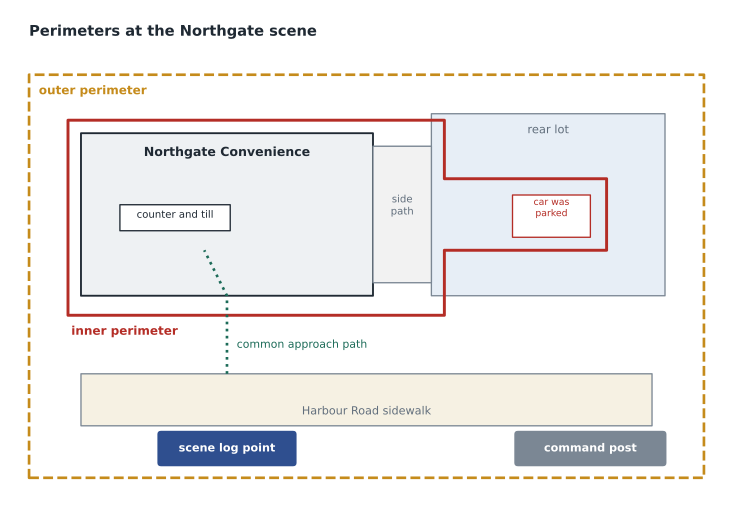
At Northgate, Malhotra set the inner perimeter around the inside of the store, the front entrance and the side path the offender had taken to the rear lot, and the outer perimeter at the edge of the sidewalk and across the part of the lot where the car had been parked. He asked Rao to wait in the back office rather than behind the counter, and closed the store to customers. A customer who had walked in thirty seconds after the robbery and bought a drink was asked to wait as a witness, and the drink bottle he had picked up from the cooler was noted, in case the offender had touched the same door.
The scene log
From the moment the perimeter is set, an officer records every person who enters or leaves it, with their name, role, time in, time out and reason. This scene log, sometimes called the scene security record, is one of the first documents in the case file and is often requested by the defence. It answers a question every court will ask: who had the opportunity to bring something into the scene, take something out or change something? If a fingerprint on the till is later identified, the log helps show it was not left by a police officer or paramedic. If an item goes missing, the log narrows down who was present.
The officer keeping the log should not leave the entry point until relieved, and should record the handover. Senior officers have no automatic right to walk into a scene; if they enter, they are logged like anyone else and should have a reason. Desjardins says one of the most common problems in scene security is the curious visitor: a supervisor, an officer from another call, a property owner who wants to check something. Each extra person is a source of contamination and another witness who may be called to testify.
# Northgate scene log: check that every person who entered also left,
# and total the minutes each person spent inside the inner perimeter
log = [
    ("Malhotra",  "21:52", "22:41"),
    ("Okeke",     "21:54", "21:58"),
    ("Paramedic", "22:03", "22:09"),
    ("Liu",       "22:35", "01:20"),
    ("Ferreira",  "22:50", "23:05"),
    ("Haddad",    "23:10", None),
]
def minutes(t):
    h, m = map(int, t.split(":"))
    return h * 60 + m
for name, t_in, t_out in log:
    if t_out is None:
        print(name, "entered at", t_in, "- NO EXIT RECORDED")
        continue
    a, b = minutes(t_in), minutes(t_out)
    if b < a:
        b += 24 * 60   # crossed midnight
print(name, "inside", b - a, "minutes")Malhotra inside 49 minutes Okeke inside 4 minutes Paramedic inside 6 minutes Liu inside 165 minutes Ferreira inside 15 minutes Haddad entered at 23:10 - NO EXIT RECORDED
The code catches the kind of gap a reviewer looks for: Sergeant Haddad's entry has no exit time. In the real Northgate log, the officer at the door had been relieved at 23:30 and the incoming officer did not record Haddad leaving. The gap was explained by both officers' notes, but Ferreira had to obtain supplementary notes to close it. The code also shows Liu, the forensic identification constable, spending almost three hours inside, which is normal; the scene examination is slow, careful work.
Protecting evidence from loss and contamination
Evidence can be lost in many ways before the specialists arrive. Weather can wash away footwear impressions or blood; wind can carry fibres; snow can melt. People can walk through the scene, touch surfaces, use the washroom, flush toilets, move furniture or switch lights on and off. Officers can contaminate a scene by smoking, eating, dropping items, or by touching things without gloves. Fragile evidence outside, such as a footprint in snow or a cigarette butt in the rain, may need to be protected immediately with a box, a tarp or a cone, and photographed before anything else happens.
At Northgate, it had snowed lightly that evening. The second officer noticed a set of footwear impressions in the thin snow on the side path, leading from the front corner of the building toward the rear lot, and a dark object near the dumpster. He placed evidence markers beside the impressions without stepping on them, photographed them with his service phone in case the snow melted before the specialist arrived, and stood a cone over the object, which turned out to be a black knit glove. That glove would become the most important piece of physical evidence in the case. Desjardins asks what the officer did right. Linh Tran lists it: he recognized fragile evidence, protected it without touching it, photographed it with a reference, and recorded what he did and when.
Witnesses at the scene
Witnesses leave quickly. They have places to be, they may not want to be involved, or they may assume someone else has already told the police. The first officers should identify everyone who may have seen or heard something, record their names and contact details, and ask them to stay. Witnesses should be separated as far as possible so that they do not compare accounts; memory is easily influenced by what others say, a problem studied in lesson 6. The first officer should take a brief first account from each, focused on what is needed immediately, such as the description and direction of the offender, and leave the full interview for later.
Officers should also note the witness's condition: whether they were frightened, injured, intoxicated, or had a good view. Rao was shaking and had trouble with times, but she was clear about the knife, the face covering and the man's voice, which she said was calm and young. Beaulieu was calm and precise about the car but had not seen the driver. A customer at the laundromat next door had heard a car door slam but seen nothing. All three accounts went into Malhotra's notes with the times they were given.
Worked problem
Setting priorities at a scene
Officers are called to a home where a woman reports that her ex-partner broke in through the back door, pushed her, and left in a red pickup two minutes ago. When the first officer arrives, the woman has a cut on her forehead that is bleeding. Her neighbour is standing on the porch saying he saw the truck turn left at the corner. The back door is broken and glass is on the kitchen floor. List what the officer should do, in order.
Show solution
- Check for safety: confirm the ex-partner has left and there are no weapons or other people in danger.
- Preserve life: assess the woman's injury, give first aid and request paramedics.
- Broadcast: the suspect's name if known, the red pickup and its direction, and the time, so other units can look for it.
- Secure the scene: keep people away from the back door and kitchen glass, set a perimeter and start a scene log.
- Identify witnesses: take the neighbour's details and a brief account, and ask him to stay, separate from the victim.
- Record observations, including what was touched or moved during first aid, and note the victim's condition and words.
Answer: Safety, life, broadcast, scene, witnesses, record: the higher priority wins when duties conflict.
Common mistakes
MistakeEvidence comes first, even if someone is hurt.
InsteadPreserving life always comes before preserving evidence; record what was moved.
MistakeA small perimeter is easier to manage, so start small.
InsteadStart large and shrink it after examination; evidence outside a small perimeter cannot be recovered.
MistakeSenior officers can enter a scene without being logged.
InsteadEveryone who enters is logged with a time and reason, whatever their rank.
MistakeWitnesses can wait together while officers secure the scene.
InsteadWitnesses should be separated so their accounts are not influenced by each other.
Summary and key terms
- The first officer's priorities are safety, life, apprehension, scene security, witnesses and records; the higher priority wins.
- A suspect broadcast should be short, structured and specific, and updated as information arrives.
- Scenes are secured with inner and outer perimeters, a common approach path and a guarded entry point.
- The scene log records everyone who enters or leaves, with times and reasons.
- Fragile evidence must be protected and photographed immediately.
- Witnesses should be identified, separated and asked for a brief first account.
- Crime scene
- Any place where evidence of a crime may be found.
- Inner perimeter
- The area where evidence is most likely to be, entered only by people with a specific task.
- Outer perimeter
- A wider boundary that keeps the public away and holds police vehicles and the command post.
- Common approach path
- A single route in and out of the inner perimeter chosen to avoid evidence.
- Scene log
- A record of everyone who enters or leaves a scene, with times and reasons.
- Contamination
- Adding, removing or altering material at a scene so that evidence is changed.
Practice problems
Work each problem on paper first, then reveal the answer to check.
Why should the first broadcast say 'last seen on foot' rather than 'fled on foot'?
Show answer
It separates what was seen from what is assumed, so officers will accept updates such as the car.
In the code example, how many minutes was Malhotra inside the inner perimeter?
Show answer
From 21:52 to 22:41, which is 49 minutes.
What should an officer do with fragile evidence before specialists arrive?
Show answer
Protect it without touching it, mark it, photograph it with a reference and record what was done.
Why are scene logs requested by the defence?
Show answer
They show who had the chance to add, remove or change evidence, which can explain or challenge forensic findings.
Lesson quiz · 5 questions
Score 60% or more to complete this lesson.
Create a free account to save your progress, take quizzes and earn a certificate.