
LES-201 · Lesson 5 of 12 · 20 min
Forensic science: DNA, fingerprints and the laboratory
▶ Video coming soon A video version of this lesson is on the way.
Eleven days after the robbery, Detective Ferreira received a report from the Centre of Forensic Sciences in Toronto. A DNA profile had been developed from the inside cuff of the black knit glove. It was a single-source male profile, and it had been searched against the National DNA Data Bank. The search had produced a match to a known profile in the database belonging to a man named Cody Marsh, 24. Desjardins pauses here. 'Some of you are thinking the case is solved,' he says. 'It isn't. What Ferreira has is a very strong lead. What she does with it, and what she does not do, is what this lesson is about.'
What forensic science offers an investigation
Forensic science applies scientific methods to questions that matter in law. In a criminal investigation, the main disciplines are biology and DNA, fingerprints, chemistry and toxicology, firearms and tool marks, trace evidence such as fibres, glass and paint, footwear and tire impressions, documents, and digital forensics. Laboratories may be run by police services or by independent government agencies. In Canada, the RCMP's National Forensic Laboratory Services serves most of the country, while Ontario's Centre of Forensic Sciences and Quebec's Laboratoire de sciences judiciaires et de médecine légale serve those provinces, and all are independent of the investigators who submit cases.
Investigators do not need to be scientists, but they need to know what each discipline can and cannot tell them, how to submit items properly, and how to read a report. A laboratory answers the questions it is asked, so the submission form matters: it should explain the case briefly, say what each item is and where it was found, and ask clear questions. Ferreira's submission for the glove asked whether DNA could be developed from areas likely to have been in contact with the wearer's skin, whether it was from one person or several, and whether it could be compared with the elimination profiles of the clerk and owner and searched in the databank. She did not tell the laboratory that she had a suspect in mind, because at that point she did not, and because examiners should work as far as possible without information that could bias their judgement.
DNA: what a profile is
Deoxyribonucleic acid, or DNA, is the genetic material found in nearly every cell of the body. Forensic DNA analysis does not read a person's whole genetic code. It looks at a set of locations, called loci, where the number of repeats of a short sequence varies a great deal between people. These short tandem repeats are inherited, half from each parent, so each person has two values at each locus. A profile is the list of values at all the loci tested. Canada's databank uses a standard set of loci that has been expanded in recent years to align with international practice. With a full profile from one person, the chance that an unrelated person chosen at random would have the same profile is extremely small, often expressed as less than one in a billion or more. Identical twins share the same profile, and close relatives share more values than strangers do.
DNA can be recovered from blood, saliva, semen, skin cells and hair roots. So-called touch DNA comes from skin cells and sweat left on objects that were handled or worn. It is often present in very small quantities, can be a mixture of several people, and can be transferred indirectly, for example from a person to a door handle and then to someone else's hand. This means a DNA profile on an object shows that the person's DNA is there, not necessarily that they touched it, or when. The inside cuff of a worn glove is a good place to look for the wearer's DNA, because it is in repeated contact with the wrist, and a single strong profile there is more meaningful than a trace on a public door handle.
Databanks and the law
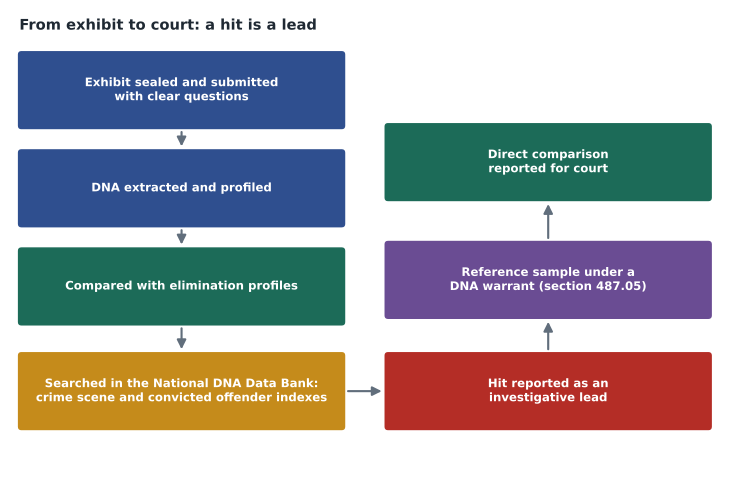
The DNA Identification Act created the National DNA Data Bank, run by the RCMP. It holds a Crime Scene Index of profiles from unsolved cases and a Convicted Offenders Index of profiles taken from people convicted of designated offences under section 487.051 of the Criminal Code. Canada does not take DNA from people who are only arrested or charged. To obtain a sample from a suspect for comparison, police can ask for consent or apply to a provincial court judge for a DNA warrant under section 487.05, which requires reasonable grounds to believe that a designated offence was committed, that a bodily substance was found at the scene or on the victim, and that the person was a party to the offence, and that the warrant is in the best interests of the administration of justice. Marsh was in the Convicted Offenders Index because of a 2022 conviction for breaking and entering. Profiles are held under strict rules about who can search them and how hits are reported.
A databank hit is reported as an investigative lead, not as an identification for court. Laboratories ask the investigator to obtain a new reference sample from the person, so that a direct comparison can be made by an analyst who handles both samples under controlled conditions. This step guards against errors in the databank, such as a mislabelled sample, and produces evidence that can be tested in court. Ferreira applied for a DNA warrant under section 487.05, setting out the robbery, the glove, the laboratory report and the hit, and a judge issued it on February 20. The sample was taken after Marsh's arrest that afternoon, by a trained officer, from his cheek with a swab, in a private room, as the Criminal Code requires. A week later, the laboratory's direct comparison confirmed that Marsh's reference profile matched the glove profile.
Statistics and the prosecutor's fallacy
DNA reports usually express the strength of a match as a statistic: either a random match probability, the chance that an unrelated person chosen at random would have the same profile, or a likelihood ratio, how many times more likely the evidence is if the person is the source than if an unknown, unrelated person is. These numbers are easy to misstate. The prosecutor's fallacy confuses the chance of a match given innocence with the chance of innocence given a match. A random match probability of one in a million does not mean there is only a one in a million chance the person is innocent. In a region of five million people, about five unrelated people would be expected to share the profile by chance, so the profile alone, without other evidence, would not point to one person.
# How many unrelated people in a population would be expected to share a profile?
populations = {"Port Ardent": 98_000, "province or state": 12_000_000}
profiles = {"full single-source profile": 1e-12, "partial profile": 1 / 50_000}
for pname, rmp in profiles.items():
    for place, n in populations.items():
        expected = n * rmp
print(f"{pname:28} {place:18} expected chance matches: {expected:,.4f}")full single-source profile Port Ardent expected chance matches: 0.0000 full single-source profile province or state expected chance matches: 0.0000 partial profile Port Ardent expected chance matches: 1.9600 partial profile province or state expected chance matches: 240.0000
For a full single-source profile with a random match probability of about one in a trillion, the expected number of chance matches even in a large population is tiny. For a partial profile with a probability of one in fifty thousand, about two people in Port Ardent and two hundred and forty in the wider population would be expected to share it. Desjardins tells the class that a partial profile can still be valuable when combined with other evidence, but it should never be described as an identification. Investigators should quote the laboratory's statistic exactly, avoid paraphrasing it, and let the analyst explain it in court.
Fingerprints
Friction ridge skin on the fingers, palms and soles forms patterns of ridges that develop before birth and stay the same throughout life unless the skin is scarred. Fingerprints are classified into broad patterns, such as loops, whorls and arches, and compared using the fine details of the ridges, called minutiae, such as ridge endings and bifurcations. Latent prints, invisible to the eye, are developed with powders on smooth surfaces or chemicals such as ninhydrin on paper and cyanoacrylate fuming on plastics and other non-porous surfaces. Prints are photographed and lifted, then searched in an automated fingerprint identification system, the RCMP's Real Time Identification system in Canada, which returns a list of candidates for a trained examiner to compare.
Examiners usually follow a method called ACE-V: analysis of the unknown print to decide whether it has enough detail to compare, comparison with the known print, evaluation to reach a conclusion of identification, exclusion or inconclusive, and verification by a second examiner. Fingerprint evidence is powerful, but it is a judgement by a human expert, not an automatic result. In 2004, the FBI wrongly identified an Oregon lawyer, Brandon Mayfield, as the source of a print found on a bag connected to the Madrid train bombings; three examiners had verified the identification. A later review found that the examiners had been influenced by the candidate's similarity and by knowing that others had agreed. Many laboratories now use blind verification and record the features relied on before seeing the known print.
At Northgate, the print from the door's push plate was identified to a regular customer who had been in the store that afternoon and had a confirmed reason to be there; he was eliminated. The print from the cigarette rack rail was smudged and judged insufficient for comparison. Desjardins notes that both results went into the file. The absence of the robber's prints on the rack was consistent with the glove: he had probably been wearing at least one.
Impressions and other evidence
The casts and photographs of the footwear impressions from the side path showed a tread pattern that the laboratory identified as consistent with a common brand of running shoe in sizes 10 to 11. That is class evidence: it could not identify one shoe. When Marsh's home was later searched under warrant, officers seized a pair of white running shoes of that brand in size 10.5. The examiner found the tread pattern and size consistent with the impressions but could not find enough individual wear features in the snow impressions to say more. Ferreira's report used the examiner's words: the shoes could not be excluded as the source. She did not write that the shoes matched.
Worked problem
Reading a laboratory report correctly
A laboratory report on a cigarette butt found outside a robbed store says: 'A partial DNA profile was obtained. The profile of the suspect cannot be excluded as a contributor. The probability of randomly selecting an unrelated individual who could not be excluded is approximately 1 in 2,000.' A detective writes in her summary: 'DNA confirms the suspect smoked the cigarette.' What is wrong, and how should it be written?
Show solution
- The report says the suspect cannot be excluded, which is not the same as identifying him as the source.
- The statistic means roughly 1 in 2,000 unrelated people could also not be excluded; in a city of 100,000, about 50 people would be expected to fit.
- The report says nothing about when the cigarette was smoked or whether it is connected to the robbery.
- A correct summary quotes the report: 'A partial DNA profile from the cigarette butt; the suspect cannot be excluded as a contributor; random probability of non-exclusion about 1 in 2,000.'
- The detective should seek other evidence linking the cigarette to the time of the robbery, such as video showing someone smoking at that spot.
Answer: Quote the laboratory's conclusion and statistic exactly; 'cannot be excluded' is not 'confirms'.
Common mistakes
MistakeA DNA databank hit identifies the offender.
InsteadA hit is an investigative lead that must be confirmed with a new reference sample and supported by other evidence.
MistakeA one in a million match statistic means a one in a million chance of innocence.
InsteadThat is the prosecutor's fallacy; the statistic is the chance of a random match, not of innocence.
MistakeFingerprint identification is automatic and cannot be wrong.
InsteadIdentification is an expert judgement; errors such as the Mayfield case show why blind verification matters.
MistakeClass evidence such as a tread pattern matches one shoe.
InsteadClass evidence is shared by many items; report it as 'consistent with' or 'cannot be excluded'.
Summary and key terms
- Forensic laboratories answer the questions investigators ask, so submissions must be clear and avoid biasing information.
- A DNA profile lists repeat counts at a set of loci; full single-source profiles are extremely rare by chance, but touch DNA can be small, mixed and transferred.
- The National DNA Data Bank holds crime scene and convicted offender profiles; samples from suspects need consent or a DNA warrant under section 487.05.
- Databank hits are leads that require a confirmatory reference sample.
- Match statistics must be quoted exactly and the prosecutor's fallacy avoided.
- Fingerprint and impression comparisons are expert judgements with known limits and should be reported in the examiner's words.
- DNA profile
- The set of values at tested genetic loci that is compared between samples.
- Touch DNA
- DNA from skin cells or sweat left on objects that were handled or worn.
- Random match probability
- The chance that an unrelated person chosen at random would have the same profile.
- Prosecutor's fallacy
- Confusing the chance of a match given innocence with the chance of innocence given a match.
- Latent print
- A fingerprint that is invisible until developed with powders or chemicals.
- ACE-V
- Analysis, comparison, evaluation and verification, the method used by fingerprint examiners.
Practice problems
Work each problem on paper first, then reveal the answer to check.
Why did Ferreira not tell the laboratory about a suspect when she submitted the glove?
Show answer
She did not have one, and examiners should work without information that could bias their judgement.
In the code example, how many chance matches would be expected for the partial profile in Port Ardent?
Show answer
98,000 divided by 50,000, about 1.96, so about two people.
What does a databank hit require before it is used in court?
Show answer
A new reference sample from the person and a direct comparison by the laboratory.
Why was the rack rail print result still recorded?
Show answer
All results, including insufficient prints, belong in the file and help explain the evidence.
Lesson quiz · 5 questions
Score 60% or more to complete this lesson.
Create a free account to save your progress, take quizzes and earn a certificate.