
LES-201 · Lesson 11 of 12 · 20 min
Building the case file: the Crown brief, disclosure and charging
▶ Video coming soon A video version of this lesson is on the way.
On the evening of February 20, after Marsh's interview ended, Ferreira sat down with Sergeant Haddad and the file. It held 47 numbered leads, 11 exhibits from the scene and 9 more from Marsh's apartment, four witness statements, two lineup records, two laboratory reports with a third pending, production records from a carrier and a payment app, 214 scene photographs, nine video files, and the notes of fourteen officers. Haddad asked her one question: 'If you were defending Marsh, what in here would you use?' Desjardins tells the class that every investigation ends in a file, and that the file is the investigation as far as the court is concerned. If it is not in the file, for legal purposes it did not happen. This lesson covers how investigators assemble the file, what must be disclosed to the defence, and how charging decisions are made.
The purpose of the case file
The case file has several readers. The Crown prosecutor uses it to decide whether to proceed, what charges to pursue, and how to present the case. The defence uses it to understand the case against the accused and to look for weaknesses and evidence that helps the accused. The court may see parts of it when ruling on applications, such as challenges to a search or a statement. Supervisors use it to review the quality of the investigation. A good file is complete, organized, accurate and honest. It contains everything relevant, including evidence that does not support the theory of the case, and it allows a reader to follow every step of the investigation without needing to ask the investigator.
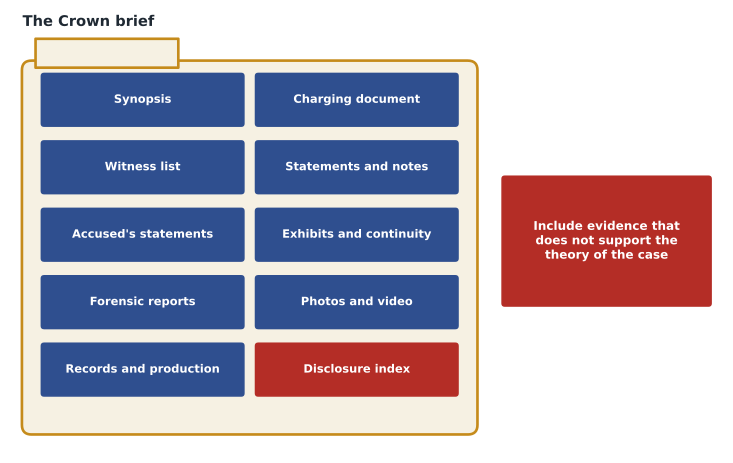
In Ontario, the file prepared for the Crown is usually called the Crown brief. It typically contains a synopsis of the case, the information or charging document, a witness list with contact details, the accused's criminal record and release documents, all witness statements and officers' notes, the accused's statements and recordings, exhibit lists and reports, photographs and video, expert reports, and a disclosure index listing every item provided.
The synopsis
The synopsis, or case summary, is a short narrative of the facts that the investigator believes the evidence can prove, written in plain language for the prosecutor. It should state the offence, the time and place, what happened, how the accused was identified, the key evidence for each element of the offence, the accused's statement if any, and any significant weaknesses or issues. It must be accurate: every fact in the synopsis should be supported by a statement, a report or an exhibit in the file, and inferences should be labelled as inferences. Prosecutors often use the synopsis to decide on bail positions and early resolution, so overstatement can cause real harm. Ferreira's synopsis described the glove DNA as 'a match to the accused's reference sample, confirmed by the laboratory', the shoe comparison as 'cannot be excluded', and Mehta's identification as 'fairly sure, not a hundred', in his words.
Disclosure: Stinchcombe and McNeil
In R. v. Stinchcombe (1991), the Supreme Court of Canada held that the Crown has a constitutional duty, flowing from the accused's right to make full answer and defence under section 7 of the Charter, to disclose all relevant information in its possession or control, whether inculpatory or exculpatory, unless it is clearly irrelevant or privileged. The information need not be evidence the Crown intends to use; it is relevant if there is a reasonable possibility that it could be useful to the defence. In R. v. McNeil (2009), the Court held that police have a corollary duty to give the Crown all material related to the investigation, and that records of serious misconduct by officers involved in the case must also be provided where they could reasonably affect the case. Disclosure should generally be made before the accused is asked to elect a mode of trial or enter a plea, and it is ongoing: new information must be disclosed as it arrives.
In both countries, the duty means that investigators cannot decide on their own that a piece of information is unhelpful or irrelevant and leave it out. Material that points away from the accused, such as another suspect, a witness who could not identify the accused, an inconsistent description or a failed laboratory comparison, is exactly what the defence is entitled to see. Withholding it can lead to a stay of proceedings, a new trial, or a wrongful conviction. Desjardins reminds the class of the wrongful convictions studied in lesson 1: in several, information that pointed to another person was in police files and never reached the defence.
What the Northgate file had to include
Haddad's question about what the defence would use produced a list. The anonymous tip naming Pelletier, the steps taken to check it and the alibi evidence that excluded him. Mehta's non-identification at the first lineup, with the video. Rao's estimate that the robber was about five foot ten; Marsh is six foot one. The doorman-style height markers on the door frame, which Rao had not been able to use. The insufficient fingerprint from the rack rail. The customer's fingerprint on the door, and his elimination. The gap in the scene log for Haddad's exit, and the supplementary notes explaining it. The fact that the gas bar video showed the car but not the driver. Marsh's claim that he lent the car to a friend, and the steps taken to check it. The neighbour's statement that a grey hatchback had been parked on her street in previous weeks. All of it went into the file and was disclosed.
Desjardins asks why the height discrepancy matters so much. Marco DiSanto answers that it is the kind of thing a defence lawyer would use to argue the robber was someone else, and that if it were hidden and came out later, it would make the whole investigation look dishonest. Desjardins adds that the honest answer to it is also in the file: Rao said herself she was not sure about height, the robber was crouched over the counter for most of the time she saw him, and research shows that witnesses' height estimates under stress are often inaccurate. The file does not need to win the argument; it needs to put everything on the table.
# Disclosure index for the Northgate file: items, pages and status
items = [
    ("synopsis", 4, "disclosed"), ("witness statements", 38, "disclosed"),
    ("officer notes (14 officers)", 96, "disclosed"), ("scene photographs", 214, "disclosed"),
    ("video files", 9, "disclosed"), ("lineup records and video", 12, "disclosed"),
    ("tip and Pelletier alibi checks", 17, "disclosed"), ("lab reports", 23, "disclosed"),
    ("phone extraction report", 61, "vetted"), ("carrier records", 14, "disclosed"),
    ("lab report: shoes", 0, "outstanding"),
]
from collections import Counter
status = Counter(s for _, _, s in items)
pages = sum(p for _, p, s in items if s == "disclosed")
print("items by status:", dict(status))
print("pages or files disclosed:", pages)
for name, p, s in items:
    if s != "disclosed":
print("follow up:", name, "-", s)items by status: {'disclosed': 9, 'vetted': 1, 'outstanding': 1}
pages or files disclosed: 427
follow up: phone extraction report - vetted
follow up: lab report: shoes - outstandingThe index shows two items not yet fully disclosed. The phone extraction report was being vetted to remove private information about third parties that was not relevant, such as photos of Marsh's family, with a note explaining the vetting and an offer to make the full report available for inspection; vetting decisions are made by the prosecutor, not the police, and must be justified. The shoe comparison report was still at the laboratory. Disclosure is a continuing duty: when the report arrived on March 9, it was disclosed within two days with an updated index. Desjardins notes that delays in disclosure are one of the main causes of delay in criminal cases, which can lead to charges being stayed. Under R. v. Jordan (2016), delay above 18 months for cases in provincial court, or 30 months in superior court, is presumed unreasonable.
Charging decisions
In Ontario and most provinces, police lay charges by swearing an information before a justice of the peace, and the Crown then reviews each case to decide whether there is a reasonable prospect of conviction and whether prosecution is in the public interest; if not, the Crown withdraws the charge. In British Columbia, Quebec and New Brunswick, the Crown approves charges before they are laid. Police should consult the Crown early in serious or complex cases. Ferreira laid charges of robbery under section 343 and wearing a disguise with intent to commit an indictable offence under section 351(2) for the Northgate robbery, and a further robbery charge for the gas bar after Mehta's identification and the other evidence linking Marsh to it. The standard for laying a charge is lower than the standard for conviction, but investigators should not charge simply because they can. The question is whether the evidence, assessed honestly, supports the charge.
Desjardins tells the class that charging decisions also involve judgement about the right charge. Overcharging, laying the most serious possible charges in the hope of pressuring a guilty plea to a lesser one, is criticized by courts and commentators because it can pressure innocent people to plead and distorts the process. Charges should reflect what the evidence can prove. In September 2026, Marsh pleaded guilty to both robberies; the disguise charge was withdrawn as part of the resolution, and sentencing is scheduled for December.
Notes, third-party records and the duty to preserve
Officers' notes are part of disclosure, and courts expect them to be complete. Notes that are vague, written long after the event, or missing for key steps invite the inference that something was not done or not recorded honestly. Rough notes, sketches, draft reports and text or email messages between officers about the case may also be disclosable, and officers should assume that anything they write about a case may be read by the defence and a judge. Investigators also have a duty to preserve evidence: an item that is lost, destroyed or overwritten before the defence can examine it may lead to a remedy for the accused, especially if the loss resulted from carelessness. In R. v. La (1997), the Supreme Court of Canada held that the Crown must explain lost evidence, and that unacceptable negligence in losing relevant evidence can breach the right to make full answer and defence. Port Ardent keeps all exhibits from serious cases until the case and any appeal are complete.
Some relevant records are held by people outside the prosecution, such as hospitals, counsellors, schools or employers. These are third-party records, and the prosecution does not usually have to disclose them because it does not hold them. The defence can apply to the court for their production under the procedure in R. v. O'Connor (1995), and sections 278.1 to 278.98 of the Criminal Code set a stricter regime for the private records of complainants in sexual offence cases. Investigators should not gather private records they do not need simply because they can, and they should tell the prosecutor when they know relevant records exist elsewhere.
Worked problem
Reviewing a file for disclosure
An investigator into an assault outside a nightclub has a file containing: the victim's statement identifying the accused; a bouncer's statement saying the attacker wore a red jacket; video showing the accused in a black jacket earlier that night; a second witness who said the attacker was 'a short guy', though the accused is tall; the investigator's notes; and a record that one officer involved was disciplined last year for falsifying a report. What must be provided to the prosecutor?
Show solution
- The victim's statement and the investigator's notes, as core evidence.
- The bouncer's statement about the red jacket and the video of the black jacket, because together they may support the defence that the attacker was someone else.
- The second witness's description of a short attacker, which is inconsistent with the accused and plainly relevant to the defence.
- The disciplinary record of the officer, because McNeil requires police to provide records of serious misconduct that could reasonably affect the case, such as falsifying a report.
- An index of everything provided, and a note of any follow-up, such as checking the club's other cameras for the red jacket.
- The investigator should not decide alone that any of this is irrelevant; the prosecutor decides on disclosure and any vetting.
Answer: Everything relevant goes to the prosecutor, especially evidence that points away from the accused and records affecting officer credibility.
Common mistakes
MistakeInvestigators can leave out material that does not support the case.
InsteadAll relevant material, including evidence that helps the accused, must go to the prosecutor and be disclosed.
MistakeThe synopsis can summarize the case persuasively.
InsteadThe synopsis must be accurate, supported by the file, and should note weaknesses.
MistakeDisclosure is finished once the file is sent.
InsteadDisclosure is a continuing duty; new information must be provided as it arrives.
MistakePolice should lay the most serious charges possible.
InsteadCharges should reflect what the evidence can honestly prove.
Summary and key terms
- The case file is the investigation as far as the court is concerned, and must be complete, organized, accurate and honest.
- The Crown brief includes a synopsis, charging document, witness list, statements, notes, exhibits, reports and a disclosure index.
- Stinchcombe requires disclosure of all relevant information, and McNeil requires police to give the Crown the investigative file and relevant misconduct records.
- Evidence that points away from the accused is exactly what must be disclosed.
- Disclosure is continuing, and delay can lead to charges being stayed or dismissed.
- In Ontario police lay charges and the Crown screens them; some provinces use Crown charge approval.
- Case file
- The organized record of an investigation prepared for the prosecutor.
- Synopsis
- A short, accurate narrative of the facts the evidence can prove.
- Disclosure
- Providing the defence with relevant information held by the prosecution.
- Exculpatory evidence
- Evidence that tends to show the accused did not commit the offence.
- Vetting
- Removing privileged or clearly irrelevant private information from disclosure, with reasons.
- Overcharging
- Laying more serious or more numerous charges than the evidence supports.
Practice problems
Work each problem on paper first, then reveal the answer to check.
What question did Haddad ask Ferreira, and why?
Show answer
What the defence would use, to make sure everything that helps the accused is in the file and disclosed.
In the code example, how many pages or files were disclosed?
Show answer
4 + 38 + 96 + 214 + 9 + 12 + 17 + 23 + 14, which is 427.
Why must the Pelletier tip and alibi checks be disclosed?
Show answer
They show another suspect was considered and excluded, which is relevant to the defence and shows how the investigation proceeded.
Who decides on vetting of disclosure?
Show answer
The prosecutor, who must justify it.
Lesson quiz · 5 questions
Score 60% or more to complete this lesson.
Create a free account to save your progress, take quizzes and earn a certificate.