
LES-201 · Lesson 3 of 12 · 19 min
Documenting the scene: notes, photographs, sketches and video
▶ Video coming soon A video version of this lesson is on the way.
Grace Liu, a forensic identification constable with nine years in the unit, arrived at Northgate at 10:31 p.m. Before she touched anything, she stood at the edge of the inner perimeter for several minutes and simply looked. Then she spoke to Malhotra about what had been touched, moved or walked on, read the scene log, and began to photograph. Desjardins tells the class that a scene can be examined only once in its original state. Every step a person takes, every item lifted, every swab taken changes it. Documentation is how the scene is preserved for everyone who was not there: the detective, the Crown, the defence, the judge and the jury, sometimes years later.
A scene is documented in four complementary ways: notes, photographs, sketches or measurements, and video. Each has strengths the others lack. Notes record observations, times and decisions in words. Photographs show what things looked like. Sketches and measurements show where things were in relation to each other, which photographs often distort. Video shows the layout and flow of a scene in a way that a set of still images cannot. A good scene record uses all four and makes sure they agree.
Notes at the scene
Officer notes are the foundation of every investigation. The previous courses covered how to write them: in a bound notebook or approved electronic system, in ink, in chronological order, at the time or as soon as possible afterwards, without blank spaces, and with any correction struck through once and initialled rather than erased. At a scene, notes should record the time of arrival, the weather and lighting, who was present, the condition of doors, windows and lights, any smells or sounds, what the officer did and touched, and what others reported. They should separate what the officer saw from what they were told. 'The till drawer was open and empty except for coins' is an observation. 'The clerk said the man took the bills' is a report.
Liu's notes for the Northgate examination run to eleven pages. They begin with the time she was called, the time she arrived, the weather (light snow, minus four degrees, wind from the west), the lighting inside and outside, and the names of everyone present. They then record each step of the examination in order: overall photographs, the walk-through, each item examined, each item collected with its exhibit number, each surface processed for fingerprints and the result. Desjardins asks the class why the weather matters. Marco DiSanto answers that it explains why the footwear impressions were fading and why the glove was cold and damp, which might affect DNA recovery. Every detail that could explain a later finding belongs in the notes.
Photographing the scene
Scene photography follows a standard sequence that moves from general to specific. Overall photographs show the whole scene and its surroundings, taken from the corners and entrances, so that a viewer understands the layout: the outside of the store, the street, the parking lot, the doors, the interior from each corner. Mid-range photographs show an item of evidence in relation to its surroundings, such as the till with the counter and door behind it. Close-up photographs show the item itself in detail, first without a scale and then with a scale or measuring device beside it, held in the same plane as the item, so that its size can be measured later. The photograph without the scale proves the scale did not cover anything important.
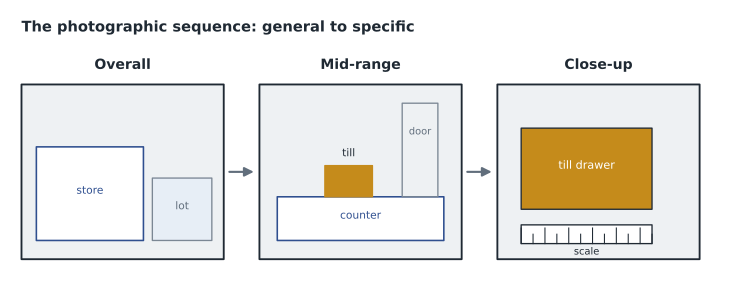
A photo log records each image: its number, the time, the location of the camera, the direction it faced, what it shows, and any scale or lighting used. Digital cameras record much of this in the file's metadata, but the log explains what the photographer intended to capture. The original image files must be preserved unaltered, with a verified copy used for any enhancement, so that the defence can be shown exactly what the camera recorded. Courts generally admit photographs when a witness, usually the photographer, can say that the image fairly and accurately represents what they saw. An image that has been cropped, brightened or sharpened can still be used, but the changes must be recorded and the original kept.
Liu took 214 photographs at Northgate. They included the store front from the street, every entrance, the counter from the customer side and the clerk's side, the open till drawer, the cigarette rack with its empty slots, the floor in front of the counter where she found faint wet footwear marks, the side path with its fading impressions in the snow, the glove where it lay near the dumpster, and the area of the lot where Beaulieu said the car had been parked. She photographed the footwear impressions in the snow using oblique lighting, holding a flashlight low to the ground so that the shadows showed the tread pattern, with a scale beside each impression.
Sketches and measurements
Photographs flatten a scene and can make distances look longer or shorter than they are. A sketch fixes the positions of things by measurement. The rough sketch is drawn at the scene, by hand or on a tablet; it does not have to be beautiful, but it must be accurate and it must show measurements, a north arrow, a legend, the date and time, the name of the person who drew it, and a note that it is not to scale. A finished, scaled diagram is prepared later from the rough sketch and the measurements, often with computer software. The rough sketch is kept, because it is the original record.
Positions are measured from fixed reference points that will still be there later, such as the corners of a building, a doorway or a utility pole. Two common methods are the rectangular coordinate method, which measures an item's distance from two walls at right angles to each other, and triangulation, which measures the distance from two fixed points to the item. Triangulation is useful outdoors where there are no walls; with two known points and two distances, the item's position can be calculated or drawn with a compass. Some services now use total stations or three-dimensional laser scanners that record millions of measured points, but the principle is the same: every position must be reproducible from fixed reference points.
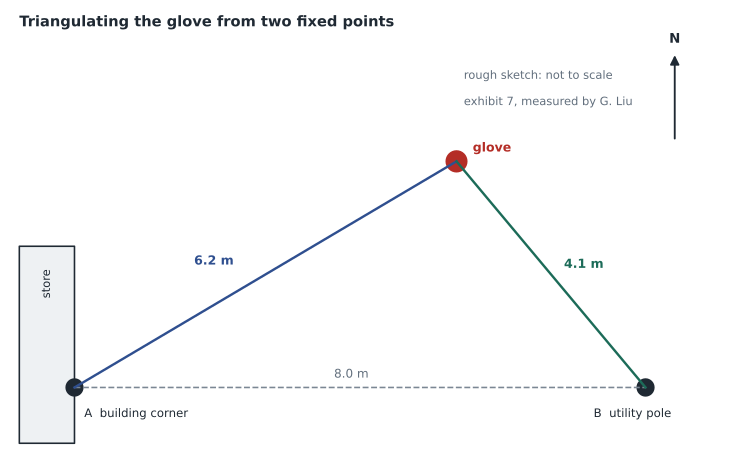
At Northgate, Liu measured the glove from the northeast corner of the building, point A, and from the base of a utility pole, point B, 8.0 metres away along the side path. The glove was 6.2 metres from A and 4.1 metres from B. The code below shows how those three measurements fix a single position. Desjardins points out that the measurements, not the calculation, are the evidence; the calculation only shows that they are consistent.
import math
# Triangulation: point A at (0, 0), point B on the x axis at distance d.
# The item is distance a from A and b from B. Solve for its position.
d = 8.0   # A to B (26 ft 3 in)
a = 6.2   # A to glove
b = 4.1   # B to glove
x = (a**2 - b**2 + d**2) / (2 * d)
y = math.sqrt(a**2 - x**2)
print("along the path from A:", round(x, 2), "m")
print("out from the path:", round(y, 2), "m")
# check: distances recomputed from the solved position
print("check A:", round(math.hypot(x, y), 2), " check B:", round(math.hypot(x - d, y), 2))along the path from A: 5.35 m out from the path: 3.13 m check A: 6.2 check B: 4.1
The glove lay about 5.35 metres along the line from the building corner toward the pole and about 3.13 metres out from that line, toward the dumpster. The check lines confirm the solved position reproduces both measured distances. If the measurements had been inconsistent, for example if the two distances added up to less than the distance between A and B, there would be no solution, and the examiner would know a measurement was wrong while still at the scene. The same calculation works in feet if all three distances are entered in feet.
Video and other recording
A video walk-through of the scene, recorded before and after the examination, shows the layout, the routes between rooms and the relationship of items in a way that still photographs cannot. The person recording should move slowly, narrate only factual information such as the time, location and direction, or record without sound to avoid capturing comments, and avoid zooming in and out rapidly. Many services also use body-worn cameras, which capture the first officer's arrival and actions. Malhotra's body-worn camera recorded his entry into the store, his first conversation with Rao, and the second officer's discovery of the glove. That footage became part of the scene record, and it showed clearly that nobody had touched the glove before Liu collected it.
Desjardins warns that body-worn camera video does not replace notes. Cameras miss what is outside their field of view, do not record smells or temperature, and cannot record the officer's reasoning. Notes should refer to the video, for example by noting the time a recording started and stopped, but should still describe the officer's observations and actions in words.
Making the records agree
The four kinds of documentation must be consistent. The photo log should match the photographs; the sketch should show items in the same positions as the photographs; the notes should record the same times as the video and the scene log; and every exhibit number should appear in the notes, the photo log, the sketch and the exhibit records. Inconsistencies are not always fatal, but each one gives the defence a reason to question the examiner's care. Liu reviewed her notes, photo log and sketch together before leaving the scene and corrected one exhibit number that she had written twice. She recorded the correction in her notes, with the time.
Worked problem
Choosing reference points for a sketch
Officers are documenting a scene in a park where a stolen bicycle and a broken lock have been found on a grass slope beside a paved path. There are no buildings nearby. Nearby fixed features include a lamp post, a park bench bolted to a concrete pad, a large oak tree and a garbage can on a chain. Which reference points should they use, and how should they measure the bicycle and lock?
Show solution
- Choose reference points that are fixed and will still be there later: the lamp post and the bench pad are good choices.
- Avoid the garbage can, which can move on its chain, and use the tree only as a backup, since its trunk is irregular and the exact measuring point is hard to repeat.
- Measure the distance between the two reference points first.
- Triangulate each item by measuring from both reference points to a defined spot on it, such as the front wheel hub of the bicycle and the centre of the lock.
- Record the measurements, a north arrow, the date, time and examiner's name, a legend and the note 'not to scale' on the rough sketch, and photograph the reference points.
Answer: Use the lamp post and the bench pad, measure between them, then triangulate each item from both.
Common mistakes
MistakePhotographs alone are enough to document a scene.
InsteadPhotographs distort distance; notes, sketches with measurements and video are also needed.
MistakeClose-ups should always include a scale.
InsteadTake each close-up first without a scale and then with one, to show the scale hides nothing.
MistakeThe rough sketch can be thrown away once the finished diagram is drawn.
InsteadThe rough sketch is the original record and must be kept.
MistakeBody-worn camera video replaces scene notes.
InsteadVideo misses what is outside the frame and the officer's reasoning; notes are still required.
Summary and key terms
- A scene can be examined only once in its original state, so documentation preserves it for everyone else.
- Notes record observations, times, actions and reports, and separate what was seen from what was told.
- Photography moves from overall to mid-range to close-up, with and without a scale, and is logged.
- Sketches fix positions by measurement from fixed reference points, using rectangular coordinates or triangulation.
- Video walk-throughs and body-worn cameras show layout and actions but do not replace notes.
- All records must agree, and corrections must be recorded.
- Overall photograph
- An image showing the whole scene and its surroundings.
- Mid-range photograph
- An image showing an item in relation to its surroundings.
- Close-up photograph
- A detailed image of an item, taken with and without a scale.
- Photo log
- A record of each photograph with its number, time, location, direction and subject.
- Triangulation
- Fixing an item's position by measuring its distance from two fixed reference points.
- Rough sketch
- The original hand-drawn or tablet sketch made at the scene with measurements.
Practice problems
Work each problem on paper first, then reveal the answer to check.
Why did Liu stand and look before touching anything?
Show answer
A scene can be examined only once in its original state; observing first lets the examiner plan and avoid destroying evidence.
Why photograph an item without a scale before adding one?
Show answer
To show that the scale did not cover or disturb anything important.
In the triangulation example, what would it mean if the two distances added up to less than the distance between A and B?
Show answer
There would be no possible position, so one of the measurements must be wrong.
Name two things a body-worn camera cannot record.
Show answer
Any two of: what is outside the frame, smells, temperature, the officer's reasoning.
Lesson quiz · 5 questions
Score 60% or more to complete this lesson.
Create a free account to save your progress, take quizzes and earn a certificate.