
LES-113 · Lesson 8 of 12 · 19 min
Newcomer, immigrant and refugee communities
▶ Video coming soon A video version of this lesson is on the way.
Nadia Rahimi, a settlement counsellor at the Port Ardent Newcomer Centre on Mercer Street, joins the eighth class. She came to Canada as a refugee from Afghanistan as a teenager. She tells the class about a woman she worked with last year who had been beaten by her husband for months before anyone called the police. 'She was afraid of three things,' Rahimi says. 'That she would be deported. That the police would take her children. And that the police in her new country would be like the police in her old one, where you did not go to them for help. None of those fears was true. But nobody had told her.'
Who newcomers are
Canada admits more than 400,000 permanent residents a year in most recent years, along with large numbers of temporary residents such as international students and temporary foreign workers, and asylum claimants. About one in four people in Canada was born outside the country. Newcomers arrive through different streams, including economic immigration, family sponsorship and refugee protection, and their legal status affects their rights, their access to services and their fears. A permanent resident can lose status only through a formal process, often after a serious criminal conviction; a temporary resident's status depends on the conditions of their permit; and an asylum claimant's future depends on a decision of the Immigration and Refugee Board.
Port Ardent has changed over the last fifteen years. The 2021 census and the city's own data show that about one in five residents was born outside the country, many of them in the Eastgate neighbourhood, where the Lindell Avenue apartment towers house families from South Asia, the Middle East, East Africa, Latin America and Ukraine. More than 50 languages are spoken in the city, and the Port Ardent call centre uses a telephone interpretation service for callers who do not speak English.
Desjardins reminds the class that newcomers are not one group. A software engineer recruited from India, a Syrian family who spent years in a refugee camp, a Ukrainian mother and her children who fled war, a Mexican farmworker on a seasonal permit and an international student from Nigeria have very different experiences, needs and views of the police. What they share is that they are learning how institutions work in a new country, often in a new language, and that many arrive with experiences of police that make them wary.
Barriers to trust and reporting
Research and the experience of settlement workers identify several barriers that keep newcomers from calling police or cooperating with them.
- Fear of immigration consequences: many newcomers fear that contact with police will affect their status or that of a family member, even when it will not.
- Experience of police elsewhere: people who come from countries where police are corrupt, violent or used for political repression may assume the worst.
- Language: people who cannot explain what happened, or understand what an officer is saying, may avoid contact or be misunderstood.
- Unfamiliar systems: newcomers may not know what police do, what is a crime, what their rights are, or how to complain.
- Family and community pressure: in some families and communities, involving outsiders in family matters is seen as shameful, especially in cases of family violence.
- Economic dependence: workers whose permits are tied to an employer, or spouses who depend on a sponsor, may fear losing their livelihood or status if they report.
Rahimi adds a seventh: the fear of being treated with suspicion. She says many of her clients from Muslim-majority countries remember the period after the September 11 attacks, when they or their relatives felt treated as security threats rather than as members of the community, and that every news story about a police incident involving a newcomer is shared quickly in community groups.
Immigration status and the police role
In Canada, immigration enforcement is a federal responsibility carried out mainly by the Canada Border Services Agency under the Immigration and Refugee Protection Act. Municipal and provincial police do not enforce immigration law as a general duty, though they may encounter people who are subject to immigration warrants, which appear in the Canadian Police Information Centre system, and they may arrest on such warrants. Many cities, including Toronto, have adopted access without fear or sanctuary city policies for municipal services, and some police services have policies that officers will not ask victims and witnesses about their immigration status. Practice varies, and new officers should learn their service's policy.
Whatever the policy, several principles help. Officers should not suggest that reporting a crime will affect someone's immigration status when it will not. Victims and witnesses who fear immigration consequences are less likely to come forward, which harms everyone. Victims of human trafficking in Canada may be eligible for a temporary resident permit, and people in abusive relationships whose sponsorship is at risk may be able to apply for permanent residence on humanitarian and compassionate grounds. Officers who refer victims to settlement or legal services help them learn their options.
Language access
Communicating across languages is one of the most practical skills in this lesson. When an officer and a person do not share a language, mistakes are easy: a witness's account is misunderstood, a victim's injuries are understated, a suspect does not understand their rights. A person who does not understand English or French well enough must be given the right to counsel in a way they understand, and courts have excluded evidence where police did not take reasonable steps to make sure a detained person understood their rights. Section 14 of the Charter guarantees an interpreter in court for a party or witness who does not understand the language of the proceedings.
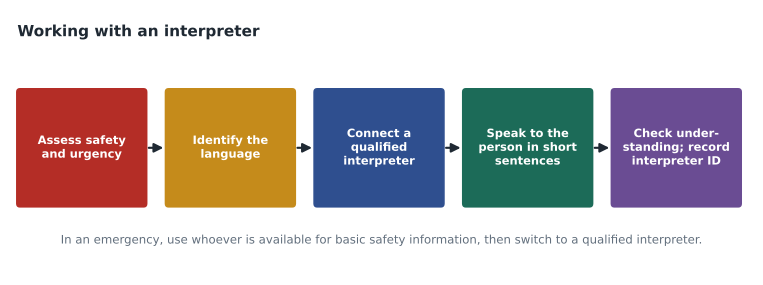
Desjardins gives the class Port Ardent's rules. Use a qualified interpreter, in person or by phone, for any statement that matters: a victim's or witness's account, a suspect's interview, the explanation of rights. Do not use children as interpreters, except in an emergency to get basic information, because they may be frightened, may not understand, may be pressured or may be harmed by what they hear. Be cautious about using family members, neighbours or other officers who speak the language: they may have their own interests or lack the vocabulary, and in family violence cases using a relative can be dangerous. Speak to the person, not to the interpreter, use short sentences, avoid slang and check understanding by asking the person to explain back in their own words.
Linh, who now works as a call-taker, shows the class data from the Port Ardent call centre on calls that needed interpretation in 2025.
# Port Ardent 911 and non-emergency calls needing a telephone interpreter, 2025
calls_by_language = {"Arabic": 412, "Punjabi": 305, "Spanish": 298, "Ukrainian": 236,
                     "Tigrinya": 121, "Dari": 114, "Mandarin": 109, "other languages": 391}
connected_within_2_min = 1702
total = sum(calls_by_language.values())
print("calls needing interpretation:", total)
for lang, n in sorted(calls_by_language.items(), key=lambda kv: -kv[1])[:3]:
    print(" ", lang, n)
print("connected to an interpreter within 2 minutes:", round(connected_within_2_min / total, 2))calls needing interpretation: 1986 Arabic 412 other languages 391 Punjabi 305 connected to an interpreter within 2 minutes: 0.86
Of 1,986 calls that needed interpretation, 0.86 were connected to an interpreter within two minutes. Linh says the other 0.14 worry her most, because a two-minute delay on an emergency call can matter, and because the languages with the longest waits, such as Tigrinya and Dari, are spoken by some of the newest and most vulnerable residents. The service has since added a second interpretation provider as a backup for those languages.
Family violence and newcomers
Family violence occurs in every community, and newcomers face particular barriers to getting help: isolation from extended family, economic dependence, fear about status and limited knowledge of services. Rahimi says that when police respond to a family violence call in a newcomer family, the most important things they can do are to separate the parties and speak to the victim alone, with a qualified interpreter and not a relative; to explain clearly what will happen next, including any arrest and release conditions; to tell the victim that their immigration status is not affected by reporting, if that is true under the policy that applies; and to connect them with a settlement agency or victim services worker who speaks their language. She says that cultural sensitivity never means accepting violence: officers should apply the law in the same way to every family, while understanding the pressures a victim may face.
Building relationships
Services that have built trust with newcomer communities share some practices. They work with settlement agencies, faith communities and community organizations to explain the role of police, often in sessions held in the community's own language. They recruit officers and civilian staff who reflect the communities served and speak their languages. They create liaison officers or advisory committees for particular communities. They publish information in multiple languages. And they make sure that the first contact newcomers have with police, often as victims or witnesses, goes well. Constable Ferreira runs a session every few months at the Newcomer Centre called 'Police in Port Ardent', with Rahimi interpreting, where she explains what police do and do not do, how to call for help, and how to make a complaint.
Hate crimes and community safety
Rahimi tells the class that many newcomer communities fear hate crimes and harassment as much as any other kind of crime, and that the response to a hate-motivated incident shapes how a whole community sees the police. The Criminal Code makes it an offence to advocate genocide, to publicly incite hatred and to wilfully promote hatred against an identifiable group, and section 718.2(a)(i) makes evidence that an offence was motivated by bias, prejudice or hate an aggravating factor at sentencing. Mischief to property used primarily for religious worship is a separate offence under section 430(4.1). Officers should ask about motivation, record any words, symbols or other evidence of bias, and make sure the incident is classified correctly, because underreporting and misclassification are common. Victims of hate crimes often feel that the attack was aimed at their whole community, so follow-up, information about the investigation and contact with community organizations matter even more than usual.
Worked problem
A collision with a newcomer driver
Constable Malhotra responds to a minor collision on Lindell Avenue. One driver, a Syrian man who arrived eight months ago, speaks little English and is visibly frightened. His twelve-year-old daughter, in the car with him, speaks good English and offers to translate. The other driver is shouting that the man ran a red light. What should Malhotra do?
Show solution
- Make the scene safe and check for injuries; use the daughter only for basic safety information if needed.
- Calm the situation and separate the drivers, explaining in simple words and gestures that Malhotra will hear both sides.
- Connect a qualified Arabic interpreter by phone for the man's account, rather than relying on his daughter.
- Explain each step through the interpreter, including what documents are needed, what will happen next and that this is a traffic matter.
- Record both accounts, any witnesses and the interpreter's identification number, and give the man written information about the next steps.
Answer: Secure the scene, use the daughter only for basic safety information, take the man's account through a qualified interpreter, explain each step and record the interpreter's details.
Common mistakes
MistakeNewcomers are one community with shared needs.
InsteadNewcomers differ greatly by origin, status, language and experience.
MistakeAsking about immigration status is always appropriate.
InsteadMany services restrict such questions for victims and witnesses; follow your service's policy and the law.
MistakeA bilingual child is a good interpreter.
InsteadChildren should be used only for basic information in an emergency; use a qualified interpreter.
MistakeCultural sensitivity means accepting different family practices.
InsteadThe law applies equally to every family; sensitivity means understanding the pressures a victim faces.
Summary and key terms
- Newcomers differ by origin, legal status, language and experience of police.
- Barriers include fear of immigration consequences, past experience of police, language, unfamiliar systems, family pressure and economic dependence.
- Immigration enforcement is a federal responsibility of the CBSA; many services limit questions about status for victims and witnesses.
- Use qualified interpreters for statements that matter, not children or relatives.
- In Port Ardent, 0.86 of calls needing interpretation were connected within two minutes.
- Relationships grow through work with settlement agencies, community sessions, diverse recruitment and good first contacts.
- Permanent resident
- A person granted the right to live in Canada permanently who is not a citizen.
- Asylum claimant
- A person who has asked for refugee protection and is awaiting a decision.
- CBSA
- The Canada Border Services Agency, which enforces immigration law.
- Access without fear
- A municipal policy allowing people to use services without being asked about immigration status.
- Qualified interpreter
- A trained interpreter who can convey meaning accurately and impartially.
- Settlement agency
- An organization that helps newcomers with housing, language, employment and services.
Practice problems
Work each problem on paper first, then reveal the answer to check.
Name three barriers that keep newcomers from reporting crime.
Show answer
Fear of immigration consequences, past experience of police, language, unfamiliar systems, family pressure or economic dependence.
Why should officers avoid using children as interpreters?
Show answer
Children may be frightened, may not understand, may be pressured and may be harmed by what they hear.
In the code example, how many calls needed interpretation and what share were connected within two minutes?
Show answer
1,986 calls; 1,702 of them, about 0.86.
Which agency enforces immigration law in Canada?
Show answer
The Canada Border Services Agency.
Lesson quiz · 5 questions
Score 60% or more to complete this lesson.
Create a free account to save your progress, take quizzes and earn a certificate.