
LES-113 · Lesson 4 of 12 · 19 min
Building and measuring public trust
▶ Video coming soon A video version of this lesson is on the way.
Port Ardent's 2025 community survey arrives on the morning of the fourth class, and Chief Diane Kowalczyk has sent Desjardins a copy to use. The headline is good news: 68 in every 100 residents said they trust the police. But Desjardins points to the rows below it. Trust was 54 in 100 among residents aged 18 to 29 and 81 in 100 among those 65 and over. It was 49 in 100 among Black respondents and 44 in 100 among Indigenous respondents. 'If I were the chief,' he says, 'the number I'd lose sleep over is not the 68. It's the gaps.'
What trust is
Trust in the police is a broad judgment that the police will act competently, fairly and in the public's interest. It overlaps with legitimacy, which you met in Lesson 3, but researchers usually separate a few related ideas. Confidence is a general sense that the police do a good job. Trust in police fairness is the belief that police treat people equally and with respect. Trust in effectiveness is the belief that police respond, solve crimes and keep people safe. Legitimacy is the belief that police have the right to authority and should be obeyed. Surveys that ask only one general question blur these together, and a service that wants to improve needs to know which is weak.
Trust matters for practical reasons. People who trust the police are more likely to report crime, to come forward as witnesses, to give information, to follow directions in emergencies and to support police budgets and powers. People who do not trust the police are more likely to handle problems themselves, which can lead to violence, and to stay silent when they are victims. Research by Wesley Skogan also found an asymmetry: a bad experience with police lowers trust much more than a good experience raises it. That makes each encounter matter, and it means that trust is easier to lose than to build.
Why trust differs between groups
Trust is not evenly distributed. In both Canada and the United States, surveys consistently find lower trust among younger people, among Black and Indigenous people, and among people who have had recent involuntary contact with the police, such as being stopped or arrested. Statistics Canada's General Social Survey on Canadians' Safety has asked about confidence in police for many years, and analyses of its results have found lower confidence among Indigenous people, among Black people and among people who identify as 2SLGBTQI+, as well as among people who had been victims of crime. Trust among recent immigrants is often high at first and can fall over time as newcomers learn local experiences.
These differences have causes. Some reflect history: policies such as the pass system and the enforcement of residential school attendance left lasting distrust. Some reflect experience: groups that are stopped more often, by any measure, have more chances for bad encounters. Some reflect neighbourhood conditions: residents of areas with high crime and slow response may doubt police effectiveness. And some reflect what people hear from others, including high-profile incidents elsewhere that shape views locally.
Measuring trust well
Desjardins teaches the class how to read a survey like Port Ardent's. The first question is how the sample was drawn. A random sample of addresses or phone numbers, weighted to match the population, gives a better picture than an online survey that anyone can answer, which tends to over-represent people with strong views. The second question is how the questions were worded, because 'Do you trust the police?' and 'Do the police in your neighbourhood treat people fairly?' measure different things. The third question is how much uncertainty there is in each estimate, especially for small groups.
# Port Ardent community survey 2025: margin of error for each estimate (95 in 100 confidence)
import math
groups = {"all residents": (1200, 0.68), "aged 18 to 29": (230, 0.54),
          "aged 65 and over": (260, 0.81), "Black respondents": (110, 0.49),
          "Indigenous respondents": (70, 0.44)}
for name, (n, p) in groups.items():
    moe = 1.96 * math.sqrt(p * (1 - p) / n)
print(f"{name:24} n={n:5} trust {p:.2f} plus or minus {moe:.2f}")all residents n= 1200 trust 0.68 plus or minus 0.03 aged 18 to 29 n= 230 trust 0.54 plus or minus 0.06 aged 65 and over n= 260 trust 0.81 plus or minus 0.05 Black respondents n= 110 trust 0.49 plus or minus 0.09 Indigenous respondents n= 70 trust 0.44 plus or minus 0.12
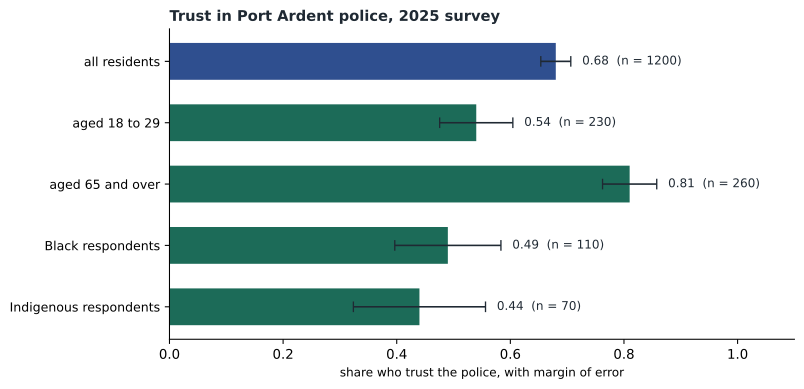
The estimate for all residents is precise: 0.68 plus or minus about 0.03. The estimates for small groups are much less precise. For the 70 Indigenous respondents, the margin is about 0.12, so the true figure could plausibly be anywhere from about 0.32 to 0.56. Even so, the gap between that group and all residents is large enough that it is very unlikely to be a sampling accident. Linh asks whether the service could survey more people from the smaller groups. Desjardins says yes: many services oversample smaller groups and then weight the results, and they also use other sources, such as focus groups and conversations with community organizations, because a survey number alone cannot say why trust is low.
Surveys are one measure among several. Others include follow-up surveys of people who had contact with the police, like the one Haddad used in Lesson 3; complaint data, which reflect both conduct and people's willingness to complain; the rate at which victims report crimes, from victimization surveys; and the share of calls where witnesses cooperate. A service that tracks several measures over time can see whether trust is changing and where.
How trust is built
There is no single program that builds trust. Desjardins groups the evidence into four kinds of action. First, fair and respectful encounters, every time, because each one adds to or subtracts from the stock of trust. Second, presence and familiarity: officers assigned long enough to an area to be known by name, who attend community events, visit schools and businesses, and are seen when nothing is wrong. Third, transparency and accountability: publishing data on stops, use of force and complaints, explaining decisions after serious incidents, and having independent oversight that the public trusts. Fourth, responsiveness: following up on what residents raise, telling them what was done and, when the police cannot help, saying so honestly and pointing them to who can.
He adds a fifth that services often avoid: acknowledging past harm. When a service has done wrong, a sincere acknowledgement can begin to repair the relationship, but only if it is followed by change. In 2022 the Chief of the Toronto Police Service apologized to Black communities when the service published race-based data on use of force and strip searches, and other Canadian services have apologized for their role in residential schools and in failing to investigate the disappearance of Indigenous women. Apologies without change tend to deepen cynicism.
Community engagement in practice
Engagement means different things in different places. Constable Grace Ferreira, the Eastgate neighbourhood officer, describes her routine to the class. She spends part of each shift on foot in the neighbourhood. She attends the monthly community meeting at the library, but she also meets the tenants' association in the Lindell Avenue towers, has coffee every two weeks with the staff of the Harbour House shelter and the St. Brendan's drop-in, and visits the newcomer settlement office on Mercer Street. She runs a basketball game with the youth program at the community centre once a month, where, she says, she has learned more about what young people think of the police than at any meeting.
She tells the class that the people who come to the library meetings are mostly older homeowners. They care about speeding, break-ins and the condition of the park. The young people she meets at the community centre care about being stopped and searched. The tenants in the towers care about building security and slow response to calls. The shelter staff care about how officers treat their clients. 'If I only listened at the library,' she says, 'I'd be policing a different neighbourhood from the one that's actually there.'
Priya asks how Ferreira decides between competing priorities. Ferreira says she does not decide alone: she brings the issues to the community meeting and to her sergeant, and she is honest when residents want different things. When the homeowners asked for more stops of young people in the park, she explained what the law allows, what the research says about the effect of frequent stops on trust and crime, and what she proposed instead, which was a problem-solving project on the specific behaviour they were worried about.
Social media, transparency and misinformation
Public views of the police are now shaped heavily by video and social media. A clip of an arrest can reach millions of people in a few hours, often without context. Services have responded in different ways: releasing body-worn camera footage after serious incidents, publishing dashboards of stop and force data, and using their own social media to explain incidents and correct errors. Each choice involves trade-offs with privacy, ongoing investigations and fairness to the people involved. In Canada, the release of video involving a serious injury or death is usually controlled by the independent oversight body, such as Ontario's Special Investigations Unit, while it investigates. Officers should assume that any encounter may be recorded and shared, and that the best protection is conduct they would be comfortable defending in public.
When trust is tested: after a serious incident
Desjardins says that trust is tested most after a serious incident, such as a death in custody, a police shooting or a video of an arrest that goes viral. In those hours and days, what a service says and does can preserve or destroy years of work. He gives the class the practices that he saw work in Port Ardent and elsewhere. Say quickly what is known and what is not, without speculating or defending the officers before the facts are clear. Notify the independent oversight body, such as the Special Investigations Unit in Ontario, and explain its role, so that the public knows that the investigation is not being done by the police themselves. Meet with community leaders and the people most affected, privately and early. Release information, including video where the law and the investigation allow, on a predictable timetable. And follow up when the investigation ends, explaining the findings and what will change.
Ferreira adds that the neighbourhood officer has a particular role in those moments. She is the officer residents already know, and she is often the person they will ask what happened. She says the most important thing she can do is to be honest about what she does not know, to listen to people's anger without arguing, and to keep showing up. 'If I disappear for two weeks after something bad happens,' she says, 'I've told people that I was only there when things were easy.'
Worked problem
Reading a survey result
The Eastgate community meeting asks Ferreira why the service's report says trust among young people 'rose sharply' from 0.51 in 2024 to 0.54 in 2025. Each year's sample had about 230 people aged 18 to 29. Was the rise real?
Show solution
- Find the margin of error for each estimate: about 1.96 times the square root of 0.54 times 0.46 divided by 230, which is about 0.06.
- Compare the change, 0.03, to that uncertainty; the two estimates' ranges overlap almost completely.
- Conclude that the data do not show a real change; the difference could easily be sampling noise.
- Look for other evidence, such as complaints from young people, contact surveys and what youth workers report.
- Report honestly: trust among young people was about the same in both years and remains well below the overall figure.
Answer: No. A change of 0.03 is well within the margin of error of about 0.06, so the report should say trust among young people was stable, and still low, rather than rising sharply.
Common mistakes
MistakeA high overall trust number means the police are trusted by everyone.
InsteadOverall figures can hide large gaps between groups; look at the breakdown.
MistakeSmall group results are meaningless.
InsteadThey are less precise, but large gaps can still be clear; check the margin of error and use other sources.
MistakeA good encounter builds as much trust as a bad one destroys.
InsteadResearch finds an asymmetry: bad experiences have a larger effect.
MistakeCommunity engagement means holding public meetings.
InsteadMeetings reach some residents; officers must also go where others are, such as tenant groups, youth programs and service agencies.
Summary and key terms
- Trust includes confidence, perceived fairness, perceived effectiveness and legitimacy.
- People who trust the police report crime and cooperate more; bad experiences lower trust more than good ones raise it.
- Trust is lower among younger people, Black and Indigenous people, and people with recent involuntary contact.
- Read surveys for sampling, wording and margin of error; small groups have wide margins.
- Trust is built through fair encounters, familiarity, transparency and accountability, responsiveness and acknowledgement of past harm.
- Engagement must reach residents who do not come to meetings.
- Trust
- A broad judgment that the police will act competently, fairly and in the public's interest.
- Confidence
- A general sense that the police do a good job.
- Margin of error
- The range around a survey estimate within which the true value is likely to fall.
- Oversampling
- Surveying more people from small groups to make their estimates more precise, then weighting the results.
- Asymmetry of contact
- The finding that negative encounters affect trust more than positive ones.
- Neighbourhood officer
- An officer assigned for a long period to a defined area to build relationships and solve problems.
Practice problems
Work each problem on paper first, then reveal the answer to check.
What did Skogan find about good and bad encounters?
Show answer
Bad encounters lower trust much more than good ones raise it.
In the code example, what is the margin of error for Indigenous respondents?
Show answer
About 0.12, because the sample was only 70 people.
Name the four kinds of action that build trust in the lesson.
Show answer
Fair encounters, presence and familiarity, transparency and accountability, and responsiveness.
Why does Ferreira meet the tenants' association and youth program as well as the library meeting?
Show answer
Different residents attend different places and have different concerns.
Lesson quiz · 5 questions
Score 60% or more to complete this lesson.
Create a free account to save your progress, take quizzes and earn a certificate.