
LES-113 · Lesson 11 of 12 · 20 min
Crime prevention: CPTED, situational prevention and what works
▶ Video coming soon A video version of this lesson is on the way.
Desjardins takes the class on a walk through the laneway behind the shops on Mercer Street at dusk. It is narrow, unlit, lined with dumpsters and fences, and opens onto the edge of Eastgate Park. Halfway along there is a recessed doorway at the back of a closed restaurant, its step covered in cigarette ends and broken glass. 'Tell me what this place is telling people,' he says. Marco says it is telling people that no one is watching. Amara says it is telling people that no one cares. Jesse says it is telling people there are places to hide. Desjardins says that all three are right, and that each points to something that can be changed without arresting anyone.
Three approaches to prevention
Crime prevention is usually divided into three broad approaches. Social or developmental prevention addresses the root causes that make people more likely to offend, through early childhood programs, family support, education, employment and recreation. Community prevention strengthens the ability of neighbourhoods to control crime through social ties, local organizations and shared norms. Situational prevention changes the immediate circumstances in which crimes happen, making them harder, riskier or less rewarding. Police play some part in all three, but their most direct role is in situational prevention, in identifying problems that other agencies can address and in protecting victims from repeat harm.
Desjardins notes that the approaches work on different timescales. Situational measures can reduce a specific problem in weeks. Community measures take years. Developmental programs, such as high-quality early childhood education, may take decades to show their full effect on crime, though some, such as the Perry Preschool Project in Michigan, have followed participants for forty years and found lower rates of arrest in adulthood. Communities need all three.
Crime prevention through environmental design
Crime prevention through environmental design, known as CPTED and pronounced 'sep-ted', is the idea that the design and management of the built environment can reduce crime and fear. It grew from the work of the criminologist C. Ray Jeffery, who coined the term in 1971, the architect Oscar Newman, whose 1972 book Defensible Space compared crime in public housing projects with different designs, and later practitioners such as Timothy Crowe. CPTED is usually described through four main principles.
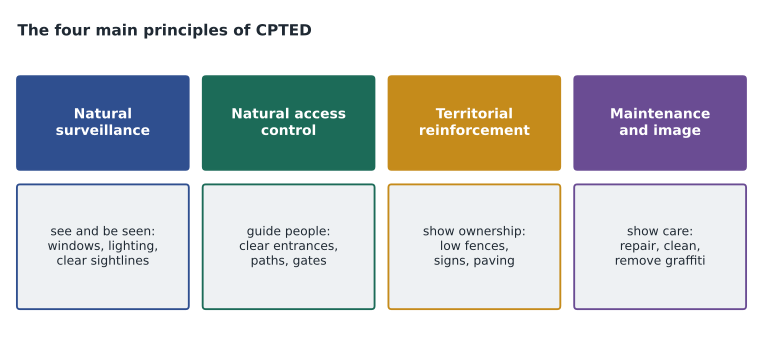
- Natural surveillance: arranging spaces so that people can see and be seen, through windows that overlook paths, good lighting, clear sightlines and the placement of activities where people naturally gather.
- Natural access control: guiding people where they should go and discouraging access where they should not, through clear entrances, paths, landscaping and gates, rather than only locks and guards.
- Territorial reinforcement: making clear which spaces are private, semi-private and public, through fences, signs, paving and landscaping, so that legitimate users feel ownership and outsiders feel noticed.
- Maintenance and image: keeping spaces clean and repaired, removing graffiti and litter promptly, and replacing broken lights, so that the space shows that someone cares, which connects to the broken windows idea from Lesson 1.
Later practitioners added second-generation CPTED, which focuses on the social side of places: building community cohesion, connecting residents through events and programs, increasing the capacity of local organizations and making sure that physical changes reflect what residents want. A well-lit park that no one feels welcome in does not provide natural surveillance. Desjardins says the laneway behind Mercer Street fails every principle: no one can see into it, anyone can enter from either end, no one has claimed it and no one maintains it.
CPTED has critics. Some designs that reduce crime can also exclude people, such as benches designed so that no one can lie on them, which critics call hostile architecture. Gated communities can increase residents' sense of security while dividing cities. And CPTED can be used to push marginalized people out of public spaces rather than to make spaces safe for everyone. Good CPTED practice involves the people who use a space, including those with the least power, and asks who will be safer and who will be excluded.
Situational crime prevention
Situational crime prevention, developed by the British criminologist Ronald Clarke from the 1980s onward, treats crime as the product of opportunity. It does not try to change offenders' motivations; it changes situations so that crime is less attractive. Clarke and Derek Cornish later organized situational techniques into twenty-five, grouped under five aims.
| Aim | Examples |
|---|---|
| Increase the effort | Locks, steering wheel immobilizers, screens at counters, controlled entrances |
| Increase the risks | Lighting, cameras, staffed exits, neighbours watching, place managers |
| Reduce the rewards | Removable car stereos, property marking, cashless payment, quick repair of graffiti |
| Reduce provocations | Staggered bar closing times, comfortable queues, avoiding crowding |
| Remove excuses | Clear rules and signs, reminders at the point of decision, easy access to toilets and bins |
Situational prevention has a strong record. Car theft fell dramatically in many countries after manufacturers fitted electronic immobilizers. Robberies of convenience stores fell where stores kept little cash, improved visibility and staffed the counter well. Some of the Northgate Plaza responses in Lesson 2, such as moving goods away from the unstaffed exit, staggering the bar's closing time and installing a gate at the back of the lot, were situational measures. The main objection, that crime will simply be displaced, was discussed in Lesson 2: research finds displacement is usually limited and diffusion of benefits is common.
Hot spots and place-based policing
Crime is concentrated in small places. Research in many cities, beginning with work by Lawrence Sherman and colleagues in Minneapolis in the late 1980s and continuing with David Weisburd's studies, has found that about half of crime occurs at around five in every hundred street segments, a pattern Weisburd called the law of crime concentration. That concentration makes place-based approaches efficient. Hot spots policing focuses police attention on those small places, through visible patrol, problem solving or both. Reviews, including a 2018 report from the U.S. National Academies of Sciences, Engineering, and Medicine and Campbell reviews by Anthony Braga and colleagues, found that hot spots policing produces modest reductions in crime without clear evidence of displacement, and that problem-oriented approaches at hot spots tend to work better than simply adding patrol.
Hot spots policing also raises concerns about fairness. If the hot spots are in neighbourhoods where racialized or poor residents live, increased enforcement there can increase stops and arrests of those residents and harm trust. The National Academies report found that hot spots strategies had small or no effects on community perceptions in the short term, but warned that aggressive tactics could have long-term costs. Desjardins says the answer is to combine place-based focus with the principles of this course: problem solving, partnership and procedural justice, so that attention to a place improves it for the people who live there.
Assessing a prevention project
In the spring of 2025, the city, with advice from the community response unit, installed LED lighting along the Mercer Street laneway and two other laneways in Eastgate, trimmed hedges, and asked the businesses to keep their back areas clear. To assess the change, the unit compared the lit laneways with three similar unlit laneways on the other side of the neighbourhood, using reported incidents for the six months before and the six months after.
# Reported incidents in Eastgate laneways, six months before and after new lighting
target = {"before": 48, "after": 30}       # three laneways with new lighting
comparison = {"before": 52, "after": 47}   # three similar laneways without changes
target_change = (target["after"] - target["before"]) / target["before"]
comparison_change = (comparison["after"] - comparison["before"]) / comparison["before"]
print("target change:", round(target_change, 2))
print("comparison change:", round(comparison_change, 2))
print("difference in differences:", round(target_change - comparison_change, 2))target change: -0.38 comparison change: -0.1 difference in differences: -0.28
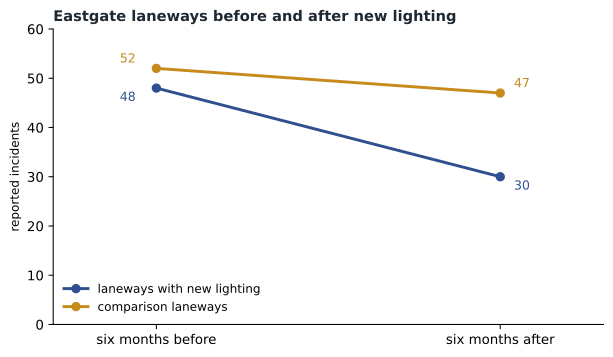
Incidents in the lit laneways fell by 0.38 of their starting level, while incidents in the comparison laneways fell by 0.10. The difference in differences, 0.28, is a better estimate of the effect of the lighting than the raw fall in the target laneways, because the comparison laneways capture changes that affected the whole neighbourhood, such as the weather or a general fall in crime. Desjardins points out the remaining limits: the numbers are small, six months is short, the laneways were not chosen at random, and residents may have reported more or less after the change. But the result is consistent with research on street lighting, including a review by Brandon Welsh and David Farrington that found improved lighting was associated with reductions in crime of about one fifth on average, often including crimes committed in daylight, which suggests that lighting works partly by signalling investment and increasing community pride.
What works, what doesn't and what's promising
In 1997 Lawrence Sherman and colleagues at the University of Maryland reviewed hundreds of evaluations of crime prevention programs for the United States Congress and sorted them into what works, what does not, and what is promising. Their approach, and later reviews by the Campbell Collaboration and the What Works Centre for Crime Reduction in the United Kingdom, changed how police think about prevention. Desjardins gives the class a summary of findings that have held up over time, with the caution that evidence keeps developing.
- Strong evidence of reducing crime: problem-oriented policing; hot spots policing, especially with problem solving; focused deterrence for group violence; situational measures targeted at specific problems; improved street lighting.
- Promising but mixed: community violence intervention; CPTED changes to specific places; neighbourhood watch; mentoring programs for young people at risk.
- Little or no evidence of reducing crime, or evidence of harm: scared straight programs that take young people to prisons, which a Campbell review found increased offending; some drug education programs delivered by police in schools, which showed little effect on drug use; and arrest-heavy crackdowns without problem solving, whose effects usually fade quickly.
Priya asks why ineffective programs survive. Desjardins says that programs are often popular because they feel right, are easy to explain and are visible, and that evaluation is rarely funded. He tells the class that one of the most valuable things a young officer can do is ask, of any program, 'How do we know it works?'
Repeat victimization
One of the most efficient forms of prevention is protecting people and places that have already been victimized. Research beginning in the 1980s, including the Kirkholt burglary project in England, found that a home that had been burgled was far more likely than others to be burgled again, often within weeks, and that targeting prevention at those homes, through better locks, property marking and neighbours watching, sharply reduced burglary in the area. The same pattern applies to domestic violence, robbery of businesses, vehicle crime and hate crime. For officers, the lesson is practical: when you respond to a victim, think about what will happen next week. Advice about security, a referral to victim services, a check-back visit and, for domestic violence, safety planning can prevent the next incident as well as respond to this one.
Worked problem
Applying CPTED and situational prevention to the laneway
The Mercer Street laneway now has lighting, but residents still report people drinking and using drugs in the recessed doorway at the back of the closed restaurant, and leaving needles there. Using CPTED and situational prevention, what should the community response unit propose?
Show solution
- Natural surveillance: ask whether the restaurant owner can add a motion-activated light and remove the recess's blind spot, or whether the neighbouring business can add a window or camera overlooking it.
- Access control and territorial reinforcement: ask the owner to install a gate or fill in the recess so it is no longer a sheltered space.
- Maintenance: arrange regular cleaning and needle pickup with the city and the harm reduction program, and remove the debris that signals neglect.
- Reduce harm and provocation: work with the harm reduction program to put a sharps disposal box nearby and to make sure people who use drugs know where supervised or safer spaces are available.
- Assess: count reports and needles found before and after, and check nearby spaces for displacement.
Answer: Remove the sheltered recess, improve surveillance of it, maintain it regularly, offer a sharps box and safer alternatives with harm reduction partners, and assess the result.
Common mistakes
MistakeCPTED means adding cameras and fences.
InsteadCPTED includes surveillance, access control, territorial reinforcement and maintenance, and the best practice involves users of the space.
MistakeSituational prevention just moves crime elsewhere.
InsteadDisplacement is usually limited and diffusion of benefits is common.
MistakeA fall in crime after a project proves it worked.
InsteadCompare with similar places that did not change, such as with a difference in differences.
MistakePopular programs must work.
InsteadSome popular programs, such as scared straight, have been found ineffective or harmful.
Summary and key terms
- Crime prevention includes social, community and situational approaches on different timescales.
- CPTED's four principles are natural surveillance, natural access control, territorial reinforcement and maintenance.
- Situational prevention increases effort and risk, reduces rewards and provocations and removes excuses.
- Crime concentrates at a few places; hot spots policing has modest effects, best combined with problem solving.
- Eastgate laneway incidents fell 0.38 against 0.10 in comparison laneways, a difference in differences of 0.28.
- Ask of every program: how do we know it works?
- CPTED
- Crime prevention through environmental design: using design and management of places to reduce crime and fear.
- Natural surveillance
- Arranging spaces so that people can see and be seen.
- Situational crime prevention
- Changing the immediate circumstances of crime to make it harder, riskier or less rewarding.
- Hot spot
- A small place where crime is concentrated.
- Law of crime concentration
- The finding that a small share of places accounts for a large share of crime.
- Difference in differences
- An estimate of effect that subtracts the change in a comparison group from the change in the target group.
Practice problems
Work each problem on paper first, then reveal the answer to check.
Name the four main principles of CPTED.
Show answer
Natural surveillance, natural access control, territorial reinforcement and maintenance.
What are the five aims of situational crime prevention?
Show answer
Increase the effort, increase the risks, reduce the rewards, reduce provocations and remove excuses.
In the code example, what was the difference in differences?
Show answer
-0.38 minus -0.10, or -0.28.
What did the Campbell review find about scared straight programs?
Show answer
They increased offending.
Lesson quiz · 5 questions
Score 60% or more to complete this lesson.
Create a free account to save your progress, take quizzes and earn a certificate.