
LES-113 · Lesson 1 of 12 · 21 min
Community policing: origins, philosophy and principles
▶ Video coming soon A video version of this lesson is on the way.
On the first morning of the course, Professor Ray Desjardins puts a photograph on the screen. It shows a police officer in the late 1980s standing in a doorway on Mercer Street in Port Ardent's Eastgate neighbourhood, talking to a shopkeeper. 'That's me,' he says, 'eleven years into patrol, the week the service started its first foot beat in Eastgate. I thought it was a punishment. Within a year it was the best job I ever had.' He tells the class that he spent the last part of his career running the community response unit, and that most of what he learned there is the subject of this course: how police work with the people they serve, how trust is built and lost, and how bias, history and difference shape every encounter.
This course builds on LES-101, where you saw the purpose of police in a democracy and the history of policing, and on LES-111 and LES-112, where you studied the Charter and police powers. Those courses asked what police may do. This one asks how police should do it, and with whom. It follows the same cohort at Georgian Shores College in Barrie, and much of it takes place in Eastgate, a neighbourhood of about 9,000 people on the east side of Port Ardent.
What community policing means
Community policing is a philosophy, not a unit. It holds that the police and the public share responsibility for safety, that the police should work with residents to identify and solve problems rather than only respond to incidents, and that the way police act, not just what they achieve, matters to whether people accept their authority. A service that has a community policing unit but treats every other officer as a call-taking machine has not adopted community policing. A service where every patrol officer knows the people on their beat, uses their discretion to solve problems and is measured partly on how well they do so has.
Most definitions share three elements. The first is partnership: working with residents, businesses, community groups, schools, social services and other agencies as equals, not as sources of information. The second is problem solving: looking beyond individual calls to the conditions that produce them, and using a wide range of responses, many of which are not enforcement. The third is organizational change: adjusting how a service assigns officers, trains them, evaluates them and makes decisions, so that partnership and problem solving become normal work rather than special projects.
Desjardins writes the three words on the board and asks which is hardest. Marco DiSanto, the army veteran, says organizational change, because every institution he has worked in resists it. Priya Sandhu says partnership, because partners have their own priorities and do not take orders. Desjardins says both are right, and that the third element is the one most often missing when community policing fails: services adopt the language without changing the incentives.
Where the idea came from
The idea is older than the name. The principles often attributed to Sir Robert Peel, compiled by later writers from the instructions given to London's Metropolitan Police in 1829, include the statement that the police are the public and the public are the police, and that the police depend on public approval to do their work. Canadian policing inherited that model, and in small towns and rural detachments officers often knew the people they policed. But through the middle of the twentieth century, as services grew and motorized patrol spread, policing in Canada, like policing in the United States, moved toward a professional model built around rapid response, random patrol and investigation.
The professional model had real strengths: training, standards, records and less political interference. But by the late 1960s and 1970s it was under strain. In the United States, the Kerner Commission in 1968 found that police practices were a major source of grievance in the urban disorders of the previous summers. Research then tested the model's core assumptions. The Kansas City Preventive Patrol Experiment of 1972 and 1973 found that varying the level of random patrol made little difference to crime or to residents' fear. Studies of response time found that faster response rarely led to arrests, because most crimes are reported long after they happen. Canadian services, following the same research, began their own reviews in the 1980s.
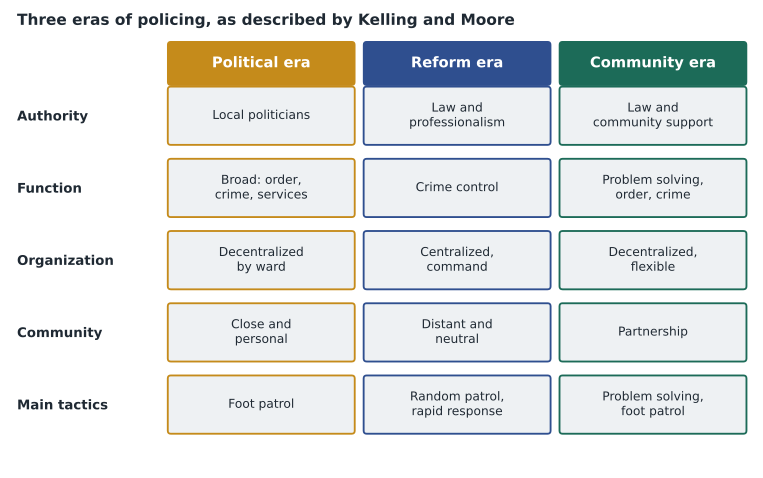
Two ideas grew out of that research. In 1979 Herman Goldstein argued that police should focus on the problems behind repeat calls rather than on the calls themselves, which became problem-oriented policing, the subject of the next lesson. In 1982 James Q. Wilson and George Kelling published 'Broken Windows', which argued that visible disorder signals that no one is in control, increases fear and can lead to more serious crime, and that police should pay attention to order and residents' concerns. By the late 1980s, George Kelling and Mark Moore were describing a community problem-solving era that was replacing the reform or professional era.
How it spread in Canada
In Canada, community policing spread through the late 1980s and 1990s. The RCMP adopted community policing as a national approach and later described it through its CAPRA problem-solving model, which stresses clients, acquiring and analyzing information, partnerships, response and assessment. Municipal services opened storefront offices and community stations, and many created neighbourhood officers. In Ontario, the Police Services Act of 1990 set out adequate and effective policing, and amendments that took effect in 2019 required every municipality to prepare a community safety and well-being plan. The Community Safety and Policing Act, 2019, which came into force on April 1, 2024, kept that duty and lists, among the principles of policing, the need for cooperation between police and the communities they serve and the importance of respecting diversity.
Today almost every police service says it practises community policing. What that means in practice varies enormously. In some places it is a philosophy that shapes how every officer works. In others it is a small unit that attends events and runs programs while patrol carries on as before. Part of the job of a new officer is to recognize which kind of service they have joined and to practise the philosophy in their own work regardless.
Core principles in practice
Desjardins gives the class six principles he used to brief new members of the community response unit. They are not a legal standard, but they summarize what the research and his experience suggest.
- Know the place. An officer assigned to an area for long enough to learn its people, its history and its problems makes better decisions than one who arrives for each call as a stranger.
- Listen before acting. Residents often define problems differently from the police, and their definition usually reveals something the call data does not.
- Solve problems, not just incidents. A call that keeps coming back is a sign that something underneath it has not been addressed.
- Share decisions. Partners who help define a problem and choose a response are far more likely to sustain it than partners who are told what the police will do.
- Act fairly every time. Trust is built in thousands of ordinary encounters and lost in a few bad ones.
- Measure what matters. Count outcomes such as fewer repeat calls, less fear and more trust, not only arrests and tickets.
What the calls say about the work
One reason community policing makes sense is that most police work is not about crime. Desjardins shows the class the breakdown of Port Ardent's 54,300 calls for service in 2025, which they first saw in LES-101, and asks Linh Tran, who now works part time as a call-taker, to group them.
# Port Ardent calls for service, 2025
calls = {"traffic": 9800, "disturbances": 6900, "suspicious person or vehicle": 6100,
         "theft and property": 5900, "well-being and mental health": 5400,
         "animals and other": 4950, "alarms": 4300, "collisions": 3400,
         "follow-ups": 3200, "domestic": 2700, "assaults": 1650}
crime = ["theft and property", "domestic", "assaults"]
total = sum(calls.values())
crime_calls = sum(calls[k] for k in crime)
print("total calls:", total)
print("calls about a reported crime:", crime_calls, round(crime_calls / total, 2))
print("everything else:", total - crime_calls, round((total - crime_calls) / total, 2))total calls: 54300 calls about a reported crime: 10250 0.19 everything else: 44050 0.81
Only about one call in five reported a crime. The rest were traffic problems, disturbances, suspicious activity, people in distress, alarms, animals and follow-ups. Many of those calls come from the same places and the same people again and again. A model of policing that measures success only by response time and arrests misses most of what the public asks the police to do. Linh adds that from the call-taker's chair, the same addresses appear night after night, and that most of the callers are not asking for an arrest; they want the problem to stop.
What the evidence says
Community policing has been studied for more than forty years, and the results are more modest than its supporters sometimes claim. A Campbell Collaboration systematic review by Charlotte Gill and colleagues in 2014 found that community-oriented policing strategies had positive effects on residents' satisfaction with police, perceptions of police legitimacy and perceptions of disorder, but little measurable effect on crime or on fear of crime in the short term. Other approaches covered later in this course, such as problem-oriented policing and focused place-based strategies, have stronger evidence for reducing crime. The honest conclusion is that community policing reliably improves the relationship between police and the public, which matters in its own right and supports everything else, but it is not by itself a crime-reduction program.
Broken windows thinking has a more contested record. Some studies found that addressing physical disorder, such as cleaning vacant lots or fixing lighting, reduced crime and fear. But when the idea was translated into aggressive enforcement of minor offences and high volumes of stops, as in New York City's stop, question and frisk practices of the 2000s, the costs were serious. In 2013 a United States federal judge found in Floyd v. City of New York that the city's stop practices had violated the constitutional rights of many Black and Latino residents, and the volume of stops fell sharply afterwards without the increase in crime that some had predicted. Kelling himself later said that broken windows was never meant to be zero tolerance or mass arrest. Desjardins asks the class to keep two things in mind: disorder matters to residents, and the way police respond to it matters just as much.
Criticisms and debates
Community policing has critics from several directions. Some officers see it as social work that takes time away from real police work, and some services have treated it as a public relations exercise. Some community advocates argue that it expands police contact with residents who would be better served by other agencies, and that a friendly face does not change policies that cause harm. Others point out that community policing can amplify the voices of residents who attend meetings, who are often older homeowners, over those of tenants, young people and people who distrust the police. Recent debates about shifting some responsibilities and funding from police to other services have sharpened those questions.
Desjardins does not ask the class to settle these debates. He asks them to notice that the critics share a point with the supporters: the police are only one part of community safety, and they do the most good when they work with others, know their limits and act fairly. He tells Jesse Morningstar, who wants to join the Nimkii Bay Anishinaabe Police Service, that the communities he will serve have long experience of policing done to them rather than with them, and that the whole course is about the difference.
Worked problem
Is this community policing?
A Port Ardent inspector proposes three changes for Eastgate. First, a two-officer bicycle patrol every summer weekend. Second, a monthly community meeting chaired by the inspector, where residents can raise concerns and hear what the police have done about the last month's issues. Third, adding to every patrol officer's annual evaluation a section on problems they identified and worked on with partners. Which of these are community policing, and what would make them work?
Show solution
- Ask which of the three elements each change supports: partnership, problem solving or organizational change.
- The bicycle patrol increases visibility and informal contact, which can help, but on its own it is a tactic, not a philosophy; it becomes community policing if the officers are assigned long enough to learn the area and use what they learn.
- The meeting supports partnership if residents help set priorities and the police report back honestly, including on what they could not do; it fails if it is a one-way briefing.
- The evaluation change is organizational change: it tells officers that problem solving is part of the job and rewards it.
- Ask who will be heard: monthly evening meetings reach some residents and miss others, so the inspector should add other channels, such as meeting with tenant groups, youth programs and newcomer organizations.
Answer: All three can contribute, but the evaluation change does the most to make community policing normal work; the meeting and the patrol work only if they lead to shared decisions and continuing assignment.
Common mistakes
MistakeCommunity policing is the job of the community policing unit.
InsteadIt is a philosophy for the whole service; a unit can support it but cannot replace it.
MistakeCommunity policing means being friendly.
InsteadIt means partnership, problem solving and organizational change; courtesy is necessary but not enough.
MistakeBroken windows means arresting people for minor offences.
InsteadThe original idea was about attending to disorder; aggressive enforcement is one interpretation, with serious costs.
MistakeCommunity policing has been proven to reduce crime.
InsteadThe evidence shows reliable gains in satisfaction and legitimacy, with little direct effect on crime; other strategies have stronger crime effects.
Summary and key terms
- Community policing is a philosophy built on partnership, problem solving and organizational change.
- It grew out of research in the 1970s that questioned random patrol and rapid response, and out of the problem-oriented and broken windows ideas.
- In Canada it spread through the RCMP and municipal services and is reflected in community safety and well-being planning in Ontario.
- Only about one in five Port Ardent calls reported a crime; most police work is about order, safety and help.
- Community policing reliably improves satisfaction and legitimacy; its direct effect on crime is small.
- Broken windows thinking and aggressive enforcement have a contested record.
- Community policing
- A philosophy in which police and the public share responsibility for safety through partnership, problem solving and organizational change.
- Professional model
- A model of policing built on rapid response, random patrol, investigation and independence from politics.
- Problem-oriented policing
- An approach that focuses on the conditions behind repeat incidents.
- Broken windows
- The idea that visible disorder increases fear and can lead to more serious crime.
- Community safety and well-being plan
- A municipal plan, required in Ontario, that coordinates police and other services to address risk.
- Legitimacy
- The public's belief that the police have the right to exercise authority and should be obeyed.
Practice problems
Work each problem on paper first, then reveal the answer to check.
Name the three elements of community policing.
Show answer
Partnership, problem solving and organizational change.
What did the Kansas City Preventive Patrol Experiment find?
Show answer
Varying the level of random patrol made little difference to crime or residents' fear.
In the code example, what share of Port Ardent calls reported a crime?
Show answer
10,250 of 54,300, about 0.19.
What did the 2014 Campbell review find about community policing?
Show answer
Positive effects on satisfaction, legitimacy and perceived disorder, but little measurable effect on crime or fear in the short term.
Lesson quiz · 5 questions
Score 60% or more to complete this lesson.
Create a free account to save your progress, take quizzes and earn a certificate.