
LES-113 · Lesson 10 of 12 · 19 min
Partnerships and multi-agency collaboration
▶ Video coming soon A video version of this lesson is on the way.
Every Tuesday at 10:00, Constable Grace Ferreira joins a meeting in a room at the Eastgate community centre. Around the table are a child protection worker, a nurse from the community mental health team, a school social worker, a housing worker from the city, an addictions counsellor, a probation officer, a victim services worker and an outreach worker from Harbour House. They call it the Eastgate Situation Table. In forty-five minutes they discuss five situations in which someone in the neighbourhood is at high risk of harm, decide which agencies will reach out to each person, and leave. Ferreira tells the class that this meeting prevents more crises than anything else she does.
Why partnerships matter
Most of the problems police deal with have causes that police cannot fix alone: poverty, addiction, mental illness, family breakdown, school failure, housing instability and social isolation. The same people and families often appear in the records of police, hospitals, child protection, schools and social services. When each agency works alone, each sees only part of the picture, and people fall through the gaps between them. Partnerships allow agencies to combine what they know, coordinate their responses and act earlier, before a problem becomes a crisis or a crime.
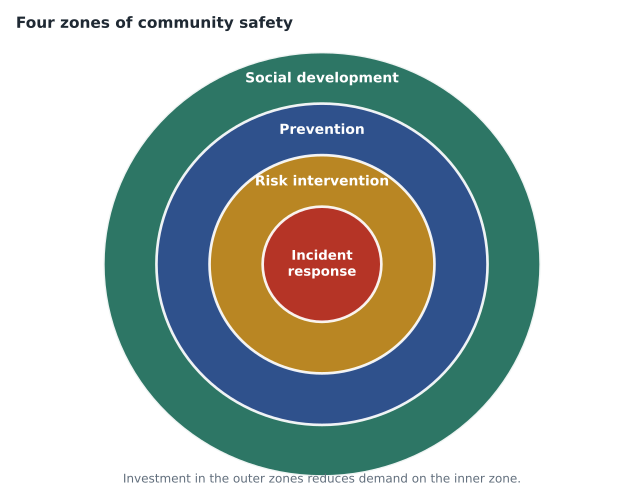
Ontario has made this approach a legal requirement. Under the Community Safety and Policing Act, 2019, every municipality must prepare and adopt a community safety and well-being plan, developed with an advisory committee that includes police, health, education, social services and community representatives. The province's planning framework describes four zones of intervention: social development, which addresses the root causes of crime and harm; prevention, which reduces identified risks; risk intervention, which mobilizes immediate support when someone is at acutely elevated risk; and incident response, which is the traditional emergency response by police, fire and paramedics. The framework argues that communities spend too much on incident response and too little on the other three.
Situation tables
Situation tables began in Prince Albert, Saskatchewan, in 2011, as the Community Mobilization Prince Albert Hub, modelled on approaches from Scotland. The idea spread quickly, and Ontario now has many tables, often called situation tables or hubs, supported by a provincial data system. Each table meets weekly. Any member agency can bring a situation in which a person or family faces acutely elevated risk of harm, meaning that several risk factors are present and that harm is likely soon without help. The table then uses what is called a four-filter approach to protect privacy while acting quickly.
- Filter one: the originating agency decides whether the situation meets the threshold of acutely elevated risk and whether it has already tried what it can alone.
- Filter two: the agency presents the situation to the group without identifying the person, describing only the risk factors, and the group decides whether it meets the threshold.
- Filter three: if it does, limited identifying information is shared so that agencies can say whether they know the person and could help.
- Filter four: the agencies that can help meet separately, plan an intervention and reach out, usually within a day or two. Only those agencies receive further information.
The intervention is usually a door knock by two or three workers from different agencies who explain that people are worried about the person and offer help. The person can decline, though most accept something. Once the risk is lowered, the situation is closed and the people involved continue with ordinary services. Privacy law, such as Ontario's Municipal Freedom of Information and Protection of Privacy Act and Personal Health Information Protection Act, allows disclosure to prevent significant risk of harm, but only as much as needed; the four filters are designed to meet that test.
How the Eastgate table works
Ferreira shows the class the Eastgate team's results for 2025.
# Eastgate situation table results, 2025
brought = 96
met_threshold = 81
risk_lowered = 62
connected_to_services = 58
declined_help = 9
still_open = met_threshold - risk_lowered - declined_help
print("situations brought:", brought, "met the threshold:", met_threshold)
print("risk lowered:", risk_lowered, round(risk_lowered / met_threshold, 2))
print("connected to services:", connected_to_services, round(connected_to_services / met_threshold, 2))
print("declined help:", declined_help, "still open or closed for other reasons:", still_open)situations brought: 96 met the threshold: 81 risk lowered: 62 0.77 connected to services: 58 0.72 declined help: 9 still open or closed for other reasons: 10
Of the 81 situations that met the threshold, risk was lowered in 62, or 0.77, and 58 people were connected to ongoing services. Nine people declined help. Police brought about a third of the situations, often after repeated calls to the same address, and other agencies brought the rest. Ferreira says that one of the most important results does not appear in the numbers: workers from different agencies now know each other and call each other directly, which speeds up help outside the weekly meeting. She cautions that the evaluation is limited. Without a comparison group, no one can be sure how many of these situations would have improved anyway, and provincial evaluations of situation tables have found good outcomes for many people but have called for stronger research.
Other kinds of partnership
Partnerships take many forms beyond risk tables.
- Co-response teams pair a police officer with a mental health worker to respond to calls involving people in crisis. They are covered in LES-114.
- Alternative response teams send civilian workers, without police, to some calls involving mental health, substance use or homelessness. The best-known American example is CAHOOTS in Eugene, Oregon, which ran from 1989 until 2025; many cities have since started their own programs.
- Focused deterrence, sometimes called group violence intervention, brings police, prosecutors, community members and service providers together to deliver a direct message to the small number of people driving serious violence: the violence must stop, help is available for those who want it, and enforcement will follow for those who continue. Evaluations, including a 2019 Campbell review by Anthony Braga and colleagues, have found moderate reductions in crime.
- Community violence intervention programs employ trusted community members, often people with their own past involvement in violence, to mediate conflicts and support people at risk. Evidence on their effects is mixed, varying by site and implementation.
- School partnerships include school resource officers, who are discussed below, and prevention programs delivered with schools.
- Business and resident partnerships include business improvement associations, neighbourhood watch and block parent programs. A Campbell review by Trevor Bennett and colleagues found that neighbourhood watch was associated with modest reductions in crime.
School resource officers
School resource officer programs, which place police officers in schools, have been the subject of intense debate in Canada. Supporters say they build relationships with young people, improve safety and help students in crisis. Critics, including many Black and Indigenous students and parents, say that a police presence makes some students feel watched and criminalized. Several school boards in Ontario, including the Toronto District School Board in 2017, the Peel District School Board and the Ottawa-Carleton District School Board, ended their programs after reviews, while others have kept or restarted them, and the debate continues. Desjardins asks the class to notice that both sides want safe schools and good relationships with young people. They disagree about whether police in schools achieve those goals, and the answer may differ by school and by how the program is run.
What makes partnerships work
Partnerships fail more often than they succeed, and Desjardins lists the reasons he has seen. Partners do not share a clear goal. One agency, often the police, dominates. Information sharing is either too loose, which breaks trust and privacy law, or too tight, so that no one can act. People attend meetings without the authority to commit their agencies. Funding is short term. Results are not measured. And partnerships depend on a few individuals and collapse when they move on.
Successful partnerships, in contrast, tend to share several features. They have a clear, shared purpose that each partner cares about. They make decisions jointly, and police are partners, not directors. They have written agreements covering roles and information sharing. They meet regularly and follow up. They measure results and report them. And they build relationships between front-line workers, not just managers. Priya says that sounds like any good project team. Desjardins agrees and adds that the difference is that the people at the table answer to different bosses, so trust and shared goals have to do the work that a chain of command would do elsewhere.
The police role in partnerships
Police bring particular strengths to partnerships: they work around the clock, they are often the first to see a problem, they have legal powers and they have data. But they also bring risks. Other agencies may defer to police, and residents may see a partnership led by police as an extension of enforcement. Information shared with police may later be used in an investigation, which can make other agencies reluctant to share and people reluctant to accept help. Good partnerships address this openly, with clear rules about when information shared for support can be used for enforcement. Ferreira says her rule is simple: at the table, she is there to help reduce risk, and if she learns of a serious crime, she tells the table that she must act on it, rather than acting quietly.
A partnership that struggled
Desjardins tells the class about a partnership that did not work. Several years ago, the service, a youth agency and the school board set up a committee to reduce youth violence in Eastgate after a stabbing outside a school. At first it met monthly with senior people from each agency. Within a year the senior people had stopped coming and sent junior staff who could not commit resources. The police representative set the agenda and presented crime statistics at every meeting, and the youth workers came to feel that their job was to give the police information about young people, which damaged their relationships with the young people themselves. No one had agreed what success would look like, so no one measured it. The committee stopped meeting after two years without anyone deciding to end it.
He says that when the service tried again, as part of the city's community safety and well-being work, the partners did several things differently. They agreed a short written purpose and a few measures before the first meeting. They rotated the chair. They wrote down what information would be shared and for what. They put front-line workers, not only managers, at the table. And they reported results to the city council every six months, which kept senior leaders interested. Ferreira's situation table grew out of that second attempt. Priya asks what the most important change was. Desjardins says it was agreeing on the purpose first, because everything else followed from it.
Worked problem
Bringing a situation to the table
Over six weeks, Port Ardent police have been called to the same apartment on Lindell Avenue five times: twice for shouting, once for a 15-year-old reported missing who returned the next day, once for a woman who appeared intoxicated in the hallway, and once after a neighbour heard what sounded like a fall. No offence has been found. The building manager says the rent is unpaid and an eviction notice is coming. Should Constable Ferreira bring the situation to the table, and how?
Show solution
- Check the threshold: several risk factors are present, including possible substance use, a youth who went missing, possible violence or injury and an impending eviction, and harm seems likely soon without help.
- Ask whether police have done what they can alone: each call was handled, but nothing has changed.
- Present the situation at filter two without names, describing the risk factors.
- If the table agrees, share limited identifying information so agencies can say whether they know the family and can help.
- Join a door knock with, for example, child protection, housing and addictions workers, offering help with the eviction, support for the youth and treatment options.
Answer: Yes. The pattern meets the threshold of acutely elevated risk, police alone have not changed it, and the four-filter process allows a coordinated offer of help while protecting privacy.
Common mistakes
MistakePartnerships mean other agencies helping the police.
InsteadPartnerships are joint efforts in which police are one partner among equals.
MistakeSharing all information makes partnerships work better.
InsteadShare only what is needed to reduce risk, following privacy law.
MistakeA partnership succeeds if it holds regular meetings.
InsteadSuccess depends on shared goals, joint decisions, follow-up and measured results.
MistakeIf the police attend a situation table, every disclosure becomes evidence.
InsteadPartners should agree on clear rules about when information shared for support can be used for enforcement.
Summary and key terms
- Most problems police face have causes that require other agencies to address.
- Ontario requires community safety and well-being plans built on four zones: social development, prevention, risk intervention and incident response.
- Situation tables use a four-filter process to address acutely elevated risk while protecting privacy.
- In Eastgate, risk was lowered in 0.77 of situations that met the threshold.
- Focused deterrence has moderate evidence of reducing violence; neighbourhood watch shows modest reductions.
- Partnerships work with shared goals, joint decisions, written agreements, follow-up and measured results.
- Situation table
- A weekly meeting of agencies that coordinates help for people at acutely elevated risk of harm.
- Acutely elevated risk
- A situation with several risk factors in which harm is likely soon without help.
- Four-filter approach
- A staged process for sharing only the information needed to intervene.
- Community safety and well-being plan
- A municipal plan, required in Ontario, that coordinates services across four zones.
- Focused deterrence
- A strategy that delivers a direct message, services and enforcement to the few people driving serious violence.
- School resource officer
- A police officer assigned to work in schools.
Practice problems
Work each problem on paper first, then reveal the answer to check.
Where did situation tables begin?
Show answer
In Prince Albert, Saskatchewan, in 2011.
What happens at filter two?
Show answer
The situation is presented without identifying the person, and the group decides whether it meets the threshold.
In the code example, what share of situations that met the threshold had risk lowered?
Show answer
62 of 81, about 0.77.
What did the 2019 Campbell review find about focused deterrence?
Show answer
Moderate reductions in crime.
Lesson quiz · 5 questions
Score 60% or more to complete this lesson.
Create a free account to save your progress, take quizzes and earn a certificate.