
IRW-120 · Lesson 7 of 12 · 23 min
Hand signals and radio signalling
▶ Video coming soon A video version of this lesson is on the way.
Dwayne Mercer came to the October 22 rigging night straight from Ashcroft, where the last of the roof steel would go up the next day. He sat in a folding chair at one end of the yard and had the apprentices take turns signalling him to move an imaginary load from one pile of cribbing to another, while he called out what he would have done with the crane. "Boom down," he said when Shay gave his first signal, "which you did not want, because you meant lower the load." He tried again. "Better. Now do it so I can see it from sixty metres away with the sun behind you." The operator sees the world through a cab window, often far from the load and sometimes not at all. Signals are the operator's eyes.
When a signal person is needed
O. Reg. 213/91 requires a signaller for a crane or similar hoisting device when the operator's view of the intended path of the load is obstructed, or when a person could be endangered by the equipment or its load. The operator and the signaller must agree on the signalling procedures in advance and follow them. Around overhead power lines, a signaller is needed whenever the crane or its load could approach the minimum distance (lesson 10).
On a steel job, the operator usually cannot see the landing point. The steel already set, the building next door or the height of the frame blocks the view, and the crane may be setting pieces on the far side of the structure. Steel erection uses a signal person on almost every pick.
Who may signal
Under O. Reg. 213/91, the signaller must be a competent worker who does no other work while signalling. The employer must give the signaller adequate oral training and written instructions in a language they understand, and keep the written instructions at the project. The signaller must wear a garment in fluorescent blaze or international orange with two yellow stripes, with silver retro-reflective stripes added at night. The signaller must stay clear of the load's path, have a clear view of it, watch any part of the equipment or load the operator cannot see, and be in full view of the operator where practicable; otherwise another reliable means of communication must be used.
A signal person is not an extra job for whoever is closest. On a raising gang, the signal person is often the foreperson, a connector at the top or a dedicated signaller with a radio. Whoever it is, they signal and do nothing else while the load is moving. A connector with both hands on a beam cannot signal.
The standard hand signals
Hand signals for mobile cranes in Canada follow the standard signals of CSA Z150, the national safety code for mobile cranes, and Ontario's construction safety association publishes them as a chart that every operator recognizes. They are close to the signals in ASME B30.5 used in the United States.
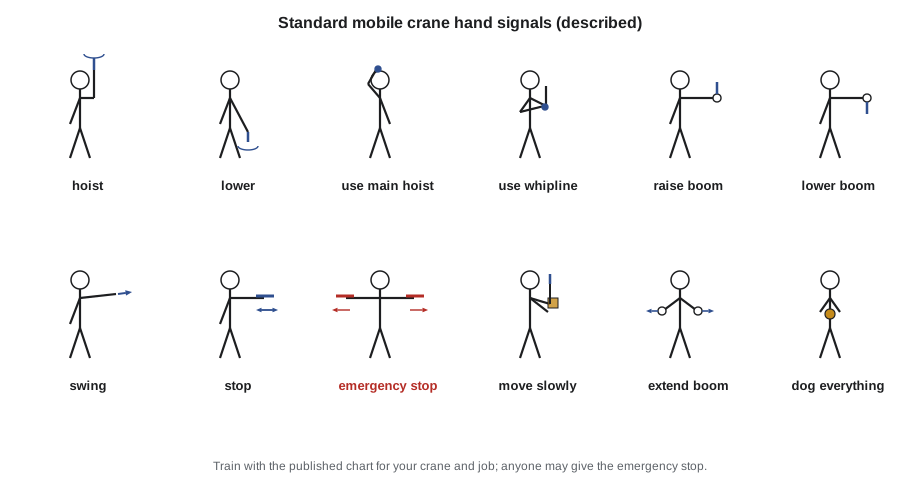
The signals below are described in words; Crossbeam trains with the published chart on the gang box door, and every signal person practises each one until it is automatic.
- Hoist (raise the load): forearm vertical, forefinger pointing up, moving the hand in a small horizontal circle.
- Lower: arm extended downward, forefinger pointing down, moving the hand in a small horizontal circle.
- Use main hoist: tap a fist on the top of the head, then give the regular signal.
- Use whipline (auxiliary hoist): tap the elbow with the other hand, then give the regular signal.
- Raise boom: arm extended, fingers closed, thumb pointing up.
- Lower boom: arm extended, fingers closed, thumb pointing down.
- Swing: arm extended, pointing with a finger in the direction the boom should swing.
- Stop: arm extended, palm down, moving the arm back and forth horizontally.
- Emergency stop: both arms extended, palms down, moving both arms back and forth horizontally.
- Move slowly: one hand held motionless in front of the hand giving the motion signal.
- Raise the boom and lower the load: arm extended, thumb up, flexing the fingers in and out as long as the movement is wanted.
- Lower the boom and raise the load: arm extended, thumb down, flexing the fingers in and out.
- Extend or retract a telescoping boom: both fists in front of the body with thumbs pointing outward to extend, or toward each other to retract.
- Dog everything (stop all motion and hold): hands clasped in front of the body.
Good hand signals are big, clear and given from a place where the operator can see them against a plain background. Gloves in a bright colour, a high-visibility vest and a position away from the sun behind the signaller all help. A signal person who must move to stay in view moves before the next signal, not during it.
Radio signalling
Many picks on a steel job are blind: the operator cannot see the signal person at all. Then signals are given by radio. Radio signalling needs as much discipline as hand signalling, and more, because the operator cannot see whether the speaker is watching the load.
- Use a dedicated channel for the crane, tested before the first lift of the day, with spare charged batteries.
- Identify the crane at the start of each instruction if more than one crane is on the job.
- Give each instruction as function, direction, speed and distance, and keep talking while the load moves: "Swing right, slow... six metres... three... one and a half... easy... stop."
- Keep up a running commentary during any blind movement, so silence means stop. If the operator hears nothing, the operator stops.
- Use plain words that cannot be confused. "Down" alone is ambiguous on a crane with a boom and a hoist; say "load down" or "boom down".
- If communication is lost or unclear, the operator stops all movement until clear communication is restored.
Ontario's regulation allows signals by a telecommunication system where the signaller cannot be in full view of the operator. Crossbeam's procedures, agreed with Summitline at the start of the job, follow CSA Z150 for radio signalling.
Worked problem
Why a running count matters
A beam is being lowered toward the connectors at about 0.6 m/s. The signal person calls "stop", and it takes about 1.5 seconds for the operator to hear, react and bring the hook to a stop. How far does the load travel after the call? What does that mean for when to call stop?
Show solution
- Distance after the call: 0.6 m/s × 1.5 s = 0.9 m.
Answer: About 0.9 m, plus a little more as the load swings. The signal person slows the load well before it arrives ("slow... easy") so that the final stop takes only a few centimetres, and calls stop before the load reaches the connectors, not when it touches them.
One voice at a time
The operator takes signals from one designated person at a time. On a steel job, the hooker-on usually signals the first hoist, then hands the load over, by a clear call or signal, to the signal person who can see the landing. Two people signalling at once, or a connector shouting while the signal person is on the radio, is how loads end up moving in two directions. Crossbeam's handover rule is spoken: "Hooker-on to Carla, your load," answered by "Carla has the load."
The exception is the emergency stop. Anyone on the job who sees danger may give the emergency stop signal, by hand or radio, and the operator must obey it at once. Shay's first week included the emergency stop as a drill; Grace had each apprentice give it to Dwayne by hand and by radio until he was satisfied.
Signals and crane motions
A signal person must understand what each signal makes the crane do, because the same load movement can be made in different ways. Lowering the boom moves the load outward and down; it also increases the radius and so reduces the capacity. Swinging the boom carries the load around in an arc, and starting or stopping the swing too quickly makes the load swing out like a pendulum. Telescoping changes both radius and height. A good signal person asks for the motion that moves the load where it needs to go with the least change in radius, and asks for it slowly near the steel.
Dwayne's advice to the apprentices was to learn the crane's motions by riding in the cab during a quiet hour, with the operator's permission. "Once you have watched a load swing from up here, you will never ask me for a fast stop again."
Signalling for connectors
At the top of the steel, the connectors need the piece to arrive level, slowly and close to its final position. The signal person watches both the load and the connectors, and the connectors communicate with the signal person by agreed hand signals or radio, never by shouting at the operator. Common connector requests are small: a few centimetres down, a few centimetres of swing, stop and hold while a pin goes in. Each is passed to the operator by the signal person in the standard form.
Connectors must never put a hand or foot where the load could pin it against the steel. The signal person's job includes watching the bite, the space between the moving load and the steel already set, and stopping the load if anyone reaches into it.
Signals at night, in rain and in noise
Conditions on a steel job often make signalling harder. In rain and fog, the operator may lose sight of the signal person; at dusk and at night, hand signals need lighted gloves or wands and the signaller's garment needs reflective stripes; on a noisy site, radio messages must be short and repeated if there is any doubt. Crossbeam's rule is that if the operator cannot clearly see or hear the signals, the lift does not continue. Dwayne put it more simply: "If I am guessing, I am stopping."
Wind is another reason signals change. In gusty conditions, a load swings and rotates, the tag line handlers have more to do, and the signal person must call smaller, slower movements and wait for the load to settle between them. The wind limit is not a target; a signal person who sees a load starting to sail calls stop and lets the lift director decide whether to continue.
Signalling from the steel
When the signal person is a connector or the foreperson at the top of the steel, they must be tied off with both hands free to signal, standing where they can see both the load and the operator, or have a radio. A connector who must let go of the steel to signal is in the wrong place. Crossbeam puts a dedicated signal person on the radio for any pick where the connectors cannot see and signal safely at the same time.
Practising signals
Signals are a skill, and skills fade without practice. Crossbeam runs a short signal drill at the start of each new job and whenever a new apprentice joins a gang: each person gives every standard signal while the operator watches and calls out what the crane would do. The drill includes the emergency stop, given without warning in the middle of a practice signal, to check that the operator and the signal person react at once.
Worked problem
A radio signal written out
Carla asked the apprentices to write the radio script for lowering a beam the last 3 m onto its seat at a steady, slow speed, with one pause while a connector moves.
Show solution
- "Crane one, load down slow... three metres... two... stop. Hold."
- Pause while the connector repositions, then: "Load down slow... one metre... half... easy... a little more... stop."
- "All stop. Hold the load." Then, when the bolts are in: "Slack off slow."
Answer: Each instruction names the motion, the speed and the distance, and ends with stop; the running count makes silence mean stop.
Shay's script had "down" without "load" the first time. Dwayne circled it and wrote "boom or load?" in the margin.
The first and last signals
The first signal of every pick comes from the hooker-on, and it is usually "take a strain" or a slow hoist to bring the slings tight, followed by a stop for the test lift. The hooker-on steps back clear of the load before giving it, so they are not beside a piece that may swing or tip as it leaves the ground. The last signal of every pick comes from the connectors' side: slack off, then hoist the empty hook clear. Between those two, one person has the load. Carla made the apprentices say the sequence aloud until it sounded natural: strain, stop, test, hoist, hand over, land, hold, slack, clear.
Common mistakes
MistakeGiving "down" when you mean load down.
InsteadSay or signal exactly which motion: load or boom.
MistakeSeveral people signalling the operator.
InsteadHand the load over clearly; one signal person at a time.
MistakeGoing silent on the radio during a blind swing.
InsteadKeep a running commentary; silence means stop.
MistakeSignalling with the sun behind you.
InsteadMove to a position where the operator can see the signal clearly.
MistakeCalling stop when the load reaches the connectors.
InsteadSlow the load early and stop it before it arrives.
MistakeSignalling while also handling the load.
InsteadThe signal person does nothing else while the load moves.
Summary and key terms
- O. Reg. 213/91 requires a competent signaller, in a blaze orange or international orange garment, when the operator's view is obstructed or a person could be endangered.
- Hand signals follow the CSA Z150 standard signals; radio signals follow agreed procedures.
- The operator takes signals from one person at a time; anyone may give the emergency stop.
- Radio signals need a dedicated channel and a running commentary; loss of communication means stop.
- A load keeps moving during the operator's reaction time, so slow it early and call stop before it arrives.
- The signal person watches the bite and stops the load if anyone reaches into it.
- Signal person
- The designated person who gives the crane operator signals.
- Blind pick
- A lift in which the operator cannot see the load or the landing area.
- Emergency stop
- The signal that anyone may give, and the operator must obey, to stop all crane movement.
- Dog everything
- The signal to stop all crane motions and hold.
- Whipline
- An auxiliary hoist line, usually from a jib or a rooster sheave, for lighter loads.
- The bite
- The space between a moving load and fixed objects where a body part can be crushed.
Practice problems
Work each problem on paper first, then reveal the answer to check.
When must Ontario's regulation have a signaller for a crane?
Show answer
When the operator's view of the load's path is obstructed or a person could be endangered.
What does a fist tapped on top of the head mean?
Show answer
Use the main hoist.
A load is moving at 0.5 m/s and reaction time is 2 seconds. How far does it travel after a stop call?
Show answer
0.5 × 2 = 1 m.
What should the operator do if radio contact is lost?
Show answer
Stop all movement until clear communication is restored.
Who may give the emergency stop?
Show answer
Anyone.
Lesson quiz · 5 questions
Score 60% or more to complete this lesson.
Create a free account to save your progress, take quizzes and earn a certificate.