
IRW-120 · Lesson 3 of 12 · 24 min
Shackles, hooks and below-the-hook devices
▶ Video coming soon A video version of this lesson is on the way.
On October 1, Carla emptied a rigging box onto a sheet of plywood: shackles of six sizes, two with bent pins, a hook with a sprung throat, a spreader bar, two beam clamps, a plate clamp and a home-made lifting eye that someone had welded from flat bar. "Half of this is fine," she said. "Find the other half." It took the apprentices twenty minutes. The hardware between the hook and the sling, and between the sling and the steel, is small and easy to overlook, and it fails in ways a sling does not. TRD-105 introduced rigging hardware; this lesson looks at it the way a steel erector must.
Shackles
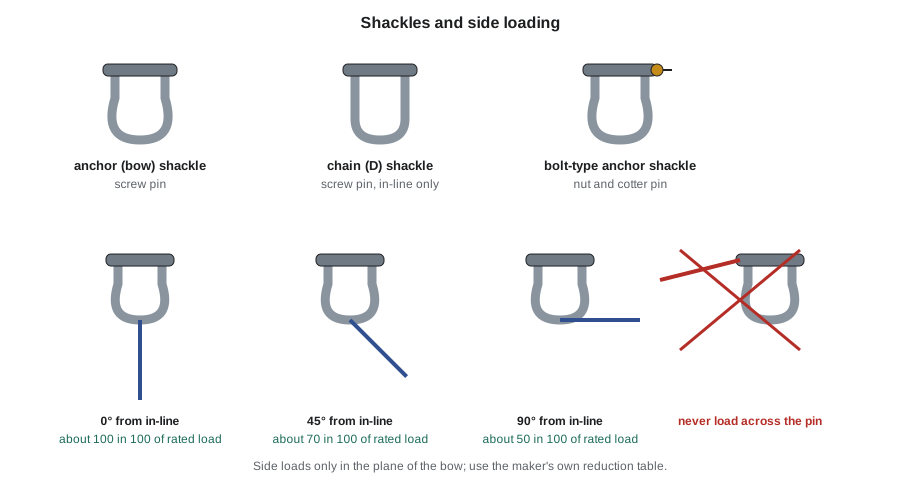
A shackle is a U-shaped body with a pin across its open end. Shackles connect slings to lifting points, slings to each other and slings to the hook. Two body shapes are common. The anchor or bow shackle has a rounded body that can take more than one sling eye and some side loading. The chain or D shackle has a narrow, straight-sided body and is meant for in-line pulls only.
Pins come in two kinds. A screw pin threads into one ear of the shackle; it is quick to use for temporary lifts, but it can back out if the load or sling rotates against it. A bolt-type or safety shackle has an unthreaded pin held by a nut and cotter pin; it cannot unscrew and is the right choice for long-term rigging, for loads that may rotate and for any lift where the pin may turn. On steel, where slings slide and loads twist, Crossbeam uses bolt-type shackles for column picks and any lift that will hang for a long time, and requires screw pins to be fully seated, backed off no more than a fraction of a turn if the pin is tight, and moused with wire when they will stay in place.
Shackle rules
- Every shackle must be marked with the maker's name or mark, its rated load and its size. An unmarked shackle is scrap.
- Never replace a shackle pin with a bolt or a pin from another shackle. The pin is matched to the body and made of heat-treated steel.
- Load a shackle in line with its centre, through the bow and the pin. A load at the side of the pin, or a sling bunched to one side, bends the body.
- Side loading in the plane of the bow reduces the rating. A typical maker's table allows about 70 in 100 of the rated load at 45 degrees and about 50 in 100 at 90 degrees. Beyond 90 degrees, and any loading across the pin, is not allowed.
- Put a pin through a lifting lug or a fixed eye, and put the moving sling eyes in the bow, so the sling cannot roll the pin loose.
- Do not let two sling legs spread more than the maker allows in one bow; a common limit is an included angle of 120 degrees.
- Use a shackle with a pin diameter that fills the hole in a lifting lug as closely as practical. A small pin in a large hole bends.
Remove a shackle from service if it is bent, twisted, cracked or stretched; if the pin is bent or will not seat; if wear has reduced the body or pin diameter by about 10 in 100 of the original; if it shows heat damage, arc strikes or weld spatter; or if its markings are gone. ASME B30.26, the standard for rigging hardware, lists these conditions.
Worked problem
Side loading a shackle
A 4¾ t shackle connects two sling legs to a lifting lug. Because of the way the load hangs, the legs pull at 45 degrees from the shackle's in-line direction, each with a tension of 2.8 t. Is the shackle adequate? What if the angle were 90 degrees?
Show solution
- Rating at 45 degrees: 4.75 × 0.70 = 3.33 t.
- Leg tension 2.8 t is less than 3.33 t: adequate.
- Rating at 90 degrees: 4.75 × 0.50 = 2.38 t, which is less than 2.8 t: not adequate.
Answer: Adequate at 45 degrees but not at 90. Use the maker's own side-load table; the values here are typical.
Hooks
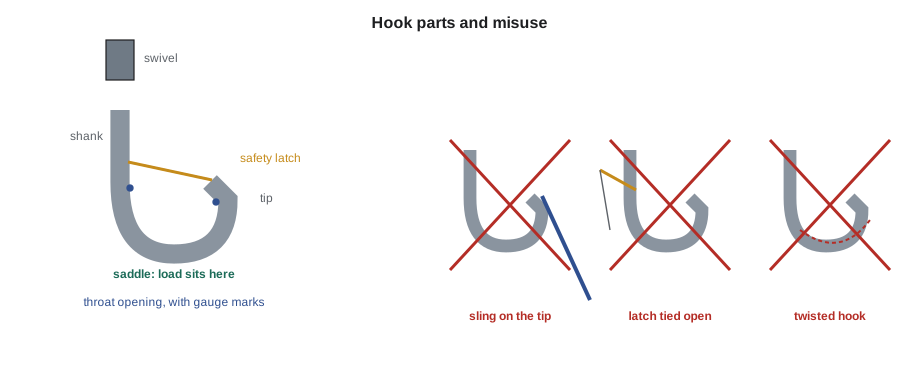
The crane's hook and the hooks on slings and hoists are forged and rated like any other rigging. A hook carries load in its saddle, the curved bottom. Loading the tip, the point of the hook, reduces its strength greatly and can open it, so slings must sit in the saddle, never on the point or the throat.
O. Reg. 213/91 requires every hoisting hook to have a safety catch, a spring latch that closes across the throat so a slack sling cannot jump out. A hook used to place structural members may be used without a catch only if the method of placing protects workers to an equal degree. The hook's rated load must be cast or stamped on it where it can be seen. A hook that is cracked, has a throat opening larger than as made, or is twisted from its original plane must not be used.
The safety latch keeps a slack sling in the hook; it does not carry load. A bent latch that does not close against the tip, a broken spring or a latch tied open must be repaired before use. ASME B30.10 lists the conditions that take a hook out of service; in summary:
- Cracks, nicks or gouges, especially across the hook body.
- An increase in throat opening beyond the maker's limit, which the standard sets at a small allowance, 5 in 100 of the original opening and no more than a few millimetres on most hooks. Many hooks carry two gauge marks so the opening can be measured.
- Twisting of the hook body more than 10 degrees from its plane.
- Wear of the saddle or the load-bearing point by more than about 10 in 100 of its original size.
- Heat damage, welding or any repair the maker did not approve.
Lifting points on steel
Steel pieces are rigged in three main ways: with slings around the piece, with hardware attached to holes or lugs that the fabricator provided, and with clamps. The erection drawings and the fabricator's shop drawings show which lifting points are intended. Using an unplanned point, such as a bolt hole that was never meant to carry the piece's weight, is a guess.
- Columns are usually picked from a lifting hole in the cap plate or the web near the top, or from a lifting lug welded by the fabricator, so the column hangs plumb and can be stood up and set on its anchor rods.
- Beams are usually picked with a choker or a two-leg bridle around the piece, placed so the beam hangs level (lessons 5 and 6).
- Heavy girders, trusses and pieces with unusual shapes have engineered lifting points or lugs shown on the drawings, with the shackle size to use.
Lifting lugs and plates must be designed for the direction they are pulled in. A lug designed for a vertical pull can bend or tear when pulled sideways by a sling leg at a low angle. If the drawing shows a vertical pull, rig so the pull is vertical, with a spreader if needed.
Clamps
Clamps grip steel without a sling. They save time, but each type must be used only for what it is made for.
- Beam clamps attach to the flange of a beam to make a temporary anchor for a hoist or a fall protection lanyard. A lifting clamp for a beam must be rated for lifting; a fall protection beam anchor is not a lifting device.
- Plate clamps grip a plate by its edge with a cam and serrated jaws. Vertical plate clamps lift plates hanging vertically; horizontal clamps, used in pairs, lift plates lying flat. A vertical clamp used to lift a plate horizontally, or a clamp on a plate thicker or thinner than its range, can let go.
- Clamps must be locked in the closed position before the lift and must not be released under load. They are not used on painted, oily or very hard surfaces unless the maker allows it.
Spreader bars and lifting beams
Long pieces such as long beams, trusses and wall panels are often lifted with a below-the-hook device that holds the slings apart. Two kinds look alike but work differently.
- A spreader bar is a strut hung from a two-leg bridle, with vertical drops from each end to the load. The bar is in compression, and the drops are vertical so the load is not squeezed.
- A lifting beam hangs from a single point at its centre and carries the load in bending, with drops or hooks along its length. It needs less headroom, because there is no bridle above it.
Below-the-hook devices are designed and marked like any rigging. ASME B30.20 covers their marking, inspection and use, and ASME BTH-1 covers their design. Each device must show its rated load and its own weight, and the weight of the device counts as part of the load on the crane. A home-made spreader made of a length of pipe, or the welded lifting eye Carla found in the rigging box, has no rating and no design. It is scrap until an engineer says otherwise.
Worked problem
What the crane really lifts
A long beam weighs 2,140 kg. It is lifted with a spreader bar that weighs 410 kg, two bridle legs and two drops with four shackles weighing 95 kg in all. The crane's hook block weighs 680 kg. What weight must the rigger tell the operator, and what must the operator check against the chart?
Show solution
- Weight below the hook: 2,140 + 410 + 95 = 2,645 kg.
- With the hook block: 2,645 + 680 = 3,325 kg.
Answer: The rigger reports 2,645 kg below the hook. The operator checks about 3,325 kg against the chart, because the block and everything under it count as load (lesson 9). The spreader and rigging add almost a quarter to the beam's own weight.
Eyebolts, swivels and other hardware
Eyebolts appear on equipment and some precast pieces. A plain eyebolt is rated only for a straight pull along its axis; an angled pull reduces its capacity sharply and can snap it. Shoulder eyebolts allow some angle, with ratings that drop as the angle increases, and must be seated with the shoulder flat against the surface. Swivel hoist rings rotate and pivot and keep their rating at any angle the maker shows. Turnbuckles, come-alongs and lever hoists used to plumb steel are tools for adjusting, not for lifting, unless they are rated and marked for it.
Every piece of hardware gets the same frequent inspection as a sling: before each use, by the person who will use it. A two-second look at a shackle pin is the cheapest safety device on the job.
Choosing a spreader or a lifting beam
Spreaders and lifting beams are chosen for the job. Their length must suit the pick points, so the drops hang vertically; their rated load must cover everything hung below them; and the bridle angle above a spreader must be the angle the spreader's rating assumes. A spreader rated for a 60 degree bridle may have a much lower rating with a flatter bridle, because the compression in it rises as the angle falls (lesson 5). A lifting beam is the better choice where headroom is tight, such as setting a long piece under steel already in place, because it needs no bridle; a spreader is the better choice where weight matters, because it is lighter for the same load.
Adjustable spreaders with several pick-point positions are common in steel erection, so one device can serve beams of different lengths. Each position has its own rating, marked on the device. Using the wrong hole, or moving the drops while the device is loaded, changes the forces in it.
Inspecting hardware
Carla's hardware check is quick and always the same. For a shackle: markings legible, body straight, pin straight and fully seated, threads clean, no cracks, nicks, wear or heat marks. For a hook: latch closing against the tip, throat opening within the gauge marks, no twist, no cracks or gouges, swivel turning freely. For a clamp: rating legible, jaws clean and sharp, lock working, spring returning. For a spreader or lifting beam: rating and weight marked, no bends, dents, cracks or missing pins. Anything that fails goes into a red-tagged bin in the conex, not back into the rigging box.
Hardware is also checked periodically, at least once a year and more often in hard service, by a qualified person, with a record kept. On Ashcroft, Carla's quarterly sling inspection covered the hardware too, and she kept the list of every item with its rating and the date it was last checked in the gang box.
Common mistakes
MistakeReplacing a lost shackle pin with a bolt.
InsteadUse only the pin made for that shackle.
MistakeSide loading a chain shackle.
InsteadUse an anchor shackle for side loads and apply the maker's reduction.
MistakeLetting a sling ride on the tip of the hook.
InsteadSeat slings in the saddle.
MistakeTying the hook latch open to save time.
InsteadKeep the latch working unless a qualified rigger or the erection plan allows otherwise.
MistakeUsing a fall protection beam anchor to lift.
InsteadUse clamps rated and marked for lifting.
MistakeForgetting the weight of the spreader and rigging.
InsteadCount everything below the hook, and the hook block, as load.
Summary and key terms
- Shackles must be marked; use anchor shackles for multiple legs and side loads, and bolt-type shackles where pins could turn.
- Side loading in the plane of the bow reduces a shackle's rating; never load across the pin.
- Hooks carry load in the saddle; safety latches keep slack slings in place but do not carry load.
- Remove hooks for cracks, a throat opening beyond the limit, twist over 10 degrees or excessive wear.
- Use the lifting points the drawings show, and pull lugs in the direction they were designed for.
- Spreader bars work in compression, lifting beams in bending; both must be rated and their weight counts as load.
- Anchor shackle
- A shackle with a rounded bow that can take several sling eyes and some side load.
- Bolt-type shackle
- A shackle whose pin is held by a nut and cotter pin and cannot unscrew.
- Mousing
- Wiring a screw pin or hook so it cannot back out or open.
- Saddle
- The curved bottom of a hook where the load is meant to sit.
- Safety latch
- A spring catch across the throat of a hook that keeps slack slings in place.
- Spreader bar
- A below-the-hook strut that holds sling legs apart and works in compression.
- Lifting beam
- A below-the-hook beam that carries a load in bending from a single point.
Practice problems
Work each problem on paper first, then reveal the answer to check.
Which shackle should be used where the pin could be rotated by the sling?
Show answer
A bolt-type (safety) shackle.
A 6½ t shackle is side loaded at 45 degrees. Using the typical reduction, what is its rating?
Show answer
6.5 × 0.70 ≈ 4.55 t.
What does a hook's safety latch do?
Show answer
It keeps a slack sling from jumping out of the hook; it does not carry load.
A spreader weighs 300 kg and rigging 60 kg. The load is 1,800 kg. What is the weight below the hook?
Show answer
1,800 + 300 + 60 = 2,160 kg.
When may a hook without a safety catch be used in Ontario?
Show answer
To place structural members, if the method protects workers equally.
Lesson quiz · 5 questions
Score 60% or more to complete this lesson.
Create a free account to save your progress, take quizzes and earn a certificate.