
IRW-120 · Lesson 10 of 12 · 23 min
Critical and tandem lifts
▶ Video coming soon A video version of this lesson is on the way.
Later on November 5, Carla put away the Ashcroft drawings and brought out a folder from 2023, when Crossbeam had replaced a pedestrian bridge girder over a rail line using two cranes at once. "Most of the picks you will make are routine," she said. "A few are not. The skill is knowing which is which before you start, because the ones that go wrong are the ones nobody called critical." Some lifts carry more risk than others because of their size, their place, the number of cranes or what is underneath them. These are planned and controlled more strictly, with written plans, engineering review and a lift director in charge.
What makes a lift critical
O. Reg. 213/91 does not use the term critical lift. Ontario contractors, crane owners and owners of large projects define critical lifts in their own procedures, and many use thresholds like Crossbeam's. The regulation does set rules that apply to many such lifts: no lift above rated capacity, engineered foundations or supports where a crane sits on a structure, safety factors of ten for rigging that supports people, signallers near power lines, and written reports to the Ministry if a crane or its load gets out of control.
Crossbeam's procedure, which is typical of steel erectors, treats a lift as critical when any of these is true:
- The load, with its block and rigging, is more than 75 in 100 of the crane's chart capacity at any point in the lift.
- More than one crane or hoisting device carries the load.
- The load passes over an occupied building, a road, a rail line or the public, or over workers who cannot be cleared.
- Any part of the crane, load line or load could come within the minimum distance of a power line.
- The crane hoists people in a personnel platform.
- The load is a long-span truss, a piece more than 15 m long that is unstable when lifted, or any piece with engineered pick points.
- The weight or centre of gravity cannot be found with confidence.
- The crane sits on a structure, a barge or ground the geotechnical report flags.
A critical lift needs a written lift plan (lesson 9) prepared and checked by competent people, reviewed by an engineer where the plan or the regulation requires, approved by the lift director and the operator, and explained to everyone involved at a pre-lift meeting. It is made only when every condition in the plan is met, and it stops when any condition changes.
The lift director
A critical lift has one person in charge. The lift director, often the erection foreperson, the rigging supervisor or a crane company's lift planner, makes sure the plan is followed, holds the pre-lift meeting, confirms that the rigging, crane and site match the plan, decides when to start, and stops the lift if anything is not as planned. The operator still controls the crane and may still refuse to lift. The signal person still gives the signals. The lift director does not run the crane or signal it; the lift director decides whether the lift happens at all.
The pre-lift meeting
Before a critical lift, the lift director gathers everyone involved, including the operator, the rigger, the signal person, the tag line handlers, the connectors and anyone controlling access to the area, and goes through the plan.
- The load, its weight and how it is rigged.
- The crane setup, the radii and the fraction of chart used at the worst point.
- The path of the load, the exclusion zone and who controls it.
- Each person's job and position, and the signals or radio channel.
- The limits: wind, weather, light and anything that would stop the lift.
- What to do if something goes wrong: stop signal, who decides, and how to land the load safely.
Everyone may ask questions and raise concerns. A person who does not understand their job in the lift does not take part until they do. At the end, the lift director asks the operator and the rigger whether they are satisfied. Their yes, out loud, is part of the plan.
Power lines
Contact between a crane and an overhead power line, or an arc that jumps from the line to the boom, load line or load, kills people on the ground: the rigger holding the tag line, the hooker-on touching the load, anyone touching the crane. The safest power line is one that has been de-energized and grounded by the utility. When that cannot be done, the crane and everything it carries must stay outside a minimum distance.
O. Reg. 213/91 sets minimum distances from energized overhead conductors for any part of a crane or similar equipment, or its load: 3 m for lines of 750 volts to 150,000 volts, 4.5 m for 150,001 to 250,000 volts, and 6 m for more than 250,000 volts. Where the equipment or load could approach the minimum distance, a competent signaller must be in full view of the operator, have a clear view of the conductor and warn the operator whenever the distance may be approached. The voltage is confirmed with the utility, never guessed.
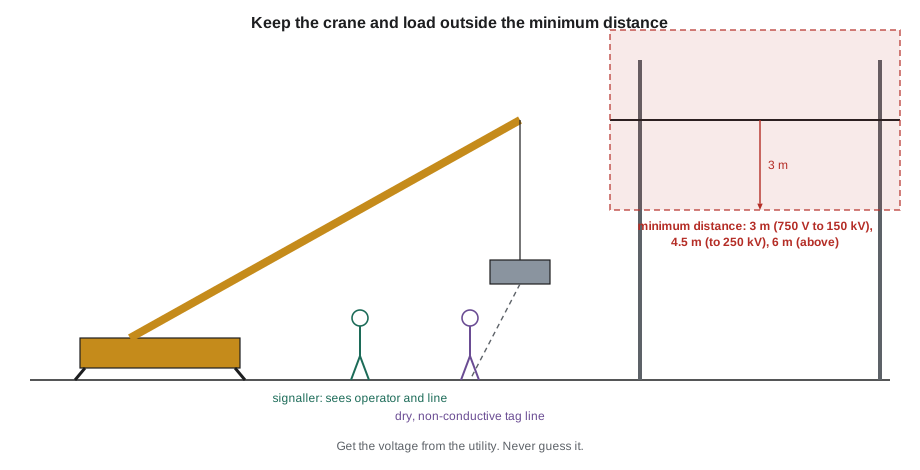
Ironworkers add three habits near power lines. Use dry, non-conductive tag lines. Never touch the crane, load or load line if contact may have happened, and keep everyone back. And if the crane does contact a line, the operator stays in the cab unless there is a fire, and anyone who must leave jumps clear with feet together and shuffles away, never touching the crane and the ground at the same time.
Tandem lifts
A tandem lift uses two cranes to lift one load, usually because the load is too long or too heavy for one crane, or must be turned over or set in a place one crane cannot reach. Tandem lifts are among the most hazardous lifts in construction, because each crane's load can change during the lift in ways that are hard to see.
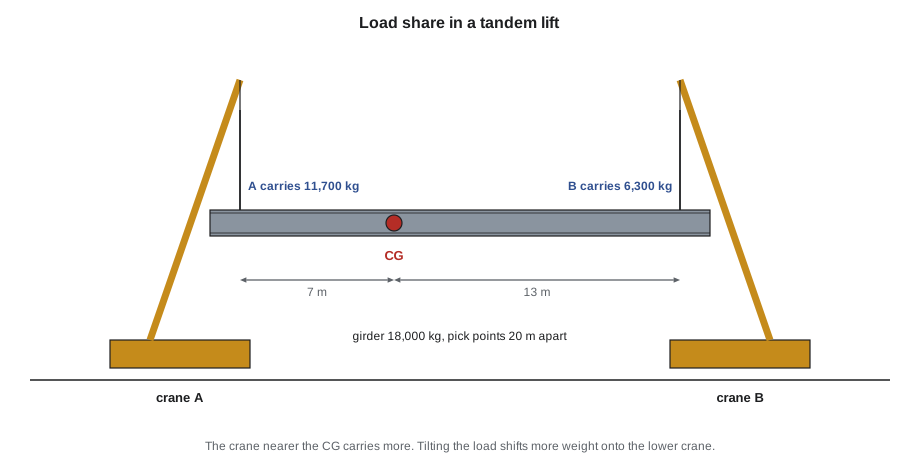
The weight carried by each crane depends on where the load's centre of gravity is between the two pick points, worked out by moments exactly as in lesson 4. If the load tilts, if one crane hoists faster than the other, if one boom deflects more, or if the hoist lines lean out of plumb because one crane booms down or swings, the load shifts between the cranes. A crane planned at 70 in 100 of its chart can suddenly be carrying far more.
For that reason, tandem lift plans commonly limit each crane to a lower fraction of its chart, often 75 in 100 or less, as set by the engineer or the lift planner; keep the hoist lines plumb throughout; move one crane at a time, slowly; use a single lift director and signal person; and avoid swinging or travelling with the load unless the plan allows it and the cranes are matched.
O. Reg. 213/91's rules on capacity and engineering apply to each crane in a tandem lift; Crossbeam's procedure requires a written plan reviewed by a professional engineer for every tandem lift.
Worked problem
Load share in a tandem lift
The 2023 bridge girder weighed 18,000 kg. Its pick points were 20 m apart, and its CG was 7 m from pick point A and 13 m from pick point B. Crane A's block and rigging weighed 900 kg; crane B's weighed 700 kg. Crane A's chart allowed 17,500 kg at its radius and crane B's allowed 11,000 kg. What fraction of chart did each crane use, against a plan limit of 75 in 100?
Show solution
- Crane A share: 18,000 × 13 ÷ 20 = 11,700 kg.
- Crane B share: 18,000 × 7 ÷ 20 = 6,300 kg.
- Crane A total: 11,700 + 900 = 12,600 kg; 12,600 ÷ 17,500 = 0.72, about 72 in 100.
- Crane B total: 6,300 + 700 = 7,000 kg; 7,000 ÷ 11,000 ≈ 0.64, about 64 in 100.
Answer: Both cranes were within the plan limit, crane A only just. The crane nearer the CG carries more. The engineer's plan required the girder to stay level within a small tolerance, because tilting it would move more of the weight onto crane A.
Hoisting people
Cranes are made to lift materials, not people. Riding the hook, the headache ball or a load is never allowed. Hoisting workers in a personnel platform suspended from a crane is allowed only when no safer way to reach the work is practical, and then only under strict rules: an engineered platform, a crane rated and set up for it, trial lifts, anti-two-block protection, fall protection for the riders, inspections and communication.
O. Reg. 213/91 requires cables and slings used to support people to have a safety factor of at least ten, double the factor for materials, and sets further conditions for personnel lifting. Crossbeam's procedure treats every personnel lift as a critical lift and uses aerial work platforms wherever they can reach.
When a critical lift stops
A plan is a list of conditions. If the wind rises above the limit, a cloud of fog hides the landing, the load is heavier than shown, a sling angle is flatter than drawn, someone enters the exclusion zone or the radios fail, the lift stops. If the load is in the air, it is landed safely in the planned emergency landing area or held where it is, low and clear of people, until the problem is fixed. The lift resumes only when the lift director confirms that the plan's conditions are met again, or the plan is changed and reviewed.
On the 2023 girder lift, the lift was held for forty minutes with the girder a metre off its trailer while a freight train passed under the work zone, because the rail company's protection window had not yet opened. Nobody minded the wait. Carla's view was that a critical lift is a lift where waiting is always an option.
Exclusion zones and the public
Every lift has an area under and around the load path that must be clear of people. For routine picks, the raising gang controls it by keeping everyone out from under the load. For critical lifts, the zone is drawn on the lift plan, marked with barriers, tape or fencing, and guarded by people with the authority to stop anyone entering it. Where the load passes near a street, a sidewalk or an occupied building, the zone may need a road closure, a sidewalk closure or a permit from the city, and the lift may have to be made outside business hours.
On the 2023 girder lift, the exclusion zone included the rail corridor, and the rail company's own flag protection controlled it. On the truss lift at Ashcroft (lesson 12), the zone was the lobby bay and the swing path, closed to all trades and held by Tallcorn's crew. In both cases, the lift director confirmed the zone was clear by radio before the load left the ground.
Engineered lifts and who checks them
An engineer's review is needed whenever the lift plan or the regulation calls for it: when a crane sits on a structure or on engineered supports, for most tandem lifts under Crossbeam's procedure, for unusual rigging such as custom lifting beams, and for pieces whose lifting points must be designed. In Ontario, that engineer is a licensed professional engineer (P.Eng.), and the review is part of the written plan kept on site.
A plan that an engineer has reviewed is not a plan that no one else needs to check. The lift director still confirms that the weights, the rigging and the crane on site match what the engineer reviewed. A sling of a different length, a different crane or a heavier piece makes the review out of date.
Worked problem
Checking a critical lift threshold
A 3,900 kg precast stair unit with 150 kg of rigging is set at 22 m with the 30 m boom (SAMPLE chart, 8,100 kg, hook block 680 kg). Is it a critical lift by the 75 in 100 rule?
Show solution
- Load: 3,900 + 150 + 680 = 4,730 kg.
- Fraction: 4,730 ÷ 8,100 ≈ 0.58, about 58 in 100.
Answer: Not critical by capacity. It may still be critical for another reason, for example if it passes over the public or the stair unit has engineered lifting inserts.
Common mistakes
MistakeTreating a heavy lift as routine because the crane can do it.
InsteadUse the critical lift criteria; capacity is only one of them.
MistakePlanning a tandem lift as if each crane's share were fixed.
InsteadPlan for load shifting; keep the load level and the lines plumb, and limit each crane's fraction of chart.
MistakeGuessing a power line's voltage.
InsteadGet the voltage from the utility and keep the required distance.
MistakeHolding a steel tag line near a power line.
InsteadUse dry, non-conductive tag lines.
MistakeLetting the lift director also signal the crane.
InsteadThe lift director decides; the signal person signals.
MistakeContinuing a critical lift when a condition changes.
InsteadStop, land or hold the load safely, and reconfirm the plan.
Summary and key terms
- Critical lifts include lifts near capacity, with more than one crane, over people or public areas, near power lines, of personnel, of unstable long pieces, or with uncertain weights.
- A critical lift needs a written plan, a lift director, a pre-lift meeting and engineering review where required.
- Ontario's minimum distances from power lines are 3 m, 4.5 m and 6 m depending on voltage, with a signaller where the distance could be approached.
- In a tandem lift, the crane nearer the centre of gravity carries more, and tilting or out-of-plumb lines shift the load further.
- People are never hoisted on hooks or loads; personnel platforms are used only under strict rules.
- A critical lift stops whenever a planned condition is not met.
- Critical lift
- A lift with higher risk that needs a written plan and stricter controls.
- Lift director
- The person in charge of a critical lift who decides whether it proceeds.
- Pre-lift meeting
- A briefing of everyone involved in a lift on the plan and their roles.
- Tandem lift
- A lift in which two cranes carry one load.
- Minimum approach distance
- The closest any part of a crane or its load may come to an energized power line.
- Personnel platform
- An engineered basket or platform for hoisting workers with a crane.
Practice problems
Work each problem on paper first, then reveal the answer to check.
Name four conditions that make a lift critical under Crossbeam's procedure.
Show answer
Any four of: over 75 in 100 of chart, more than one crane, over occupied areas or the public, near power lines, personnel, long unstable pieces, uncertain weight or CG, crane on a structure or poor ground.
What is Ontario's minimum distance from a 13,800 volt line?
Show answer
3 m.
A 12,000 kg load is carried by two cranes with pick points 10 m apart and the CG 4 m from crane A. What does crane A carry?
Show answer
12,000 × 6 ÷ 10 = 7,200 kg.
Why is a tandem-lifted load kept level?
Show answer
Tilting shifts more of the weight onto the lower crane.
What safety factor does Ontario require for slings supporting people?
Show answer
At least ten.
Lesson quiz · 5 questions
Score 60% or more to complete this lesson.
Create a free account to save your progress, take quizzes and earn a certificate.