
IRW-120 · Lesson 2 of 12 · 25 min
Wire rope, slings and their ratings
▶ Video coming soon A video version of this lesson is on the way.
Carla's second rigging night, on Thursday, September 24, began with a cut-off length of wire rope passed around the group. "Unlay it," she said, and Shay pulled the strands apart: six strands around a core, each strand made of dozens of wires. "Everything you hang from a hook depends on how this is built and how it is treated. When you know what a rope is, you know why we throw slings away for a few broken wires." TRD-105 introduced sling types and ratings; this lesson goes deeper into wire rope, because ironworkers use more wire rope slings than any other kind.
How wire rope is built
Wire rope has three parts. Wires are the basic elements, drawn from high-carbon steel. Strands are groups of wires laid in a helix around a centre wire. The core is the centre the strands are laid around. The way these are combined gives the rope its strength, flexibility and resistance to crushing and abrasion.
- The core may be fibre (FC), natural or synthetic, or an independent wire rope core (IWRC), a small wire rope of its own. Slings used in steel erection are almost always IWRC, because it is stronger and resists crushing when the rope is bent around a load or choked tight.
- The classification, written as strands × wires per strand, describes the construction. A 6 × 19 class rope has six strands of about 15 to 26 wires each; a 6 × 36 class rope has six strands of about 27 to 49 wires. More, smaller wires make a rope more flexible and better at bending around small diameters; fewer, larger wires resist abrasion and crushing better.
- The lay describes how the wires and strands are twisted. In regular lay, the wires are twisted one way and the strands the other, so the wires run roughly along the rope; it resists crushing and untwisting and is the usual choice for slings. In lang lay, wires and strands twist the same way; it wears well but must be held at both ends to stop it untwisting. Right lay or left lay describes the direction the strands spiral.
- The grade describes the strength of the steel. Most slings are made from extra improved plow steel (EIPS) rope. The rope's minimum breaking strength, or minimum breaking force, is published by the maker for each size and grade.
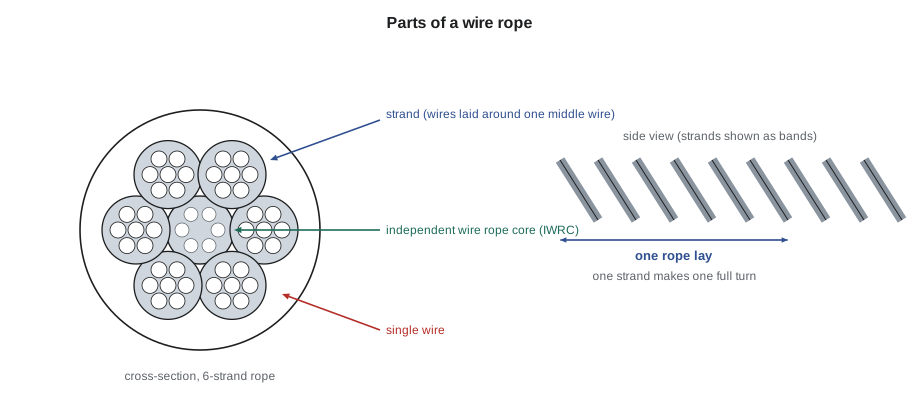
One more word matters for inspection: a rope lay is the length of rope in which one strand makes one complete turn around the rope. It is about six to seven times the rope diameter on a six-strand rope. Removal criteria count broken wires in one rope lay, so riggers learn to see it.
Rated capacity and the design factor
A sling's rated capacity, also called its working load limit (WLL), is the most it is allowed to lift in a given hitch. It is set far below the breaking strength by a design factor. For wire rope slings the design factor is 5: the sling's rated capacity is no more than one fifth of its nominal breaking strength, allowing for the efficiency of the end fittings.
O. Reg. 213/91 requires slings and similar devices to have a safety factor of at least five times the maximum load likely to be applied, and ten times if a sling is used to support a person. Slings are made and rated to CSA and ASME standards; ASME B30.9 is the North American standard for slings, and its rated capacity tables are used by sling makers in Canada.
The design factor is not spare capacity for the rigger to use. It covers things that cannot be measured on site: shock loads when a load is snatched, wear and small damage, bending around the load, and the difference between the calculated and the real weight. A sling loaded to twice its rated capacity may not break today, but it has been damaged in ways no one can see.
Worked problem
Working out a rated capacity
A sling maker uses a 16 mm EIPS IWRC rope with a minimum breaking force of 18.7 t (a SAMPLE value for this example), and its mechanical splice eye is rated at 95 in 100 of the rope strength. With a design factor of 5, what is the vertical rated capacity of a single-leg sling?
Show solution
- Strength of the sling at the splice: 18.7 × 0.95 = 17.77 t.
- Rated capacity: 17.77 ÷ 5 = 3.55 t.
Answer: About 3,550 kg in a vertical hitch. The tag on the sling gives the maker's figure for each hitch; use the tag, not your own calculation.
The sling tag
Every sling must carry a legible tag from the maker giving at least the maker's name or mark, the rated capacity for the hitches it may be used in, the diameter or size, and the number of legs if more than one. ASME B30.9 requires slings with a missing or unreadable tag to be removed from service until they are re-tagged by the maker or a qualified person. A rigger who cannot read a tag does not use the sling; a guess about capacity is not an inspection.
Sling types an ironworker uses
Ironworkers use several kinds of sling, each with strengths and limits.
- Single-part wire rope slings with eyes at each end are the everyday sling for beams and columns. They resist cutting better than synthetic slings, though not completely, and they tolerate heat better.
- Multi-part (braided) wire rope slings are woven from several ropes. They are more flexible and grip a load better in a choker or basket, so they are used for bundles and awkward loads.
- Alloy chain slings, Grade 80 or Grade 100 and marked as such, resist heat, abrasion and cuts and last for years in rough service. Only alloy chain made for overhead lifting may be used; transport chain and proof coil chain may not.
- Synthetic web slings and round slings are light, flexible and kind to finished surfaces such as painted or galvanized steel and architectural pieces. They are easily cut on sharp edges and damaged by heat and some chemicals, so they need edge protection on steel.
O. Reg. 213/91 adds that a web-type or nylon sling must carry a legible label with its load rating, and must not be used where it may be cut. On steel, that means softeners, corner protectors or wear pads at every edge.
End terminations
The eye or end fitting is usually the weakest part of a wire rope sling. Common terminations are the mechanical splice, where the rope is turned back into a Flemish eye and a steel sleeve is pressed over it; the hand splice, where the strands are tucked back into the rope; wedge sockets, used on crane load lines and some rigging; and swaged or poured sockets for heavy fittings.
Wire rope clips are used to make temporary eyes and to secure the dead end of a wedge socket. They are never used to make up a sling for overhead lifting. When clips are used, the U-bolt goes on the short, dead end and the saddle on the long, live end, which riggers remember as "never saddle a dead horse." The number of clips, the turnback length and the nut torque come from the clip maker's table; a typical table for 16 mm rope calls for three clips, a turnback of about 300 mm and a torque of about 130 N·m, retightened after the first load.
Bending and the D/d ratio
When wire rope is bent around a small object, the outer wires stretch and the inner ones crush, and the rope loses strength. The ratio of the diameter of the object (D) to the diameter of the rope (d) is called the D/d ratio. The smaller the ratio, the weaker the sling at that bend. A typical efficiency table gives about 50 in 100 of the rope's strength at a D/d of 1, about 65 in 100 at 2, about 75 in 100 at 4, about 86 in 100 at 10 and about 91 in 100 at 20. Sling makers' rated capacities for basket hitches assume a minimum D/d, often 25 for wire rope; when the rope bends around something smaller, the capacity must be reduced.
Worked problem
A sling bent around a small pin
A 16 mm wire rope sling is used in a basket hitch around a 32 mm lifting pin. The sling's tagged basket capacity, which assumes a large bend, is 7.1 t. Using the typical efficiency table, about what capacity should the rigger use?
Show solution
- D/d = 32 ÷ 16 = 2.
- Efficiency at D/d of 2: about 65 in 100.
- Reduced capacity: 7.1 × 0.65 ≈ 4.6 t.
Answer: About 4.6 t, much less than the tag says. Carla's fix was a larger shackle or a pin with a bigger diameter, not a guess.
The same rule explains why a wire rope sling should not be bent sharply over the edge of a beam flange. An edge is a bend with almost no diameter at all. Softeners, rounded corner protectors or split pipe spread the bend and protect both the sling and the steel.
Inspecting wire rope slings
Slings are inspected in three ways. An initial inspection is made when a sling is new or repaired, to check that it matches its order and tag. A frequent inspection is made by the rigger before each use or each shift: a visual and hands-on check of the whole sling. A periodic inspection is a thorough, documented inspection by a qualified person at least every 12 months, more often in severe service, such as steel erection with daily choking on sharp edges.
O. Reg. 213/91 requires cables on cranes to be inspected weekly by a competent worker, with records kept, and requires damaged rigging to be taken out of service. Crossbeam follows ASME B30.9 for slings: each rigger checks every sling before use, and Carla does a documented periodic inspection of the whole sling inventory every three months on erection work.
ASME B30.9 lists the conditions that take a wire rope sling out of service. For single-part slings and strand-laid grommets, they include:
- Broken wires: 10 randomly distributed broken wires in one rope lay, or 5 broken wires in one strand in one rope lay.
- Kinking, crushing, birdcaging or any other damage that distorts the rope structure.
- Evidence of heat damage, such as discoloured wires or arc strikes from welding.
- Severe corrosion, with pitting or wires bound together.
- Cracked, bent, worn or broken end fittings, or a splice that has pulled or slipped.
- A missing or unreadable tag.
- Any other condition, including visible damage, that causes doubt about the sling's continued use.
Broken wires show first at the outer surface, but the dangerous damage is often where the sling bears on the load: at the choke point, at the eye and where it has been bent over flanges. Run a gloved hand slowly along the sling, flex it to open the strands, and look closely at the eyes and fittings. Never slide a bare hand along a rope; broken wires are sharp.
Worked problem
Counting broken wires
During his check on Monday, October 5, Shay found a group of broken wires near the eye of a 16 mm single-part sling. In one rope lay of about 105 mm, there were 6 broken wires, and 5 of them were in the same strand. Does the sling stay in service?
Show solution
- Total broken wires in one lay: 6, which is fewer than the limit of 10.
- Broken wires in one strand in one lay: 5, which meets the limit of 5.
- Either condition is enough to remove the sling.
Answer: The sling is removed from service. Shay tagged it out and cut the eye so no one could reuse it, and Carla noted it in the sling log.
A sling that is removed from service is tagged, destroyed or made unusable, and recorded. Slings are not repaired on site. A damaged sling left in the rigging box will be used by someone in a hurry.
Care and storage
Slings last longer and stay safer when they are cared for. Keep them off the ground and out of mud, water and chemicals, hang them on a rack in the gang box or the conex, and keep them away from welding and cutting. Never drag slings over the ground or out from under a landed load; land loads on blocking so slings can be pulled free. Do not shorten a sling by tying a knot in it or wrapping it around the hook, and do not use a sling to drag or roll a load unless it is made for that.
Common mistakes
MistakeUsing a sling whose tag is missing or unreadable.
InsteadRemove it from service until it is re-tagged by the maker or a qualified person.
MistakeTreating the design factor as extra capacity.
InsteadLoad slings only to their rated capacity for the hitch and angle.
MistakeMaking a sling with wire rope clips.
InsteadClips are not used for overhead lifting slings.
MistakeFitting clips with the saddle on the dead end.
InsteadSaddle on the live end, U-bolt on the dead end.
MistakeBending a wire rope sling over a bare flange edge.
InsteadUse softeners or corner protectors to spread the bend.
MistakeCounting all broken wires but ignoring how many are in one strand.
InsteadCheck both limits: 10 in one lay, or 5 in one strand in one lay.
Summary and key terms
- Wire rope is made of wires laid into strands around a core; slings usually use 6 × 19 or 6 × 36 class EIPS rope with an IWRC.
- A rope lay is the length in which one strand makes a full turn; inspection counts broken wires per lay.
- Wire rope slings have a design factor of 5; rated capacity is set far below the breaking strength.
- Every sling needs a legible tag; slings without one are removed from service.
- Bending around a small diameter (a low D/d ratio) reduces strength; protect slings at edges.
- Remove a single-part wire rope sling for 10 broken wires in one lay, 5 in one strand in one lay, kinks, crushing, birdcaging, heat damage, severe corrosion or damaged fittings.
- IWRC
- Independent wire rope core: a small wire rope at the centre of a larger rope.
- Rope lay
- The length of rope in which one strand makes one complete turn.
- Design factor
- The ratio of a sling's breaking strength to its rated capacity; 5 for wire rope slings.
- Rated capacity
- The most a sling may lift in a given hitch, also called the working load limit (WLL).
- D/d ratio
- The diameter of the object a rope bends around divided by the rope diameter.
- Birdcaging
- Damage in which the strands open out like a cage, usually from shock or twisting.
- Flemish eye
- An eye formed by splitting the rope and laying the strands back, often secured with a pressed sleeve.
Practice problems
Work each problem on paper first, then reveal the answer to check.
What does IWRC mean, and why is it used in slings?
Show answer
Independent wire rope core; it is stronger and resists crushing.
A rope has a minimum breaking force of 25 t and a splice efficiency of 95 in 100. What is its rated capacity with a design factor of 5?
Show answer
25 × 0.95 ÷ 5 = 4.75 t.
What is the D/d ratio of a 20 mm sling around an 80 mm pin?
Show answer
80 ÷ 20 = 4.
A sling has 9 broken wires in one lay, no more than 3 in any one strand. Is it removed?
Show answer
Not for broken wires alone (under both limits), but it is watched closely and checked for other damage.
Where does the saddle of a wire rope clip go?
Show answer
On the live end.
Lesson quiz · 5 questions
Score 60% or more to complete this lesson.
Create a free account to save your progress, take quizzes and earn a certificate.