
IRW-120 · Lesson 1 of 12 · 21 min
How ironworkers use cranes
▶ Video coming soon A video version of this lesson is on the way.
On the Thursday after his first week, Shay Donnelly stayed late at the Crossbeam yard for the first of Carla Duquette's rigging nights. Eight Thursday evenings, from September 24 to November 12, 2026, would cover what a raising gang needs to know about cranes, rigging and signals. "You will spend your whole career under a hook," Carla told the six apprentices sitting on a stack of cribbing. "The crane is the most powerful tool on the job, and it is the one that kills ironworkers when somebody gets it wrong. This course is about getting it right." The general rigging course (TRD-105) covered the basics every trade needs. This course goes further, into the picks ironworkers make every day: columns, beams, bundles, trusses and multiple lifts.
Steel erection is crane work
Almost every piece of structural steel in a building is set by a crane. A raising gang works to the rhythm of the hook: a piece is rigged on the ground, hoisted, swung to the connectors, guided into place, bolted and released, and the hook comes back for the next one. The speed of a steel job is mostly the speed of that cycle, and the safety of a steel job depends on every step of it being done properly. A steel erector's crane may be a mobile hydraulic crane, a lattice-boom crawler, a tower crane or, on tall buildings in the past, a guy derrick climbing with the frame. Lesson 8 looks at these types and their limits.
At Ashcroft Medical Building, the crane was a 90 t hydraulic truck crane from Summitline Crane Rental, run by Dwayne Mercer. It set up on mats at the east side of the footprint and could reach every piece in the frame from two setups. Over six weeks it made more than 600 picks: columns, beams, girders, bracing, joists, deck bundles, stair stringers and the long truss over the entrance lobby that lesson 12 follows step by step.
The people in a lift
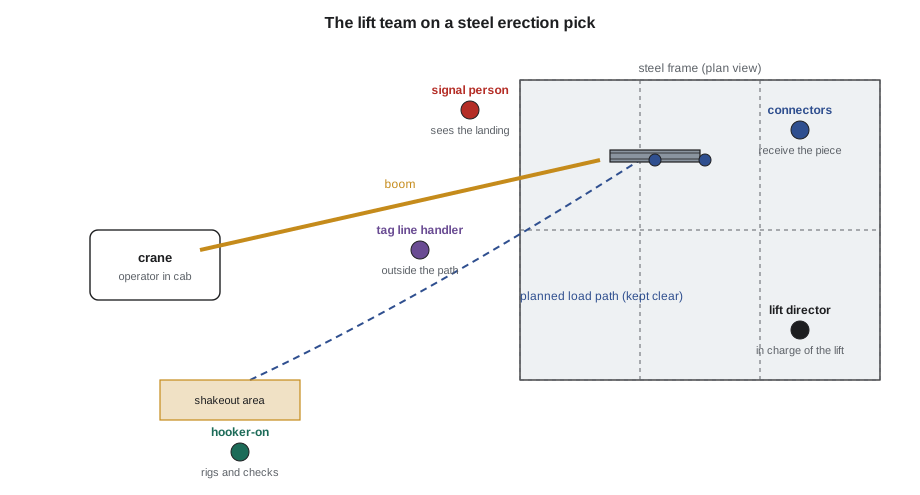
Every lift involves a small team, and each person has a defined job. On a busy steel job one person may fill more than one role, but the roles do not disappear.
- The crane operator runs the crane, knows its load chart and its condition, and has the authority to refuse any lift that looks unsafe. The operator is responsible for the crane's movements and stops whenever a signal is unclear.
- The lift director or lift supervisor, often the raising gang foreperson, plans the lift and is in charge of it. At Ashcroft that was Carla for most picks.
- The rigger selects and attaches the rigging. On a steel job the rigger is often the hooker-on, the ironworker on the ground who rigs each piece and checks it before giving the signal to hoist.
- The signal person gives the operator signals by hand or radio when the operator cannot see the load or the landing area. Only one person signals at a time, but anyone may signal an emergency stop.
- The tag line handlers control the rotation and swing of the load from a safe position, never under it.
- The connectors receive the piece at the top of the steel, guide it into place, make the first connections and release the hook.
Who may run the crane
In Ontario, mobile crane operation is a compulsory trade. Operators of the larger mobile cranes need a Certificate of Qualification as a Hoisting Engineer – Mobile Crane Operator, or must be registered apprentices working under supervision, and tower crane operators need their own certificate. The Hoisting Engineer – Mobile Crane Operator 1 apprenticeship covers lattice and telescopic boom mobile cranes and runs about 6,000 hours. O. Reg. 213/91 sets the crane rules on a construction project: the crane must not be loaded beyond its rated capacity, the load chart must be on the crane, logs must be kept, and the crane must be inspected and maintained. Dwayne holds his certificate and carries it in the cab.
Ironworkers do not run the crane, but they must understand enough about it to work safely with it: what the operator can and cannot see, how the crane's capacity changes as the boom moves, how wind affects the load and the boom, and why a signal must be clear and given by one person.
Who may rig a load
O. Reg. 213/91 requires rigging to be done in a way that keeps workers safe, and it sets minimum safety factors for slings and other rigging: at least five times the maximum likely load for slings. Riggers must be competent workers, which means trained, experienced and familiar with the hazards. Ontario has no separate licence for riggers, so Crossbeam trains its apprentices in this course and in TRD-105 and assesses each one on the job before they rig alone. Carla is Crossbeam's lead rigger on Ashcroft.
Being allowed to rig is not the same as being allowed to rig everything. A first-year apprentice may rig a single beam with a choker under the eye of the hooker-on long before being trusted to rig a column, a bundle of joists or a multiple lift. Shay's first picks at Ashcroft were bracing angles and short beams, checked by Andy every time.
A pick, step by step
Carla drew a single pick on the yard's whiteboard as ten steps, the same ten that every lesson in this course fills in.
- Know the piece: its mark, its weight and where its centre of gravity is (lesson 4).
- Choose the rigging: slings, hardware and hitch, sized for the load and the angles (lessons 2, 3, 5 and 6).
- Check the crane: the radius, the chart capacity and the deductions (lessons 8 and 9).
- Inspect the rigging before use and attach it at the planned points.
- Clear the area and the load path, and agree on signals (lesson 7).
- Lift a few centimetres, stop and check: balance, rigging, crane and ground.
- Hoist and swing under control, with tag lines (lesson 11).
- Land the piece at the connection, with the connectors out of the bite.
- Make the connection: the minimum bolts in place before the hook is released.
- Release the hook and send it back clear of the steel and the people below.
Most accidents with cranes on steel jobs happen when one of these steps is skipped because it is the four hundredth pick and everything has gone well so far. Andy's version was shorter: "Weight, rigging, chart, signals, test, and keep your hands out of the bite."
Crane hazards on a steel job
The hazards were covered in IRW-110, but they are worth listing again from the crane's point of view, because every rigging decision in this course is about one of them.
- Struck by the load: a swinging or rotating piece, a piece that slips out of its rigging, or a load lowered onto a worker.
- Caught between: hands and bodies trapped between a load and the steel, or between a sling and the piece.
- Falling load: a sling, shackle or hook failure, a piece that drops because it was not balanced, or a load released before it was connected.
- Crane overturn or collapse: overloading at radius, poor ground, outriggers not set as the chart requires, wind, or side loading the boom.
- Power lines: a boom, load line or load contacting or arcing to an overhead conductor.
- Two-blocking: the hook block pulled into the boom tip, which can part the load line and drop the load.
Keeping people out from under suspended loads is the single most important rule. On a steel job the only people allowed near a load are the hooker-on while rigging it and the connectors receiving it at the landing point. Everyone else stays out of the load path.
Productivity and the hook
Crane time is expensive and limited, so steel erectors plan picks to keep the hook busy. The erection sequence groups pieces by area and tier, the shakeout crew lays out each bundle in the order it will be lifted, and the hooker-on rigs the next piece while the crane is setting the last one. Good planning makes a job faster and safer at the same time, because a gang that is not rushing is a gang that does not skip steps.
Worked problem
Counting crane time for a tier
The second tier at Ashcroft had 64 pieces. Carla estimated an average single-pick cycle of 9 minutes, from hooking on to the hook coming back. She planned to set 20 of the lighter floor beams in multiple lifts of up to three beams each, which takes 7 lifts, at about 15 minutes per lift, and the other 44 pieces singly. How much crane time does the plan save compared with setting all 64 pieces singly?
Show solution
- All singly: 64 × 9 = 576 minutes = 9.6 hours.
- Planned: 44 single picks × 9 = 396 minutes; 7 multiple lifts × 15 = 105 minutes.
- Planned total: 396 + 105 = 501 minutes ≈ 8.4 hours.
- Saving: 576 − 501 = 75 minutes.
Answer: About 75 minutes, a little more than one hour of crane time on one tier. Multiple lifts save time only when they are planned, rigged and approved under strict rules; lesson 11 covers those rules.
A faster cycle is never worth a skipped check. Carla's rule was that the hooker-on decides when a piece is ready to go, and no one on the gang may hurry them.
When to stop
Every person in a lift has the right and the duty to stop it. The operator may refuse a lift. A connector who sees a damaged sling, a load that is not balanced or a person under the load signals a stop. The hooker-on does not give the signal to hoist until satisfied. Weather stops lifts too: Crossbeam stops connecting in gusts over 50 km/h, and the crane's own wind limits, set by the manufacturer, may be lower, especially for loads with a large surface area such as deck bundles, wall panels and trusses.
In Ontario, a crane overturn, a structural failure of a crane, or a failure to control a crane or its load, including a rigging failure, must be reported to the Ministry by the constructor even if no one is hurt, and the joint health and safety committee or representative must be told. Crossbeam also reports near misses internally, so that the whole company learns from them.
What the operator can and cannot see
Dwayne spent part of the first rigging night describing his view from the cab. From the seat of a truck crane, the operator sees the boom, the hook block and the load when it is in front of the cab and not too high. He cannot see behind the counterweight, under the boom near the carrier, into the steel on the far side of the building, or the landing point when it is above or behind other steel. He sees the load from far away, so small movements are hard to judge, and he cannot hear shouted instructions over the engine.
That shapes how a raising gang works. The hooker-on stands where the operator can see them before the first hoist. The signal person takes a position with a clear view of the load and the landing and, where possible, of the operator. Nobody walks behind the counterweight while the crane is swinging; Crossbeam barricades the swing radius of the counterweight with tape and cones at every setup. And anyone who needs the operator's attention uses the radio or the agreed signal, never a wave from the shakeout area.
A day's rhythm with the crane
A typical day on a raising gang starts before the first pick. The operator inspects the crane and checks the wind. The foreperson reviews the day's sequence with the operator: the pieces, their weights and radii, the heaviest pick and any special lifts. The hooker-on checks the rigging. The connectors inspect their harnesses, lanyards and SRLs. The shakeout crew lays out the first pieces in order. Only then does the first piece leave the ground.
Through the day, the gang keeps the hook moving: the hooker-on rigs the next piece while the connectors bolt the last one, and the empty hook comes back to a piece that is ready. Breaks are taken together, with the hook landed and the load lines clear. At the end of the shift, the crane is secured as the maker requires, the hook is left empty and raised, and loose pieces on the steel are secured against wind. A good gang finishes the day with nothing left hanging, nothing left loose and nobody hurt.
Shay's notebook from his first month had one line underlined twice: "The crane is never in a hurry. Neither am I."
Common mistakes
MistakeStanding under a suspended load to save a few steps.
InsteadStay out of the load path. Only the hooker-on at the start of the lift and the connectors at the landing are near the load.
MistakeLetting several people signal the operator.
InsteadOne designated signal person gives signals; anyone may give an emergency stop.
MistakeRigging a piece without knowing its weight.
InsteadFind the weight from the erection drawings, the piece mark or by calculation before choosing rigging.
MistakeSkipping the test lift on a routine pick.
InsteadLift a few centimetres, stop and check every time.
MistakeReleasing the hook before the piece is connected.
InsteadKeep the hook on until the minimum connection is made.
MistakeHurrying the hooker-on to keep the crane busy.
InsteadPlan the sequence so the next piece is ready; never rush the check.
Summary and key terms
- Almost every piece of structural steel is set by a crane, and the speed and safety of a steel job depend on the pick cycle.
- A lift team includes the operator, lift director, rigger or hooker-on, signal person, tag line handlers and connectors.
- In Ontario, mobile crane operators need a Certificate of Qualification as a hoisting engineer, and riggers must be competent workers.
- Every pick follows the same steps: weight, rigging, chart, inspection, clear area, test lift, controlled hoist, landing, connection, release.
- No one stands under a suspended load except the connectors receiving it.
- Anyone may stop a lift; the operator may refuse one.
- Raising gang
- The crew that hoists, connects and initially bolts structural steel.
- Hooker-on
- The ironworker on the ground who rigs each piece to the crane hook.
- Lift director
- The person in charge of planning and directing a lift.
- Qualified rigger
- A person with the knowledge, training and experience to rig the loads being lifted.
- Load path
- The route a load takes from where it is picked to where it is set.
- Two-blocking
- Pulling the hook block or load into the boom tip, which can break the load line.
- Pick
- A single lift of a load by a crane.
Practice problems
Work each problem on paper first, then reveal the answer to check.
Who has the authority to refuse a lift?
Show answer
The crane operator, and anyone may signal a stop.
Which workers may be near a suspended load during steel erection?
Show answer
The hooker-on rigging it and the connectors receiving it.
What trade certificate does a mobile crane operator need in Ontario?
Show answer
A Certificate of Qualification as a Hoisting Engineer – Mobile Crane Operator (or registered apprentice status).
At a 10-minute average cycle, how long would 48 single picks take?
Show answer
48 × 10 = 480 minutes = 8 hours.
Name three crane hazards on a steel job.
Show answer
Any three of: struck by the load, caught between, falling load, crane overturn, power lines, two-blocking.
Lesson quiz · 5 questions
Score 60% or more to complete this lesson.
Create a free account to save your progress, take quizzes and earn a certificate.