
INS-310 · Lesson 6 of 12 · 23 min
Tanks and storage vessels
▶ Video coming soon A video version of this lesson is on the way.
On Monday, October 26, Wendell and Bernie walked through the Kellerton engine room with Lou Brisebois to look at a hot water storage tank that is about fifty years old. INS-230 told part of that story: the plant's 2019 survey showed lead paint on the tank, so the new insulation, planned for January 2027, will be held by clamp-on rings and bands with no welded pins. When the walk-down was finished, Lou took them outside to look at something else. Behind the processing building stands the plant's largest tank, a field-erected steel tank of process hot water about 7.3 m across and 6.1 m tall, insulated in 2019 by another contractor with a panel system. Brown streaks ran down the panels from just below the roof. "Water's getting in somewhere up top," Lou said. "Tell me what it would take."
Tanks hold liquids, usually at or near atmospheric pressure, and they come in every size from a few hundred litres to tens of millions. Some are hot, some are cold, many are outdoors. This lesson covers the kinds of tanks insulators meet, the main ways their walls and roofs are insulated, the details that let water in, and how to take off materials for a tank job.
Kinds of tanks
- Shop-built tanks are made in a factory and delivered whole. Most indoor tanks are shop-built: hot water storage tanks, expansion tanks, chemical tanks, buffer tanks, small process tanks. They are insulated like vessels, as lesson 2 describes, and some arrive factory-insulated.
- Field-erected tanks are too big to ship and are built on site from steel plates, usually to the American Petroleum Institute standard API 650 for welded atmospheric storage tanks, which is used in both Canada and the United States. They sit on a foundation or ring wall, with a flat or slightly sloped bottom, a cylindrical shell made of courses of plate, and a roof: a shallow cone roof, a dome roof, or a floating roof that rides on the liquid. Large outdoor tanks of hot water, oil, asphalt, molasses, chemicals and process liquids are often insulated.
- Atmospheric and low-pressure tanks are not pressure vessels in the code sense, but they are still the owner's equipment, often coated or lined inside, and welding to them needs the owner's agreement and may be forbidden on lined or coated tanks.
- Bolted and plastic tanks, of bolted steel panels, fibreglass or plastic, need insulation systems that do not depend on welding and that suit their materials.
Ask what the tank holds, at what temperature, whether it is ever emptied or cycled, whether it is coated, lined or painted (and with what), and what the owner will allow you to attach. Those answers choose the system.
Insulating tank walls
Tank walls, or shells, are large vertical cylinders, and are insulated with one of four main systems:
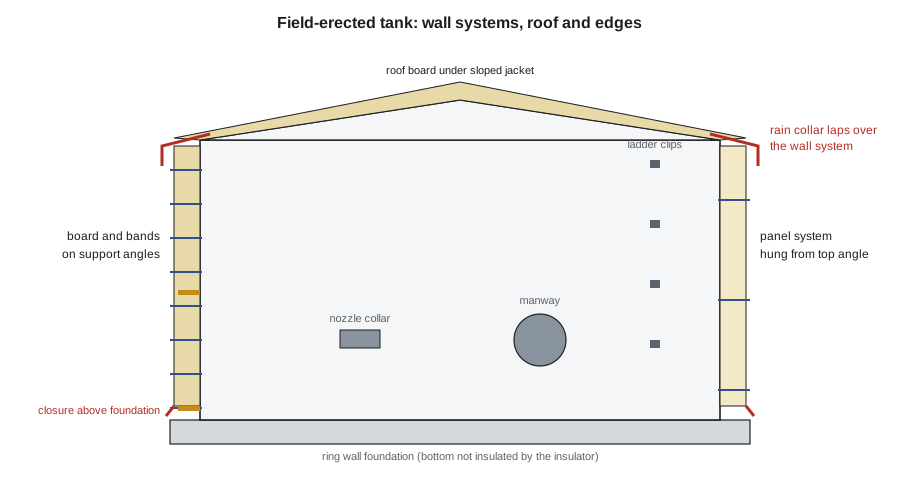
- Board or block with bands. Rigid or semi-rigid board, scored board or curved block is laid on the shell in courses from the bottom up, held by bands around the tank at regular spacing, and carried by support rings or angles at intervals (lesson 3). Joints are staggered between courses. A metal jacket, often corrugated or ribbed on tall tanks for stiffness, goes over it. This is the traditional system for shop-built and field-erected tanks.
- Pre-fabricated panel systems. Tall panels of metal sheet with insulation bonded to their backs are hung from a top angle or clips at the roof edge and held against the shell by bands, with their edges joined by standing seams, interlocking ribs or battens. Panels go up quickly, can be removed for inspection, and are common on large outdoor tanks. Their weak points are their top edges and their seams.
- Spray-applied polyurethane foam. Foam is sprayed onto the clean shell by specialist crews to build up a seamless layer, then covered with a protective coating or mastic that shields it from sunlight and weather. Foam works on hot tanks within its temperature limit and on cold tanks, but it is combustible and needs a thermal barrier or protective coating where codes require one, careful surface preparation, and good weather to apply.
- Blanket and mesh, wired blanket laced to rings or banded, for irregular or very hot tanks, often with a cement or mastic finish.
The roof and the shell-to-roof edge
The roof is the hardest part of an outdoor tank to keep dry, because water sits on it and runs off it onto the shell. Cone roofs are usually insulated with rigid board or foam held by pins, adhesives or a grid of bands, and covered with a jacket of sloped metal sheets lapped downslope like roofing, or with a weatherproof membrane or coating. The roof insulation and jacket must be strong enough to walk on where people will walk, or have marked walkways.
The shell-to-roof edge is where most outdoor tank insulation leaks. Water running off the roof must be carried out past the top of the shell insulation, never into it. The usual detail is a rain collar or drip flashing: a sloped metal flashing fixed at the roof edge that laps over the top of the shell jacket or panels by a good margin, with its lower edge turned out to shed water clear. Panel systems often have a top cap or closure that does the same job. If this flashing is missing, short, sloped the wrong way or sealed only with caulk, water runs behind the shell insulation and down, as the brown streaks on Lou's tank showed.
Wind matters on outdoor tanks too. On a tall tank, the jacket or panels on the windward side are pushed on, and those on the sides and leeward side are sucked off. Specifications for large outdoor tanks set band spacing, clip spacing and panel fastening to suit the design wind, and those details must be followed exactly, especially near the top edge where wind loads are highest.
The bottom and the foundation
The bottom of a field-erected tank rests on its foundation and is not insulated by the insulator; any insulation under the bottom is part of the foundation design and is installed by others before the tank is built. The insulator's work stops at the bottom of the shell, which needs a careful termination: the bottom of the shell insulation is usually held a short distance above the foundation, so it cannot wick water up from the ground, and is closed with a metal closure or flashing that sheds water outward and leaves a small gap for inspection of the shell-to-bottom weld. Shop-built tanks on legs or skirts have their bottom heads insulated like vessel heads, as lesson 2 explains.
Nozzles, manways and attachments
Tanks have many openings and attachments: inlet and outlet nozzles, manways, level gauges and transmitters, thermometer wells, vents, overflow pipes, ladders and stairways with their clips, platforms, and lifting lugs. Each one interrupts the insulation and the jacket, and each one is a place for water to get in. Every penetration of the jacket on an outdoor tank needs a sealed collar or flashing that sheds water, as INS-220 described for pipe. Ladders and stair stringers are usually bolted to clips welded to the shell by the tank builder; the insulation is fitted around the clips and the jacket is flashed around them.
Manways and inspection openings get removable covers or framed openings, as lesson 11 explains. Level gauges and instruments must remain readable and serviceable.
Tanks with lead paint, coatings and linings
Older tanks may be coated with lead-containing paint, as the Kellerton engine room tank is. INS-230 explained why that paint must not be disturbed by grinding, sanding, cutting or welding without the controls for lead work. A clamp-on and banded system avoids disturbing it. Newer tanks may have coatings that heat would damage, or internal linings, such as glass, rubber or epoxy, that welding on the outside could crack or burn. In all these cases, ask the owner what may be attached and how, before planning the job.
Worked problem
Bands for the engine room tank
The engine room tank is 2.4 m in diameter and 4.5 m tall on its shell. The January 2027 plan is 50 mm of mineral wool board held by stainless bands at 300 mm spacing, with the end bands 75 mm from the top and bottom of the shell, and 75 mm added to each band for the seal. Bands come in coils of 30.5 m. How many bands and coils are needed for the shell?
Show solution
- Distance between end bands = 4,500 − 2 × 75 = 4,350 mm; 4,350 ÷ 300 = 14.5, so 15 spaces and 16 bands.
- Insulated diameter = 2.4 + 2 × 0.05 = 2.5 m; band length = π × 2.5 + 0.075 = 7.854 + 0.075 = 7.93 m.
- Total = 16 × 7.93 = 126.9 m.
- Coils = 126.9 ÷ 30.5 = 4.2, so 5 coils, with spare for the heads and for any band that is cut short.
Answer: 16 bands about 7.93 m long, from 5 coils.
Taking off a large outdoor tank
Lou's outdoor tank is a good example of how a tank job is measured. Wendell and Bernie walked round it with Lou on October 26, photographed the streaks, and found the cause from the stairway: the rain collar at the top of the panels had been cut back around the roof vents and a level transmitter added in 2023, and the cut edges had been caulked instead of flashed. Water was running off the roof, under the cut collar and into the top of the panels. Raj Sandhu is pricing two options, as plans: repairing the top edge and the panels below it, or replacing the wall panels entirely if the insulation behind them proves wet over a large area.
Worked problem
Panels and roof for the outdoor tank
The tank is 7.3 m in diameter and 6.1 m tall on its shell. The wall panels hold 100 mm of insulation, are 6.1 m tall, and each covers 1.0 m of the girth measured at the panel face. The cone roof has a radius of 3.75 m at the insulation and rises about 1 in 12. How many wall panels go round the tank, and what is the roof's insulated area?
Show solution
- Diameter at the panel face = 7.3 + 2 × 0.1 = 7.5 m; girth = π × 7.5 = 23.56 m.
- Panels = 23.56 ÷ 1.0 = 23.6, so 24 panels, with the last one trimmed to fit.
- Wall area = 23.56 × 6.1 = 143.7 m².
- Roof plan area = π × 3.75² = 44.18 m². A 1 in 12 slope adds very little: the sloped length is √(1 + (1/12)²) = 1.0035 times the plan length, so the roof area is 44.18 × 1.0035 = 44.3 m².
Answer: 24 panels for about 144 m² of wall, and about 44 m² of roof.
A full takeoff adds the shell-to-roof flashing (one girth of the tank, plus laps), the bottom closure (another girth), and every nozzle, manway, ladder clip and instrument as a counted item, each with its collar or flashing. Experienced estimators also add an allowance for the time it takes to work round the stairway and platforms, which on many tanks is greater than the time for the plain wall.
Inspection and maintenance of tank insulation
Tank insulation fails slowly and out of sight. Streaks, bulges, loose panels, open seams, damaged collars and rust staining at the bottom closure are all signs that water is getting in. On hot tanks, the jacket may also show hot spots where insulation has slumped or fallen inside the panels; an infrared camera survey shows them clearly. Water held against the shell for years causes corrosion under insulation, the problem INS-220 described for pipe, which can thin the tank wall unseen. Owners of large tanks often schedule an insulation inspection every few years, and lesson 11 covers the inspection ports that let them check the shell without stripping the whole system.
Hot and cold tanks
Most insulated tanks are hot: hot water, heated oils, asphalt, syrups and process liquids kept warm to stay pumpable. For these, the main concerns are keeping water out and allowing for growth, which on a large tank can be many millimetres around the girth. Cold tanks, such as chilled water storage and some chemical and refrigerated tanks, need everything lesson 9 describes: closed-cell materials or a perfect vapour retarder, vapour stops at every nozzle and attachment, and insulated supports. A chilled water storage tank outdoors in summer has a large vapour drive inward over a large surface, and small defects become large failures.
Common mistakes
MistakeWelding pins or clips to a coated, lined or lead-painted tank without asking.
InsteadAsk the owner what may be attached; use bands and clamp-on supports where welding is not allowed.
MistakeCaulking a cut rain collar instead of flashing it.
InsteadFlash every penetration at the shell-to-roof edge so water is carried outward.
MistakeRunning shell insulation down onto the foundation.
InsteadStop it above the foundation with a closure that sheds water.
MistakeIgnoring the wind details on a tall outdoor tank.
InsteadFollow the specified band, clip and panel spacing exactly, especially near the top.
MistakeCovering level gauges and instruments.
InsteadKeep them readable and serviceable.
Summary and key terms
- Tanks are shop-built or field-erected, usually atmospheric; field-erected steel tanks are commonly built to API 650.
- Walls take board or block with bands and support rings, panel systems, spray foam with a protective coating, or blanket and mesh.
- The shell-to-roof edge is the main leak point; use a rain collar or top closure that laps over the wall system and sheds water out.
- The bottom rests on the foundation and is not insulated by the insulator; stop the shell insulation above the foundation with a closure.
- Flash or collar every nozzle, manway, ladder clip and instrument; keep instruments readable.
- Ask before attaching anything to coated, lined or painted tanks; follow the wind details on outdoor tanks.
- Field-erected tank
- A tank built on site from steel plates, usually to API 650.
- Cone roof
- A shallow conical tank roof.
- Panel system
- Pre-fabricated insulated metal panels hung on a tank wall and held by bands.
- Rain collar
- A sloped flashing at the shell-to-roof edge that laps over the wall insulation and sheds water outward.
- Bottom closure
- The flashing that closes the bottom of the shell insulation above the foundation.
- Spray polyurethane foam
- Foam insulation sprayed in place and covered with a protective coating.
- Ring wall
- A concrete ring foundation under the shell of a field-erected tank.
Practice problems
Work each problem on paper first, then reveal the answer to check.
Who installs insulation under the bottom of a field-erected tank?
Show answer
Others, as part of the foundation, before the tank is built.
A tank is 6 m across with 100 mm panels covering 1.0 m each. How many panels?
Show answer
π × 6.2 = 19.48 m, so 20 panels.
Bands at 300 mm with end bands 75 mm from each end of a 3.6 m shell. How many bands?
Show answer
3,450 ÷ 300 = 11.5, so 12 spaces and 13 bands.
Where do most outdoor tank insulation leaks start?
Show answer
At the shell-to-roof edge and at penetrations.
Why is the shell insulation stopped above the foundation?
Show answer
So it cannot wick water from the ground, and so the shell-to-bottom weld can be inspected.
Lesson quiz · 5 questions
Score 60% or more to complete this lesson.
Create a free account to save your progress, take quizzes and earn a certificate.