
INS-310 · Lesson 1 of 12 · 28 min
Insulating large surfaces
▶ Video coming soon A video version of this lesson is on the way.
On Monday, September 28, Priya Lam walked into the Kellerton processing building behind Wendell Ashby with a tape measure, a notebook and, for the first time in her apprenticeship, no pipe in sight. Their job for three days was the blancher water tank: a rectangular stainless steel tank about 3.0 m long, 1.5 m wide and 1.2 m deep that held water at about 95 °C for blanching vegetables before freezing. Its old insulation had been soaked by years of washdown, and its walls were too hot to touch. "Pipe teaches you to go round," Wendell said, running his hand a few centimetres above the steel to feel the heat. "Equipment teaches you to go flat, then round, then flat again, and to make it all meet."
This course is about insulating equipment: vessels, tanks, heat exchangers, boilers, breeching, stacks and ductwork. These are bigger and less regular than pipe, they come in many shapes, and they usually have nozzles, manways, nameplates and supports that the insulation has to work around. This first lesson covers the methods used on any large surface, flat or curved: choosing the material form, laying it in layers with staggered joints, holding it in place, and dealing with edges, corners and movement. The lessons that follow apply these methods to particular kinds of equipment.
What makes a surface large
Pipe insulation comes as preformed sections made to fit one pipe size. Equipment has no standard size, so its insulation is built up on site from flat or flexible products cut to fit. A surface counts as large, for insulating purposes, when it is too big or too flat for pipe covering to fit it. In practice, that means flat walls of tanks, casings, ducts and breeching, and curved surfaces whose diameter is larger than the largest pipe covering available, typically somewhere above NPS 24 to NPS 36, depending on the material and the maker.
Large surfaces bring problems that pipe does not have. The insulation must be held up against gravity on vertical walls and against sagging on undersides. Joints run for metres instead of centimetres, so every gap or open joint is a long line of heat loss or, on cold service, a long path for moisture. The surface moves as it heats and cools, and the insulation has to move with it. And large surfaces usually have edges and corners where flat meets flat or flat meets round, which are the hardest places to close.
Material forms for large surfaces
The same insulating materials that INS-120 described for pipe are used on equipment, but in different forms. Choosing the form is the first decision.
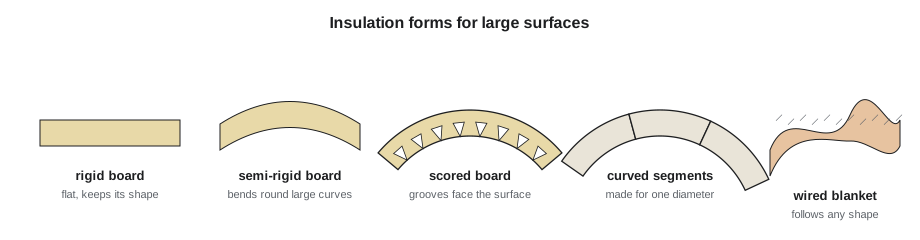
- Rigid board and block are flat pieces, typically about 600 by 1,200 mm for board and smaller for block. Mineral wool board, cellular glass block, calcium silicate block, perlite block and rigid foam boards are common. Rigid forms give a flat, firm surface for jacket, resist compression where people lean or step, and keep their thickness. They do not bend, so on curved surfaces they must be cut, scored or bought as curved segments.
- Semi-rigid board is a mineral wool or glass fibre board with enough flexibility to bend gently around large curves. It is often used on vessel shells over about 1 m in diameter.
- Scored or grooved board, sometimes sold as lagging or V-groove board, has parallel grooves cut part way through on one face so it folds around a curve. The grooves go against the hot surface and close as the board is bent, leaving the outer face smooth.
- Curved segments of calcium silicate, cellular glass, perlite or foam are made to fit a given diameter. Several segments form a ring around a vessel or a large duct.
- Blanket is flexible mineral wool, glass fibre or high-temperature fibre, sometimes stitched to wire mesh on one or both faces (wired blanket). It follows irregular shapes, curves and heads easily and is often used on breeching, boilers, turbines and irregular equipment, but it compresses under jacket and bands, so its installed thickness and density must be checked.
- Field-applied systems such as spray-applied polyurethane foam or insulating cements are used on some tanks and irregular shapes. Spray foam is applied by specialist crews and is covered in lesson 6; cements and finishing coats in lesson 10.
The specification usually names the material, the form and the thickness. When it gives a choice, the right form depends on the shape, the temperature, how much abuse the finished surface will take, and whether the equipment must be opened for maintenance. Wendell's rule of thumb for Priya was simple: "Rigid where people walk, flexible where it bends, removable where somebody has to get in."
Layers and staggered joints
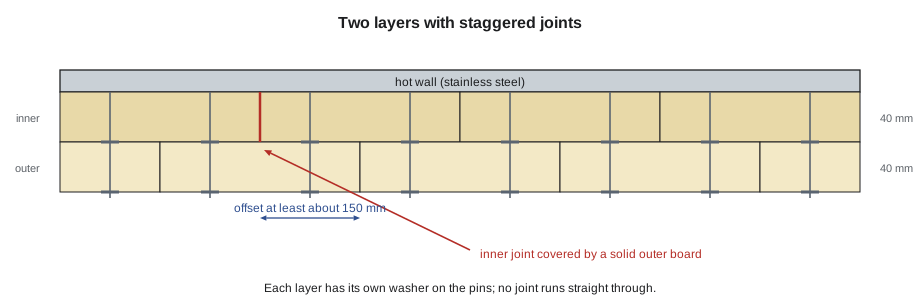
Insulation thicker than about 75 mm is usually applied in two or more layers rather than one thick layer. There are three reasons. Thinner pieces are easier to cut, bend and fit tight. Layers let the joints of each layer be staggered, or offset, from the joints of the layer below, so no joint runs straight through the full thickness. And on hot service, an inner layer of a high-temperature material can protect an outer layer of a cheaper material that could not take the full temperature, as the Kellerton cogeneration exhaust quote in INS-120 did.
Staggering is the heart of good equipment insulation. A straight-through joint is a short circuit for heat: hot air convects through it, radiant heat shines along it, and on cold service moist air flows in through it and condenses. When the joints of the outer layer are offset from the joints of the inner layer, the path through the joint is blocked by solid insulation. Common practice is to offset the joints of each layer by at least about 150 mm, or by half a board where the layout allows, in both directions. Board joints within one layer are also staggered like brickwork, so that four corners never meet at one point.
Each layer is secured on its own. The inner layer is held by pins, clips or bands before the outer layer goes on; the outer layer is then held by its own pins or bands. A common mistake is to hang both layers on one set of pins with one washer on the outside, which lets the inner layer slump and open its joints. On equipment that runs hot, the inner layer's bands or wire are often made of stainless steel so they do not soften or corrode.
Fitting board tightly
A large surface insulated with board is only as good as its joints. Boards are butted tightly with no visible gaps, cut with a long knife or saw against a straightedge so that edges are square, and pressed together as they go on. Small gaps, up to a few millimetres, are packed with loose fibre of the same material or, on some systems, filled with a compatible insulating cement. Larger gaps mean the cut was wrong and the piece should be recut. On cold service, joints in the outer layer of cellular glass or foam are often sealed with a joint sealant made for that material, as lesson 9 explains.
Rigid board must lie flat against the surface. Where the surface has bumps such as weld seams, bolt heads or stiffeners, the board is cut or notched to fit over them rather than left bridging, because a bridged board leaves a hollow behind it that lets air move. On curved surfaces, rigid board is either cut into narrow strips laid lengthwise, like the staves of a barrel, or replaced with scored board, semi-rigid board or curved segments. Flat board laid flat across a curve leaves a large air gap at each edge.
Worked problem
How narrow must flat staves be on a curved shell?
A flat stave laid across a curved shell touches it along its centre line and stands off at its edges. For a shell of radius 1,200 mm, how far does the edge of a 200 mm wide stave stand off the shell? What width keeps the stand-off under 2 mm?
Show solution
- The stand-off is the gap between the stave's edge and the arc: gap = R − √(R² − (w/2)²).
- For w = 200 mm: gap = 1,200 − √(1,200² − 100²) = 1,200 − √1,430,000 = 1,200 − 1,195.8 = 4.2 mm.
- For a gap of 2 mm: (w/2)² = R² − (R − 2)² = 2 × 1,200 × 2 − 4 = 4,796, so w/2 = 69.3 mm and w = 139 mm.
- So staves about 140 mm wide or narrower lie close enough; wider boards should be scored or curved.
Answer: A 200 mm stave stands off about 4 mm; staves about 140 mm wide keep the gap under 2 mm.
The example shows why flat board is rarely used across curves smaller than a few metres in diameter: the staves become narrow, there are many joints, and each joint has to be tight. Scored board does the same job with grooves instead of separate staves, and curved segments remove the problem altogether.
Holding insulation on a large surface
On pipe, insulation holds itself on by wrapping around. On a large flat or gently curved surface, it must be held. The main methods, which lesson 3 covers in detail, are:
- Pins and studs welded or bonded to the surface, with the insulation pushed over them and held by speed washers or clips.
- Bands around a vessel or duct, holding the insulation against a curved surface by tension. Bands work on cylinders and on ducts with all four sides insulated; they do not hold anything on a single flat wall.
- Wire, mesh or expanded metal over blanket or block, tied to pins or rings, which holds the material and gives a key for cement or mastic finishes.
- Support rings and angles on vertical vessels and walls, which carry the weight of insulation and jacket so the lower layers are not crushed.
- Adhesives, used for some foams, cellular glass on cold service and duct liner, but rarely relied on alone for heavy material on hot surfaces.
Gravity decides how much holding a surface needs. Undersides need the most, because the insulation hangs from its fasteners; vertical walls need enough to stop the insulation sliding and bulging; tops need least, but still need something so the insulation does not move when the jacket is fitted or the wind lifts it. Specifications and maker instructions often give closer fastener spacing on undersides than on tops, a point lesson 3 returns to.
Edges, corners and terminations
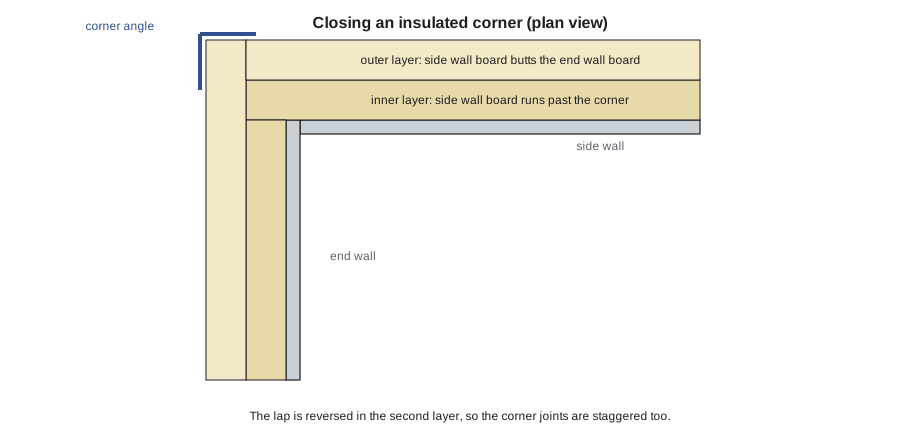
Where two insulated flat surfaces meet at a corner, such as the side and end walls of a rectangular tank, the insulation must close the corner without a gap. The usual method is to run the insulation of one wall past the corner by the full thickness of the insulation on the other wall, so that the second wall's insulation butts against the back of the first. In two layers, the inner layer laps one way and the outer layer the other, so the corner joints are staggered too. Corners on hot equipment are often finished with a metal corner angle or a jacket bent around the corner, which protects the board edges from damage.
Where insulation stops, at a flange, a support, a nameplate or the edge of the equipment, the edge of the insulation must be closed so water and air do not get behind it. Hot equipment usually has its edges finished with a metal end cap, a bevelled edge sealed with a finishing cement, or a jacket turned in to the surface. Cold equipment needs a sealed vapour stop at every termination, which lesson 9 explains. Edges that are left raw are where insulation starts to fail: the fibres fray, water wicks in, and the board crumbles back from the edge.
Movement on large surfaces
Large surfaces grow when they heat up. A steel tank or breeching grows about 12 millionths of its length for each degree Celsius of temperature rise (about 6.7 millionths per degree Fahrenheit), and stainless steel about 17 millionths per degree Celsius (about 9.6 per degree Fahrenheit). Over a long wall at a high temperature, that is several millimetres. The insulation, which stays much cooler on its outer face, does not grow as much. If the insulation is rigidly fixed, the surface slides under it, joints open on heating, and pins or bands are strained.
Worked problem
How much does the blancher tank grow?
The blancher tank's long wall is 3.0 m of stainless steel. It is filled cold, at about 10 °C, and runs at 95 °C. Using 17 millionths per degree Celsius, how much does the wall grow? What does that mean for the insulation joints?
Show solution
- Temperature rise = 95 − 10 = 85 °C.
- Growth = 17 × 10⁻⁶ × 3,000 mm × 85 = 4.3 mm.
- The wall has about 5 board joints along its length, so each joint opens about 4.3 ÷ 5 ≈ 0.9 mm if the boards do not move.
- That is small enough to be taken up by tightly packed joints in a two-layer system with staggered joints.
Answer: The wall grows about 4 mm; a two-layer system with tight, staggered joints takes this up.
On bigger and hotter equipment, such as breeching, boiler casings and exhaust ducts at several hundred degrees, the movement is much larger and is planned for: the insulation is fixed at one point and allowed to slide elsewhere, expansion joints in the equipment are covered with flexible blanket rather than rigid board, and the jacket has slip joints, as lesson 5 explains. Multiple layers help here too: when joints are staggered, an opening joint in one layer is still covered by the other.
The blancher tank
The blancher job followed this lesson almost line by line. On Monday, Wendell and Priya stripped the wet insulation and found the old system: a single layer of 75 mm glass fibre board held by carbon steel pins that had rusted where washdown water reached them, with no staggering and with open joints along the bottom edge where water had pooled. Lou Brisebois, Kellerton's maintenance manager, agreed to the new system that Raj Sandhu had priced: two layers of 40 mm mineral wool board with staggered joints, stainless pins and washers, and a sealed stainless steel jacket that the washdown crews could hose without wetting the insulation.
Worked problem
Boards for the blancher tank
The tank is 3.0 m long, 1.5 m wide and 1.2 m deep. The two long walls, the two end walls and the bottom are insulated; the top has removable covers that are not insulated. Boards are 600 × 1,200 mm. Allowing 1 in 10 for waste, how many boards are needed for each layer, and for the job?
Show solution
- Long walls: 2 × 3.0 × 1.2 = 7.2 m².
- End walls: 2 × 1.5 × 1.2 = 3.6 m².
- Bottom: 3.0 × 1.5 = 4.5 m².
- Total = 15.3 m²; one board = 0.6 × 1.2 = 0.72 m².
- Boards per layer = 15.3 ÷ 0.72 = 21.25; with waste, 21.25 × 1.1 = 23.4, so 24 boards.
- Two layers: 48 boards. The outer layer is slightly larger at the corners, which the waste allowance covers.
Answer: 24 boards per layer, 48 for the job.
Priya laid out the boards on the long wall in chalk before she cut anything: inner layer starting with a full board at one end, outer layer starting with a half board, so every vertical joint in the outer layer fell in the middle of an inner board. Horizontal joints were staggered the same way. By Tuesday afternoon both layers were on, and on Wednesday the jacket went on, as lesson 10 describes. When the tank was refilled and heated on Thursday, the outside of the jacket was warm but comfortable to touch, where before it had been too hot to hold a hand on.
Common mistakes
MistakeLaying one thick layer of board on hot equipment to save time.
InsteadUse two or more layers above about 75 mm (3 in) and stagger the joints.
MistakeLetting the joints of the outer layer line up with those of the inner layer.
InsteadOffset them by at least about 150 mm (6 in), or half a board.
MistakeLaying wide flat boards across a tight curve.
InsteadUse narrow staves, scored board, semi-rigid board or curved segments.
MistakeHanging both layers on one set of pins with a washer only on the outside.
InsteadSecure each layer separately.
MistakeLeaving insulation edges raw at terminations.
InsteadClose edges with end caps, cement, turned-in jacket or, on cold service, a sealed vapour stop.
Summary and key terms
- Large surfaces are insulated with boards, blocks, segments or blanket cut and fitted on site.
- Choose the form by shape, temperature, abuse and access: rigid where people walk, flexible where it bends, removable where people must get in.
- Apply thick insulation in layers and stagger joints within and between layers so no joint runs straight through.
- Secure each layer separately; undersides need the most holding.
- Close corners by running one wall's insulation past the other and reversing the lap in the next layer.
- Allow for movement: tight staggered joints take small growth; bigger, hotter equipment needs planned sliding points and flexible covers at expansion joints.
- Rigid board
- A flat, stiff insulation board that keeps its shape and thickness.
- Semi-rigid board
- A board flexible enough to bend around large curves.
- Scored board
- Board with grooves cut part way through one face so it folds around a curve; also called lagging or V-groove board.
- Curved segment
- A preformed piece of insulation made to fit a given diameter; several form a ring.
- Wired blanket
- Flexible insulation blanket stitched to wire mesh.
- Staggered joints
- Joints offset from the joints next to them or in the layer below, so no joint runs straight through.
- Stave
- A narrow strip of flat board laid lengthwise on a curved surface.
- Termination
- A place where the insulation stops and its edge must be closed.
Practice problems
Work each problem on paper first, then reveal the answer to check.
Why is thick insulation applied in layers?
Show answer
Thinner pieces fit better, joints can be staggered, and an inner high-temperature layer can protect an outer layer.
How far should joints in one layer be offset from joints in the next?
Show answer
At least about 150 mm, or half a board where possible.
A shell has a 1,500 mm radius. How far does a 200 mm flat stave stand off at its edges?
Show answer
1,500 − √(1,500² − 100²) = 1,500 − 1,496.7 = 3.3 mm.
A 4 m stainless wall heats from 15 °C to 85 °C. How much does it grow at 17 millionths per °C?
Show answer
17 × 10⁻⁶ × 4,000 × 70 = 4.8 mm.
How is a corner between two insulated walls closed?
Show answer
One wall's insulation runs past the corner by the other wall's thickness; the lap is reversed in the next layer.
Lesson quiz · 5 questions
Score 60% or more to complete this lesson.
Create a free account to save your progress, take quizzes and earn a certificate.