
INS-310 · Lesson 5 of 12 · 23 min
Boilers, breeching and stacks
▶ Video coming soon A video version of this lesson is on the way.
The Tuesday after Labour Day, September 8, was Priya's first day with Wendell. Kellerton had asked Coldstream to re-insulate the breeching from boiler No. 2 to the stack, a rectangular steel duct about 900 mm wide and 600 mm high and about 12 m long, carrying flue gas at about 205 °C. The old mineral wool had been knocked off in several places when a forklift clipped the bottom of the duct, and the bare patches glowed with heat. Wendell held an infrared thermometer at one of them: 190 °C. "That's a burn in less than a second," he said. "And everything in this room is warmer because of it."
Boilers, the ducts that carry their flue gas, and the stacks that release it to the outdoors are some of the hottest equipment an insulator works on, and some of the most closely regulated. This lesson covers what an insulator does and does not do on boilers, how breeching and exhaust ducts are insulated, how stacks are treated, and the special problems of high temperature: material limits, expansion, and the reasons for insulating something whose heat is going up the chimney anyway.
Boilers: what the insulator does
A boiler is a pressure vessel heated by a burner, an exhaust stream or electricity. Many boilers arrive as packaged boilers, built and insulated in the factory with their own casing, so the insulator's work is on the piping and equipment around them. Larger field-erected and watertube boilers have parts that are insulated on site: steam drums and mud drums, headers, downcomers, economizers, air heaters and the casings between them.
Two kinds of work on boilers belong to other trades. Refractory, the brick, castable and ceramic lining inside the furnace and gas passages, is installed by refractory installers and boilermakers; it faces the flame directly and is a different material and a different skill. And anything that touches the pressure boundary, such as welding clips or rings, belongs to the boiler's authorized repair organization, as lesson 3 explained. The insulator works outside the pressure boundary and outside the refractory, usually with bands, clamp-on supports and fabricator-welded clips.
Around every boiler there is also a group of hot small equipment that insulators cover: blowdown tanks and separators, feedwater tanks and deaerators, condensate receivers like the one in lesson 2, steam separators and traps. These are vessels and are insulated as lessons 2 and 3 describe, with removable covers where they are opened (lesson 4) and access to their nameplates and relief valves (lesson 11).
Breeching and exhaust ducts
Breeching is the duct that carries flue gas from a boiler or furnace outlet to the stack. On gas-fired equipment, the connecting duct is often called a vent connector. Exhaust ducts carry hot gas from engines, turbines and process equipment, such as the Kellerton cogeneration exhaust that INS-120 described, which runs at about 540 °C. These ducts are usually made of steel plate or sheet, rectangular or round, stiffened with angles, and joined by flanges or welds. They are not pressure vessels; they run near atmospheric pressure. That means they can usually take welded pins, with the owner's agreement.
Insulating breeching follows the large-surface methods of lesson 1, with high-temperature materials and extra attention to movement:
- Materials. The inner layer must be rated for the surface temperature with a margin. Mineral wool board and block are common up to several hundred degrees; ASTM C612 lists board types by their maximum use temperature, and makers give their own limits. Calcium silicate block (ASTM C533) takes higher temperatures and rough handling. High-temperature blankets of mineral wool, alkaline earth silicate (AES) or refractory ceramic fibre are used on very hot ducts and on expansion joints. On a two-layer system, the outer layer can be a cheaper material if the inner layer brings the temperature at the interface down within its limit.
- Fastening. Pins or studs welded to the duct at the specified spacing, closer on the bottom; stainless or heat-resistant pins and washers on hot work, because plain steel pins at high temperature oxidize and weaken.
- Stiffeners and flanges. The angles and flanges that stiffen the duct stick out from the surface. They are insulated over, with the insulation built up between them to a flat outer face, or they are boxed in with board. They conduct heat outward, so they need the full thickness over them.
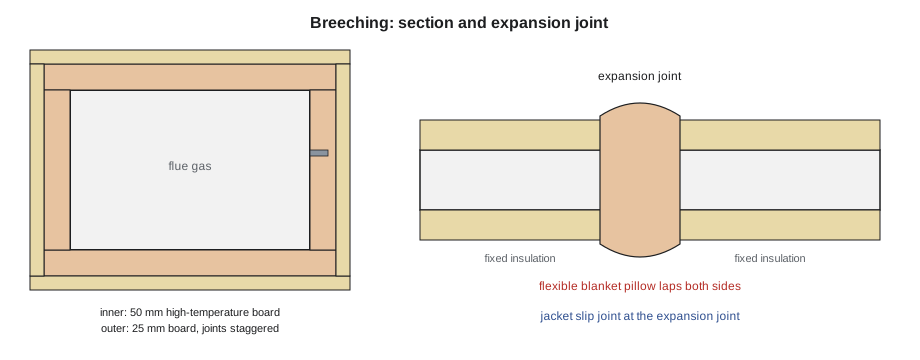
- Expansion joints. Breeching has expansion joints of metal bellows or fabric to take its growth. These must stay flexible, so they are never covered with rigid board or banded tight. They are covered with flexible blanket pillows or removable blanket covers that lap over the fixed insulation on each side.
- Jacket. Aluminum or stainless jacket on rectangular duct is usually ribbed or corrugated, so it does not ripple, with slip joints at intervals and at every expansion joint, and with its top seams lapped to shed water if the duct is outdoors.
Movement at high temperature
Lesson 1 showed small growth on a warm tank. At breeching temperatures, growth is large. Steel grows about 12 millionths of its length per degree Celsius (about 6.7 millionths per degree Fahrenheit).
Worked problem
How much does the breeching grow?
The No. 2 breeching is 12 m of steel. It is installed at about 20 °C and runs at about 200 °C. How much does it grow?
Show solution
- Temperature rise = 200 − 20 = 180 °C.
- Growth = 12 × 10⁻⁶ × 12,000 mm × 180 = 25.9 mm.
- That growth goes into the breeching's expansion joint; the insulation and jacket must let the duct slide under them, and the cover over the joint must flex by the same amount.
Answer: About 26 mm, taken up at the expansion joint.
Because the outer face of the insulation stays near room temperature, the jacket grows much less than the duct. A jacket fixed tightly to the duct at many points would be dragged, torn or buckled. The usual approach is to fix the insulation to the duct with pins (it moves with the duct), let the jacket float on the insulation held by bands or clips, and put slip joints in the jacket at the duct's expansion joints.
Why insulate breeching?
On a steam line, insulation saves fuel: heat lost from the pipe has to be replaced by the boiler. Breeching is different. The flue gas has already left the boiler, and its heat would go up the stack whether the breeching is insulated or not. So why insulate it? There are four good reasons:
- Personnel protection. Bare breeching at 190 °C causes serious burns on contact. Insulation keeps the outer surface at a temperature people can touch briefly.
- Room heat. Heat from bare breeching goes into the boiler house, making it hotter for the people working there and for electrical equipment, and adding to the ventilation load.
- Condensation and corrosion. Flue gas from natural gas contains water vapour that condenses if the gas cools below its dew point, typically about 55 to 60 °C for natural gas combustion. When a boiler fires at low rate or starts from cold, uninsulated breeching and stacks can cool the gas enough for condensate to form on their inner walls. That condensate is acidic and corrodes steel. Keeping the gas warm protects the duct and stack, and keeps the draft strong.
- Fire safety. Insulation and its jacket help keep surfaces near the breeching cooler, but they do not replace the clearances to combustibles that the vent and appliance rules require (see below).
Worked problem
Bare and insulated breeching
The 12 m breeching is 900 × 600 mm, so its surface is 2 × (0.9 + 0.6) × 12 = 36 m². Bare, at a surface of 190 °C in a boiler house at 30 °C, it loses about 3,000 W/m² by convection and radiation. With 75 mm of mineral wool block (k about 0.055 W/m·K at its mean temperature), the loss falls to about 113 W/m² and the outer surface runs at about 41 °C. How much heat does the bare breeching put into the room, and how much does the insulated breeching?
Show solution
- Bare: 36 × 3,000 = 108,000 W, about 108 kW.
- Insulated: 36 × 113 = 4,068 W, about 4.1 kW.
- The insulation cuts the heat into the room by about 104 kW, over 96 in 100 of it, and brings the surface from 190 °C to about 41 °C.
Answer: About 108 kW bare against about 4 kW insulated.
The heat-loss figures here are typical values for this temperature and material, rounded; INS-410 shows how they are worked out. The main benefit, you will see, is a safer, cooler boiler house and a drier, longer-lived breeching, not lower fuel use.
Venting rules and clearances
Breeching and vent connectors on gas-fired boilers are part of the appliance's venting system, which is governed by CSA B149.1, the appliance's certification and its maker's instructions; on oil and solid-fuel equipment other codes apply. These rules set clearances from vents and connectors to combustible material, and they can limit or require insulation on certain vent types. Insulation does not reduce a required clearance unless the code or the listing says so. When a specification calls for insulating a vent connector, check that the vent type allows it, and never cover a factory-built vent or chimney with insulation unless its listing and maker allow it. If in doubt, ask the mechanical contractor or the gas technician responsible for the venting, as GAS-230 explains.
Stacks
A stack or chimney carries the flue gas up and out. Many modern stacks are factory-built, double-walled or insulated between their walls, and listed as a system; they are installed by the mechanical contractor and are not insulated on site. Single-wall steel stacks, common on older plants and some industrial equipment, are sometimes insulated outside, especially where they pass through occupied spaces or roofs, or where the owner wants to keep the gas above its dew point. Masonry chimneys are not insulated by insulators; they may be relined by others.
Insulating a tall single-wall stack combines lesson 3's support rings with this lesson's high temperatures. The insulation is carried on rings at intervals, the jacket is supported by clips and has slip joints, and the top of the insulation is closed by a sloped rain collar or flashing so water cannot run down between the insulation and the stack. Work on tall stacks is work at height, with fall protection and rescue planning, and often needs a crane, a mast climber or scaffold; it is planned well ahead.
Safety on hot equipment
Hot equipment is often worked on while it is running, because the plant cannot shut it down. That brings rules beyond ordinary insulation work:
- Get the plant's work permit and follow its rules for hot surfaces. Many plants require heat-resistant gloves and long sleeves within reach of surfaces above about 60 °C.
- Use an infrared thermometer to check surface temperatures before you touch anything. Bare steel looks the same at 30 °C and at 300 °C.
- Watch for flue gas leaks at damaged breeching joints. Carbon monoxide has no smell; if the plant has portable gas detectors, use one, and report any leak at once.
- Keep combustible materials, such as facings, adhesives, cardboard and rags, away from hot surfaces, and make sure the insulation's facings and adhesives are rated for the temperature. Some binders and facings smoke as they burn off on first heat-up; tell the plant to expect it and ventilate.
- Plan for heat stress. Boiler houses are hot, and working next to hot equipment adds to it. Drink water, take breaks in cooler areas and watch your partner.
Finishing the No. 2 breeching
Wendell and Priya stripped the damaged insulation from the bottom and the two sides where the forklift had struck, checked the existing pins and replaced the corroded ones with stainless pins, and installed two layers: 50 mm of high-temperature mineral wool board against the duct and 25 mm of mineral wool board outside it, for the 75 mm the plant standard calls for, with staggered joints. They boxed in the stiffening angles, covered the breeching's fabric expansion joint with a blanket pillow lapped over the insulation on both sides, and jacketed the duct with ribbed aluminum, leaving a slip joint over the expansion joint. Lou asked for a steel guard angle along the bottom corner where the forklifts turned, which the plant's millwrights installed on Friday. Wendell's thermometer read 41 °C on the new jacket.
Common mistakes
MistakeWelding pins to a boiler's pressure parts.
InsteadWeld only to ducts and non-pressure parts, with the owner's agreement; on boilers, use clips, bands and clamp-on supports.
MistakeCovering a breeching expansion joint with rigid board and bands.
InsteadCover it with a flexible blanket pillow or removable cover and leave a jacket slip joint.
MistakeUsing standard pins and washers on very hot ducts.
InsteadUse stainless or heat-resistant fasteners.
MistakeInsulating over a factory-built vent or chimney.
InsteadOnly where its listing and maker allow it.
MistakeTouching equipment because it looks cool.
InsteadCheck with an infrared thermometer first.
Summary and key terms
- Packaged boilers are factory-insulated; on site, insulators work outside the pressure boundary and the refractory.
- Breeching and exhaust ducts take high-temperature inner layers, pins, full cover over stiffeners and flexible covers at expansion joints.
- Steel grows about 12 millionths per °C; let the duct move under the insulation and give the jacket slip joints.
- Breeching is insulated for personnel protection, room heat, condensation and corrosion control, not mainly for fuel savings.
- Venting codes and listings govern vents and clearances; insulation does not reduce clearances unless allowed.
- Factory-built stacks are not insulated on site; single-wall stacks use rings, clips, slip joints and a rain collar.
- Packaged boiler
- A boiler built, insulated and cased in the factory.
- Refractory
- Heat-resistant lining inside a furnace or gas passage, installed by other trades.
- Breeching
- The duct that carries flue gas from a boiler or furnace to the stack.
- Vent connector
- The pipe or duct that connects a gas appliance to its vent or chimney.
- Exhaust duct
- A duct carrying hot gas from an engine, turbine or process.
- Expansion joint
- A flexible section that takes a duct's growth and shrinkage.
- Blanket pillow
- A flexible sewn insulation cover used over an expansion joint.
- Stack
- The chimney that carries flue gas up and out of the building.
- Dew point
- The temperature at which water vapour in a gas begins to condense.
Practice problems
Work each problem on paper first, then reveal the answer to check.
Why can breeching usually take welded pins when a boiler drum cannot?
Show answer
Breeching is a duct near atmospheric pressure, not a pressure vessel.
A 15 m steel exhaust duct heats by 300 °C. How much does it grow?
Show answer
12 × 10⁻⁶ × 15,000 × 300 = 54 mm.
Give two reasons for insulating breeching other than fuel savings.
Show answer
Any two: personnel protection, less room heat, preventing condensation and corrosion, keeping draft.
How is a breeching expansion joint covered?
Show answer
With a flexible blanket pillow or removable cover lapping the fixed insulation, and a jacket slip joint.
A breeching has 40 m² of surface losing 3,000 W/m² bare and 110 W/m² insulated. How much heat does insulation keep out of the room?
Show answer
40 × (3,000 − 110) = 115,600 W, about 116 kW.
Lesson quiz · 5 questions
Score 60% or more to complete this lesson.
Create a free account to save your progress, take quizzes and earn a certificate.