
INS-310 · Lesson 11 of 12 · 23 min
Access, inspection ports and maintenance
▶ Video coming soon A video version of this lesson is on the way.
On Friday, November 13, Wendell brought Priya back to Kellerton for a walk-through with Lou Brisebois and Anika Varga, the plant's utilities engineer. Their subject was the boiler house deaerator, a horizontal storage tank about 1.8 m across and 6 m long with a vertical deaerating head on top. At the plant's last boiler and pressure vessel inspection, the inspector had written two items against it: the vessel's nameplate was covered by insulation and could not be read, and the plant had no way to check the shell for corrosion under the insulation without stripping it. Anika had a third item of her own: the manway cover had been opened in 2024 and its insulation thrown away. "Every time maintenance opens this thing, we lose a bit more of it," she said. "I want a system they can open and close."
Equipment is insulated to be used, inspected and maintained, often for decades. Good insulation work plans for that from the start: it leaves what must be seen visible, makes what must be opened removable, gives inspectors a way to check under the insulation, and leaves the owner the information needed to keep the system whole. This lesson covers access requirements, inspection ports, removable covers at openings, and what happens to insulation when maintenance crews work on equipment.
What must stay visible and reachable
Before insulating any piece of equipment, list everything on it that someone will need to see, read, operate or open. A typical list for a vessel is:
- Nameplates and code markings. Boilers and pressure vessels carry a nameplate or stamping with the maker, serial number, design pressure and temperature, and the Canadian registration number. Inspectors under Ontario's boiler and pressure vessel rules must be able to read it. The usual detail is a framed opening in the insulation with a removable cover, so the plate stays readable without leaving bare metal exposed.
- Pressure relief valves and their discharge and drain lines. Relief valves must be free to operate and be tested; their bodies are usually left uninsulated or covered only with removable covers that do not interfere with the spring housing, the lifting lever or the discharge.
- Manways, handholes and inspection openings, which are opened for internal inspection and cleaning.
- Instruments: gauges, level glasses, transmitters, thermowells and sample points, which must be readable and serviceable.
- Drains, vents and isolation valves, which operators must reach and operate.
- Bolted joints that are opened for maintenance (lesson 4).
- Grounding and bonding lugs, lifting lugs and identification tags, which others may need.
If any item on this list is not shown on the specification, ask before insulating over it. The answer is almost never "cover it up".
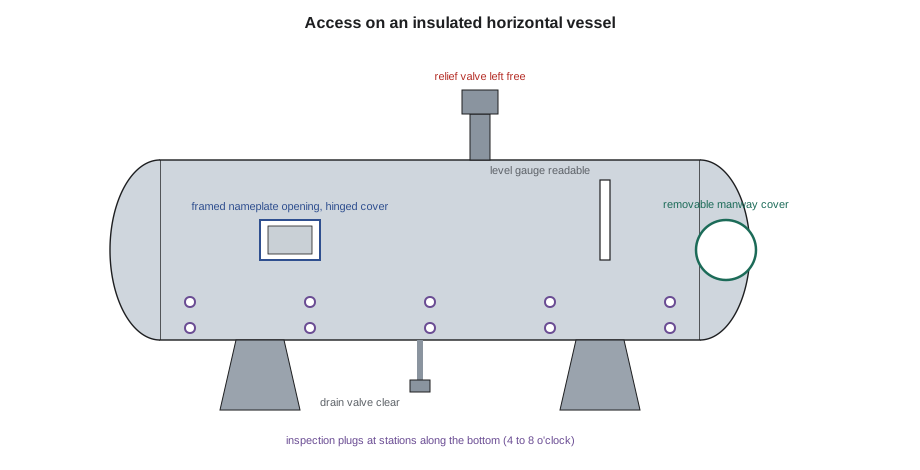
Framed openings
A framed opening is a hole in the insulation and jacket around something that must be seen, such as a nameplate, with its edges closed so water cannot get behind the insulation, and usually a cover. The opening is cut a little larger than the item, the cut edges of the insulation are sealed with a closure, a frame of jacket material or a sealed end cap, and a removable cover, hinged or held by quick-release fasteners or screws, closes it. On hot equipment the cover is insulated on its back; on cold equipment it must seal against a vapour retarder flange, or the opening must be avoided by moving the nameplate to a standoff bracket, which the maker or the authorized repair organization must do.
Worked problem
A framed opening for the deaerator nameplate
The deaerator nameplate is 150 × 100 mm. Coldstream's detail cuts the opening 25 mm larger than the plate on every side, frames it with jacket, and fits a hinged cover that overlaps the frame by 50 mm on every side. What are the opening and cover sizes?
Show solution
- Opening = (150 + 2 × 25) × (100 + 2 × 25) = 200 × 150 mm.
- Cover = (200 + 2 × 50) × (150 + 2 × 50) = 300 × 250 mm.
- The cover is lined with insulation on its back to the same thickness as the vessel insulation, less what the frame leaves room for.
Answer: A 200 × 150 mm opening with a 300 × 250 mm cover.
Inspection ports
INS-220 described corrosion under insulation (CUI): water held against steel under the insulation, corroding it unseen. On vessels, tanks and large pipes, owners and inspectors check for CUI in several ways, including stripping sections, using X-ray or other scanning methods, and measuring wall thickness with an ultrasonic probe at fixed points. Inspection ports or inspection plugs make the last method possible without damaging the insulation: a small hole is cut through the jacket and insulation to the metal at each test point, and closed with a removable plug or cap that seals into the jacket. The inspector pulls the plug, measures through the hole, and pushes it back.
Inspection ports are placed where water collects and corrosion is most likely: at the bottom of horizontal vessels and pipes, typically between the 4 and 8 o'clock positions; just above supports, saddles, rings and stiffeners where water is trapped; below nozzles and penetrations; and at low points and drains. The owner's inspection program, often built on industry practices for managing CUI, sets the locations and spacing; the insulator installs the ports and marks them. Each plug must seal so that the port is not itself a leak; on cold equipment, ports are generally avoided or specially designed, because every hole is a breach of the vapour retarder.
Worked problem
Inspection plugs for the deaerator storage tank
Anika's inspection plan for the 6 m deaerator storage tank calls for plugs at stations every 1.5 m along the shell, starting at one head weld, with three plugs at each station at the 4, 6 and 8 o'clock positions. It also asks for two plugs above each of the two saddles and one plug below each of the six nozzles. How many plugs are needed?
Show solution
- Stations along the shell: 6 ÷ 1.5 = 4 spaces, so 5 stations (including both ends).
- Shell plugs = 5 × 3 = 15.
- Saddle plugs = 2 × 2 = 4. Nozzle plugs = 6 × 1 = 6.
- Total = 15 + 4 + 6 = 25 plugs, each marked on the plan and numbered on the jacket.
Answer: 25 inspection plugs.
Ports must be installed so the inspector can find them years later: numbered on the jacket with a durable label, shown on a sketch or drawing given to the owner, and located where a person can reach them from the floor, a platform or a planned ladder position.
Manways and other openings
A manway is a large bolted opening, typically 450 to 600 mm across, that lets a person enter a vessel for inspection or cleaning. Its cover is heavy and usually hinged on a davit arm or a hinge. Insulating it permanently guarantees that the insulation will be destroyed at the next inspection. Instead, the fixed insulation is stopped at a cutback around the manway neck and flange, as lesson 4 describes for bolted joints, and a removable cover or box closes over the flange and cover. The removable cover must clear the davit or hinge, must not be so heavy that one person cannot handle it, and must be tagged so it goes back on the right way.
Handholes, inspection nozzles and sight glasses are treated the same way on a smaller scale. Sight glasses and level glasses are left clear; insulation is cut around them and the edges closed.
Insulation and maintenance
Most damage to equipment insulation is done not by weather but by people working on the equipment: mechanics, inspectors, electricians and contractors who remove insulation to reach something and do not put it back, or put it back badly. Wet, crushed or missing insulation left after maintenance is a major source of heat loss, CUI and, on cold service, ice. An insulator can do a lot to prevent this:
- Design for removal. Make every part that is opened removable, light enough to handle and easy to refit (lessons 4 and 9).
- Tag and record. Number every removable cover and inspection plug; give the owner a list with locations, sizes and how to refit them.
- Show the people who will open it. A short handover at the equipment with the maintenance crew is worth more than any document.
- Leave spare material for small repairs where the specification or the owner asks for it, such as a few spare plugs, a roll of the right tape, or a spare closure.
- Encourage a call-back rule. Many plants have a rule that insulation removed for maintenance must be reinstated by a qualified insulator before the work permit is closed. Where a plant has no such rule, it is worth suggesting one.
When an insulator is called back to reinstate insulation after maintenance, the first job is to find out what was there: the original material and thickness, whether it was hot or cold service, and whether the insulation that was removed contained asbestos (INS-230). Wet or damaged material is replaced, not reused. On cold equipment, the vapour retarder and vapour stops are restored and sealed before the jacket goes back.
Safety around access points
Openings in insulation expose hot or cold metal. A framed nameplate opening on a steam vessel is a burn point if its cover is left open; label covers on hot equipment with a warning that the surface beneath is hot. Removable covers on relief valves must never be fastened so that they could stop the valve lifting or block its discharge. And before removing any insulation from equipment, confirm with the plant whether the equipment is in service, at what temperature, and whether the insulation is known to be free of asbestos, as INS-230 explained.
The deaerator plan
Wendell and Priya measured the deaerator that afternoon: the nameplate, the manway on the storage tank's end head, the two relief valves on the deaerating head, the level gauge, the six shell nozzles and the two saddles. Anika marked the inspection stations on the shell with a paint stick. The plant's survey showed the deaerator's insulation as mineral wool installed in 2008, asbestos-free, so no special controls were needed to open it. Raj Sandhu is pricing the work as a plan for the plant's Christmas shutdown: a framed nameplate opening with a hinged cover, a removable box cover over the manway, removable blankets on the relief valve inlets that leave the valves free, 25 inspection plugs to Anika's plan, and repairs to the jacket around every nozzle. Lou asked for one more item: a laminated sheet, zip-tied to the deaerator's ladder, showing where every removable cover and plug is.
Insulation inspection programs
Large plants manage their insulation the way they manage their equipment, with a written inspection program. A typical program divides the plant into circuits or areas, records the insulation system on each piece of equipment and line, and sets how often each one is surveyed. The survey looks at the outside first: damaged or missing jacket, open laps, failed sealant, rust stains, sagging insulation and ice or sweating on cold service. On hot equipment, an infrared camera shows hot spots where insulation is wet, slumped or missing. On equipment with inspection ports, the plant's inspectors take thickness readings at the ports, and where readings or stains suggest corrosion, they strip a section to look. The results go into a list of repairs ranked by risk.
Insulators are part of this in two ways. They install and record the access features that make the program possible: the inspection ports, the numbered removable covers, the framed openings and the sketches. And they carry out the repairs that the program finds, usually as a planned list during shutdowns. Repairs done to the same standard as the original, with the same records, keep the program honest; repairs done in a hurry, with no records, are where the next round of corrosion starts.
Records to leave with the owner
At the end of an equipment job, the owner should receive, at the least: the list of equipment insulated, with the materials, thicknesses and finishes used; the product data sheets; the list of removable covers and inspection ports with their numbers and locations; any departures from the specification, with who approved them; and the cover drawings or measurements so that covers can be remade. On plants with an inspection program, the owner may ask for this in a set format. Keep a copy at Coldstream too; when the plant calls years later about a damaged cover, the measurements will still be on file.
Common mistakes
MistakeInsulating over a nameplate.
InsteadLeave a framed opening with a removable cover so inspectors can read it.
MistakeFastening a cover so it could stop a relief valve operating.
InsteadKeep relief valves free; use covers that do not touch the spring housing, lever or discharge.
MistakeCutting inspection ports without sealing plugs.
InsteadEvery port needs a plug that seals into the jacket.
MistakeLeaving removable covers untagged and unrecorded.
InsteadNumber them, record them and hand over the list.
MistakeReusing wet insulation when reinstating after maintenance.
InsteadReplace wet or damaged material and restore the vapour retarder on cold work.
Summary and key terms
- List everything that must be seen, read, operated or opened before insulating equipment.
- Nameplates on boilers and pressure vessels must stay readable: use framed openings with removable covers.
- Keep relief valves, instruments, drains and vents free and reachable.
- Inspection ports let owners check for CUI; place them where water collects, seal their plugs, number and record them.
- Manways and bolted openings get cutbacks and removable covers that clear hinges and davits.
- Design for removal, tag and record, train the maintenance crew, and replace wet material when reinstating.
- Nameplate
- The plate or stamping on a boiler or pressure vessel that records its maker, serial number and design data.
- Framed opening
- A sealed opening in insulation around an item that must be seen, usually with a removable cover.
- Inspection port
- A small sealed opening through the insulation and jacket where the metal can be tested.
- Inspection plug
- The removable plug that closes an inspection port.
- Manway
- A large bolted opening that lets a person enter a vessel.
- Davit
- An arm that supports a manway cover when it is opened.
- Corrosion under insulation
- Corrosion of metal caused by water held against it under insulation.
Practice problems
Work each problem on paper first, then reveal the answer to check.
Name four items on a vessel that must stay visible or reachable.
Show answer
Any four: nameplate, relief valves, manways, instruments, drains and vents, bolted joints, lugs and tags.
A nameplate is 200 × 120 mm. With a 25 mm margin, what is the opening?
Show answer
250 × 170 mm.
Plugs every 2 m along an 8 m shell, three per station. How many shell plugs?
Show answer
8 ÷ 2 = 4 spaces, 5 stations, 15 plugs.
Where on a horizontal vessel are inspection ports most useful?
Show answer
At the bottom between about 4 and 8 o'clock, above supports and below nozzles.
Why are inspection ports generally avoided on cold equipment?
Show answer
Every hole breaches the vapour retarder.
Lesson quiz · 5 questions
Score 60% or more to complete this lesson.
Create a free account to save your progress, take quizzes and earn a certificate.