
INS-310 · Lesson 2 of 12 · 25 min
Vessel heads and shells
▶ Video coming soon A video version of this lesson is on the way.
During the Kellerton outage in the first week of November, while Devon's crew worked on the steam header and Tomasz and Wendell waited for the receiver to be ready for jacket, Priya spent Monday and Tuesday on the crew that re-insulated the condensate receiver. The receiver is a horizontal steel vessel, 1,220 mm in diameter and 2,440 mm long on its shell, with a dished head at each end. Its old insulation had been wet for years. The shell went quickly: curved board, banded tight. The heads took longer. "A head is a shell that changed its mind," the crew's journeyperson said, holding up the first tapered gore Priya had cut. "It curves two ways at once, so nothing flat will lie on it."
A vessel is a closed container for liquid or gas: a tank, a receiver, a drum, a column, a deaerator, a separator. Most are a cylindrical shell closed at each end by a head. INS-220 showed how the jacket goes over a vessel's shell and heads. This lesson covers the insulation underneath: the kinds of heads, how vessels are measured, how shells are insulated, and how heads are insulated with gores, blanket, block or cement.
Shells, heads and how vessels are described
The shell is the cylindrical body of the vessel. It is described by its outside diameter, its length or height between the two tangent lines (the lines where the straight shell ends and the curve of the head begins), and its orientation: vertical or horizontal. Vessel drawings give the tangent-to-tangent length, the outside or inside diameter and the wall thickness. For insulation, the outside diameter matters; if only the inside diameter is given, add twice the wall thickness.
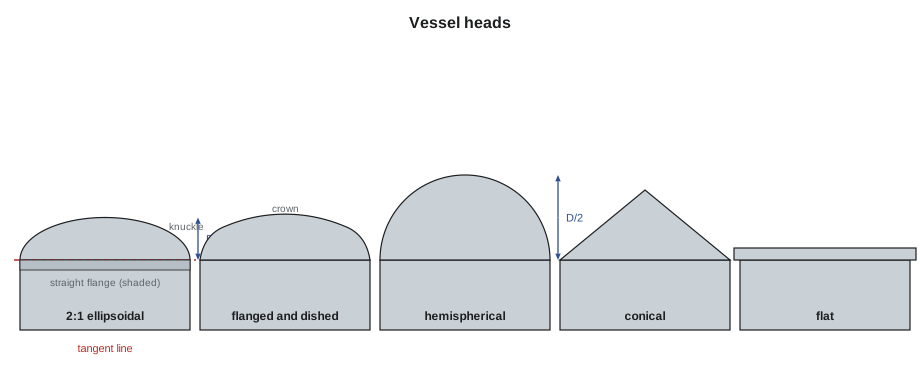
The head closes the end of the shell. Heads come in several shapes, and the shape decides how they are insulated:
- Ellipsoidal heads, usually 2:1, are shaped like half of a squashed sphere. The depth of the dish is about one quarter of the diameter. They are common on pressure vessels.
- Torispherical heads, also called flanged and dished (F&D) heads, have a large central dish of one radius blending into a tight knuckle of a smaller radius at the edge. They are shallower than 2:1 heads and are common on pressure and atmospheric vessels.
- Hemispherical heads are half spheres, the deepest common head, used on high-pressure vessels and some storage spheres.
- Conical heads are cones, used at the bottom of vessels that must drain completely, such as hoppers and food or process tanks.
- Flat heads are flat plates, often bolted, used on low-pressure vessels, heat exchanger channels and some tanks.
Each head type except the flat one has a short straight flange between the tangent line and the weld that joins it to the shell. On a drawing the straight flange belongs to the head; on site it looks like part of the shell. Shell insulation usually runs to the weld seam or the tangent line, and head insulation picks up from there.
Measuring a vessel for insulation
Before cutting anything, measure the vessel itself; drawings may show the design, not what was built. For the shell, measure the circumference with a tape at several places along the length, because large shells are not perfectly round and a few millimetres of difference in diameter matters over a full ring. Divide the circumference by π to get the actual outside diameter. Measure the length between the head welds or tangent lines along the top and along the bottom.
For each head, measure its depth from the tangent line to the centre, the length of a meridian (a line over the head from the tangent line to the centre, measured with a flexible tape laid on the surface), and the positions of every nozzle, manway and lifting lug. Record everything on a sketch showing the vessel from the side and from each end, with nozzles marked by their angle around the vessel and their distance from a tangent line. Every one of those nozzles is a hole the insulator will have to cut, fit and close.
Then work out the insulated dimensions. The insulation adds twice its thickness to every diameter and its thickness to every depth. On a vessel insulated in two layers, the outer layer is cut to the outer surface of the inner layer, not to the vessel. Jacket, as INS-220 showed, is cut to the outer surface of the insulation.
Insulating the shell
Vessel shells are insulated with curved segments, scored board, semi-rigid board, flat staves or blanket, chosen by diameter, temperature and service. Small vessels, up to the largest pipe covering size, can take oversize pipe covering. Above that, the common choices are:
- Curved segments of calcium silicate, cellular glass, perlite or foam, made for the vessel's diameter. They give a firm, accurate surface and are common on hot process vessels and on cold vessels.
- Scored or semi-rigid board for vessels of moderate temperature, folded or bent around the shell. The grooves face the vessel.
- Blanket, wired or unfaced, for irregular or very hot vessels, held with bands or mesh.
On a horizontal vessel, shell insulation is laid in rings around the shell with the longitudinal joints staggered from ring to ring, like brickwork. On a vertical vessel, it is laid in courses from the bottom up, each course resting on the one below or on a support ring (lesson 3), with the vertical joints staggered between courses. In two-layer work, the outer layer's joints are offset from the inner layer's joints in both directions, as lesson 1 explains.
Shell insulation is usually held by bands of stainless steel or galvanized steel at regular spacing, plus support rings on tall vertical vessels. Bands should be tight enough to close joints but not so tight that they crush the outer edges of the board. On vessels that get very hot, the inner layer's bands are sometimes fitted with expansion springs or breathing clips, so the bands stay tight as the vessel grows and shrinks.
Worked problem
Insulating the receiver shell
The receiver shell is 1,220 mm in outside diameter and 2,440 mm long, insulated with 64 mm board. What is the outer diameter and girth of the insulation, and what area of insulation does the shell take? Bands go at about 300 mm spacing with one within about 75 mm of each end. How many bands are needed?
Show solution
- Insulated diameter = 1,220 + 2 × 64 = 1,348 mm.
- Girth at the insulation's outer surface = π × 1,348 = 4,235 mm.
- Area at the outer surface = 4.235 × 2.44 = 10.33 m². (At the vessel surface it is π × 1.22 × 2.44 = 9.35 m²; boards are ordered on the outer area plus waste.)
- Bands: the end bands are 2,440 − 2 × 75 = 2,290 mm apart; 2,290 ÷ 300 = 7.6, so 8 spaces and 9 bands.
Answer: The insulation is 1,348 mm across and 4,235 mm round; the shell takes about 10.3 m² and 9 bands.
Why heads are harder
A cylinder curves in one direction only, so a flat sheet or board can be bent around it. A head curves in two directions at once, like a ball. Nothing flat can be laid on a double curve without cutting, stretching or folding it. That is why heads are insulated with materials that can be cut into small tapered pieces, materials that are flexible enough to follow the shape, or materials that can be formed in place.
The surface area of a head is larger than it looks. A 2:1 ellipsoidal head has an outer surface area roughly 1.1 times the square of its diameter, measured at whatever surface you are insulating. A flanged and dished head is a little less; a hemispherical head is about 1.57 times the square of its diameter. A flat head is simply the area of a circle, about 0.79 times the square of its diameter. These factors are close enough for ordering material; for cutting, measure the real meridian.
Method 1: gores
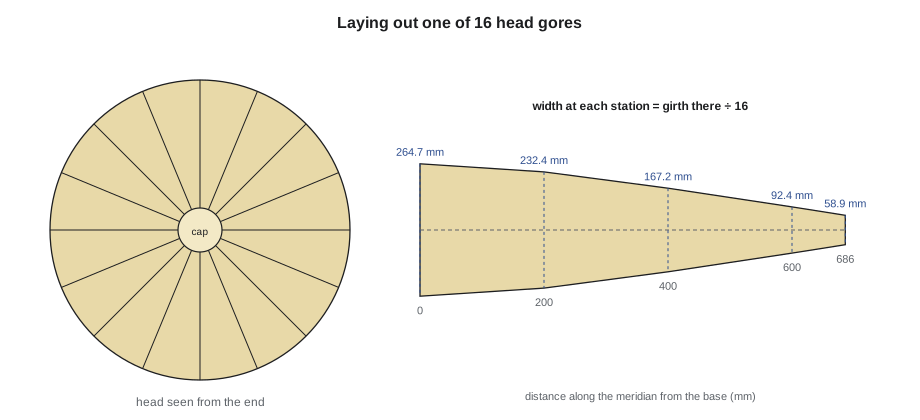
The most common way to insulate a dished head with board is to cut it into gores: tapered pieces that run from the edge of the head to a small circle at the centre, like the segments of a peeled orange. Each gore is narrow enough that, although it is flat across its width, it lies close to the head. The centre, where the gores would become too thin to cut, is closed by a round centre cap of board. This is the same layout INS-220 used for jacket gores on heads, applied to the insulation underneath.
To lay out gores, decide the number of gores, N. The width of each gore at the base (the tangent line or the shell edge of the head) is the girth there divided by N. Its length is the length of the meridian from the base to the edge of the centre cap. Its width at any point along its length is the girth of the head at that point divided by N. Because the head curves, the width does not shrink evenly; it shrinks slowly near the base and quickly near the centre. Measure the girth at several points, or calculate it, and mark the widths at those stations along the gore's centre line, then join the points with a smooth curve.
Worked problem
Gores for a receiver head
The receiver's heads are 2:1 ellipsoidal. At the outer surface of the 64 mm insulation, the head is 1,348 mm across at its base and 369 mm deep. The crew cut 16 gores per head and a centre cap 300 mm across. Measured over the insulated surface, the meridian from the base to the cap edge is 686 mm. The girth at the base is π × 1,348 = 4,235 mm. Measured at stations along the meridian, the head's girth at 200 mm, 400 mm and 600 mm from the base was 3,718, 2,675 and 1,478 mm. What are the gore widths at the base, at each station and at the cap edge?
Show solution
- Base width = 4,235 ÷ 16 = 264.7 mm.
- At 200 mm: 3,718 ÷ 16 = 232.4 mm. At 400 mm: 2,675 ÷ 16 = 167.2 mm. At 600 mm: 1,478 ÷ 16 = 92.4 mm.
- At the cap edge, 686 mm from the base, the girth is π × 300 = 942.5 mm, so the width = 942.5 ÷ 16 = 58.9 mm.
- The width falls by only 32 mm in the first 200 mm but by 75 mm between 400 and 600 mm, so the gore's sides curve inward near the tip.
Answer: Gore widths: 264.7 mm at the base, 232.4, 167.2 and 92.4 mm at the stations, and 58.9 mm at the cap.
Gores are cut from board thin enough or flexible enough to follow the curve along their length. Rigid board thicker than about 50 mm may need to be scored across its width, or the head insulated in two thinner layers of gores with the second layer's joints falling in the middle of the first layer's gores. The gores are held by bands that run from a floating ring at the centre of the head to the shell bands or a ring at the tangent line, by pins on the head, or by wire laced between them. The centre cap is held by the same bands or pins. Joints between gores are butted tight and packed.
More gores give a closer fit but more cutting and more joints. A common starting point is to make the gore base width about 250 to 300 mm, then round N to a number that is easy to lay out: 8, 12, 16, 20 or 24.
Method 2: blanket and mesh
Flexible blanket follows a head without being cut into gores, as long as it is slit or darted to take up the excess material as it curves in. Wired blanket is laid over the head in pieces, the wire mesh faces are laced together with tie wire at every joint, and the blanket is held by bands or by lacing to a ring at the tangent line and a floating ring at the centre. Blanket is fast and forgiving on irregular heads with many nozzles, but it compresses where it is banded and gives a softer surface under jacket, so the jacket may need extra support or the blanket may need a rigid outer layer.
Method 3: block and cement
On high-temperature equipment, heads are sometimes insulated with small pieces of block, such as calcium silicate, cut to fit and laid in courses like a dome, with insulating cement filling the gaps and the whole surface finished with cement over wire mesh. This is slow work but gives a hard, durable surface that can take high temperatures and some physical abuse. It is common on boiler drums, older equipment and repair work. Small heads, such as those on strainers or small tanks, are sometimes insulated entirely with insulating cement built up over mesh in layers, as INS-210 described for fittings.
Conical and flat heads
A cone curves in only one direction, so it can be insulated with board or blanket cut to a flat pattern developed by the radial line method, the same method INS-220 used for jacket cones. Rigid board on a cone is cut into tapered staves, each narrow at the small end; semi-rigid board and blanket can be cut as one or a few large pieces. Bottom cones need the most holding of any surface, because the insulation hangs below them; pins on the cone or bands to a ring at the outlet are common.
A flat head is insulated like any flat surface, with board on pins, but it is often a bolted cover that must come off for maintenance. In that case the insulation is made as a removable cover, as lesson 4 explains.
Horizontal and vertical vessels
Orientation changes the details. On a horizontal vessel, both heads are vertical, so gores hang from their fasteners and the bottom half of the shell insulation hangs from its bands; the saddles that support the vessel interrupt the insulation and must be insulated around and sealed. On a vertical vessel, the top head sheds water and the bottom head hangs; the shell insulation is carried by support rings at intervals, and the bottom head and its skirt or legs are often the hardest part of the job, insulated from below with the material held up by pins, bands and mesh. Lesson 12 follows a vertical vessel through its whole insulation job.
On the receiver, the crew finished both heads with 16 gores and a centre cap each, held by stainless bands from a floating ring at the centre of each head to the end bands of the shell. When Wendell and Tomasz came to jacket the receiver later that week, the jacket gores lay over the insulation gores almost one for one, which, Wendell told Priya, is the best compliment an equipment jacketer can pay an equipment insulator.
Common mistakes
MistakeMeasuring the shell diameter from the drawing only.
InsteadMeasure the circumference in several places and divide by π.
MistakeCutting head gores with straight sides from base to tip.
InsteadMark the width at several stations along the meridian and join them with a smooth curve.
MistakeLaying thick rigid board gores that bridge the curve of the head.
InsteadUse thinner layers, scored board or more gores so they lie close.
MistakeForgetting the straight flange.
InsteadKnow where the tangent line is and where the shell insulation stops and the head insulation starts.
MistakeOrdering head material from the flat area of a circle.
InsteadUse the head's real area, about 1.1 times the diameter squared for a 2:1 head.
Summary and key terms
- Vessels are a cylindrical shell closed by heads: ellipsoidal, flanged and dished, hemispherical, conical or flat.
- Measure the real vessel: circumference, length between tangent lines, head depth and meridian, and every nozzle.
- Shells take curved segments, scored or semi-rigid board, staves or blanket, banded and staggered.
- Heads curve two ways, so they are insulated with gores and a centre cap, blanket and mesh, or block and cement.
- Gore width at any station is the girth there divided by the number of gores.
- Cones are developed by radial line; flat heads are insulated like flat surfaces or made removable.
- Shell
- The cylindrical body of a vessel.
- Head
- The closed end of a vessel shell.
- Tangent line
- The line where the straight shell ends and the curve of the head begins.
- Straight flange
- The short straight part of a head between its tangent line and the weld to the shell.
- Ellipsoidal head
- A dished head shaped like half a flattened sphere; a 2:1 head is one quarter of its diameter deep.
- Flanged and dished head
- A torispherical head with a central dish and a tight knuckle at the edge.
- Meridian
- A line over a head from the tangent line to the centre.
- Gore
- A tapered piece of insulation or jacket that runs from the edge of a head to its centre.
- Centre cap
- The round piece that closes the centre of a head where the gores meet.
Practice problems
Work each problem on paper first, then reveal the answer to check.
A shell measures 4,712 mm around. What is its diameter?
Show answer
4,712 ÷ π = 1,500 mm.
What is the base width of each of 20 gores on a head whose insulated girth is 5,500 mm?
Show answer
5,500 ÷ 20 = 275 mm.
Roughly what area does a 2:1 head 1.5 m across have?
Show answer
About 1.1 × 1.5² = 2.5 m².
Why can't flat board be laid on a dished head without cutting?
Show answer
The head curves in two directions at once.
Name three ways of insulating a dished head.
Show answer
Gores and a centre cap; blanket and mesh; block and cement.
Lesson quiz · 5 questions
Score 60% or more to complete this lesson.
Create a free account to save your progress, take quizzes and earn a certificate.