
INS-220 · Lesson 2 of 12 · 21 min
Jacket materials: aluminum, stainless steel and PVC
▶ Video coming soon A video version of this lesson is on the way.
For the second jacketing night, Tomasz laid out samples on the long bench in the Coldstream shop: a roll of smooth aluminum with a brown paper backing, a sheet of stucco-embossed aluminum, a piece of corrugated aluminum, a roll of stainless steel, a stack of white PVC sheet and a box of PVC elbow covers. "Pick up each one," he said. "Bend it. Look at the back. Then tell me where you would put it and where you would never put it." Devon picked up the stainless roll and nearly dropped it. It was much heavier than it looked, and its cut edge was sharp enough to catch on his glove.
The previous lesson explained why insulation needs a jacket. This lesson describes the materials jackets are made of: aluminum, stainless steel and PVC, plus a few others you will meet. For each one it covers the forms it comes in, its thickness and finishes, the moisture barrier on its back, and where it is and is not used. The choice is usually made by the specification, but an insulator who understands the materials can spot a wrong substitution, order the right product and fasten each one the right way.
Aluminum jacketing
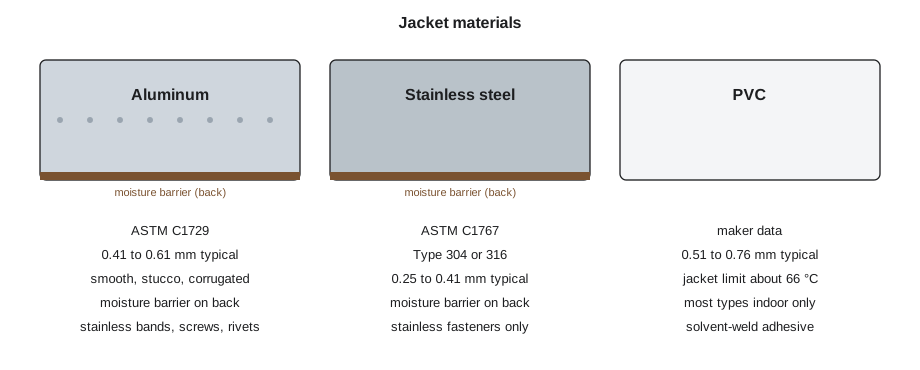
Aluminum is the most common metal jacket. It is light, it resists weather well, it is easy to cut and form with hand tools, and it costs much less than stainless steel. Aluminum jacketing is covered by ASTM C1729, which sets the alloys, thicknesses, coatings and moisture barriers for aluminum made for insulation. The base metal is aluminum sheet of the kind covered by ASTM B209, the general standard for aluminum sheet and plate. C1729 lists several alloys, including the 3000 series alloys commonly used for jacketing, 1100 and 5052, and groups the product by its outer surface (bare, painted or film-coated), its alloy and its moisture barrier.
Aluminum jacketing comes in rolls, in flat sheets, and as factory-made pieces: pre-cut and rolled pipe jacket with a factory longitudinal seam, two-piece pressed elbow covers, and fitting covers for tees and valves. Rolls are usually 914 mm or 1,219 mm wide. Sheets are cut from rolls or bought flat. Three surface finishes are common:
- Smooth: a plain surface. It shows dents and scratches easily but is easy to clean and cut.
- Stucco embossed: a pebbled surface pressed into the sheet. It hides small dents and reflects light less harshly, and it is slightly stiffer than smooth sheet of the same thickness.
- Corrugated: shallow corrugations, often about 5 mm deep, that run around the pipe. They let the jacket stretch a little as the pipe expands and add stiffness. Deep corrugated and box-rib profiles are used on large tanks and vessels.
Thickness is given in millimetres or in thousandths of an inch. Common jacket thicknesses are about 0.41 mm (0.016 in), 0.51 mm (0.020 in), 0.61 mm (0.024 in) and 0.81 mm (0.032 in). C1729 relates the minimum thickness to the outside diameter of the insulation and to how rigid the insulation is: thicker jacket on larger diameters, and thicker jacket over soft insulation that cannot support the metal. As a typical pattern, 0.41 mm (0.016 in) is common on pipe insulation up to a few hundred millimetres across, with thicker sheet on larger pipe and equipment. The specification sets the thickness for each size; it should be checked against what was delivered.
The moisture barrier
Turn over a piece of aluminum jacketing and you will usually find a thin layer on the back: brown kraft paper with a plastic film, or a clear or coloured plastic film alone. This is the moisture barrier. It is not a vapour retarder for cold service, though it is sometimes mistaken for one. Its job is to stop corrosion of the jacket itself. Moisture trapped between bare aluminum and insulation, especially insulation that contains chlorides or is alkaline, such as calcium silicate, can pit the jacket from the inside. Moisture can also collect between the metal and a hot steel pipe and cause galvanic corrosion where the two touch. A moisture barrier keeps the metal separated from the insulation and the pipe.
C1729 classes moisture barriers as polykraft (a kraft paper and polyethylene layer) or polyfilm (a plastic film), and requires them to be factory applied and heat laminated to the metal, not glued on site. Polyfilm resists water better than polykraft and is often preferred outdoors and over insulation that may get wet. Many specifications require a moisture barrier on all aluminum jacket over pipe insulation. When you cut, form and install aluminum, the moisture barrier must always face inward, against the insulation. When forming laps and beads, take care not to tear or scrape it.
Stainless steel jacketing
Stainless steel jacketing is covered by ASTM C1767, which follows the same pattern as C1729 for types and classes and names two grades: Type 304 and Type 316. Type 304 is the common general-purpose stainless steel; Type 316 contains molybdenum and resists chlorides and many chemicals better, so it is chosen for marine and coastal areas, plants that use chlorinated cleaners and many chemical plants. Common jacket thicknesses are thinner than aluminum for the same job, often about 0.25 mm (0.010 in) or 0.41 mm (0.016 in), because stainless steel is much stronger and stiffer.
Stainless steel is used where aluminum would not last or would not be safe: food and beverage plants where caustic washdown would attack aluminum; chemical areas; high-abuse areas where people stand on or bump the jacket; and fire-risk areas, where an aluminum jacket would melt and fall away and where molten aluminum dripping on stainless steel pipe at fire temperatures can damage the pipe metal. Some plant standards forbid aluminum jacket on stainless steel piping for that reason.
Stainless steel is harder to work. It needs sharper and stronger snips, a heavier brake and more care with edges. It work-hardens, so a bead or crimp that is formed and then re-formed can crack. It must be fastened with stainless steel bands, screws and rivets. Carbon steel tools can leave steel particles on the surface, which rust and stain it; many shops keep separate tools and benches for stainless for this reason.
PVC jacketing and fitting covers
PVC, polyvinyl chloride, is a plastic jacket used mainly indoors. It comes in rolls and sheets in thicknesses from about 0.25 mm to 1.0 mm (10 to 40 mil), with about 0.51 mm (20 mil) common for interior pipe and heavier sheet for higher abuse, and as pre-formed fitting covers for elbows, tees, valves, reducers and end caps. INS-210 showed how PVC fitting covers are fitted over insulation inserts; this course covers the PVC jacket over straight runs as well.
PVC has real advantages. It is cleanable, which is why hospitals and food plants like it. It can be sealed with a solvent-weld adhesive made for the purpose, so laps and joints become one continuous plastic skin. It is easy to cut with a knife or shears, and it does not dent. White PVC looks clean and reflects light well in a mechanical room.
It also has firm limits. Its service temperature is low: makers commonly limit the jacket itself to about 66 °C (150 °F), so on a hot line there must be enough insulation under it to keep the PVC below that temperature, and PVC is never put directly against a hot surface. Most coloured PVC is for indoor use only, and even white PVC rated for some sunlight may need a heavier sheet or paint for outdoor use; follow the maker's instructions. PVC grows and shrinks much more with temperature than metal does. It becomes stiff and brittle in the cold, so makers give minimum temperatures for installing it, and work in an unheated building in January may have to wait or be warmed. Finally, PVC jackets used in plenums and exposed in buildings must carry the required flame spread and smoke ratings, often 25 and 50.
| Property | Aluminum | Stainless steel | PVC |
|---|---|---|---|
| Standard | ASTM C1729 (sheet to ASTM B209) | ASTM C1767 (Types 304, 316) | Maker data; flame and smoke ratings |
| Typical thickness on pipe | 0.41 to 0.61 mm | 0.25 to 0.41 mm | 0.51 to 0.76 mm |
| Relative weight of a piece of the same size and typical thickness | Light | About twice aluminum | About two-thirds of aluminum |
| Temperature | Fine over hot insulation; melts at about 660 °C | Fine over hot insulation; keeps its shape in fire | Jacket limit about 66 °C; brittle in the cold |
| Main weakness | Dents; attacked by strong alkalis | Cost, harder to work | Heat, sunlight, cold weather installation |
| Fastening | Bands, stainless screws or rivets | Stainless bands, screws, rivets | Solvent-weld adhesive, tacks, bands where needed |
Expansion and contraction
All jackets grow when they warm and shrink when they cool. A jacket on a hot line is heated by the small amount of heat that gets through the insulation and by the sun; it also cools on winter nights. The amount of movement depends on the material. As typical values, aluminum grows about 23 millionths of its length per degree Celsius (12.8 millionths of its length per degree Fahrenheit), stainless steel about 17 (9.6) millionths and PVC much more, roughly 60 (33) millionths. Over a long run, those small numbers add up, and a jacket that is fastened so it cannot move will buckle at laps or pull its fasteners out. Lessons 5 and 11 show how laps are left free to slide and where slip joints go.
Worked problem
Comparing jacket materials for a long run
Tomasz asked the apprentices to compare a 30 m run of jacket on an outdoor line that will see a jacket temperature swing of 50 °C between a cold winter night and a hot summer afternoon. Use typical expansion values of 23, 17 and 60 millionths per degree Celsius for aluminum, stainless steel and PVC. Then compare the weight of one jacket piece 914 mm × 730 mm in 0.41 mm aluminum, 0.25 mm stainless steel and 0.51 mm PVC, using densities of about 2,700, 8,000 and 1,400 kg/m³.
Show solution
- Length = 30 m = 30,000 mm.
- Aluminum movement = 23 × 10⁻⁶ × 30,000 × 50 = 34.5 mm.
- Stainless steel movement = 17 × 10⁻⁶ × 30,000 × 50 = 25.5 mm.
- PVC movement = 60 × 10⁻⁶ × 30,000 × 50 = 90 mm.
- Piece area = 0.914 × 0.730 = 0.667 m².
- Aluminum: 0.667 × 0.00041 × 2,700 ≈ 0.74 kg. Stainless: 0.667 × 0.00025 × 8,000 ≈ 1.33 kg. PVC: 0.667 × 0.00051 × 1,400 ≈ 0.48 kg.
Answer: Aluminum moves about 35 mm, stainless about 26 mm and PVC about 90 mm over the run. A piece weighs about 0.74 kg in aluminum, 1.33 kg in stainless and 0.48 kg in PVC.
The point of the comparison was not the exact numbers. The point was that PVC moves about two and a half times as much as aluminum and should not be used outdoors unless the maker allows it, and that stainless steel, even in a thinner sheet, is heavier to carry up a ladder and onto a rack.
Other finishes you will meet
Several other finishes appear on specifications and older work. Mastic and reinforcing fabric finishes, covered in INS-210, are used on irregular shapes and where metal cannot be formed. Factory facings such as the all-service jacket and foil-scrim-kraft are used on concealed work. Multi-layer laminated jackets, made of foil and plastic layers with a pressure-sensitive adhesive, are used on some outdoor and cold-service work because they seal well at laps; they need clean, dry surfaces and must be applied within the maker's temperature range. Aluminum with a factory plastic film or paint finish is used where a colour is wanted or where bare aluminum would corrode. Galvanized steel jacketing is now rare but is found on older plants, where its rust shows how long water has been getting in.
Storing and handling jacketing
Jacketing is easy to ruin before it ever reaches the pipe. Rolls stored on end crush their edges; rolls dropped off a truck dent. Aluminum and stainless stored outside in the wet can stain, and wet moisture barrier paper can rot and peel off. PVC left in the sun or in a hot truck can warp, and PVC brought in from a cold trailer must warm up before it is formed. Store rolls flat or on their sides on racks or pallets, indoors and dry, with their wrapping on until they are used. Keep stainless away from carbon steel grinding and cutting. Keep PVC adhesive within its storage temperature and use it before its expiry date.
Handle sheet metal with cut-resistant gloves and sleeves. A sheet of jacket is light, but it is a large, sharp blade in the wind. On a roof or a pipe rack, carry only what can be controlled, keep pieces tied down, and never leave loose sheets where wind can catch them.
Common mistakes
MistakeCalling the jacket's paper backing a vapour retarder.
InsteadIt is a moisture barrier that protects the jacket; cold service still needs its own sealed vapour retarder.
MistakeInstalling aluminum with the moisture barrier facing out.
InsteadThe moisture barrier always faces the insulation.
MistakeUsing aluminum in a caustic washdown area because it was in stock.
InsteadUse the specified jacket, usually stainless steel or a suitable PVC, where caustic washdown is used.
MistakeFastening stainless jacket with carbon steel screws.
InsteadUse stainless steel bands, screws and rivets on stainless jacket.
MistakePutting PVC on a line hotter than its limit with thin insulation under it.
InsteadCheck that the PVC will stay below its service temperature, and use metal if it will not.
Summary and key terms
- Aluminum jacketing is covered by ASTM C1729 and comes smooth, stucco embossed or corrugated, in rolls, sheets and formed pieces.
- The factory-laminated moisture barrier on metal jacket protects the jacket from corrosion; it must face the insulation and is not a vapour retarder.
- Stainless steel jacketing, covered by ASTM C1767 in Types 304 and 316, is used in corrosive, washdown, high-abuse and fire-risk areas.
- PVC is cleanable and sealable but has a low service temperature, limited sunlight resistance and high expansion, and is brittle when cold.
- Thickness is set by the specification and depends on insulation diameter and rigidity.
- Store jacketing flat, dry and wrapped, and handle it with cut-resistant gloves.
- Moisture barrier
- A factory-laminated film or paper and film on the back of metal jacket that protects the jacket from corrosion.
- Polykraft
- A moisture barrier of kraft paper and polyethylene laminated to metal jacket.
- Polyfilm
- A plastic film moisture barrier laminated to metal jacket.
- Stucco embossed
- A pebbled surface pressed into aluminum jacket.
- Corrugated jacket
- Jacket with shallow ridges around the pipe that add stiffness and allow some movement.
- Type 316
- A stainless steel grade with molybdenum, used where chlorides or chemicals are present.
- Solvent-weld adhesive
- An adhesive that softens PVC so laps fuse into one piece.
- Work hardening
- The hardening of metal such as stainless steel each time it is bent, which can lead to cracking.
Practice problems
Work each problem on paper first, then reveal the answer to check.
Which ASTM standard covers aluminum jacketing for insulation?
Show answer
ASTM C1729.
Which way does the moisture barrier face?
Show answer
Inward, against the insulation.
Why is Type 316 stainless chosen over Type 304 in some areas?
Show answer
It resists chlorides and many chemicals better.
What is a common service temperature limit for a PVC jacket?
Show answer
About 66 °C.
A 20 m run of aluminum jacket warms by 40 °C. Using 23 millionths per degree, how much does it grow?
Show answer
23 × 10⁻⁶ × 20,000 × 40 = 18.4 mm.
Lesson quiz · 5 questions
Score 60% or more to complete this lesson.
Create a free account to save your progress, take quizzes and earn a certificate.