
INS-220 · Lesson 11 of 12 · 23 min
Outdoor and corrosive environments
▶ Video coming soon A video version of this lesson is on the way.
Lou Brisebois, Kellerton's maintenance manager, came to the Coldstream shop on the last jacketing night of September, a week before the rack job started, with a piece of steel pipe in a plastic bag. It was a short length of NPS 3 condensate line cut out of the yard rack in the summer, after it had leaked. The outside of the pipe was scaled and pitted, and in one spot the wall was gone. "Twenty-two years old," Lou said. "The inside is fine. The outside rotted under the insulation. We never saw it until it sprayed a forklift driver with hot water." He passed the pipe around. Then he said why he had come: Kellerton wanted the new rack jacket, starting the next Monday, built so that it would not happen again, and wanted the apprentices to understand why.
Indoor jacketing protects insulation from bumps and the occasional leak. Outdoor and corrosive environments are much harder: rain and snow for months of the year, sun, wind, freeze-thaw cycles, salt, chemicals and washdown. This lesson covers how those conditions attack jacketed systems, what corrosion under insulation is and when it happens, how jacket materials are chosen for corrosive areas, and the details that keep outdoor jacket working for decades.
Weather
Outdoors, every lap and penetration is tested by rain, and wind drives rain sideways and even uphill into laps that would shed falling rain. Snow sits on the top of pipes and on vessel heads and melts slowly into any gap. Ice forms in laps and pries them open. Sun heats the top of a jacket far above the air temperature, so the jacket expands and contracts more outdoors than indoors, and ultraviolet light breaks down plastics, many sealants and some facings. Wind pulls at loose jacket, flexes it until fasteners loosen and bands fatigue, and in a storm can peel jacket off a rack.
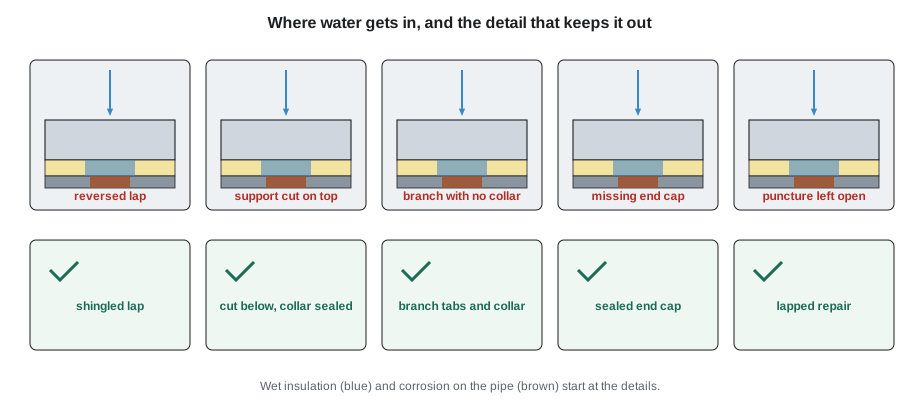
Outdoor jacket is therefore built more strictly than indoor jacket: metal jacket only unless a plastic is rated for the exposure, laps sealed where the specification calls for it, bands at closer spacing or heavier, seams placed away from the prevailing weather, every termination capped and every penetration flashed and sealed, and slip joints for movement. The specification for the Kellerton rack, for example, called for aluminum jacket with polyfilm moisture barrier, stainless bands at 230 mm (9 in) spacing, sealant in every circumferential lap and slip joints at about 9 m (30 ft).
Corrosion under insulation
Corrosion under insulation, CUI, is corrosion of the outside of a pipe or vessel caused by water held against it by wet insulation. It is hidden by the insulation and jacket, so it often goes unnoticed until a leak, and it is one of the largest maintenance costs in many plants. Industry guidance, such as the AMPP (formerly NACE) standard practice on CUI and the API recommended practice on it, explains where it happens and how to control it.
- Carbon and low-alloy steel corrode under insulation most actively in a band of operating temperatures, commonly given as about −4 °C to 175 °C (25 °F to 350 °F). Below that range, water is mostly frozen; above it, water boils off quickly. Within it, warm water and oxygen make an aggressive mix, and the corrosion rate generally rises with temperature until the surface becomes too hot to stay wet.
- Austenitic stainless steel, such as Types 304 and 316, does not rust the same way, but it can suffer chloride stress corrosion cracking under wet insulation, typically at about 60 °C to 175 °C (140 °F to 350 °F). Chlorides can come from the insulation, from rain, from coastal air or from chemicals. This is why insulation for stainless steel is often required to meet ASTM C795, which limits leachable chlorides.
- Lines that cycle in temperature, or that run hot only part of the time, are often the worst. A steam line that runs above the CUI range most of the year still corrodes during outages and shutdowns, when it cools into the range with wet insulation on it. Dead legs and lines that are usually off are high risk too.
Controlling CUI is shared work. The owner and designer decide on coatings for the pipe under the insulation, on insulation materials and on inspection. The insulator's part is to keep water out and, where water does get in, to let it get out: correct laps, sealed penetrations, end caps, drain holes on hot service where specified, and no damage left unrepaired. Most CUI starts at the details listed in lesson 1, and most of those details are in the insulator's hands.
Worked problem
Which rack lines are at risk?
The Kellerton yard rack carries five lines: an NPS 6 steam line at about 186 °C that is shut down for about two weeks each year; an NPS 3 condensate return at about 95 °C; an NPS 2 hot water line at about 60 °C; an ammonia suction line at about −34 °C; and an NPS 2 stainless steel process line that runs at about 80 °C. Using the typical ranges above, which lines are in a CUI range, and what kind?
Show solution
- Steam, carbon steel, 186 °C: above the 175 °C top of the range in service, but it cools through the range at every shutdown. At risk during outages; treat as at risk.
- Condensate, carbon steel, 95 °C: inside −4 to 175 °C. At risk all the time. This is the line Lou brought in.
- Hot water, carbon steel, 60 °C: inside the range. At risk.
- Ammonia suction, carbon steel, −34 °C: below the range. Corrosion is slow while it is cold, but the line is cold service: its risk is wet, iced insulation if the vapour retarder fails.
- Stainless process line, 80 °C: inside the 60 to 175 °C range for chloride stress corrosion cracking. At risk if chlorides reach the pipe; insulation should meet ASTM C795.
Answer: Four of the five lines are in a CUI range for at least part of the year, and the fifth depends entirely on its vapour retarder. Every line on the rack needs a jacket built to keep water out.
Chemicals, washdown and salt
Some environments attack the jacket itself. Aluminum is attacked by strong alkalis, such as the caustic cleaners used in food plant washdown, and by some acids; in those areas, stainless steel or a suitable PVC is specified. Chlorides from coastal air, road salt spray, pool and water treatment chemicals and chlorinated sanitizers can pit Type 304 stainless steel, so Type 316 is chosen where they are present. Some plant atmospheres contain fumes that attack bare aluminum, and coated aluminum with a factory plastic film is used there. At Kellerton, the outdoor rack is aluminum, but the processing rooms where the floors and equipment are washed down daily are jacketed in Type 316 stainless steel and PVC.
Sealants, bands and screws must suit the environment too. A sealant that is fine on a dry rack may soften under washdown chemicals. Aluminum bands corrode where stainless bands last. Every fastener in a corrosive area should be stainless, and of the same grade as or a better grade than the jacket.
Inspection openings and drain points
Many owners inspect insulated lines for CUI. Some use methods that look through the insulation; many also cut small openings or install inspection plugs: removable plugs in the jacket and insulation at set intervals and at likely CUI locations, such as low points, supports and branches, so the pipe surface can be checked without stripping the line. An inspection plug is a short cylinder of insulation with a jacket cap, fitted in a round hole and sealed with a removable sealant or a gasketed cap. They are only as good as their seal; an unsealed plug is a hole in the jacket.
Worked problem
Inspection plugs and drain holes on a section of the rack steam line
Kellerton's standard calls for inspection plugs on outdoor hot lines at 3 m spacing, plus one at each support, each branch and each low point not already covered. The 36 m straight section of the steam line between its expansion loops has 7 supports, 2 branches and 2 low points. Plugs on the regular spacing start 1.5 m from one end. The same standard calls for a 6 mm drain hole in the bottom of the jacket at each low point and at the bottom of each vertical drop; the line has the 2 low points and 2 drip leg drops. About how many plugs and drain holes are needed? Assume that 3 of the supports and 1 low point happen to fall within 300 mm of a regular plug and share it.
Show solution
- Regular plugs at 1.5, 4.5, 7.5 ... 34.5 m: (34.5 − 1.5) ÷ 3 + 1 = 12 plugs.
- Extra plugs: supports 7 − 3 shared = 4; branches 2; low points 2 − 1 shared = 1. Extra = 7.
- Plugs = 12 + 7 = 19.
- Drain holes = 2 low points + 2 drip leg drops = 4.
Answer: About 19 inspection plugs and 4 drain holes on that section.
People, ice and walking on jacket
Outdoor lines are walked on, whatever the rules say. Workers step on pipes to reach valves, and snow and ice make the top of a jacketed pipe slippery and dangerous. A dented jacket holds water and opens its laps. Where people must cross or stand near lines, the owner may add walkways, crossovers or step platforms; where they will stand on jacket anyway, specifications may call for heavier jacket, stiff insulation or protective covers. Report places where the jacket is being used as a step. Never stand on jacketed pipe yourself to reach work; use the access equipment provided.
Maintaining outdoor jacket
Outdoor jacket needs inspection and maintenance like any other part of a plant. Owners who look after their insulation walk their racks and tanks every year or two and look for dented, open or missing jacket, failed sealant, missing end caps, loose bands, rust staining, bulges and wet spots, and ice on cold lines. Insulators are often called to repair what they find. Repairs follow the same rules as new work: cut out wet insulation, replace it, and patch or replace the jacket with laps that shed water. A patch of sealant or tape over a hole is a temporary repair only; record it so it is done properly.
Winter and lake weather
Hamilton sits at the west end of Lake Ontario, with lake-effect weather, many freeze-thaw cycles each winter, road salt on every truck lane and onshore winds that drive rain sideways across open racks. Jacket on the Kellerton rack sees all of it. Freeze-thaw is hard on laps: water that gets into a lap freezes, expands and opens the lap a little more each time. Salt spray from the truck lane under the rack carries chlorides onto the jacket and into any open lap, which is one reason the plant asked for sealant in every circumferential lap and stainless bands throughout.
Snow and ice add load as well as water. Snow that drifts onto a rack and sits on the jacket for weeks melts slowly in the sun and refreezes at night, working into the top of every lap that is not tight. Ice falling from a structure above can dent jacket. Where ice regularly falls on a line, the owner may add a deflector or a heavier jacket; report it.
Sunlight and coatings
Sunlight affects more than PVC. Many sealants harden and crack in ultraviolet light unless they are rated for exposure, and factory coatings on aluminum fade and chalk over the years. Coated jackets should be handled so the coating is not scratched; scratches through a coating expose bare metal to whatever the coating was meant to keep off. Touch-up coatings, where the maker offers them, are applied to cut edges and scratches on coated jacket in corrosive areas. Bright aluminum and stainless need no coating, but they should be kept clean of steel filings and grinding dust, which rust on the surface and stain it.
Repairs that last
A lasting repair follows the same rules as new work. Find where the water came from, not just where it showed. Remove the jacket back to dry insulation, cut out and replace wet insulation, let the pipe dry and have it inspected if it is corroded, and fit new jacket that laps correctly with the old: the new piece goes under the old jacket on its upstream side and over it on its downstream side, so the repair sheds water like the rest of the run. Seal, band and record the repair. A repair that laps the wrong way, or that is sealed over the outside of an old reversed lap, will fail in the same place again.
Common mistakes
MistakeTreating outdoor jacket like indoor jacket.
InsteadSeal laps where specified, cap every end, flash every penetration and allow for movement.
MistakeThinking a line above the CUI range never corrodes.
InsteadLines that cool through the range in outages and shutdowns are at risk.
MistakeUsing aluminum in a caustic washdown room.
InsteadUse stainless steel or suitable PVC where strong alkalis are used.
MistakeLeaving inspection plugs unsealed or loose.
InsteadSeal every plug; an open plug is a hole in the jacket.
MistakeCovering a hole in outdoor jacket with tape and walking away.
InsteadRecord it as temporary and repair it properly with shingled jacket.
Summary and key terms
- Outdoor jacket faces rain, wind-driven water, snow, ice, sun, ultraviolet light and wind, and is built more strictly than indoor jacket.
- Carbon steel corrodes under wet insulation most actively at about −4 °C to 175 °C; austenitic stainless can crack from chlorides at about 60 °C to 175 °C.
- Cycling lines, lines off for outages and dead legs are high CUI risk; the insulator's part is keeping water out and letting it out.
- Caustic washdown, chlorides and fumes attack jacket: use stainless Type 316, PVC or coated aluminum as specified, with matching fasteners and sealants.
- Inspection plugs and drain holes must be placed as specified and sealed or kept clear.
- Outdoor jacket needs regular inspection; repair it properly, not with tape.
- CUI
- Corrosion under insulation: corrosion of a surface under wet insulation.
- Chloride stress corrosion cracking
- Cracking of austenitic stainless steel caused by chlorides, stress and heat.
- ASTM C795
- A specification limiting leachable chlorides in insulation used on stainless steel.
- Inspection plug
- A removable sealed plug in insulation and jacket for checking the pipe surface.
- Dead leg
- A section of pipe with no flow, often at high CUI risk.
- Washdown
- Regular cleaning of equipment and rooms with water and chemicals.
- Coated aluminum
- Aluminum jacket with a factory paint or plastic film finish.
- Wind-driven rain
- Rain blown sideways or upward into laps and gaps.
Practice problems
Work each problem on paper first, then reveal the answer to check.
Name three outdoor conditions that are hard on jacket.
Show answer
Any three of rain, wind-driven rain, snow, ice, sun, ultraviolet light and wind.
Is a carbon steel line at 120 °C in the typical CUI range?
Show answer
Yes; it is within about −4 °C to 175 °C.
Why is a steam line at 190 °C still at risk of CUI?
Show answer
It cools through the CUI range during outages and shutdowns.
Why is Type 316 chosen over 304 near salt spray?
Show answer
It resists chloride pitting better.
Plugs at 3 m spacing on a 24 m line, starting 1.5 m from one end: how many?
Show answer
(22.5 − 1.5) ÷ 3 + 1 = 8 plugs.
Lesson quiz · 5 questions
Score 60% or more to complete this lesson.
Create a free account to save your progress, take quizzes and earn a certificate.