
INS-220 · Lesson 12 of 12 · 21 min
Case study: jacketing a pipe rack
▶ Video coming soon A video version of this lesson is on the way.
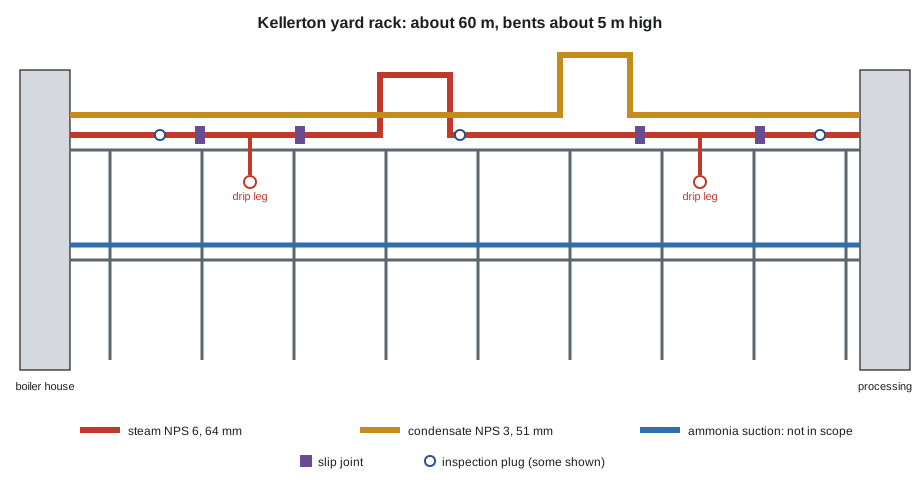
The Kellerton yard rack carries steam, condensate and hot water about 60 m across the yard from the boiler house to the processing building, on steel bents about 5 m (16 ft) above the truck lane. In September 2026, after the condensate leak that Lou Brisebois described in lesson 11, Kellerton hired Coldstream to strip and replace the jacket on the steam and condensate lines and to replace any wet insulation found under it. Tomasz Nowicki ran the job with Wendell Ashby and Priya Lam, a third-year apprentice, from Monday, October 5 to Friday, October 16. Devon joined them for one day. This lesson follows the job from survey to handover and uses it to bring the course together.
The survey and the scope
Tomasz and Wendell surveyed the rack in mid-September from a boom lift, with Lou and the plant's safety coordinator. They looked at every piece of jacket on both lines, opened a sample of laps and cut test openings at the places most likely to be wet. On the NPS 6 steam line they found 14 pieces with reversed or open laps and wet insulation, and 6 more pieces dented but dry, as the lesson 1 example showed. On the NPS 3 condensate line, the wet insulation was mostly at supports and at branch connections. Across both lines, the pattern was the one Tomasz had shown the apprentices: the open runs were mostly fine, and almost every wet spot was at a lap that faced the wrong way, a support or a branch.
Because the old jacket's laps were reversed along long stretches and the old bands were carbon steel and rusting, Kellerton chose to replace all the jacket on both lines rather than patch it. The scope became:
- Strip the old jacket from 60 m of steam line and 60 m of condensate line, including the elbows at the two expansion loops on each line.
- Replace wet insulation with new mineral wool to Kellerton's standard: 64 mm (2 1/2 in) on the steam line and 51 mm (2 in) on the condensate line.
- Install new aluminum jacket with polyfilm moisture barrier, stainless bands at 230 mm (9 in) spacing, sealant in every circumferential lap, slip joints at about 9 m (30 ft), end caps at every termination, sealed collars at every support and branch, inspection plugs to the plant standard and drain holes at low points.
- Leave the ammonia suction line, a cold-service line re-insulated by another Coldstream crew in 2025, untouched, and protect it from damage during the work.
Planning the work
The lines stayed in service. Kellerton could not shut down the steam to the processing building in October, so the crew would be stripping and re-insulating sections of a live line at about 186 °C (366 °F). The plan had to deal with that, with work at height over a truck lane, and with the weather.
- Permits and plant rules: Kellerton's work permit for the rack, renewed daily, with the truck lane coned off under the work area; the plant's rule that insulation is opened on a live steam line only one section at a time and closed by the end of the shift.
- Burns: heat-resistant gloves over cut-resistant gloves when handling insulation on the live line, long sleeves, and a rule that nobody rests a hand or a knee on bare pipe. Stripped sections were covered with temporary insulation blankets if work stopped.
- Access and fall protection: two boom-type elevating work platforms, with operators trained to the CSA standards for mobile elevating work platforms; full-body harnesses and lanyards attached to the platform's anchor point, as Ontario's construction regulation and the maker require; and a written rescue plan for a worker who falls and is held by the harness. Everyone on the crew had current Working at Heights training.
- Weather: no lift work in winds above the platform maker's limit; no sealant or jacket laps closed over wet insulation; wet insulation replaced only when it could be closed in the same day.
- Falling objects: tools tethered on the platforms; offcuts and old jacket bagged in the basket, never dropped; the lane below closed while work was overhead.
Tomasz planned the order of work to follow the water. On each line, the crew would start at the low end of each sloped section and work uphill, so every new piece lapped over the one below, and would jacket each elbow, branch and loop in the order that let it lap correctly onto the straight runs around it. The steam line, on the high side of the upper tier, would be done before the condensate line beside it, so that nobody would be leaning over or kneeling on new condensate jacket to reach the steam line.
Materials takeoff
Worked problem
Jacket and bands for the two lines
Both lines are jacketed from 914 mm rolls 30.5 m long, with 50 mm laps, so each piece covers 864 mm. The steam insulation is 296.3 mm across and the condensate insulation 190.9 mm. Tomasz planned on 70 pieces per line, with bands at each of the 69 laps between pieces, 2 ends and 70 middles, each band the girth plus 75 mm. Banding comes in 30.5 m coils. Allow 1 in 10 extra jacket for waste. Find the roll length, the rolls and the banding.
Show solution
- Pieces: 60,000 ÷ 864 = 69.4, so 70 per line.
- Steam: girth = π × 296.3 = 930.9 mm; cut width 981 mm; roll = 70 × 0.981 = 68.7 m.
- Condensate: girth = π × 190.9 = 599.7 mm; cut width 650 mm; roll = 70 × 0.650 = 45.5 m.
- Total roll = 114.2 m; with 1 in 10 waste, 125.6 m. Rolls = 125.6 ÷ 30.5 = 4.1, so 5 rolls.
- Bands per line = 69 + 2 + 70 = 141. Steam bands = 141 × (0.931 + 0.075) = 141.8 m; condensate bands = 141 × (0.600 + 0.075) = 95.1 m.
- Total banding = 236.9 m; coils = 236.9 ÷ 30.5 = 7.8, so 8 coils, and 282 seals.
Answer: Five rolls of jacket, eight coils of banding and seals for every band, plus the elbow gores, end caps and branch pieces made in the shop.
The straight jacket was not the whole order. The shop made 16 gore elbows for the four expansion loops (four elbows per loop), branch pieces for the four drip legs, end caps for every termination at the flanges and the building walls, and 40 inspection plugs. Tomasz cut the elbow gores from the ordinates in lesson 6 using the measured insulation diameters, and labelled every piece with its line, its location and its order.
Estimate and schedule
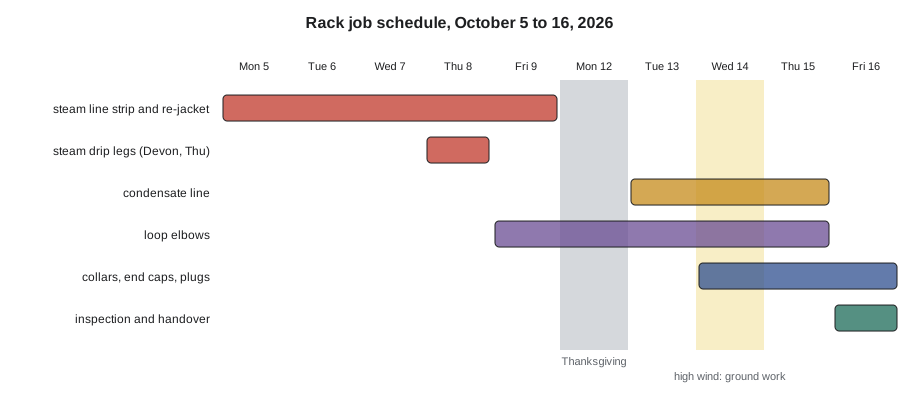
Tomasz estimated the field labour from Coldstream's own production figures, which are company figures, not standards. With 9 working days in the two weeks and a crew of Wendell and Priya, plus Tomasz for part of each day, about 150 crew-hours were available.
| Task | Basis | Estimated hours |
|---|---|---|
| Strip and re-jacket steam line | 60 m at 0.30 h/m | 18 |
| Strip and re-jacket condensate line | 60 m at 0.25 h/m | 15 |
| Replace wet insulation | about 18 m at 1.0 h/m | 18 |
| Gore elbows at loops | 16 at 1.5 h each | 24 |
| Drip leg branches | 4 at 2.0 h each | 8 |
| Slip joints, end caps, collars at supports | allowance | 14 |
| Inspection plugs | 40 at 0.25 h each | 10 |
| Access, permits, setup and cleanup | 2 h per day for 9 days | 18 |
| Contingency | about 1 in 10 | 13 |
| Total field | 138 |
How the work went
The first week went to plan. The crew stripped the steam line section by section from the low end near the boiler house, replaced the wet insulation in the 14 places the survey had found and in two more where the old jacket had hidden it, and closed every section the same day. The old reversed laps had been lapped from the high end; the new jacket was lapped from the low end, each piece over the one below. Monday, October 12 was Thanksgiving, and the crew did not work.
On Thursday, October 8, Bernie lent Devon to the job for the day. Wendell put him in the second basket with Priya on the steam line drip legs, the detail from lesson 7. The first drip leg dropped from the bottom of the header, so Priya fitted the branch piece first, tabs folded out, and Devon fitted the header jacket over the tabs, with sealant under them. At the second drip leg, Devon found that the old header insulation was wet for a full metre each side of the branch, and that the pipe under it was scaled and pitted. Tomasz stopped the work there, called Lou up to look, and Lou had the plant's inspector check the wall thickness before the crew closed it in. It was within the plant's limit, and the insulation was replaced.
On Wednesday, October 14, the wind rose through the morning until the gusts were above the platform maker's limit, and Tomasz brought both platforms down. A loose sheet of jacket on a lift in that wind could have pulled someone off the basket or gone through a truck windshield below. The crew spent the rest of the day at ground level, fitting collars, cutting branch pieces and making up end caps from the shop stock they had brought, and lost about 5 hours of lift time.
In the second week, the condensate line took longer than planned. More of its insulation was wet than the survey had found, about 4 m more, all of it at supports where the old jacket had been cut on top to clear the shoes and never sealed. The new jacket was cut around each shoe from underneath and sealed with a collar, as lesson 4 describes.
Inspection and handover
On Friday, October 16, Tomasz and Lou walked the whole rack from the lifts. Lou checked laps, seams, bands, collars, end caps, slip joints, plugs and drain holes against the specification. He found three items:
- One band seal on the steam line at 12 o'clock, where water would run over it and where it caught the light from the lane; it was turned to the seam side.
- A support collar on the condensate line with no sealant at its back edge; it was sealed.
- An inspection plug at the second loop that had been fitted without its sealant; it was refitted and sealed.
All three were closed the same afternoon. Tomasz handed Lou a marked-up rack drawing showing every slip joint, inspection plug and drain hole, and the locations where wet insulation had been replaced, so that the plant's inspector could check those places first at the next inspection. He also listed the places where the pipe surface had shown corrosion when the insulation was opened.
| Item | Estimated | Actual | Reason for difference |
|---|---|---|---|
| Field hours | 138 | 147 | More wet insulation on the condensate line; the wind day |
| Wet insulation replaced | about 18 m | about 24 m | Two more wet places on the steam line and about 4 m more on the condensate line at supports |
| Days on site | 9 | 9 | Wind day used for ground work |
| Inspection items | 3 | All closed the same day |
What the job showed
At the last jacketing night of the year, on Thursday, November 12, Tomasz used the rack job to sum up the course. He put up the survey photographs beside the finished work and asked the apprentices where the water would go now. Every answer was a rule from one of the lessons: laps shingled from the low end, seams below the centreline with their edges down, a cut width measured from the real girth, gore elbows lapped in the direction of the water, branches lapped by whether they rose or dropped, bands at every lap and stainless fasteners, slip joints for movement, sealed collars at every support, capped ends, sealed plugs and drain holes at the low points.
"The insulation on that rack was fine," Tomasz said. "The jacket killed it, and nearly killed the pipe. Now the jacket will keep it alive for twenty years, if nobody cuts a hole in it and walks away." He looked at Devon. "And if somebody does, you will know how to fix it."
Records and photographs
Throughout the job, Priya kept the daily records: weather and wind readings, hours by task, materials used, permits signed, and photographs of every place where wet insulation or corrosion was found, before and after. Each photograph was tagged with its line and its location from the nearest rack bent. Those records turned the estimate-and-actual table into something Coldstream could learn from, and they gave Kellerton evidence for its own corrosion records. The photographs of the second drip leg went into the plant's inspection file the same week.
Common mistakes
MistakePlanning rack work without a plan for live lines.
InsteadOpen one section at a time, close it the same day and guard against burns.
MistakeKeeping the lifts up in rising wind to finish a section.
InsteadStop lift work at the maker's wind limit and work at ground level.
MistakeClosing in wet insulation or corroded pipe to stay on schedule.
InsteadStop, show the owner and replace or inspect before closing.
MistakeJacketing the lower line first on a multi-line rack.
InsteadPlan the order so finished work is not leaned or knelt on.
MistakeHanding over without records.
InsteadGive the owner a marked drawing of slip joints, plugs, drain holes and repaired areas.
Summary and key terms
- A survey found that almost every wet spot was at a detail: reversed laps, supports and branches.
- The plan covered live lines, permits, fall protection and rescue, wind and falling objects, and an order of work that follows the water.
- The takeoff was worked from measured girths, coverage per piece and a band count, with shop pieces made from patterns.
- The estimate used company production figures; wind and extra wet insulation explained the difference.
- Corrosion found under the insulation was shown to the owner before it was closed in.
- Inspection, same-day close-out and a marked drawing completed the handover.
- Pipe rack
- A steel structure carrying several pipes across a site.
- Bent
- One frame of a pipe rack, with columns and a cross beam.
- Expansion loop
- A U-shaped section of pipe that takes up thermal expansion.
- Elevating work platform
- A machine such as a boom lift that raises workers to the work.
- Rescue plan
- A written plan for reaching a worker held by fall protection.
- Takeoff
- A list of quantities worked out from drawings or measurements.
- Punch list
- A list of items found at inspection that must be fixed.
- Handover
- Turning finished work over to the owner with its records.
Practice problems
Work each problem on paper first, then reveal the answer to check.
Why was all the jacket replaced rather than patched?
Show answer
The laps were reversed along long stretches and the old bands were rusting carbon steel.
Why did the crew start each sloped section at its low end?
Show answer
So each new piece lapped over the one below.
A line is 45 m long and each piece covers 864 mm. How many pieces?
Show answer
45,000 ÷ 864 = 52.1, so 53.
What did Tomasz do when the wind rose above the lift maker's limit?
Show answer
Brought the lifts down and had the crew work at ground level.
What did the crew do when they found scaled pipe under wet insulation?
Show answer
Stopped, showed the owner and had the wall thickness checked before closing it in.
Lesson quiz · 5 questions
Score 60% or more to complete this lesson.
Create a free account to save your progress, take quizzes and earn a certificate.