
INS-220 · Lesson 1 of 12 · 22 min
Why insulation needs a jacket
▶ Video coming soon A video version of this lesson is on the way.
On a Tuesday evening in late September, Tomasz Nowicki opened the first of his jacketing nights in the Coldstream shop with a section of NPS 6 pipe covering that looked fine from the outside. It was mineral wool under an aluminum jacket, cut out of the Kellerton yard pipe rack the week before. He set it on the bench, slit the jacket with snips and pulled the two halves apart. Water ran out across the bench. The insulation was grey and matted, and the pipe under it was orange with rust. "Somebody saved twenty minutes on that line," Tomasz said, pointing to a circumferential lap that faced uphill. "Ten years later the owner pays for new pipe." Devon Marsh, Tessa Moreau and two other apprentices leaned in to look.
Every insulation system has two parts: the insulation, which slows the flow of heat, and the finish over it, which protects the insulation so it can keep doing that job. On most pipe, duct and equipment in plants and mechanical rooms, the finish is a jacket: a skin of aluminum, stainless steel or PVC wrapped over the insulation and fastened in place. This course is about that jacket: what it is made of, how it is measured and cut, how its laps shed water, and how it is built over pipe, elbows, tees, reducers and equipment. This first lesson explains why the jacket matters so much. A jacket that is put on badly can destroy the insulation under it, and sometimes the pipe as well.
What a jacket does
A jacket has several jobs at once. Which of them matters most depends on where the pipe is and what it carries, but on most work it is doing all of them.
- It keeps water out. Rain, snow, washdown water, leaks from above and dripping condensate from other lines will soak unprotected insulation. Wet insulation loses much of its insulating value and can start corrosion on the pipe.
- It protects the insulation from damage. People stand on pipe, ladders lean on it, forklifts and carts bump it, and maintenance crews brush past it with tools. Most insulation is soft or brittle and is crushed or broken by small impacts.
- It protects against weather and sunlight. Ultraviolet light breaks down many plastics, foams and facings. Wind lifts loose facings and works fasteners loose.
- It holds the insulation in place. On large pipe, vertical lines and equipment, the jacket and its bands help hold the insulation tight against the surface.
- It gives a cleanable, durable surface. Hospitals and food plants want surfaces that can be wiped or washed down; mechanical rooms want a finish that looks the same for years.
- It can help on cold service. On chilled water and refrigeration lines, the vapour retarder is the critical layer. The jacket protects that vapour retarder from damage, and in some systems the jacket and its sealed laps are part of the retarder.
- It affects the surface temperature and how hot the outside feels, because different jacket surfaces give off heat at different rates.
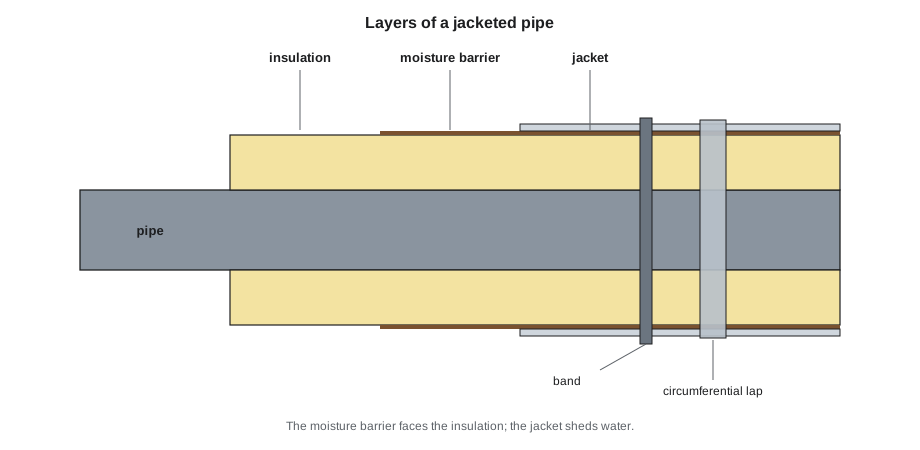
What water does to insulation
Water is the main enemy of an insulation system. Water conducts heat many times better than the still air trapped in insulation, so when insulation gets wet its thermal conductivity rises sharply. A fibrous insulation that is soaked can lose most of its insulating value. Some materials also break down: calcium silicate can soften if it stays wet, and some insulations hold water for a long time once it gets in. On a hot line, the water boils off slowly and carries heat away as it does. On a cold line, the water can freeze, split the insulation and keep growing as ice.
Wet insulation also causes corrosion of the pipe or equipment under it. This is called corrosion under insulation, or CUI, and it is one of the most costly problems in plants. Carbon steel corrodes fastest when it is warm and wet, and a wet insulation layer holds water against the steel for months. Because the corrosion is hidden under the jacket, it is often found only when a line leaks. Lesson 11 covers CUI in more detail. For now, remember that most CUI starts where water got through or behind the jacket: at a lap that faced the wrong way, a missing seal at a support, a gap at a branch, a hole where a screw was pulled out, or damage that nobody repaired.
Water gets into a jacketed system in a few common ways: rain and washdown water running into laps that face uphill or into the weather; water running down the outside of a pipe and into an unsealed penetration; water that gets in at damage; and, on cold lines, condensation that forms inside the system when moist air reaches the cold surface. The jacket's design and workmanship decide whether that water gets in and whether it can get out again.
Damage and abuse
Insulation is not built to carry loads. Mineral wool pipe covering crushes under a boot. Cellular glass is strong in compression but chips and cracks on impact. Elastomeric foam is soft and is torn easily. Fibreglass with an all-service jacket is fine in a ceiling space but is ruined in a few months in a plant corridor where carts run against it. Wherever insulation can be hit, stood on or rubbed, it needs a jacket strong enough for the abuse it will see.
Specifications usually say which areas need a metal jacket and which can use a lighter finish. A typical commercial specification might call for PVC jacketing on exposed piping in mechanical rooms, aluminum on piping outdoors, stainless steel in food processing areas, and no extra jacket on piping above ceilings where the factory facing is enough. A plant specification may call for aluminum on all piping and add a heavier jacket or a stainless one where piping is within reach of traffic. The insulator does not choose the jacket, but should know why it was chosen and should report places where the specified jacket will clearly not survive.
Jackets and fire, sunlight and appearance
Jackets also have to suit the fire rules for the space. In air plenums and many occupied spaces, finishes must meet flame spread and smoke ratings, often a flame spread of 25 or less and smoke developed of 50 or less when tested to the standard surface burning test. Many PVC jackets and metal jackets with their moisture barriers are tested to that level, but some plastics are not. In some plants, stainless steel jacketing is chosen because it keeps its shape in a fire much longer than aluminum, which melts at about 660 °C (1,220 °F).
Sunlight is hard on plastics. Many PVC jackets are made for indoor use only. Some white PVC is made to resist ultraviolet light, and some makers allow outdoor use only with a heavier sheet or a coat of paint. Outdoors, metal jackets are the normal choice. Appearance matters too: owners of hospitals, schools and offices expect a neat, even jacket with laps lined up, bands spaced evenly and no dents or fingerprints. A neat jacket is not just about looks. Laps that are straight and evenly lapped are also laps that shed water.
Surface temperature and personnel protection
On hot lines, the outside of the jacket is part of the personnel protection. INS-110 explained that surfaces people can touch are kept below a safe-to-touch temperature, often about 60 °C (140 °F). The jacket surface matters here. A bright, bare aluminum surface gives off heat by radiation slowly, so it runs hotter than a painted or plastic surface over the same insulation. A dull or painted surface gives off heat more easily and runs cooler. That is why heat loss and surface temperature calculations ask for the jacket type: the same insulation thickness can give a surface temperature that passes with one jacket and fails with another. The difference is usually a few degrees, but near the limit it decides whether more insulation is needed.
This works the other way on cold lines. A bright aluminum jacket on a chilled water line runs a little colder at the surface than a painted one, which brings it closer to the dew point. The thickness tables used for condensation control assume a jacket surface, and a change of jacket after the design can matter.
| Jacket | Typical use | Main strengths | Main limits |
|---|---|---|---|
| Aluminum | Outdoor piping and equipment, plant areas, mechanical rooms | Light, easy to form, weather resistant, cheap compared with stainless | Dents easily; attacked by strong alkalis such as caustic washdown; melts in a fire |
| Stainless steel | Food plants, chemical areas, fire-risk areas, high-abuse areas | Strong, resists many chemicals, keeps its shape in a fire | Costs more, harder to cut and form, needs stainless fasteners |
| PVC | Indoor piping in mechanical rooms, hospitals, food areas; fitting covers | Cleanable, sealable with adhesive, easy to cut | Low service temperature limit (about 66 °C on the jacket); most types not for sunlight; brittle when cold |
| Factory facings (all-service jacket, foil) | Concealed piping, ceiling spaces, chases | Already on the insulation; fast | Little resistance to damage or water |
What happens when a jacket fails
Tomasz kept a folder of photographs from jobs where Coldstream had been called in to fix someone else's work. He went through it with the apprentices. A steam line on a roof where every circumferential lap faced the wrong way, so rain ran straight into the joints; the insulation was soaked for 40 m. A chilled water line in a food plant where the PVC jacket had been screwed on, the screws had punched through the vapour retarder, and ice had formed in rings at every screw. A vertical condensate riser where the jacket had slid down because nobody put in support clips, leaving a 150 mm (6 in) band of bare insulation at the top that soaked up rain. A pipe rack where a branch came out of the jacket with no seal, and water ran down the branch and into the main line. A tank where the jacket on the roof was lapped the wrong way and rainwater had collected in a low spot and run under it.
"In every one of these," Tomasz said, "the insulation was the right material at the right thickness. The jacket killed it." He made the apprentices say the rule back to him: the jacket keeps water out only if every lap, every seam and every penetration is built so water runs over it, not into it.
Worked problem
Damage found on the Kellerton rack survey
Before the Kellerton rack job, Tomasz's crew surveyed 60 m of NPS 6 steam line on the yard pipe rack. Jacketing on the line came in pieces 864 mm long (914 mm sheets less 50 mm of lap). The survey found 14 pieces with open or reversed laps and wet insulation, and 6 more pieces dented but dry. What length of jacket and insulation must be replaced, and what fraction of the 60 m line is that?
Show solution
- Wet pieces: insulation and jacket both come off. Length = 14 × 864 mm = 12,096 mm, about 12.1 m.
- Dented but dry pieces: replace the jacket only, or reform it if the dents are shallow. Length = 6 × 864 mm = 5,184 mm, about 5.2 m.
- Fraction of the line with wet insulation = 12.1 ÷ 60 ≈ 0.20, about 20 in 100.
- Jacket to replace in total = 12.1 + 5.2 = 17.3 m, about 29 in 100 of the line.
Answer: About 12.1 m of insulation and jacket and 5.2 m of jacket only: wet insulation on about 20 in 100 of the line.
The survey also showed where the wet pieces were. Nine of the fourteen were within one piece of a pipe support or a branch, where the jacket had been cut and never sealed, and the other five were at laps that faced uphill on the sloped part of the line. That pattern is typical. The open length of jacket is rarely where water gets in; the details are.
Where jackets fit in the work
On most jobs, jacketing is the last step of the insulation work and the step everybody sees. Pipe is insulated, fittings are insulated, vapour retarders are sealed and inspected, and then the jacket goes on. On some jobs, the jacketing is done by the same crew right behind the insulation; on others, a separate jacketing crew comes through later, sometimes with jacket pieces made up in the shop from field measurements. Coldstream does both. Tomasz's shop makes up elbow gores, tee pieces, cones and equipment heads from field sketches, and his crews install them; on smaller jobs, insulators cut and fit jacket in the field with hand tools.
Either way, the jacket can only be as good as the work under it. Insulation must be the right thickness, tight and dry. Cold-service vapour retarders must be sealed and checked before they are covered. Protective shields at supports must be in place. Once the jacket is on, defects under it are hidden, so a jacketing crew should not cover insulation that is wet, damaged or short of thickness. Report it and get it fixed first.
Jacketing also brings its own hazards. Sheet metal edges are sharp enough to cut through ordinary gloves. Snips, shears and brakes can crush or cut fingers. Jacketing is often done at height, on ladders, scaffolds, pipe racks and elevating work platforms, and a sheet of aluminum caught by wind can pull a worker off balance. Each lesson notes the safety points that go with its work; lesson 12 shows how a full jacketing job at height was planned.
Common mistakes
MistakeTreating the jacket as decoration, put on after the "real" work is done.
InsteadTreat it as the part that keeps the insulation working: laps, seams and penetrations must shed water.
MistakeJacketing over wet or damaged insulation to finish on time.
InsteadStop, report and replace wet or damaged insulation before it is covered.
MistakeChoosing a jacket by what is on the truck.
InsteadUse the jacket the specification calls for in that area, and report areas where it will not survive.
MistakeAssuming a sealed jacket is watertight forever.
InsteadPlan for water to get in somewhere, and do not trap it: no uphill laps, no low spots without drainage.
MistakePutting PVC outdoors because it was easier to install.
InsteadUse PVC outdoors only where the maker and specification allow it.
Summary and key terms
- A jacket protects insulation from water, damage, weather and sunlight, holds it in place and gives a durable surface.
- Wet insulation loses much of its insulating value and can cause corrosion under insulation on the pipe.
- Most water enters at details: reversed laps, unsealed supports, branches and penetrations, and damage.
- Jackets must suit the area: aluminum, stainless steel and PVC each have strengths and limits.
- The jacket surface affects surface temperature; specifications and calculations name the jacket for that reason.
- Jacketing is the last step and hides the work under it, so only cover dry, complete, inspected insulation.
- Jacket
- The protective outer covering over insulation, usually aluminum, stainless steel or PVC.
- Finish
- Any outer layer over insulation, such as a jacket, mastic or factory facing.
- Corrosion under insulation (CUI)
- Corrosion of pipe or equipment caused by water held against it by wet insulation.
- Circumferential lap
- A lap that runs around the pipe where one jacket piece overlaps the next.
- Longitudinal lap
- The lap that runs along the pipe where a jacket piece overlaps itself.
- Vapour retarder
- A layer that slows the movement of water vapour into insulation on cold service.
- Flame spread and smoke developed
- Ratings from a standard surface burning test, often limited to 25 and 50.
- Personnel protection
- Insulation that keeps touchable surfaces below a safe temperature.
Practice problems
Work each problem on paper first, then reveal the answer to check.
Name four jobs a jacket does.
Show answer
Keeps water out, protects insulation from damage, resists weather and sunlight, holds the insulation and gives a durable surface (any four).
Why does wet insulation insulate poorly?
Show answer
Water conducts heat many times better than the still air the insulation traps.
What is CUI?
Show answer
Corrosion under insulation: corrosion of the pipe caused by water held against it by wet insulation.
A survey finds 9 wet jacket pieces 864 mm long. What length of insulation must be replaced?
Show answer
9 × 864 = 7,776 mm, about 7.8 m.
Why should a jacketing crew not cover wet insulation?
Show answer
The water is sealed in, the insulation stays poor and the pipe corrodes; the defect is hidden.
Lesson quiz · 5 questions
Score 60% or more to complete this lesson.
Create a free account to save your progress, take quizzes and earn a certificate.