
HSE-401 · Lesson 7 of 12 · 20 min
Recognition and incentives that do not hide injuries
For four years, the distribution centre at Dartmouth had paid every worker a quarterly safety bonus of $150 if the site went the whole quarter without a recordable injury. A large banner by the entrance counted the days since the last one. The site had won the company's safety award three years running. During the culture review, Sam Pellerin told Elena about a forklift operator who had been struck on the foot by a pallet jack in the third week of a quarter and had worked the rest of his shift in pain rather than report it, because he did not want to cost 110 co-workers their bonus. He saw his own doctor on the weekend and told her he had hurt it at home.
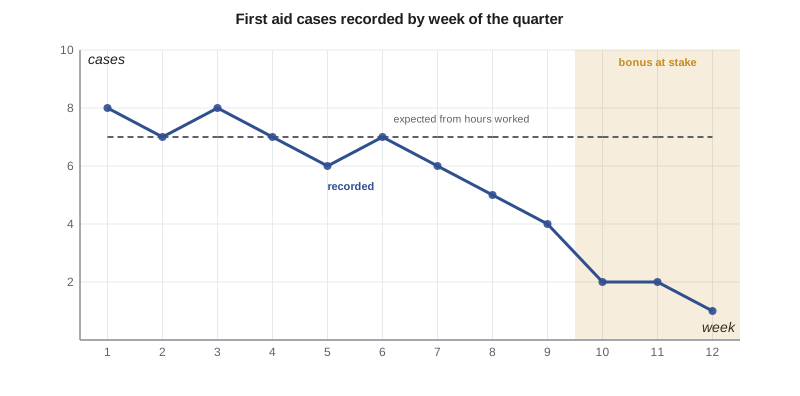
Elena then looked at the distribution centre's first aid log and found that minor injuries were treated on site and recorded far less often in the weeks before the end of each quarter. The bonus had not made the site safer. It had made injuries less visible. This lesson is about how to recognize and reward safety in ways that encourage the behaviours you want, without creating pressure to hide injuries and near misses.
Why injury-based incentives backfire
Incentive programs tied to injury counts are common because they seem logical: reward people for not getting hurt. The problem is that injuries are a lagging outcome influenced by luck as well as behaviour, and the easiest way for a group to keep the count at zero is not to report. Several mechanisms are at work:
- Peer pressure: when a group reward depends on no one reporting, the injured worker feels responsible for taking money from co-workers, and co-workers may say so.
- Supervisor pressure: when supervisors' bonuses depend on low injury counts, some discourage reporting, steer injured workers away from medical treatment or reclassify injuries as personal.
- Light-duty games: injured workers are brought back immediately to sit in an office so the injury is not counted as lost time, regardless of whether that helps their recovery.
- False reassurance: leaders see a falling count and believe the culture is improving, when the information has simply gone underground.
Researchers and government agencies have documented these effects. A 2012 report by the US Government Accountability Office on safety incentive programs found that experts and workers widely believed programs rewarding low injury rates could discourage reporting. OSHA itself has repeatedly said that programs which discourage reporting undermine safety.
What the law says about discouraging reports
In Nova Scotia, workers have a legal duty to report hazards and injuries, and the Workers' Compensation Board of Nova Scotia (WCB) requires injuries that need medical treatment beyond first aid or cause lost time to be reported. Employers must report such injuries to the WCB within five business days of learning of them. Workers' compensation law also expects employers not to discourage or obstruct a worker's report or claim, and section 45 of the Act, which protects workers from discriminatory action for raising safety concerns. An incentive program that pressures workers not to report can expose an employer to penalties under both laws, quite apart from the damage it does to safety.
What to recognize instead
The better approach is to recognize the behaviours and activities that lead to safety, which are within people's control, rather than outcomes, which are partly luck. These are often called leading or upstream behaviours. Examples include:
- reporting hazards, near misses and minor injuries promptly;
- stopping work that is unsafe, and the supervisors who back them;
- suggesting or implementing an improvement to a task, tool or procedure;
- helping a new or temporary worker learn the job safely;
- taking part in an investigation, risk assessment or the joint occupational health and safety committee;
- completing a safety conversation or walk-around with good worker feedback;
- closing out corrective actions on time.
Recognition is not mainly about money
Research on motivation suggests that people respond strongly to being noticed and appreciated, and that small, sincere, specific recognition often works better than cash. Financial rewards can crowd out intrinsic motivation, turning safety into something people do for money rather than because they care about colleagues. Effective recognition at Harrowgate Foods Ltd. follows a few principles:
- Specific: 'Thank you for stopping the spiral when you saw the lock was missing' rather than 'good job on safety'.
- Timely: as soon as possible after the behaviour, not months later at an awards dinner.
- Sincere and personal: from someone the person respects, ideally their own supervisor or a senior leader who has taken the trouble to understand what they did.
- Public, if the person is comfortable with that: so others see what is valued.
- Fair: available to everyone, including night shift, temporary workers and contractors.
- Never conditional on low injury numbers.
Rachel started ending every monthly operations review with five minutes of specific recognition stories from each site, told by the supervisor involved. Within a few months, supervisors were competing to bring the best story, and the stories travelled through the plant faster than any newsletter.
Redesigning the distribution centre program
The distribution centre's workers liked the bonus, and simply cancelling it would have felt like a pay cut. Grace Whitfield and the joint occupational health and safety committee redesigned it over two months, with workers' input. The new program kept the same budget but changed what it rewarded:
| Old program | New program |
|---|---|
| $150 per worker if no recordable injury in the quarter | Same budget, split between team and individual recognition |
| Group reward lost when anyone reported an injury | Team reward for completing quarterly safety goals: hazard reports closed, walk-arounds done, training current |
| Days-without-injury banner at the entrance | Board showing hazards reported this month and what was done about each |
| Safety award based on lowest injury rate | Recognition for the best improvement suggestion and the best near miss report each month, chosen by the joint occupational health and safety committee |
| Supervisor bonus tied to recordable count | Supervisor objectives tied to walk-arounds, closure of concerns and worker feedback scores |
Taking down the days-without-injury banner caused the most argument. Some workers saw it as a symbol of pride. Elena explained that the banner told every injured worker, every day, exactly how much their report would cost the team. Sam suggested replacing it with a board showing the number of hazards fixed that month, which became a new source of pride.
Watching for under-reporting
Changing incentives is not enough on its own. Leaders also need to check whether reporting is honest. Useful signs that injuries may be going unreported include:
- reporting that clusters at the start of a period and falls before a deadline;
- a very low ratio of first aid cases and near misses to recordable injuries, because a healthy reporting system usually captures many more minor events than serious ones;
- workers' compensation claims that appear without an internal report, or injuries first reported days later;
- workers seeing their own doctor rather than the company's first aid provider;
- sites or shifts with very different reporting rates for similar work.
Elena used the second sign to compare the three sites. She calculated the ratio of minor events reported (first aid cases plus near misses) to recordable injuries for the year before and the year after the program changed.
# Minor events (first aid + near misses) reported per recordable injury, by site.
before = {"Main plant": (310, 21), "Distribution": (38, 2), "Sauces plant": (41, 3)}
after = {"Main plant": (720, 18), "Distribution": (260, 5), "Sauces plant": (95, 3)}
for site in before:
    m0, r0 = before[site]
    m1, r1 = after[site]
    print(f"{site:<13} before {m0:4d}/{r0:2d} = {m0/r0:5.1f} per recordable   "
f"after {m1:4d}/{r1:2d} = {m1/r1:5.1f} per recordable")Main plant before 310/21 = 14.8 per recordable after 720/18 = 40.0 per recordable Distribution before 38/ 2 = 19.0 per recordable after 260/ 5 = 52.0 per recordable Sauces plant before 41/ 3 = 13.7 per recordable after 95/ 3 = 31.7 per recordable
Before the change, the distribution centre reported only 19 minor events for every recordable injury, against about 15 at the plant, which looked similar. But the absolute numbers were tiny for a site of 110 workers with forklifts. After the change, minor event reporting at the distribution centre rose almost sevenfold, and recordable injuries rose from 2 to 5. Grace was alarmed until Elena pointed out that the recordable injuries had probably always been there: the forklift operator with the hurt foot would now have been counted. The plant, which had been through the same changes, saw recordables fall slightly while minor reports more than doubled, the pattern you would expect as hazards reported early are fixed before they cause injury.
Recognizing leaders, not just workers
Recognition programs often focus on front-line workers, but leaders' behaviour drives culture. Harrowgate Foods Ltd. changed how it evaluated managers and supervisors. Instead of injury rates, their safety objectives now included the quality of their walk-arounds, the percentage of concerns closed with feedback, the results of their teams' climate surveys, and whether their teams' reporting rates were healthy. A supervisor whose crew reported nothing for a year was asked why, not congratulated.
Worked problem
Recognizing a near miss report the right way
Show solution
- A picker at the distribution centre reports that a rack beam is bent near the floor where forklifts turn.
- The supervisor thanks her within the hour and tags the bay out of use until the rack is inspected.
- Maintenance replaces the beam that week and installs a column guard at the turn.
- At the next shift huddle, the supervisor tells the story: what was reported, what was found and what was fixed, and thanks the picker by name with her permission.
- The joint occupational health and safety committee selects it as the near miss report of the month; the picker chooses a gift card and a reserved parking spot for a month.
Answer: Specific, timely and public recognition of reporting encourages more reports, with no pressure to hide anything.
Days-without-injury counters and safety awards
Days-without-injury signs, safety awards based on injury rates and leaderboards comparing sites by recordable counts all send the same message: the goal is a low number. Even when no money is attached, they create pressure, because nobody wants to be the person who resets the counter in front of everyone. Many companies, industry associations and safety professionals have moved away from these displays for exactly that reason. If an organization wants to celebrate progress, better choices include the number of hazards reported and fixed, the number of learning teams held, the share of corrective actions that were engineering changes, or the results of critical control verifications.
Awards from customers, insurers and industry bodies can be a particular trap. Harrowgate Foods Ltd.'s largest grocery customer had for years given a supplier safety award to the facility with the lowest recordable rate, and the distribution centre had been proud to win it. Rachel wrote to the customer explaining why Harrowgate Foods Ltd. would no longer compete on that basis, and offered to share the company's leading indicators instead. To her surprise, the customer's own safety team agreed and changed the award criteria the following year to recognize programs that improved reporting and reduced serious-injury precursors.
Light duty and return to work
Return-to-work programs are good for injured workers when they are designed around recovery, not around avoiding lost-time counts. Meaningful modified work, agreed with the worker and their health care provider, helps people stay connected to the workplace and recover faster. Bringing someone back the day after a serious injury to sit in an empty room so the injury is not counted as lost time does the opposite, and workers see it for what it is. Harrowgate Foods Ltd. separated the two: return-to-work decisions are made by the health and safety manager with the worker and their provider, and supervisors are no longer measured on lost-time counts at all.
Common mistakes
MistakePaying bonuses for low injury counts.
InsteadReward behaviours within people's control, such as reporting, stopping unsafe work and improvements.
MistakeCelebrating a falling injury count without checking reporting.
InsteadCheck ratios of minor events to recordables, timing patterns and claims without internal reports.
MistakeAssuming recognition must be financial.
InsteadSpecific, timely, sincere recognition from respected leaders often works better than cash.
MistakeTying supervisors' pay to recordable counts.
InsteadTie supervisors' objectives to walk-arounds, concern closure and worker feedback.
MistakeLeaving days-without-injury signs in place.
InsteadReplace them with boards that celebrate hazards reported and fixed.
Summary and key terms
- Incentives tied to injury counts encourage under-reporting through peer and supervisor pressure.
- Discouraging injury reporting can breach workers' compensation and OHS law, and pressures to stay silent harm safety.
- Recognize leading behaviours: reporting, stopping work, improvements, helping new workers and taking part in safety activities.
- Good recognition is specific, timely, sincere, public where appropriate, fair and never conditional on low injury numbers.
- Watch for under-reporting: deadline patterns, low ratios of minor events to recordables, late reports and claims without internal reports.
- Rising reports, and even rising recordables, after a program change often mean the truth is becoming visible.
- Safety incentive program
- A program that offers rewards in connection with safety performance or activities.
- Lagging indicator
- A measure of outcomes that have already happened, such as injuries.
- Leading behaviour
- An action within people's control that helps prevent harm, such as reporting a hazard.
- Under-reporting
- Injuries, illnesses or near misses that happen but are not reported.
- Recognition
- Noticing and appreciating specific safe behaviour, which may or may not involve a reward.
Practice problems
Work each problem on paper first, then reveal the answer to check.
Give three ways in which injury-count incentives can lead to under-reporting.
Show answer
Any three: peer pressure in group rewards, supervisor pressure, light-duty games, false reassurance from falling counts.
Name two laws that a program discouraging injury reports could breach in Nova Scotia.
Show answer
Workers' compensation law, which expects employers not to discourage or obstruct claims, and the Occupational Health and Safety Act protections against discriminatory action.
List four behaviours that are good targets for recognition.
Show answer
Any four: reporting hazards and near misses, stopping unsafe work, suggesting improvements, helping new workers, joining investigations or the committee, closing actions on time.
Why did recordable injuries rise at the distribution site after the program changed?
Show answer
Injuries that had previously gone unreported were now being reported.
What makes recognition effective?
Show answer
It is specific, timely, sincere and personal, public if the person agrees, fair to everyone and never tied to low injury counts.
Lesson quiz · 5 questions
Score 60% or more to complete this lesson.
Create a free account to save your progress, take quizzes and earn a certificate.