
HSE-401 · Lesson 12 of 12 · 21 min
Capstone: a culture improvement plan
In the second year after the spiral conveyor injury, Rachel Okoye asked Elena Novak and the three site managers to turn everything they had learned into a written culture improvement plan for Harrowgate. The board wanted a plan it could follow and hold leaders to. The joint occupational health and safety committee co-chairs wanted a plan that workers would recognize as their own. And Rachel wanted a plan that would still be working after she had moved on. This capstone lesson walks through how they built it, and gives you a structure you can use for your own workplace.
A culture improvement plan is different from an ordinary safety plan. A safety plan lists hazards and controls. A culture plan sets out how leaders will change what people believe is really expected, through consistent changes in leadership behaviour, systems and conditions over two to five years. It brings together every topic in this course.
Step 1: Understand where you are
Every plan starts with an honest assessment. At Harrowgate Foods Ltd., the baseline drew on the sources covered in lessons 1, 2 and 11: the original pulse survey and the one-year climate survey; focus groups at all three sites; records of reports, injuries, near misses with SIF potential, corrective action closure and stop-work events; the investigation of the spiral conveyor injury; and leaders' own reflections using the maturity ladder.
The team summarized the baseline as a short set of findings rather than a score:
- The main plant and the distribution centre had moved from mostly reactive toward proactive; Kentville was still reactive.
- Reporting had become safer and more worthwhile at two sites, but not yet at Kentville or among agency workers.
- Procedures still often did not match how work was really done.
- Leaders' visible commitment had improved, but depended heavily on a few people.
- SIF precursors around forklifts and pedestrians remained the largest serious-injury risk.
- Night shift was better served than before but still had less access to training, meetings and leaders.
Step 2: Set a direction people can picture
A plan needs a clear direction. Slogans such as 'zero harm' or 'safety first' are easy to write but hard to act on, and zero-injury targets can encourage under-reporting, as lesson 7 showed. The team wrote a short statement of what the culture would look like in three years, in terms people on the floor could picture:
- 'Anyone at Harrowgate Foods Ltd. can stop a job and will be thanked for it.'
- 'Leaders spend real time on every shift, ask questions and come back with answers.'
- 'Procedures are written with the people who use them and match how the work is done.'
- 'Every event that could have killed someone is investigated as seriously as an injury.'
- 'New, temporary and night workers get the same protection and voice as everyone else.'
These statements came from the focus groups. Several were close to word-for-word quotes from workers describing what they wanted.
Step 3: Choose a few priorities
The most common reason culture plans fail is trying to do everything at once. The team chose four priorities for the next year, each linked to a finding:
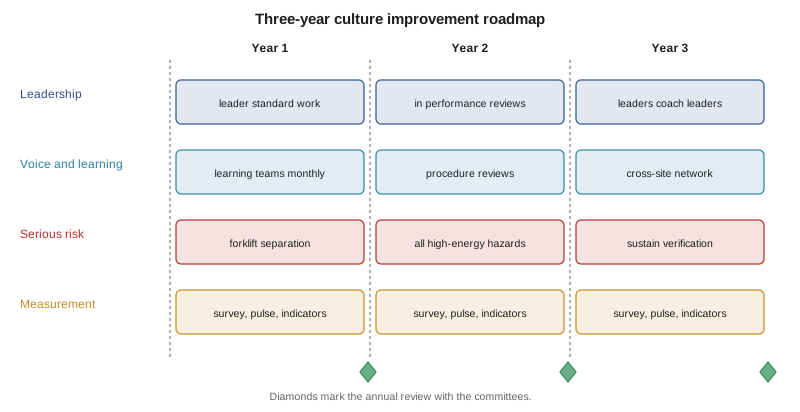
- Leadership consistency: make the behaviours from lessons 3 and 4 part of every leader's standard work, coach them, and build them into performance reviews so they do not depend on individuals.
- Voice and learning: extend speak-up channels and learning teams to Kentville, night shift and agency workers, and start reviewing procedures with the people who use them.
- Serious risk: separate forklifts and pedestrians at the distribution centre and both plants, and verify critical controls for the company's top five high-energy hazards every week.
- Measurement and feedback: keep the annual survey and the indicator set, add quarterly pulse checks and share results with everyone.
Step 4: Turn priorities into actions with owners
Each priority became a small number of specific actions, each with an owner, a date, the resources needed and a way to know it was done. The team insisted that every action change something people could see or experience, not just produce a document.
| Priority | Action | Owner | By | Evidence it worked |
|---|---|---|---|---|
| Leadership | Leader standard work: two walk-arounds a week, one on a back shift | Site managers | Month 2 | Worker feedback cards above 80% "listened" |
| Leadership | Safety behaviours added to leader performance reviews | VP operations and HR | Month 6 | Reviews completed with evidence |
| Voice | Learning team every month at each site, including Kentville | EHS manager | Month 3 | 12 teams a year per site; actions closed |
| Voice | Procedure reviews with users for the 20 highest-risk tasks | Site managers with the joint occupational health and safety committee | Month 12 | Reviewed procedures signed off by users |
| Serious risk | Pedestrian walkways, barriers and crossings at all sites | Maintenance managers | Month 5 | Forklift-pedestrian SIF near misses fall |
| Serious risk | Weekly field verification of critical controls | Supervisors | Month 2 | 95% of planned checks done; failures fixed in 7 days |
| Measurement | Quarterly pulse survey and indicator report to all staff | EHS manager | Month 3 | Response rate above 60%, including agency workers |
Step 5: Involve workers throughout
Culture cannot be changed for people; it can only be changed with them. The joint occupational health and safety committee co-chairs, Sam Pellerin at the distribution centre and Tanya Morris at the main plant, helped choose the priorities, reviewed every action and agreed to co-present the plan to workers at every site and shift. Workers on each site helped decide how the pedestrian separation would be laid out and which procedures to review first.
In Nova Scotia, this involvement is also consistent with Nova Scotia's Occupational Health and Safety Act, which gives the joint occupational health and safety committee functions that include participating in identifying hazards, making recommendations and monitoring the occupational health and safety program. A culture plan developed with the committee strengthens the internal responsibility system rather than working around it.
Step 6: Plan for the hard moments
Every culture plan will be tested by something: a serious incident, a production crisis, a change in leadership, a downturn that brings cost cuts. The team wrote down in advance how leaders would respond to the most likely tests, so that the response would not depend on the mood of the moment:
- After a serious incident: leaders will respond with care for the people affected, use the just culture framework from lesson 6, and share what was learned at all sites.
- Under production pressure: no shortcuts on life-saving rules or critical controls; delays will be explained to customers rather than passed to the floor.
- During change: every significant change goes through management of change with workers involved (lesson 10).
- When leaders change: new leaders receive the plan, the leader standard work and a briefing from the joint occupational health and safety committee co-chairs in their first month.
- When the numbers look good: leaders will stay uneasy and keep looking for SIF precursors and drift (lessons 2 and 9).
Step 7: Measure, review and adjust
The plan included the measurement approach from lesson 11: an annual triangulated review using the survey, focus groups, observation and records, with quarterly pulse checks and indicators shared with all staff. Each quarter, the leadership team reviewed progress on every action, removed obstacles, and adjusted actions that were not working. Each year, the plan was refreshed with the joint occupational health and safety committees.
Elena built a simple tracker to show the leadership team, each quarter, which actions were on track and which needed help.
# Quarterly tracker for the year 1 culture plan actions.
from datetime import date
today = date(2026, 9, 30)
actions = [
    ("Leader standard work", date(2026, 3, 1), 100, 100),
    ("Behaviours in performance reviews", date(2026, 7, 1), 100, 70),
    ("Monthly learning teams incl. sauces plant", date(2026, 4, 1), 18, 18),
    ("Procedure reviews, top 20 tasks", date(2026, 12, 31), 20, 9),
    ("Pedestrian separation, all sites", date(2026, 6, 1), 3, 2),
    ("Weekly critical control checks", date(2026, 3, 1), 100, 96),
    ("Quarterly pulse survey", date(2026, 4, 1), 3, 3),
]
for name, due, target, done in actions:
    pct = 100 * done / target
    if pct >= 95:
        status = "on track"
    elif due < today:
        status = "LATE - needs help"
    else:
        status = "in progress"
print(f"{name:<44} {pct:5.0f}% due {due} {status}")Leader standard work 100% due 2026-03-01 on track Behaviours in performance reviews 70% due 2026-07-01 LATE - needs help Monthly learning teams incl. sauces plant 100% due 2026-04-01 on track Procedure reviews, top 20 tasks 45% due 2026-12-31 in progress Pedestrian separation, all sites 67% due 2026-06-01 LATE - needs help Weekly critical control checks 96% due 2026-03-01 on track Quarterly pulse survey 100% due 2026-04-01 on track
At the end of the third quarter, two actions needed help: leader performance reviews were only 70 percent complete, and pedestrian separation was finished at two of the three sites, with the third held up by a racking supplier. The leadership team agreed to extend the review deadline for one month with HR support and to escalate the racking order. They also noted that procedure reviews, though only 45 percent complete, were ahead of the pace needed to finish by year-end.
What made the plan work
Two years after the spiral conveyor injury, the triangulated review showed the main plant and the distribution centre solidly proactive, and Kentville moving out of reactive. Reports and learning team actions continued to rise. The number of SIF-potential forklift events at the distribution centre had fallen by more than half after pedestrian separation. The injured worker had returned to work, helped train new sanitation staff and joined the joint occupational health and safety committee. When the night sanitation crew was asked what had changed, the most common answer was simple: 'They come and ask now, and they come back.'
Looking back, Rachel identified the things that had made the biggest difference: leaders who changed what they did and admitted their own say-do gaps; responses to bad news that made people want to bring more; a fair way of handling mistakes; a few visible decisions that put safety ahead of production when it cost something; and workers involved from the start. None of these required large budgets. All of them required consistency over time. The remaining courses in this track build on that foundation: supervisor responsibilities in HSE-402, investigation in HSE-403, management systems in HSE-404, committees in HSE-405, contractors in HSE-406, metrics and audits in HSE-407, and the final course, HSE-408.
Worked problem
Writing one action in the plan well
Show solution
- Weak version: 'Improve communication about safety.' It has no owner, no date and nothing anyone could see.
- Ask what finding it addresses: agency workers at the distribution centre had low survey responses and few reports.
- Ask what people should experience: agency workers know how to report, believe it is safe and see results.
- Write the action: 'Agency workers receive orientation in their language, a buddy, and supervisor check-ins at day 1, week 1 and month 1; the hazard board is translated. Owner: distribution centre manager. By: month 4. Evidence: agency survey response above 60% and reporting per worker within 20% of permanent staff.'
- Agree it with the joint occupational health and safety committee co-chair and the agency's coordinator.
Answer: A good action addresses a specific finding, changes what people experience, and has an owner, a date and evidence.
Communicating the plan
A plan that lives in a binder changes nothing. The team presented it at every site and shift, in short sessions led jointly by the site manager and a joint occupational health and safety committee co-chair, with translation where needed. Each session covered three things only: what leaders had heard from workers, the four priorities and what people would see change in the next three months, and how to tell leaders if it was not happening. A one-page summary went on every notice board and in the break rooms, and the quarterly tracker was posted beside it. Rachel insisted that the first visible action at each site, such as a new pedestrian crossing or a learning team on a task workers had asked about, happen within a month of the presentation, so that the plan was linked from the start to something people could see.
Common mistakes
MistakeStarting with slogans and zero-injury targets.
InsteadDescribe the culture in terms people can picture and measure behaviours and experiences.
MistakeTrying to fix everything in year one.
InsteadChoose a few priorities linked to findings, and sequence the rest over several years.
MistakeWriting actions that only produce documents.
InsteadEach action should change something people see or experience, with an owner, date and evidence.
MistakeBuilding the plan without workers.
InsteadInvolve the committee and front-line workers in findings, priorities, actions and presenting the plan.
MistakeAssuming the plan will survive a crisis on its own.
InsteadDecide in advance how leaders will respond to incidents, pressure, change and good numbers.
Summary and key terms
- A culture improvement plan changes what people believe is really expected, through consistent leadership, systems and conditions over several years.
- Start with an honest, triangulated baseline summarized as findings, not a single score.
- Describe the direction in terms people can picture, avoiding slogans and zero-injury targets.
- Choose a few priorities, turn them into actions with owners, dates, resources and evidence, and involve workers throughout.
- Plan in advance for incidents, production pressure, change, leadership turnover and good numbers.
- Review quarterly and annually, adjust what is not working, and keep leaders consistent over time.
- Culture improvement plan
- A multi-year plan to change the shared beliefs and behaviours that shape safety.
- Baseline
- An assessment of the current culture used as a starting point for improvement.
- Leader standard work
- A defined set of routine leadership activities, such as walk-arounds, built into every leader's week.
- Roadmap
- A plan showing priorities and actions over time.
- Evidence of effect
- A measure showing that an action changed what people experience or do, not just that it was completed.
Practice problems
Work each problem on paper first, then reveal the answer to check.
How is a culture improvement plan different from an ordinary safety plan?
Show answer
A safety plan lists hazards and controls; a culture plan sets out how leaders will change what people believe is expected, over several years.
Why did the team avoid a zero-injury target?
Show answer
Zero-injury targets can encourage under-reporting and say little about the behaviours that build culture.
What four priorities did the company choose for year 1?
Show answer
Leadership consistency, voice and learning, serious risk, and measurement and feedback.
What makes a culture plan action well written?
Show answer
It addresses a specific finding, changes what people experience, and has an owner, a date, resources and evidence of effect.
What did Rachel identify as the biggest factors in the improvement?
Show answer
Leaders changing their own behaviour, good responses to bad news, fair handling of mistakes, visible safety-first decisions at a cost, and early worker involvement, all applied consistently.
Lesson quiz · 5 questions
Score 60% or more to complete this lesson.
Create a free account to save your progress, take quizzes and earn a certificate.