
HSE-401 · Lesson 6 of 12 · 21 min
Just culture and fair accountability
When the spiral conveyor investigation was finished, the question everyone at Harrowgate Foods Ltd. was waiting for was simple: who would be disciplined? The injured worker had reached into running equipment, which the procedure clearly prohibited. The night supervisor knew lockout was being skipped. The shift manager had praised on-time restarts. Some managers argued that the worker had broken a cardinal rule and must face consequences, or the rule would mean nothing. Others argued that punishing him would tell everyone else to hide the next shortcut. Both sides had a point.
This lesson is about how to hold people accountable fairly. It introduces just culture, a way of deciding how to respond to errors and rule-breaking that distinguishes honest mistakes from at-risk choices and from reckless behaviour, and that looks at the system as well as the individual. Just culture is often misunderstood as a no-blame culture. It is not. It is a fair-blame culture.
Why blame does not work, and why no-blame does not either
For most of the history of workplace safety, the standard response to an incident was to find the person who made the error and discipline them. Investigations ended at 'worker failed to follow procedure'. The problem is that blame does not fix the conditions that led to the error, and it teaches everyone else to hide their own mistakes. In a blame culture, the organization loses the information it most needs.
In the 1990s, some organizations swung to the opposite extreme and declared a no-blame approach. That fails too. Most people sense that some behaviour does deserve a firm response: deliberately removing a guard to go faster, coming to work impaired, or ignoring a lockout after being warned. A workplace where nothing ever has consequences loses credibility, and workers who follow the rules feel let down when others are not held to account.
The psychologist James Reason, whose work on human error and organizational accidents shaped modern safety thinking, argued in his 1997 book Managing the Risks of Organizational Accidents that what is needed is a just culture: an atmosphere of trust in which people are encouraged, even rewarded, for providing essential safety information, but in which they are also clear about where the line must be drawn between acceptable and unacceptable behaviour. Later writers, notably David Marx in health care and Sidney Dekker, developed practical models for applying it.
Three kinds of behaviour
David Marx's version of just culture, widely used in health care and aviation, separates three kinds of behaviour that can lead to harm:
| Behaviour | What it is | Example at Harrowgate Foods Ltd. | Fair response |
|---|---|---|---|
| Human error | An unintended slip, lapse or mistake | A worker on a new line forgets one step of a twelve-step changeover | Console the person; fix the system that made the error likely |
| At-risk behaviour | A choice where the risk is not recognized or is believed to be justified, often because the shortcut has become normal | Skipping lockout on the spiral because "everyone does it when we are behind" | Coach the person; remove the incentives and pressures that make the shortcut attractive |
| Reckless behaviour | A conscious disregard of a substantial and unjustifiable risk | Bypassing an interlock with a jumper wire after being told twice not to, to finish early | Disciplinary action, applied consistently |
The key distinction is between at-risk and reckless behaviour. At-risk behaviour is the most common cause of serious incidents in most workplaces, and it is driven by the system: the shortcut is faster, nothing bad has happened, everyone does it and the supervisor tolerates it. Punishing at-risk behaviour as if it were reckless is unfair, because the person did not recognize the risk or believed it was acceptable, and ineffective, because the system that produced the behaviour is left in place for the next person.
Tests for drawing the line
Reason proposed a decision tree, sometimes called the culpability decision tree, that asks a series of questions about an act. Several versions exist. Harrowgate Foods Ltd. adopted a simplified one with four tests.
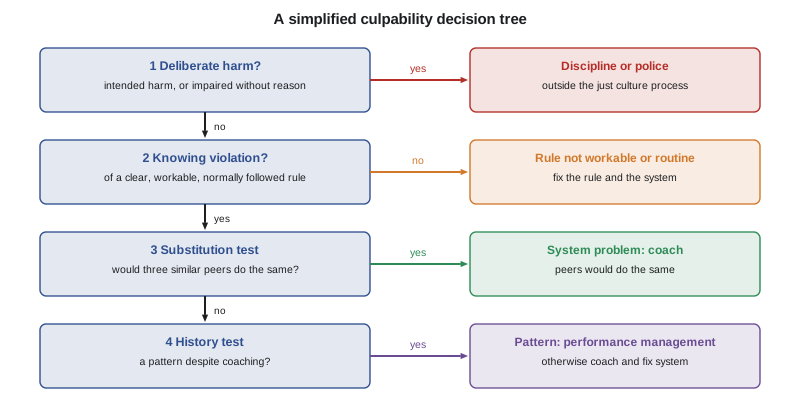
Deliberate harm test. Did the person intend to cause harm, or come to work impaired by alcohol or drugs without a legitimate medical reason? These cases are rare and are matters for discipline and possibly police, outside the just culture framework.
Knowing violation test. Did the person knowingly break a rule? If so, was the rule clear, workable and normally followed? A rule that cannot be followed with the time and equipment provided, or that is routinely broken by everyone with management's knowledge, is not a fair basis for singling out one person.
Substitution test. Take the person out of the situation and imagine substituting three peers with similar training and experience. Would they have done the same thing, under the same pressures, with the same information? If the honest answer is yes, the problem is the system, not the individual.
History test. Does the person have a pattern of similar unsafe choices despite coaching and support? A pattern suggests an individual performance issue that needs managing, but even then the system should be checked.
Applying the tests to the spiral conveyor
Rachel asked Elena and the joint occupational health and safety committee's worker co-chair, Sam Pellerin, to apply the tests together, so that the decision would be seen as fair by both managers and workers. Their analysis:
- Deliberate harm: no. The worker was trying to finish the job in time, and was not impaired.
- Knowing violation: yes, he knew the procedure required lockout. But the rule was not workable as designed, because the disconnect was far away and the schedule did not allow time, and it was routinely broken with the night supervisor's knowledge.
- Substitution: the investigation found that most of the night sanitation crew had skipped lockout on the spiral when behind. Three peers would very likely have done the same.
- History: he had no record of similar issues and had been praised for his work.
The conclusion was that this was at-risk behaviour produced by the system. The fair response to the worker was coaching and support during his recovery and return to work, not discipline. The night supervisor's position was different. He had known about the routine shortcut for months and had not acted or reported it. The tests applied to him found a knowing failure to act on a hazard he was responsible for, and the company issued him a written warning, moved him to a day-shift role with closer coaching and made clear that the same standard applied to every supervisor. The shift manager who had repeatedly praised on-time restarts while never asking how sanitation achieved them received coaching and a change in his performance objectives.
The outcome surprised some managers, who had expected the injured worker to be disciplined. It surprised some workers too, who had expected the supervisor to be protected. Sam told the joint occupational health and safety committee that the way the decision was made mattered as much as the result: it had been reasoned out openly, with a worker representative involved, using a framework everyone could see.
Accountability is forward-looking too
Sidney Dekker distinguishes between backward-looking accountability, which asks who is to blame for what happened, and forward-looking accountability, which asks who needs to do what to make sure it does not happen again. In a just culture, the main form of accountability is forward-looking: the people involved help explain what happened and take responsibility for making things better. The night sanitation crew helped redesign the spiral cleaning procedure, test the new disconnect location and train new hires. That was accountability, and it produced far more safety than punishment would have.
Dekker also emphasizes restorative questions after an incident: who was hurt, what do they need, and whose obligation is it to meet those needs? The injured worker, his family and his co-workers were all affected. So was the crew lead who hit the emergency stop. A just response includes caring for all of them.
Consistency is everything
Just culture only works if it is applied consistently: to managers as well as workers, to high performers as well as average ones, and on busy days as well as quiet ones. If the same at-risk choice leads to coaching for one person and dismissal for another, or if outcomes depend on whether someone was hurt, workers will see the framework as a disguise for arbitrary blame.
That last point, outcome bias, is one of the hardest to overcome. People naturally judge an act more harshly when it leads to serious harm, even if the act was the same as hundreds that caused no harm. A just culture judges the behaviour, not the outcome. Skipping lockout on the spiral was the same at-risk behaviour on the night it caused an injury as on the hundred nights it did not.
In Nova Scotia, just culture has to fit with legal duties. Nova Scotia's Occupational Health and Safety Act requires workers to take every reasonable precaution to protect themselves and others and to follow the employer's safety rules, and requires supervisors to ensure workers comply. Discipline for serious, knowing violations is part of due diligence. At the same time, discipline must not be used to punish workers for raising safety concerns or refusing unsafe work, which section 45 of the Act, which protects workers from discriminatory action for raising safety concerns. A clear, documented just culture framework helps an employer show both that it enforces its rules and that it does so fairly.
Tracking fairness
Sam asked Elena whether the joint occupational health and safety committee could check, every quarter, that the framework was being applied consistently. They agreed to review anonymized outcomes of every safety-related performance conversation, grouped by the classification the tests produced and by role.
# Quarterly review of safety-related accountability outcomes (anonymized).
cases = [
    ("worker", "error", "coach"), ("worker", "at-risk", "coach"), ("worker", "at-risk", "coach"),
    ("supervisor", "at-risk", "coach"), ("worker", "at-risk", "warning"), ("worker", "reckless", "warning"),
    ("manager", "at-risk", "coach"), ("worker", "error", "coach"), ("supervisor", "reckless", "warning"),
    ("worker", "at-risk", "coach"),
]
from collections import Counter
by = Counter((c, o) for _, c, o in cases)
for cls in ["error", "at-risk", "reckless"]:
    total = sum(v for (c, o), v in by.items() if c == cls)
    print(f"{cls:<9} cases {total}: " + ", ".join(f"{o} {v}" for (c, o), v in sorted(by.items()) if c == cls))
odd = [c for c in cases if c[1] == "at-risk" and c[2] != "coach"]
print("At-risk cases that led to discipline:", len(odd), odd)error cases 2: coach 2
at-risk cases 6: coach 5, warning 1
reckless cases 2: warning 2
At-risk cases that led to discipline: 1 [('worker', 'at-risk', 'warning')]The review flagged one at-risk case that had led to a warning instead of coaching. When the joint occupational health and safety committee looked at it, they found the supervisor involved had not used the decision tree. The case was reviewed and the warning withdrawn, and the supervisor was coached on the framework. Reviews like this one are how a just culture stays just over time.
Worked problem
Classifying a forklift incident at the distribution centre
Show solution
- A forklift operator clips a rack upright while reversing. He was not using the spotter the procedure requires for that aisle.
- Deliberate harm: no. Impairment: no.
- Knowing violation: yes, but spotters had been unavailable on that shift for weeks because of short staffing, and supervisors had told operators to 'manage'.
- Substitution: other operators confirmed they had done the same; three peers would likely have done the same.
- Classification: at-risk behaviour driven by the system. Response: coach the operator, fix the staffing gap, and address the supervisors' instruction to manage without spotters.
Answer: The fair response targets the staffing and supervision that made the shortcut normal, not just the operator.
Common mistakes
MistakeTreating just culture as no-blame.
InsteadJust culture is fair blame: errors are consoled, at-risk choices coached and reckless acts disciplined.
MistakeJudging the act by its outcome.
InsteadThe same choice deserves the same response whether or not it caused harm.
MistakeDisciplining at-risk behaviour as if it were reckless.
InsteadAt-risk behaviour is usually system-driven; coach the person and fix the system.
MistakeHolding workers accountable but not supervisors and managers.
InsteadApply the framework consistently to every role.
MistakeOnly looking backward for who is to blame.
InsteadEmphasize forward-looking accountability: who will do what to prevent it happening again.
Summary and key terms
- Blame cultures hide information; no-blame cultures lose credibility. Just culture is fair blame.
- Human error deserves consolation and system fixes; at-risk behaviour deserves coaching and removal of the pressures behind it; reckless behaviour deserves discipline.
- Use tests such as deliberate harm, knowing violation, substitution and history to decide fairly.
- At-risk behaviour is the most common cause of serious incidents and is usually produced by the system.
- Accountability should be mainly forward-looking and applied consistently to every role, regardless of the outcome.
- Discipline for knowing violations supports legal compliance, but must never punish people for reporting or refusing unsafe work.
- Just culture
- A culture of trust in which people are encouraged to report safety information, with a clear and fair line between acceptable and unacceptable behaviour.
- Human error
- An unintended slip, lapse or mistake.
- At-risk behaviour
- A choice where the risk is not recognized or is believed to be justified, often because the shortcut has become normal.
- Reckless behaviour
- Conscious disregard of a substantial and unjustifiable risk.
- Substitution test
- Asking whether peers with similar training would have done the same in the same situation.
- Outcome bias
- Judging an act more harshly because it happened to cause serious harm.
- Forward-looking accountability
- Responsibility for making things better after an incident, rather than only being blamed for it.
Practice problems
Work each problem on paper first, then reveal the answer to check.
What are the three kinds of behaviour in the Marx model, and the fair response to each?
Show answer
Human error: console and fix the system; at-risk behaviour: coach and remove the pressures; reckless behaviour: discipline.
Describe the substitution test.
Show answer
Imagine three peers with similar training and experience in the same situation; if they would likely have done the same, the problem is the system.
Why was the injured worker coached rather than disciplined?
Show answer
The behaviour was at-risk: the rule was not workable as designed, was routinely broken with supervisor knowledge, and peers would have done the same.
What is outcome bias and why does it undermine just culture?
Show answer
Judging an act more harshly because it caused harm; it makes responses depend on luck rather than behaviour.
What did the quarterly fairness review find and how was it fixed?
Show answer
An at-risk case had led to a warning because the supervisor had not used the tree; the warning was withdrawn and the supervisor coached.
Lesson quiz · 5 questions
Score 60% or more to complete this lesson.
Create a free account to save your progress, take quizzes and earn a certificate.