
HSE-401 · Lesson 1 of 12 · 24 min
What safety culture is
At 3:40 a.m. on a Tuesday in February, a sanitation worker at Harrowgate Foods Ltd.'s main plant in Truro reached into a running spiral conveyor to free a tray that had jammed. The conveyor was supposed to be locked out for cleaning. It was not, because the night crew was behind schedule, the line had to restart at 5:00 for the morning bread run, and locking out the spiral meant walking to a disconnect on a mezzanine at the far end of the room. His glove caught, and his forearm was pulled into the gap between the belt and the frame. A co-worker hit the emergency stop within seconds. He kept his arm, but he needed two operations and was off work for five months.
The investigation found that skipping lockout on the spiral during night sanitation was not unusual. Several workers said it happened 'most nights when we're behind'. The night supervisor knew. The plant had a lockout procedure, annual lockout training, a lockout audit form and a recordable injury rate that had been falling for three years. On paper, the plant was safe. In practice, the way work really got done on night shift had drifted a long way from the way the procedure said it should be done, and nobody with the power to change it had noticed or acted.
Rachel Okoye had joined Harrowgate Foods Ltd. as vice-president of operations six weeks earlier, after twenty years in aviation maintenance. When she read the investigation report, her first question was not 'who broke the rule?' but 'why did so many people think this was normal?' That question is the subject of this course. HSE-401 is the first of eight courses on leading safety. It follows Rachel, the plant manager Marcus Bell, the health and safety manager Elena Novak and the people on the floor at Harrowgate Foods Ltd. as they try to understand and change the safety culture of a company with three sites: the bakery and frozen meals plant in Truro, a distribution centre in Dartmouth and a small sauces plant in Kentville.
Why culture matters as much as rules
Most organizations start their safety journey with hazards and rules. They identify hazards, write procedures, buy guards and protective equipment, train people and inspect. Earlier courses in the safety stream, such as HSE-101 and HSE-103, cover those foundations. They are necessary. They are not sufficient. The spiral conveyor had a guard, a procedure, a trained crew and an emergency stop. What it did not have was a shared belief, strong enough to survive a 5:00 a.m. deadline, that nobody reaches into running equipment, ever.
Researchers who studied major accidents in the 1980s and 1990s kept finding the same pattern. The technical failure that triggered the disaster was usually the last link in a long chain of decisions, habits and pressures that had been building for years. After the Chernobyl nuclear accident in 1986, the International Atomic Energy Agency's safety group used the term safety culture to describe what had been missing: a set of attitudes and characteristics in an organization and its people that make safety an overriding priority. The term spread quickly to aviation, rail, oil and gas, mining, health care and manufacturing.
Definitions you will meet
There is no single agreed definition of safety culture, but the useful ones share a core idea. Here are three that you will see in the literature and in practice:
- The UK Health and Safety Executive's widely quoted version: the product of individual and group values, attitudes, perceptions, competencies and patterns of behaviour that determine the commitment to, and the style and proficiency of, an organization's health and safety management.
- A shorter working version used by many companies: how people behave when they think no one is watching.
- The version Rachel wrote on the whiteboard in her first leadership meeting: what people here believe is really expected of them when safety and production pull in different directions.
The second definition is memorable but incomplete, because culture also shapes how people behave when someone is watching. Supervisors who praise a crew for making the bread run on time, without asking how, are sending a cultural message even while standing in the room. Rachel's version captures the point that matters most for leaders: culture is revealed by trade-offs. It is easy to be safe when nothing else is at stake. Culture shows up at 3:40 a.m. when the line is behind.
Culture and climate
You will also see the term safety climate. The two are related but not the same. Safety climate is the shared perception of how safety is valued at a given moment: what people would tell you on a survey this month about whether their supervisor cares, whether reporting is safe and whether rules are enforced. It is a snapshot and it can change quickly, for better or worse, after a serious incident, a new manager or a layoff. Safety culture is deeper and slower to change. It is made of the assumptions and values that produce the climate. A useful analogy is weather and climate: safety climate is today's weather, safety culture is the long-term climate that makes some kinds of weather likely.
This distinction matters for measurement. Surveys mostly measure climate. Lesson 11 shows how to use surveys together with interviews, observation and records to get closer to the underlying culture.
Schein's three levels
The most useful model for leaders comes from the organizational psychologist Edgar Schein, who described culture in three levels. Imagine an iceberg.
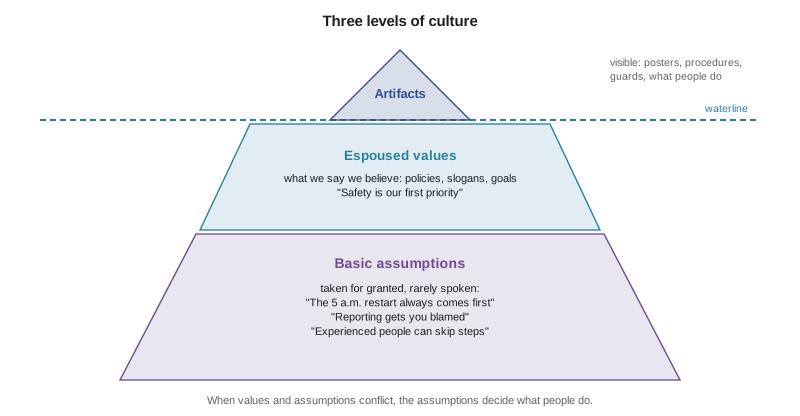
Artifacts are the visible things: the posters by the time clock, the procedure binders, the colour of the hard hats, the safety stand-down after an incident, the way people actually work. Artifacts are easy to see but hard to interpret on their own. A plant full of safety posters might have a strong culture or a weak one.
Espoused values are what the organization says it believes: 'Safety is our first priority', 'Everyone goes home safe', 'Stop the job if it isn't safe'. These appear in policies, speeches and orientation videos. They matter, because they set expectations, but they only become culture if people see them acted on.
Basic underlying assumptions are the beliefs that people take for granted and rarely say out loud, because they seem obvious. At Harrowgate Foods Ltd.'s Truro plant, the investigation interviews surfaced several: 'The morning bread run always comes first.' 'Night shift is on its own.' 'If you report a near miss, you will be the one who gets questioned.' 'Experienced people know when it's safe to skip a step.' These assumptions explained the spiral conveyor better than any missing procedure. They were also in direct conflict with the espoused value painted on the wall of the lunchroom.
Schein's key insight for leaders is that when espoused values and basic assumptions conflict, the assumptions win. People watch what leaders do, what gets rewarded, what gets punished and what gets ignored, and they learn the real rules from that. Changing culture therefore means changing what leaders do consistently over time, not just what they say.
Maturity models: where are we now?
A second family of models describes culture as a ladder of maturity. The best known is the safety culture ladder developed by Patrick Hudson and colleagues from earlier work by Ron Westrum, used widely in oil and gas and later in other industries. It describes five stages.
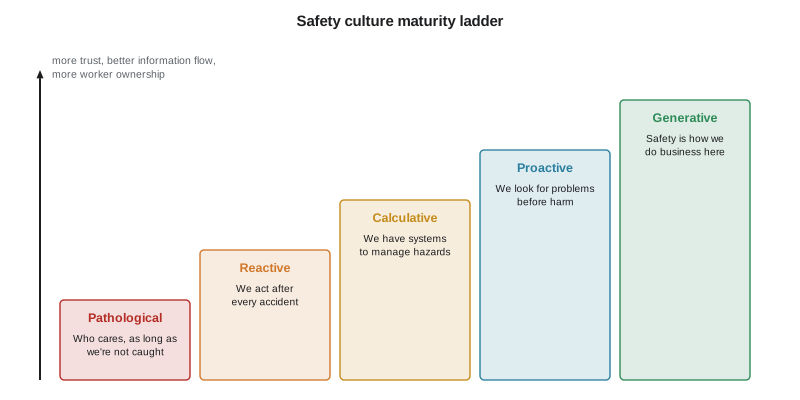
- Pathological: safety is seen as a problem caused by workers; the main driver is not getting caught by the regulator.
- Reactive: safety gets attention after something goes wrong, and then fades.
- Calculative: the organization has management systems, procedures, audits and statistics; safety is managed by the numbers and by the safety department.
- Proactive: leaders and workers look for problems before they cause harm, and the workforce is increasingly involved.
- Generative: safety is built into how the business works; bad news is sought out, information flows freely and everyone feels ownership.
Elena Novak's honest assessment was that Harrowgate Foods Ltd. was calculative on paper and reactive in practice. The Truro plant had a certified management system, monthly audits and a dashboard. But most real change happened after injuries, and night shift and the distribution centre had barely been touched by the systems at all. Maturity is rarely uniform: different sites, departments and shifts in the same company can sit on different rungs.
Maturity models are useful as a conversation tool. Asking a leadership team 'which rung are we on, and what would the next rung look like here?' gets people talking about specific behaviours instead of slogans. They are less useful as a scoring system. Treat them as a map, not a measurement.
What a strong safety culture looks like
Reviews of safety culture research, including the work of James Reason on the elements of a safety culture, keep returning to a small number of characteristics. In a strong safety culture:
- People report: hazards, near misses and errors are reported freely, because reporting is easy, valued and safe.
- Accountability is fair: people understand where the line is between honest mistakes and reckless choices, and leaders apply it consistently. Lesson 6 covers just culture.
- The organization learns: reports lead to visible changes, and lessons spread between sites and shifts.
- The organization is flexible: in a crisis, decisions move to the people with the knowledge, not just the people with the title.
- Leaders are visibly committed: they spend time where work is done, ask questions, listen and act, and they protect safety when it costs time or money.
- Workers are involved: they help design procedures, assess risks and investigate incidents, and they have real influence through the joint occupational health and safety committee.
- Risk awareness stays high: people stay uneasy about what could go wrong, instead of becoming comfortable with a good injury rate.
That last point is sometimes called chronic unease. Organizations that go a long time without a serious incident can start to believe they are safe, and stop looking hard. High-reliability organizations, such as aircraft carrier flight decks and air traffic control, are studied precisely because they manage to stay uneasy for decades.
The law sets the floor, not the culture
In Nova Scotia, Nova Scotia's Occupational Health and Safety Act makes safety a shared responsibility. Employers, supervisors, workers, owners, contractors and suppliers all have duties. Workers have the right to know, the right to participate and the right to refuse. A workplace with 20 or more regularly employed workers must have a joint occupational health and safety committee, a workplace with 5 to 19 must have a health and safety representative, and an employer with 20 or more regularly employed workers in the province must have a written occupational health and safety program. This internal responsibility system is itself a cultural idea: the law expects safety to be managed by the people in the workplace, not imposed from outside by inspectors. Since September 1, 2025, employers must also have a written harassment prevention policy and train workers on it, a reminder that psychological safety and physical safety are linked.
Either way, compliance and culture are different things. A workplace can comply with every rule and still have a culture in which people quietly skip steps under pressure. A strong culture usually produces compliance as a side effect, because people take ownership of hazards before an inspector finds them.
Measuring the starting point at Harrowgate Foods Ltd.
Before changing anything, Rachel asked Elena for a simple picture of the gap between what leaders believed and what workers experienced. Elena ran a short anonymous pulse survey with five statements at the Truro plant, scored from 1 (strongly disagree) to 5 (strongly agree), and compared managers with front-line workers.
# Pulse survey at the main plant: mean score out of 5 by group.
items = [
    ("Safety comes before production here", 4.6, 3.1),
    ("I can report a near miss without getting in trouble", 4.4, 2.8),
    ("Supervisors stop work when it is unsafe", 4.5, 3.3),
    ("Procedures match how the job is really done", 4.2, 2.6),
    ("Leaders act on the concerns we raise", 4.3, 2.7),
]
print(f"{'Statement':<52}{'Mgrs':>6}{'Floor':>7}{'Gap':>6}")
gaps = []
for text, mgr, floor in items:
    gap = mgr - floor
    gaps.append(gap)
    print(f"{text:<52}{mgr:>6.1f}{floor:>7.1f}{gap:>6.1f}")
print(f"Average perception gap: {sum(gaps)/len(gaps):.2f} points")
worst = max(items, key=lambda r: r[1] - r[2])
print("Largest gap:", worst[0])Statement Mgrs Floor Gap Safety comes before production here 4.6 3.1 1.5 I can report a near miss without getting in trouble 4.4 2.8 1.6 Supervisors stop work when it is unsafe 4.5 3.3 1.2 Procedures match how the job is really done 4.2 2.6 1.6 Leaders act on the concerns we raise 4.3 2.7 1.6 Average perception gap: 1.50 points Largest gap: I can report a near miss without getting in trouble
The average gap of 1.5 points on a five-point scale is large. Managers believed they led a safety-first plant. Front-line workers did not experience it that way, especially on two statements: that procedures matched how the job was really done, and that leaders acted on the concerns raised. Research on safety climate has found the same pattern in many organizations: the further people are from the front line, the more positive their view of safety tends to be. The gap is itself a finding. It tells leaders that their picture of the plant is filtered, and that the information reaching them is incomplete.
Worked problem
Reading the spiral conveyor through Schein's levels
Show solution
- Artifacts: a lockout procedure, an audit form, training records, a falling injury rate and a lunchroom sign saying safety comes first.
- Actual behaviour, also an artifact: night sanitation regularly cleaning the spiral without lockout when behind schedule.
- Espoused value: 'Never work on equipment that is not locked out.'
- Basic assumptions uncovered in interviews: the 5:00 a.m. restart is non-negotiable; night shift handles its own problems; experienced people can judge when a shortcut is safe; reporting a shortcut gets you blamed.
- Conclusion: the procedure was not the weak point. The assumptions were. Fixing the disconnect location helps, but unless leaders change what they reward and tolerate on night shift, the drift will return somewhere else.
Answer: The behaviour came from basic assumptions about production and blame, so the fix must address leadership signals as well as the equipment.
Common mistakes
MistakeTreating safety culture as a poster campaign or a slogan.
InsteadCulture is what people believe is really expected, learned from what leaders do, reward and tolerate.
MistakeAssuming a falling injury rate proves the culture is strong.
InsteadLow injury numbers can hide drift and under-reporting; look at behaviour, reporting and how trade-offs are made.
MistakeMeasuring culture only with a manager's opinion.
InsteadCompare front-line and management views; the gap is often the most important finding.
MistakeScoring the company with a single maturity rung.
InsteadDifferent sites, shifts and departments often sit on different rungs; use the ladder as a conversation map.
MistakeBelieving compliance and culture are the same.
InsteadA workplace can meet every rule on paper while people skip steps under pressure.
Summary and key terms
- Safety culture is the set of shared values, assumptions and patterns of behaviour that decide how safety is handled, especially when it competes with production.
- Safety climate is the shared perception of safety at a point in time; culture is deeper and slower to change.
- Schein's levels are artifacts, espoused values and basic assumptions; when values and assumptions conflict, the assumptions win.
- Maturity ladders run from pathological through reactive, calculative and proactive to generative, and different parts of one company can sit on different rungs.
- Strong cultures report, learn, hold people fairly accountable, involve workers and stay uneasy about what could go wrong.
- The law sets a floor; culture decides whether people work safely when no rule or inspector is present.
- Safety culture
- The shared values, beliefs, assumptions and patterns of behaviour that shape how an organization handles safety.
- Safety climate
- The shared perception of how safety is valued at a particular time, usually measured by surveys.
- Artifacts
- The visible level of culture in Schein's model: procedures, posters, equipment and observable behaviour.
- Espoused values
- What an organization says it believes, as stated in policies, speeches and slogans.
- Basic assumptions
- Beliefs taken for granted and rarely spoken, which drive behaviour when they conflict with stated values.
- Perception gap
- The difference between how managers and front-line workers rate safety in the same workplace.
- Chronic unease
- A healthy, continuing wariness about what could go wrong, even when results look good.
Practice problems
Work each problem on paper first, then reveal the answer to check.
Explain the difference between safety culture and safety climate in one or two sentences.
Show answer
Climate is the shared perception of safety at a moment, usually measured by surveys; culture is the deeper set of values and assumptions that produces that climate and changes slowly.
Name Schein's three levels and give one example of each from the spiral conveyor case.
Show answer
Artifacts (the lockout procedure, the audit form, night crews skipping lockout), espoused values (never work on unlocked equipment), basic assumptions (the 5:00 restart comes first; reporting gets you blamed).
Why can a falling injury rate be misleading as a measure of culture?
Show answer
Injuries are rare and can be under-reported; a falling rate can coexist with routine shortcuts and drift that have not yet caused harm.
List the five rungs of the safety culture maturity ladder from lowest to highest.
Show answer
Pathological, reactive, calculative, proactive, generative.
What did the perception gap in the pulse survey tell Rachel?
Show answer
That managers rated safety much higher than front-line workers, so the information reaching leaders was filtered and incomplete.
Lesson quiz · 5 questions
Score 60% or more to complete this lesson.
Create a free account to save your progress, take quizzes and earn a certificate.