
HSE-401 · Lesson 5 of 12 · 20 min
Psychological safety and speaking up
Six months before the spiral conveyor injury, a sanitation worker named Priya had raised the lockout problem at a night shift toolbox talk. She said, carefully, that 'sometimes we don't have time to do the full lockout on the spiral'. The night supervisor at the time replied that the procedure was the procedure and everyone had been trained. The talk moved on. Priya told the investigators later that she had taken that as a message not to raise it again, and she did not. Two of her co-workers said they had thought about mentioning it to the plant manager but assumed it would get back to the supervisor.
Every serious incident investigation seems to find someone who knew. The question for leaders is not just why the problem existed, but why the information did not reach someone who could act on it, or why it reached them and nothing happened. This lesson is about psychological safety: the shared belief that it is safe to speak up, ask questions, admit mistakes and challenge the way things are done without being humiliated or punished.
What psychological safety is
Amy Edmondson, a professor at Harvard Business School, defined team psychological safety in a 1999 study as a shared belief that the team is safe for interpersonal risk taking. Interpersonal risks are the everyday social risks of speaking up at work: looking ignorant by asking a question, looking incompetent by admitting a mistake, looking negative by pointing out a problem, or looking disruptive by challenging a decision. Most people manage these risks by staying quiet, because silence is safe for the individual in the short term even when it is costly for the team.
Edmondson's research began with a puzzle. Studying hospital teams, she found that the best-led teams appeared to make more medication errors, not fewer. On closer inspection, they did not make more errors; they reported more, because people felt safe to admit them. The teams that reported few errors were not safer. They were quieter.
Psychological safety is not the same as being nice, lowering standards or avoiding conflict. A psychologically safe team can have frank disagreements and high expectations. What it does not have is fear that speaking up will be punished or ridiculed.
Psychological safety and accountability
Edmondson describes a useful two-by-two grid. One axis is psychological safety; the other is the standards or accountability people are held to.
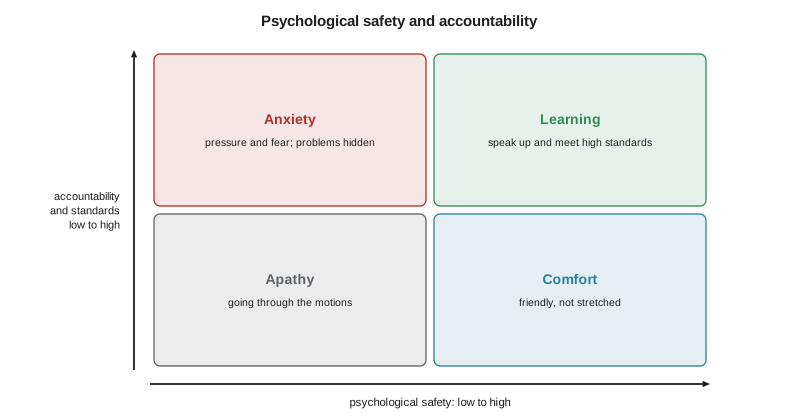
- Low safety, low standards (apathy): people go through the motions and keep their heads down.
- High safety, low standards (comfort): a friendly workplace where people get along but are not stretched or held to account.
- Low safety, high standards (anxiety): people are pushed hard and afraid to raise problems, so mistakes and shortcuts are hidden. This is where the night sanitation crew was.
- High safety, high standards (learning): people are held to high standards and feel safe to speak up about anything that gets in the way. This is the zone leaders should aim for.
The grid matters for safety leadership because many leaders respond to an incident by raising pressure and accountability alone. That moves a team from apathy to anxiety, where it becomes less likely, not more, to report the next problem.
Why people stay silent
Research on employee voice and silence has found that people stay quiet at work for several reasons, often several at once:
- Fear of consequences: being blamed, labelled a troublemaker, losing shifts or overtime, or damaging relationships with the supervisor.
- Futility: believing nothing will change, usually because past concerns went nowhere. This was the main reason at Harrowgate.
- Hierarchy and status: feeling it is not their place to question someone more senior or more experienced.
- Uncertainty: not being sure the concern is valid, especially for new or temporary workers.
- Loyalty to co-workers: not wanting to get someone else in trouble.
- Language and culture: workers whose first language is not English, or who come from workplaces where questioning authority was dangerous, may face extra barriers.
Note that only some of these reasons are about fear. Futility is just as powerful. People who believe speaking up is pointless will stop, even if they are not afraid. That is why closing the loop on concerns, covered in lessons 3 and 4, is so central to psychological safety.
Speaking up in high-hazard industries
Aviation learned this lesson the hard way. In 1977, two Boeing 747s collided on the runway at Tenerife in the Canary Islands, killing 583 people, the deadliest accident in aviation history. Investigations found that the crew of one aircraft began its takeoff without clearance, and that the flight engineer's tentative question about whether the other aircraft was clear of the runway did not stop the captain. Accidents like Tenerife led airlines to develop crew resource management training, which teaches all crew members to speak up clearly and teaches captains to invite and act on challenges. The same principles have since spread to operating rooms, nuclear plants and, increasingly, manufacturing.
Crew resource management uses graded assertiveness. A crew member raising a concern moves through steps until it is resolved: get attention, state the concern, state the problem as you see it, propose an action, and seek agreement. A common memory aid in health care is CUS: 'I am Concerned', 'I am Uncomfortable', 'This is a Safety issue'. Saying 'this is a safety issue' is a signal that the speaker needs the work to stop until the concern is resolved. Harrowgate Foods Ltd. adopted a version of this for its stop-work authority.
Stop-work authority
Most companies, including Harrowgate Foods Ltd., give every worker the authority to stop work they believe is unsafe. Stop-work authority is written into policies and orientation. On its own, it rarely works. Workers will not use it if they expect to be blamed for lost production, if supervisors restart the job without addressing the concern, or if stops are treated as a sign that the worker is difficult.
In Nova Scotia, stop-work authority sits alongside the right to refuse unsafe work under Nova Scotia's Occupational Health and Safety Act. A worker may refuse work they have reasonable grounds to believe is likely to endanger their health or safety or that of another person, must report the refusal, and is protected by section 45 of the Act, which protects workers from discriminatory action for raising safety concerns. A good stop-work culture means most concerns are resolved well before anyone needs to use the formal refusal process.
For stop-work authority to be real, leaders at Harrowgate Foods Ltd. agreed on four commitments:
- thank every person who stops work, publicly where appropriate, whether or not the concern turns out to be valid;
- never restart a stopped job until the concern has been reviewed and resolved with the person who raised it;
- never use lost production as a reason to question someone who stopped work;
- record stops, review them monthly and share what was learned.
How leaders build psychological safety
Edmondson describes three things leaders can do. First, set the stage: explain why speaking up matters, describe the work honestly as complex and uncertain, and make it clear that problems are expected and valued. Second, invite participation: ask questions, acknowledge your own fallibility ('I may be missing something here'), and create structures for input such as pre-job briefings and after-action reviews. Third, respond productively: thank people for speaking up, respond to bad news with curiosity rather than anger, and offer help and next steps.
Of the three, the response matters most. A single angry or dismissive reaction from a leader can undo months of encouragement, because everyone hears about it. Marcus Bell started telling supervisors that their first words after hearing bad news should always be 'thank you for telling me'.
Making it easier to speak
Leaders can also lower the barriers to speaking up by changing the structures around it:
- Pre-shift huddles that ask a question: 'What might hurt someone today?' rather than 'Any safety issues? No? Good.'
- Several channels: in person, through the joint occupational health and safety committee, on a card, by text or app, and anonymously, because different people are comfortable with different routes.
- Translation and plain language: materials and huddles in the languages workers speak, and interpreters for key conversations.
- Rotating the voice: asking newer workers to speak first in huddles, before senior people set the tone.
- Public answers: a board showing concerns raised and what happened to each.
Tracking speak-up at Harrowgate Foods Ltd.
Elena tracked two simple measures of speak-up at each site after the new commitments: the number of safety concerns and near misses reported per 100 workers per month, and the share of those closed with feedback to the person who raised them.
# Concerns and near misses reported per 100 workers per month, and % closed with feedback.
sites = {
    "Main plant (420 workers)":   ([22, 30, 41, 55, 61, 66], [40, 55, 70, 82, 88, 90]),
    "Distribution (110 workers)": ([9, 10, 12, 21, 30, 34], [25, 30, 45, 70, 80, 85]),
    "Sauces plant (60 workers)":  ([15, 17, 20, 24, 26, 27], [60, 70, 75, 80, 85, 85]),
}
workers = {"Main plant (420 workers)": 420, "Distribution (110 workers)": 110, "Sauces plant (60 workers)": 60}
for site, (reports, closed) in sites.items():
    per100 = [100 * r / workers[site] for r in reports]
    print(site)
    print("  reports per 100:", " ".join(f"{p:4.1f}" for p in per100))
print(" closed with feedback %:", " ".join(f"{c:3d}" for c in closed))Main plant (420 workers) reports per 100: 5.2 7.1 9.8 13.1 14.5 15.7 closed with feedback %: 40 55 70 82 88 90 Distribution (110 workers) reports per 100: 8.2 9.1 10.9 19.1 27.3 30.9 closed with feedback %: 25 30 45 70 80 85 Sauces plant (60 workers) reports per 100: 25.0 28.3 33.3 40.0 43.3 45.0 closed with feedback %: 60 70 75 80 85 85
Reporting rose at every site, most sharply at the distribution centre after month 3, when Grace changed how she responded to reports. Elena was careful to explain to the leadership team that a rising report count was good news: it meant problems that had always existed were now visible. A company that sees reports fall after a safety push should worry that people have gone quiet, not celebrate.
Worked problem
Using graded assertiveness at the spiral conveyor
Show solution
- A new sanitation worker sees a crew member reach toward the spiral before the lockout lock is applied.
- Attention: 'Hey, Tom, hold on a second.'
- Concern: 'I'm concerned the spiral isn't locked out yet.'
- Problem and proposal: 'The lock isn't on the disconnect. Can we put it on and test before you reach in?'
- Safety signal if needed: 'This is a safety issue. I need us to stop until it's locked.' The crew lead, trained to respond, thanks him and applies the lock.
Answer: A shared script and a leader who responds well make it possible for even a new worker to stop a senior colleague.
Psychological safety for supervisors
Supervisors need psychological safety too. A supervisor who fears being blamed for a missed target or a reported injury will pass that fear down to the crew. At Harrowgate Foods Ltd., several night supervisors admitted in a facilitated session that they had stopped reporting minor equipment problems to the day maintenance planner because 'it just comes back as us not managing our shift'. Rachel and Marcus responded by changing the daily production review: it now began with what had got in the way of safe work on each shift, and supervisors were thanked for bringing problems rather than questioned about them. Within weeks, maintenance requests from night shift doubled, and the planner was able to schedule repairs that had been quietly worked around for months. Leaders who want workers to speak up have to make it safe for the managers in between to speak up as well.
Common mistakes
MistakeAssuming a low number of reports means a safe workplace.
InsteadLow reporting often means people are quiet; rising reports after a culture push are usually good news.
MistakeTreating psychological safety as being nice or lowering standards.
InsteadAim for high psychological safety and high standards together.
MistakeResponding to bad news with anger or blame.
InsteadStart with 'thank you for telling me', then get curious and offer help.
MistakeWriting stop-work authority into policy and stopping there.
InsteadBack every stop, never restart until the concern is resolved and never question people about lost production.
MistakeRelying on one reporting channel.
InsteadOffer several channels, including anonymous ones and in workers' own languages.
Summary and key terms
- Psychological safety is a shared belief that it is safe to speak up, ask, admit mistakes and challenge without being humiliated or punished.
- Edmondson found that well-led teams reported more errors because people felt safe, not because they made more.
- Aim for high psychological safety with high standards; high pressure without safety produces fear and hidden problems.
- People stay silent because of fear, futility, hierarchy, uncertainty, loyalty, and language or cultural barriers.
- Stop-work authority only works if every stop is backed, concerns are resolved before restart and lost production is never held against the worker.
- Leaders build psychological safety by setting the stage, inviting participation and, above all, responding productively.
- Psychological safety
- A shared belief that a team is safe for interpersonal risk taking, such as speaking up or admitting mistakes.
- Employee voice
- Workers raising concerns, ideas or questions with the aim of improving the workplace.
- Graded assertiveness
- A structured way of escalating a concern until it is resolved.
- Stop-work authority
- The authority of any worker to stop work they believe is unsafe.
- Crew resource management
- Training developed in aviation that teaches teams to communicate, challenge and share decision-making.
Practice problems
Work each problem on paper first, then reveal the answer to check.
What surprising result did Edmondson find in her hospital study?
Show answer
Better-led teams appeared to make more errors, but they were actually reporting more because they felt safe to do so.
Name the four zones of the psychological safety and accountability grid.
Show answer
Apathy (low/low), comfort (high safety, low standards), anxiety (low safety, high standards), learning (high/high).
Give four reasons people stay silent at work.
Show answer
Any four: fear of consequences, futility, hierarchy, uncertainty, loyalty to co-workers, language or cultural barriers.
What four commitments make stop-work authority real?
Show answer
Thank every person who stops work; never restart until the concern is resolved; never question people over lost production; record, review and share stops.
Why did Elena treat rising reports as good news?
Show answer
Because they showed problems that already existed were becoming visible, which means people feel safe to speak up.
Lesson quiz · 5 questions
Score 60% or more to complete this lesson.
Create a free account to save your progress, take quizzes and earn a certificate.