
HSE-401 · Lesson 10 of 12 · 21 min
Leading safety through change, contractors and shift work
In the autumn after the spiral conveyor injury, Harrowgate Foods Ltd. faced three changes at once. A large grocery customer awarded the company a contract for a new line of frozen meals, which meant installing a new freezer tunnel and packaging line at the Truro plant in six weeks. The distribution centre hired 25 seasonal and agency workers for the holiday peak. And the Kentville sauces plant moved to a twelve-hour shift pattern to cover a vacancy in supervision. Elena knew from experience that the months of change are the months when serious incidents happen. Culture that holds up on an ordinary Tuesday can crack under the pressure of a project deadline, a crowd of new faces or tired people on long shifts.
This lesson looks at three situations that test safety culture: organizational and technical change, contractors and temporary workers, and shift work and fatigue. In each case, the question for leaders is how to keep the shared expectations of the core workforce alive when the conditions that support them are disrupted.
Why change is dangerous
Change disrupts the informal knowledge and routines that keep work safe. Experienced people know where the hazards are, which machine misbehaves and who to ask. When equipment, people, procedures or schedules change, that knowledge may no longer apply, and the new hazards may not be recognized. Investigations of major accidents frequently find an unmanaged change in the background: a modification to equipment that was not reviewed, a reorganization that removed an experienced role, or a schedule change that left a gap in supervision.
Change also brings pressure. Projects have deadlines, start-ups have targets and customers have penalty clauses. That pressure is felt most by the people commissioning new equipment and training new workers, at exactly the moment when the work is least familiar.
Management of change
Management of change, usually shortened to MOC, is a structured process for identifying and controlling the hazards that a change introduces before it is made. It began in the chemical industry. In the United States, OSHA's process safety management standard requires it for processes involving highly hazardous chemicals, which includes large ammonia refrigeration systems like the one at Harrowgate Foods Ltd.'s Truro plant. Good practice applies it much more widely.
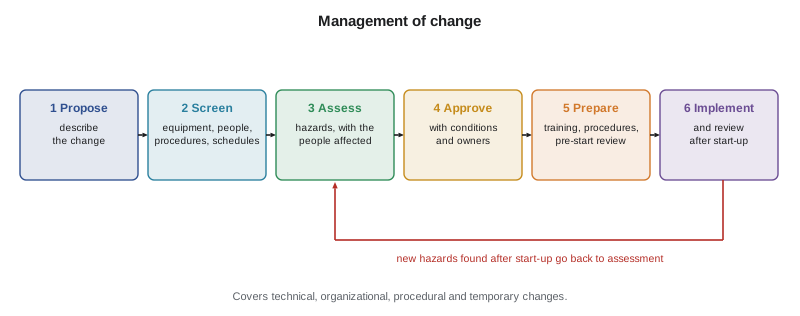
A useful MOC process covers four kinds of change: technical changes to equipment, materials and processes; organizational changes such as reorganizations, staffing reductions and new roles; procedural changes; and temporary changes, which are often the most dangerous because they bypass review on the assumption that they will not last. The key steps are to describe the change, screen it for safety impact, assess the hazards with the people who will be affected, approve it with conditions, prepare training and procedures, run a pre-start review, and check after start-up that the controls are working.
Leading the freezer line project
The freezer line project was the first big test of whether Harrowgate Foods Ltd.'s leaders would hold to their new commitments under pressure. In week four, the installation contractor fell behind. The project manager proposed starting up the packaging line without the guarding on the infeed conveyor, which was on back order, and running with a person stationed beside it 'just for two weeks'.
Under the old culture, that proposal would probably have been approved. Instead, Marcus Bell put it through the MOC process. The hazard assessment, which included two operators who would run the line, concluded that a person standing beside an unguarded infeed was exactly the kind of SIF precursor the company had committed to eliminating. Marcus approved a two-week delay to the infeed section, started the freezer tunnel on schedule and told the customer. The customer accepted the delay without penalty. The story travelled through the plant within days.
Leaders' behaviour during change matters more than at any other time, for a simple reason: people are watching to see whether the commitments made after the injury were real or just a phase.
Organizational change
Organizational changes, such as reorganizations, cost cuts, mergers and changes in leadership, can affect safety in less visible ways. Removing a supervisor position, cutting maintenance staff or combining roles may leave tasks undone or knowledge lost. A useful practice is to apply MOC thinking to organizational changes too: before the change, ask which safety-critical tasks, decisions and knowledge sit with the roles affected, and who will do them afterwards. The move to twelve-hour shifts at Kentville, for example, was reviewed to make sure that every shift would still have a supervisor trained to authorize confined space entry for the kettle cleaning.
Contractors and temporary workers
Contractors, agency workers and seasonal hires are at higher risk of serious injury than permanent employees doing similar work. Studies of injury data in several countries have found higher rates among new and temporary workers, especially in their first months. The reasons are partly obvious, such as unfamiliarity with the site and its hazards, and partly cultural: temporary workers may not feel part of the team, may fear losing their placement if they raise concerns, and may not know the informal rules that keep permanent staff safe.
In Nova Scotia, Nova Scotia's Occupational Health and Safety Act places duties on employers, contractors and owners, and an employer that brings agency workers onto its site must still protect them. The host employer controls the workplace and the work, so it must provide site-specific orientation, training and supervision, while the agency keeps its own duties as employer of record. HSE-406 covers contractor safety management in depth.
For the distribution centre's 25 seasonal workers, Grace and the joint occupational health and safety committee built the onboarding around culture as much as rules:
- Same orientation as permanent staff, including the life-saving rules, the stop-work commitment and how to report, delivered in the workers' languages.
- A buddy for the first two weeks: an experienced permanent worker who shows them the real hazards and the right way to do the job.
- Visible identification: a coloured vest for the first 30 days so that everyone knows to look out for them, framed as support rather than suspicion.
- Early check-ins: a supervisor conversation at the end of the first day, the first week and the first month, asking what has been confusing or hard.
- The same rights and recognition: seasonal workers were eligible for the near miss report of the month, and two of them won it.
Shift work and fatigue
Shift work, especially nights and long shifts, increases the risk of errors and injuries. Human beings have circadian rhythms that make alertness lowest in the early morning hours, typically between about 2:00 and 6:00 a.m. Research has found that injury risk rises on night shifts compared with day shifts, rises with successive night shifts, and rises in the later hours of long shifts. Fatigue impairs attention, reaction time and judgement in ways that resemble alcohol impairment; studies have found that staying awake for around 17 to 19 hours can produce performance decrements comparable to a blood alcohol concentration around the legal driving limit.
The spiral conveyor injury happened at 3:40 a.m., in the lowest part of the circadian cycle, on the fourth consecutive night shift for the injured worker. Fatigue was not the main cause, but it was part of the context.
Shift work also affects culture. Night shifts typically have less supervision, fewer leaders present, fewer support staff and less involvement in meetings and committees. Workers on nights often feel forgotten, which is exactly what the night sanitation crew had said. A safety culture that only exists during office hours is not really a culture.
Good practice for managing fatigue and shift work includes:
- designing rosters with forward rotation (days, then evenings, then nights), limits on consecutive night shifts and enough rest between shifts;
- avoiding scheduling the most hazardous tasks in the early morning hours where possible;
- allowing and encouraging short rest breaks, and having a way for workers to say they are too tired to work safely;
- making sure night shifts have trained supervision, first aid and the authority to stop work;
- holding committee meetings, training and leader walk-arounds at times night workers can attend, and paying them to attend;
- watching for overtime creep, especially during peaks and staff shortages.
Checking fatigue risk in the Kentville roster
Before approving the twelve-hour shift pattern at Kentville, Elena checked the proposed roster against simple fatigue rules agreed with the joint occupational health and safety committee: no more than four consecutive twelve-hour shifts, no more than three consecutive nights, and at least eleven hours off between shifts.
# Check a four-week roster for one worker against simple fatigue rules.
# D = 12 h day (07-19), N = 12 h night (19-07), - = off.
roster = "DDDD----NNNN----DDD-NND--DD-"
MAX_RUN, MAX_NIGHTS, MIN_REST = 4, 3, 11
problems = []
run = nights = 0
for i, s in enumerate(roster):
    run = run + 1 if s != "-" else 0
    nights = nights + 1 if s == "N" else 0
    if run > MAX_RUN:
        problems.append(f"day {i+1}: {run} shifts in a row")
    if nights > MAX_NIGHTS:
        problems.append(f"day {i+1}: {nights} nights in a row")
    if i > 0 and roster[i-1] == "N" and s == "D":
        problems.append(f"day {i+1}: night then day leaves no rest")
print("Shifts worked:", sum(1 for s in roster if s != "-"), "of", len(roster), "days")
print("Problems found:" if problems else "No problems found")
for p in problems:
print(" -", p)Shifts worked: 16 of 28 days Problems found: - day 12: 4 nights in a row - day 23: night then day leaves no rest
The check flagged two problems in the proposed roster: a run of four nights, one more than the agreed limit, and a night shift followed straight by a day shift, which leaves no time to sleep. The roster was redesigned with forward rotation and an extra rest day after the night block before it was approved.
Keeping the culture alive through change
Across all three situations, the same leadership principles apply. Leaders should expect that change will test the culture and plan for it; put the people who will do the work at the centre of hazard assessments; refuse shortcuts on SIF precursors even under deadline pressure, and make those decisions visible; extend the full culture, including recognition and stop-work authority, to contractors, temporary and night workers; and check after the change that controls and behaviours have held.
Worked problem
A temporary change at the ammonia plant room
Show solution
- A compressor fails at the Truro plant, and maintenance proposes running a temporary hose to an alternative unit until a part arrives.
- The change is temporary but affects an ammonia system, so it goes through MOC instead of being treated as a quick fix.
- The hazard assessment, with the refrigeration technician and an operator, identifies the hose rating, leak detection coverage and the emergency response plan as critical.
- Approval is given with conditions: a rated hose, a portable ammonia detector at the connection, a daily check and a removal date.
- The temporary change is logged with an expiry date, and Elena checks on the date that it has been removed and the permanent repair completed.
Answer: Temporary changes need the same hazard review as permanent ones, and a firm end date.
After the change: checking that it held
The last step of any change is easy to skip: going back to check that the controls and behaviours have held once the project team has left. Thirty days after the freezer line started up, Elena and two operators did a post-start review. They found that the guarding was in place and working, but that the packaging film rolls were being changed by lifting them by hand because the roll lift ordered for the line had been delivered to the wrong site. They also found that the new line's emergency stops had been labelled in English only, while three of the operators spoke Portuguese as their first language. Both issues were fixed within a week. Without the review, the first might have been found only after a back injury, and the second during an emergency.
Common mistakes
MistakeExempting temporary changes from review.
InsteadTemporary changes often bypass controls; review them and set an end date.
MistakeAssessing changes in the office without the people who will do the work.
InsteadInclude operators and maintenance staff in every hazard assessment.
MistakeTreating temporary and agency workers as outsiders.
InsteadGive them the same orientation, buddies, rights and recognition as permanent staff.
MistakeAssuming culture reaches night shift automatically.
InsteadPut supervision, leaders, training and meetings where night workers can reach them.
MistakeAccepting shortcuts on SIF precursors to meet a project deadline.
InsteadHold the line visibly; these are the decisions people remember.
Summary and key terms
- Change disrupts informal knowledge and routines and adds pressure, so serious incidents cluster around it.
- Management of change identifies and controls hazards before technical, organizational, procedural and temporary changes are made.
- Leaders' decisions during change show whether safety commitments are real.
- Contractors and temporary workers face higher risk and cultural barriers; give them full orientation, buddies, check-ins, rights and recognition.
- Night work and long shifts raise fatigue and injury risk; design rosters carefully and extend leadership and participation to back shifts.
- Plan for change to test the culture, involve workers, refuse shortcuts on high-energy hazards and check afterwards that controls held.
- Management of change (MOC)
- A process for identifying and controlling the hazards introduced by a change before it is made.
- Temporary change
- A change intended to last a limited time, which still needs hazard review and a set end date.
- Host employer
- The employer at whose workplace agency or contract workers do their work.
- Circadian rhythm
- The body's roughly 24-hour cycle of alertness and sleepiness.
- Forward rotation
- A shift rotation that moves from days to evenings to nights, which is easier on the body than backward rotation.
- Fatigue
- A state of reduced mental and physical capacity caused by lack of sleep, long hours or circadian disruption.
Practice problems
Work each problem on paper first, then reveal the answer to check.
Name the four kinds of change an MOC process should cover.
Show answer
Technical, organizational, procedural and temporary changes.
What did Marcus decide about the unguarded infeed conveyor, and why did it matter?
Show answer
He delayed that section until the guarding arrived; it showed the post-injury commitments held under deadline pressure.
Give three practices for onboarding temporary workers safely.
Show answer
Any three: full orientation in their languages, a buddy, visible identification, early check-ins, the same rights and recognition.
Why are early morning hours a particular fatigue risk?
Show answer
Circadian alertness is lowest between about 2:00 and 6:00 a.m., impairing attention, reaction time and judgement.
What two problems did the roster check find?
Show answer
Four nights in a row, above the limit of three, and a night shift followed directly by a day shift with no rest.
Lesson quiz · 5 questions
Score 60% or more to complete this lesson.
Create a free account to save your progress, take quizzes and earn a certificate.