
HSE-401 · Lesson 4 of 12 · 21 min
Safety conversations and leader walk-arounds
Grace Whitfield, the manager of Harrowgate Foods Ltd.'s distribution centre in Dartmouth, did her first scheduled safety walk-around the week after the leadership meeting. She walked the dock with a clipboard, found a pallet jack parked in a pedestrian aisle, a missing dock plate pin, two workers without high-visibility vests and an overloaded rack bay, wrote them down, told the supervisor to fix them and left. The supervisor fixed them. Nobody on the dock said a word to her. Afterwards, a forklift operator told Sam Pellerin, the worker co-chair of the joint occupational health and safety committee, that 'the boss came to do an inspection'.
Grace had done something useful: four hazards were fixed. But she had not done what Rachel had asked for, which was to learn how work at the distribution centre really happened and to show people that leaders cared. This lesson is about how to turn a walk-around from an inspection into a conversation, and how to hold the kind of safety conversation that surfaces what you would never see on a checklist.
Inspections and walk-arounds are different tools
Both inspections and leader walk-arounds involve walking through the workplace, so they are easy to confuse. They have different purposes:
| Inspection | Leader walk-around | |
|---|---|---|
| Main purpose | Find and fix hazardous conditions | Understand how work is really done and build trust |
| Main focus | Conditions: guards, housekeeping, equipment, PPE | People and work: pressures, workarounds, ideas |
| Tool | Checklist | Open questions and listening |
| Who leads | Supervisors, the joint occupational health and safety committee, safety staff | Leaders at every level, especially senior ones |
| Output | List of deficiencies and corrective actions | Insights, concerns to close, recognition, relationships |
| Frequency | Scheduled, often weekly or monthly | Regular and frequent, including back shifts |
Workplaces need both. Inspections are a core part of a safety program and, in many jurisdictions, a legal expectation; HSE-407 covers them in depth. But a leader who only inspects teaches people that leadership visits are about catching faults. Workers then tidy up, stand up straight and say nothing when a manager approaches, which is exactly the opposite of what a leader needs.
Gemba and visible felt leadership
The idea of leaders going to where work happens comes partly from lean manufacturing, where the place value is created is called the gemba, a Japanese word meaning 'the real place'. A gemba walk is a walk to observe and understand the work, not to judge the people. Safety leadership borrowed the idea and combined it with visible felt leadership: being present in a way that workers experience as genuine interest and care.
What makes a walk-around felt rather than merely seen? Workers consistently mention a few things: the leader stops and talks, not just waves; asks about the work and listens to the answer; knows or learns people's names; comes back to report what happened about a concern; and comes at times when work is hard, such as night shift, peak season and shutdowns, not only on quiet afternoons.
Planning a walk-around
A good walk-around takes 30 to 60 minutes and some thought beforehand. Elena gave every leader at Harrowgate Foods Ltd. a one-page guide:
- Pick a focus: one task, area or shift, rather than trying to see everything. The spiral conveyor, the dock at shift change, the forklift charging area, the sauces kettles.
- Check the context: recent incidents, near misses, open concerns and changes in the area.
- Tell the supervisor you are coming, and why: so the visit does not feel like an ambush, and invite them along if appropriate.
- Leave the clipboard: carry a small notebook for commitments, not a checklist.
- Wear the PPE and follow the rules: every rule, every time. Leaders are always being watched.
- Block the time: a walk-around squeezed between meetings becomes a quick wave.
The conversation itself
Most safety conversations follow a simple shape. Several companies and safety organizations have published versions; the one Harrowgate Foods Ltd. adopted has five steps.
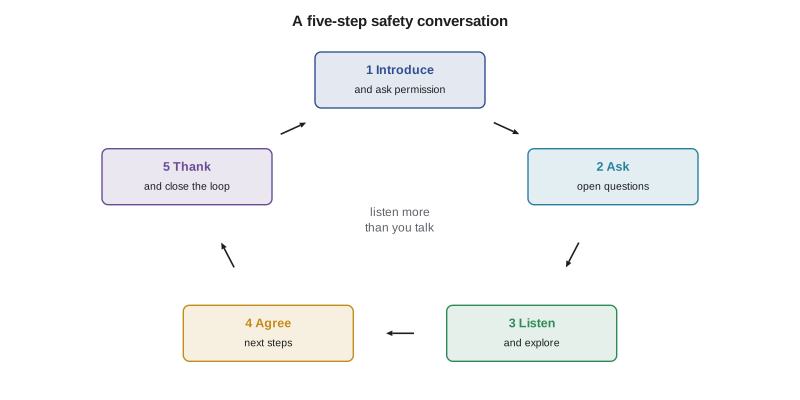
1. Introduce yourself and ask permission. 'Hi, I'm Rachel. I'm trying to understand how the spiral cleaning works on nights. Have you got ten minutes, or is there a better time?' Asking permission respects the work and signals that this is not an inspection. Never interrupt a task at a critical point to start a conversation.
2. Ask about the work with open questions. Open questions invite stories instead of yes or no answers. Useful questions include:
- 'Can you walk me through how you do this job?'
- 'What part of this job is hardest, or most likely to hurt someone?'
- 'When does this job not go the way the procedure says?'
- 'What do you need that you don't have?'
- 'If you were in charge, what would you change first?'
- 'What do new people find difficult here?'
- 'Have you ever had a close call doing this?'
3. Listen and explore. The leader's job in this step is mostly to stay quiet. Follow up with 'tell me more about that' or 'what happens then?' Resist the urge to correct, defend or solve the problem on the spot. If the worker describes a shortcut, do not pounce; ask why it makes sense to them. You will learn about the pressure, the equipment and the design that make the shortcut attractive.
4. Agree what will happen next. If the conversation reveals an immediate danger, stop the work and deal with it, explaining why. Otherwise, agree on something concrete: what you will look into, who you will talk to, and when you will come back. If you observed someone working safely, or doing something better than the procedure, say so specifically.
5. Thank them and close the loop. Thank the worker for their time and honesty. Then follow through: come back, call or send word through the supervisor with what was done, by when, or why not. The follow-up is the part most leaders forget and the part workers remember.
What to do when you see an unsafe act
Leaders sometimes worry that a conversational approach means ignoring unsafe behaviour. It does not. If a worker is about to be hurt, the leader intervenes immediately, calmly and clearly, and stops the work. What changes is what happens next. Instead of a lecture or a write-up on the spot, the leader asks: 'Help me understand what was happening there.' Often the answer reveals a missing tool, a confusing procedure, a time pressure or a design problem that the leader can fix. Lesson 6 covers how to decide when a behaviour needs a disciplinary response.
Common mistakes in safety conversations
Elena watched several leaders' first conversations, with their permission, and gave feedback. The same mistakes came up again and again:
- Interrogating: firing closed questions such as 'Did you lock out?' 'Have you had training?' People hear an investigation and stop talking.
- Lecturing: turning the conversation into a speech about the importance of safety.
- Solving too fast: offering a fix before understanding the problem, which often solves the wrong thing.
- Defending the system: responding to a concern with 'but the procedure says' or 'we already spent money on that'.
- Promising too much: committing to things the leader cannot deliver, which damages trust when they do not happen.
- Visiting only easy places: the office, the day shift and the clean areas.
A walk-around on night shift
Marcus Bell's first walk-around on night sanitation was at 2:00 a.m., two months after the injury. He went with the night supervisor, Dev Sandhu, and asked the crew lead whether he could watch the spiral being cleaned. He asked open questions and mostly listened. He learned three things that no report had told him: that the new disconnect beside the spiral was working well; that the crew now lost twenty minutes every night waiting for the oven line to cool before they could start; and that two of the five crew members had been on the job less than a month and had been trained by watching. He agreed to look at the oven cool-down schedule and the training gap, and came back eight days later with answers on both.
Measuring walk-around quality
Rachel worried that walk-arounds would become another box to tick. Counting visits says nothing about quality. So for one month, Elena asked workers who had been part of a leader conversation to answer three questions on a card, anonymously: Did the leader listen more than talk? Did you learn what would happen next? Has it happened?
# Worker feedback cards after leader conversations (yes = 1, no = 0).
cards = {
    "Main plant days":   [(1,1,1),(1,1,0),(1,0,0),(1,1,1),(1,1,1),(0,0,0),(1,1,1),(1,1,0)],
    "Main plant nights": [(1,1,1),(1,1,1),(1,1,0),(1,1,1),(1,1,1)],
    "Distribution":      [(0,1,1),(0,0,0),(1,0,0),(0,1,0),(1,1,1),(0,0,0)],
    "Sauces plant":      [(1,1,0),(1,0,0),(1,1,1),(1,1,0)],
}
labels = ["listened", "knew next step", "it happened"]
for site, rows in cards.items():
    n = len(rows)
    rates = [sum(r[i] for r in rows) / n for i in range(3)]
    text = ", ".join(f"{l} {100*p:.0f}%" for l, p in zip(labels, rates))
print(f"{site:<18} n={n}: {text}")Main plant days n=8: listened 88%, knew next step 75%, it happened 50% Main plant nights n=5: listened 100%, knew next step 100%, it happened 80% Distribution n=6: listened 33%, knew next step 50%, it happened 33% Sauces plant n=4: listened 100%, knew next step 75%, it happened 25%
The cards showed the night shift at the main plant rating leader conversations highly, which matched Marcus's effort there. The distribution centre scored lowest on listening, which confirmed what Sam had told Elena about Grace's inspection-style visits. Grace asked Elena to come with her on her next three walk-arounds and give her feedback. Within two months, the distribution centre's scores were similar to the plant's.
In Nova Scotia, walk-arounds complement the inspections that the joint occupational health and safety committee carries out under Nova Scotia's Occupational Health and Safety Act, and leaders should invite committee members along and share what they learn. Committee members have a legal role in inspecting the workplace and making recommendations; a leader's walk-around should strengthen, not replace, that role.
Worked problem
Turning Grace's inspection into a conversation
Show solution
- Before: Grace picks the dock at shift change as her focus, tells the dock supervisor she is coming and invites Sam from the joint occupational health and safety committee.
- She asks a forklift operator if he has ten minutes after he parks his truck, and asks: 'What makes the dock hardest to work safely at shift change?'
- He explains that the outbound trailers are scheduled so tightly that pickers walk through the forklift lane to save time, and that the pedestrian aisle is blocked by staged pallets most mornings.
- Grace listens, asks what would help, and agrees to review the trailer schedule and the staging area with the supervisor within a week. She thanks him.
- She returns nine days later with a new staging layout and a ten-minute buffer in the trailer schedule, and asks him whether it has helped.
Answer: The conversation found the cause behind the blocked aisle and the pedestrian risk, which the checklist alone would never have revealed.
Walk-arounds by senior leaders
Walk-arounds by the most senior leaders carry extra weight, and extra risk. When a vice-president appears on the floor, everyone notices, supervisors may feel judged, and workers may assume something is wrong. Rachel handled this by telling each site in advance that she would be visiting regularly to learn, not to inspect, by always going with the local supervisor or a joint occupational health and safety committee member, and by never giving instructions directly to workers on the spot. If she saw something that needed fixing, she raised it with the site manager afterwards, so that local leaders kept their authority and the fix came through the normal line. She also made a point of visiting at least once a month during a night shift and once during a weekend sanitation, and of asking each time what had happened to the concerns raised on her previous visit. Over time, workers began to greet her visits with lists of things they wanted her to see.
Common mistakes
MistakeTreating every leader visit as an inspection.
InsteadUse inspections for conditions and walk-arounds for understanding work and building trust.
MistakeAsking closed questions such as 'Did you lock out?'
InsteadAsk open questions about how the job is done, what makes it hard and what should change.
MistakeFixing the problem on the spot before understanding it.
InsteadListen and explore first; the obvious fix is often the wrong one.
MistakeForgetting to follow up.
InsteadClose the loop with the person who raised the concern: what was done, by when, or why not.
MistakeVisiting only day shift and clean areas.
InsteadGo to night shift, peak periods and hard jobs, where the real risks and pressures are.
Summary and key terms
- Inspections find hazardous conditions; leader walk-arounds aim to understand how work is really done and to build trust.
- Visible felt leadership means workers experience a leader's presence as genuine interest and care.
- Plan walk-arounds: pick a focus, check context, tell the supervisor, leave the clipboard and follow every rule.
- A safety conversation has five steps: introduce and ask permission, ask open questions, listen and explore, agree next steps, thank and close the loop.
- Stop immediate danger at once, then ask what made the unsafe act make sense to the worker.
- Measure walk-around quality from the worker's point of view, not just the number of visits.
- Leader walk-around
- A planned visit by a leader to where work is done, to observe, ask and listen.
- Gemba
- A lean manufacturing term for 'the real place' where work is done.
- Open question
- A question that invites a description or story rather than a yes or no answer.
- Safety conversation
- A structured, respectful discussion between a leader and a worker about how work is done safely.
- Follow-up
- Returning to the worker to report what was done about a concern.
Practice problems
Work each problem on paper first, then reveal the answer to check.
Give two differences between an inspection and a leader walk-around.
Show answer
Any two: inspections focus on conditions with a checklist, walk-arounds on people and work with open questions; inspections produce deficiency lists, walk-arounds produce insights and relationships.
Write three open questions you could ask during a walk-around.
Show answer
For example: 'Can you walk me through this job?' 'What part of this job is most likely to hurt someone?' 'When does this job not go the way the procedure says?'
What are the five steps of the safety conversation in this lesson?
Show answer
Introduce and ask permission; ask about the work; listen and explore; agree what happens next; thank and close the loop.
What should a leader do on seeing a worker about to be hurt?
Show answer
Intervene immediately and stop the work, then ask what made the act make sense and look for causes such as tools, time pressure or design.
What did the feedback cards reveal about the distribution site?
Show answer
It scored lowest on leaders listening, matching the inspection-style visits; coaching raised its scores within two months.
Lesson quiz · 5 questions
Score 60% or more to complete this lesson.
Create a free account to save your progress, take quizzes and earn a certificate.