
HSE-393 · Lesson 8 of 12 · 21 min
Home and community care visits
▶ Video coming soon A video version of this lesson is on the way.
Nadia Rahman, a home care nurse with Northbridge Home Care, makes about seven visits a day across Northbridge and the farm country around it, and drives about 180 kilometres a week. In the hospital, help is a button press away. In a client's farmhouse at the end of a gravel road, with no phone signal and a client's adult son drinking in the kitchen, it may be twenty minutes or more. Home and community care workers face many of the same risks as hospital staff, plus the risks of working alone, in places they do not control, among people they may know little about. This lesson covers how Northbridge Home Care protects them.
What is different about working in homes
In a hospital, the organization controls the building, the staffing, the security and the rules. In a home, the client and their household do. Home care workers often face:
- Working alone, often out of sight and hearing of any colleague, sometimes with no phone signal.
- Unknown people: family members, friends and neighbours who may be intoxicated, hostile, or involved in crime.
- Unknown places: cluttered or unsafe homes, aggressive dogs, weapons in the house, drugs and drug paraphernalia, poor lighting, isolated rural locations.
- Driving: long distances, winter roads, parking in unfamiliar places, and carrying medical equipment and drugs that make the car a target.
- Less information: referrals that leave out a history of violence, and clients whose situation has changed since the last visit.
- Pressure to continue: a sense that leaving means abandoning a client who needs care.
The OHSA applies to home care workers just as to hospital staff. The home care agency must assess the risks of workplace violence in its work, including the risks of working in clients' homes, have measures and procedures to control them and to summon immediate assistance, and share information about clients with a history of violent behaviour. PSHSA's community care toolkit sets out practical tools, including a home safety assessment and a working-alone procedure. Ontario does not have a separate working-alone regulation, but the duty to take every reasonable precaution covers it.
Before the first visit
Most of the protection for home care workers is put in place before anyone goes to the door. At Northbridge Home Care, every new client goes through three steps:
- Referral screening. The intake coordinator asks the referring hospital, physician or agency directly about any history of violence, aggression, weapons, drug or alcohol use in the home, aggressive animals and other people living there. Referral forms have a mandatory field for violence risk, and incomplete forms are sent back.
- Phone assessment. Before the first visit, the coordinator calls the client or family to confirm the address and directions, who lives in the home, whether there are pets and whether they can be shut away during visits, whether anyone smokes or there are weapons, and any other concerns.
- Home safety assessment. On the first visit, the nurse completes a short checklist covering access, lighting, parking, phone signal, pets, weapons, other occupants, and how to get out quickly. The results go in the client record and inform the care plan.
If the screening finds a significant risk, the visit is planned differently. Options include a joint visit by two staff, visits only in daylight, a first meeting in a clinic, a family member present, the pet shut away, weapons locked up or removed, or, rarely, a police check before the visit. A small number of clients cannot be visited safely at home at all, and their care is provided another way.
Flags in the community
The flags described in Lesson 3 are just as important in the community, and harder to get right. Home care clients may be flagged because of their own behaviour or because of someone else in the home. The flag in the client record must be visible to every worker before they visit, including on the visit schedule on their phone, and it must describe the risk and the precautions, such as "son may be intoxicated in the evening; visit before 1500; two staff if he is home". Flags are reviewed when the household changes.
Check-in and check-out
The single most important control for lone workers is a check-in system that notices quickly when someone does not come back. A worker who is hurt, trapped or ill in a client's home cannot call for help if nobody knows where they are or expects to hear from them. Northbridge Home Care uses a check-in procedure based on its scheduling app:
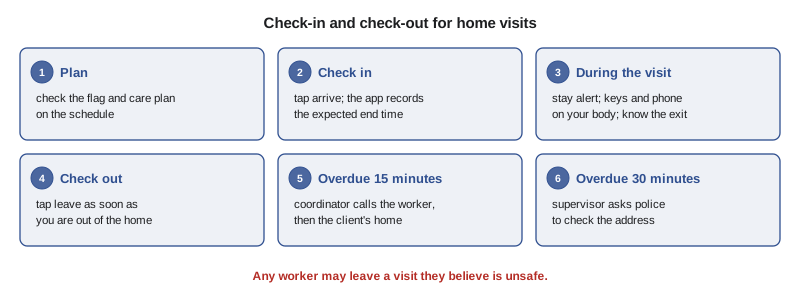
- The worker taps "arrive" when they reach the home, and the app records the location and the expected end time for that visit.
- They tap "leave" when they leave.
- If a worker has not checked out within 15 minutes of the expected end time, the coordinator, or the on-call coordinator after hours, calls the worker.
- If there is no answer, the coordinator calls the client's home and the worker's supervisor.
- If the worker still cannot be reached 30 minutes after the expected end time, the supervisor asks police to check the address.
- Workers who visit in the evening or at night check in by phone with the on-call coordinator at the end of their last visit.
The coordinator's dashboard runs a short script every five minutes to list workers who are overdue and what to do next:
from datetime import datetime, timedelta

now = datetime(2026, 2, 11, 16, 40)
visits = [  # (worker, client, expected end, checked out?)
    ("Nadia", "Fournier, Riverside Rd", datetime(2026, 2, 11, 16, 30), False),
    ("Joel",  "Kaur, 3rd Line",         datetime(2026, 2, 11, 16, 0),  False),
    ("Priti", "Ames, Mill St",          datetime(2026, 2, 11, 16, 15), True),
    ("Sam",   "Novak, Gravel Pit Rd",   datetime(2026, 2, 11, 16, 20), False),
]
for worker, client, end, out in visits:
    if out:
        continue
    late = now - end
    if late >= timedelta(minutes=30):
        step = "call supervisor and ask police to check the address"
    elif late >= timedelta(minutes=15):
        step = "call the worker, then the client's home"
    else:
        step = "watch"
print(f"{worker:<6} {client:<22} {int(late.total_seconds() // 60):>3} min late -> {step}")Nadia Fournier, Riverside Rd 10 min late -> watch Joel Kaur, 3rd Line 40 min late -> call supervisor and ask police to check the address Sam Novak, Gravel Pit Rd 20 min late -> call the worker, then the client's home
On this afternoon, Joel is 40 minutes overdue at a farm on the 3rd Line, so the coordinator moves straight to his supervisor and the police. In this case, the phone signal had dropped and Joel was safe, but he had not checked out; the coordinator reminded the team that a missed check-out has consequences for everyone, and that the system only works if it is trusted.
Personal safety at the visit
Home care workers learn habits that keep them safer at every visit:
- Driving and parking: park on the street rather than in the driveway, where the car could be blocked in; park facing the way out; keep the car locked and equipment out of sight; keep enough fuel in winter.
- Approaching: look and listen before going to the door. If something seems wrong, such as shouting inside, an intoxicated person outside or a dog loose, stay in the car and call the coordinator.
- Entering: let the client or family lead the way; note the exits; ask that pets be shut away.
- During the visit: sit or work nearer the door when possible; keep car keys and phone on your body, not in your bag across the room; stay alert to changes in mood or new people arriving.
- A code word: Northbridge Home Care uses an agreed phrase for distress. A worker who phones the office and asks for "the blue binder" is signalling that they need help but cannot say so; the coordinator asks yes or no questions and sends help.
- Personal alarms: workers in rural areas or high-risk homes carry a lone worker device with an alarm button, a fall detector and satellite messaging where there is no cell signal.
Leaving a visit
Every Northbridge Home Care worker has the right, and is expected, to end a visit and leave if they feel unsafe. The procedure is simple: make a short, calm excuse if possible ("I need to get something from the car"), leave, drive to a safe place, and call the coordinator. The coordinator decides with the worker what happens next, including how and when the client's care will continue, whether a return visit needs two staff, and whether police or other services should be involved. No worker is disciplined for leaving a visit they believed was unsafe.
Leaving can feel like abandoning a client who needs care, especially one who is frail or alone. The answer is in the system, not in the worker's conscience: the agency arranges care another way, such as a joint visit later the same day, a visit by a family member with phone support, or, if needed, an ambulance. A worker who stays in a dangerous situation out of loyalty is not protecting the client; if the worker is hurt, the client gets no care at all.
Client agreements
When a client or someone in their home has behaved in a threatening or abusive way, the agency may ask the client to agree to conditions for continued service: pets shut away, no smoking during visits, a particular person not present, weapons secured, no abusive language. These are explained clearly, in writing, with the reasons and what will happen if they are not followed. Most clients agree, and the agreement itself often improves behaviour. If conditions are repeatedly broken and the risk remains high, the agency may change how care is delivered, but it works with the client, their physician and other services to make sure their needs are still met.
Worked problem
Nadia's visit to the Kowalchuk farm
Nadia has a new client, Mrs. Kowalchuk, who needs daily wound care after surgery. The referral says nothing about violence. On the phone assessment, Mrs. Kowalchuk's daughter mentions that her brother, who lives on the farm, "has a temper when he drinks" and keeps hunting rifles in the house. What should happen before and during the visits?
Show solution
- The coordinator adds a flag to the record: "son on property may be intoxicated; firearms in home", with a care plan.
- Visits are scheduled in the morning, when the daughter says her brother is usually sober or out working, and the daughter agrees to be present for the first visits.
- The coordinator asks, through the daughter, that the rifles be locked in a cabinet during visits, and records the agreement.
- Nadia carries her lone worker device, parks on the road facing out, and checks in and out as usual.
- If the son is intoxicated or threatening when she arrives, she does not go in; she calls the coordinator, who arranges a joint visit later or another plan.
Answer: Screening found the risk the referral missed. A flag, morning visits, a family member present, secured firearms, the lone worker device and the right to leave together make the visits as safe as they can be.
Common mistakes
MistakeRelying on the referral to mention every risk.
InsteadAsk directly at referral, on the phone before the first visit and at the first visit.
MistakeTreating check-out as optional paperwork.
InsteadCheck out after every visit; the system only works if overdue workers stand out.
MistakeParking in the client's driveway behind other cars.
InsteadPark on the street, facing the way out.
MistakeStaying in a home where you feel unsafe because the client needs care.
InsteadLeave, call the coordinator, and let the agency arrange the client's care another way.
MistakeKeeping your phone and keys in a bag across the room.
InsteadKeep them on your body throughout the visit.
Summary and key terms
- Home care workers face extra risks: working alone, unknown people and places, driving and less information.
- Protection starts before the visit: referral screening, a phone assessment and a home safety assessment.
- Flags must reach community workers and describe both the person and household risks.
- A check-in and check-out system with timed escalation is the key control for lone workers.
- Safe habits cover parking, approaching, entering, positioning and keeping keys and phone on the body.
- A code word lets a worker ask for help without alerting the people in the home.
- Every worker may leave a visit they believe is unsafe, without discipline; the agency arranges care another way.
- Client agreements set clear conditions for continued service when there has been threatening behaviour.
- Lone worker
- A worker who works out of sight and hearing of colleagues, such as a home care nurse.
- Check-in procedure
- A system in which workers report arrival and departure, and someone follows up if they are overdue.
- Home safety assessment
- A checklist completed at the first visit covering access, occupants, pets, weapons, exits and phone signal.
- Code word
- An agreed phrase that tells the office a worker needs help without alerting others.
- Client service agreement
- Written conditions a client agrees to so that services can continue safely.
Practice problems
Work each problem on paper first, then reveal the answer to check.
What three steps does the home care team take before and at the first visit?
Show answer
Referral screening, a phone assessment, and a home safety assessment at the first visit.
What happens if a worker has not checked out 15 minutes after the expected end of a visit? After 30 minutes?
Show answer
At 15 minutes the coordinator calls the worker, then the client's home and supervisor; at 30 minutes the supervisor asks police to check the address.
Why should a home care worker park on the street rather than in the driveway?
Show answer
So the car cannot be blocked in and the worker can leave quickly.
What is a code word for?
Show answer
To let a worker signal that they need help without alerting the people in the home.
What should a worker do if they feel unsafe during a visit?
Show answer
Make a calm excuse, leave, drive to a safe place and call the coordinator, who arranges the next steps and the client's care.
Give two conditions that might be in a client service agreement.
Show answer
For example: pets shut away, no smoking during visits, a particular person not present, weapons secured, no abusive language.
Lesson quiz · 5 questions
Score 60% or more to complete this lesson.
Create a free account to save your progress, take quizzes and earn a certificate.