
HSE-393 · Lesson 3 of 12 · 22 min
Risk assessment and flagging
▶ Video coming soon A video version of this lesson is on the way.
Most violence in healthcare is not random. The same units, the same times of day, the same kinds of care and often the same patients come up again and again in incident reports. Risk assessment is how a hospital finds those patterns before someone is hurt, and flagging is how it makes sure the person walking into the room knows what the last person learned. This lesson covers both levels of assessment, the organization and the individual patient, and how Northbridge built a flagging system that staff trust and that respects patients.
Two levels of assessment
The OHSA requires an assessment of the risks of workplace violence that arise from the nature of the workplace, the type of work and the conditions of work. That is an organizational assessment: it looks at units, tasks, times and places, not at named patients. The Ministry of Labour has said that individual patient risk assessments are not a requirement of the Act itself, but it recommends them as best practice, and in practice a hospital cannot meet its duty to share information about people with a history of violent behaviour without them. PSHSA's violence toolkits include tools for both levels.
The two levels feed each other. Individual assessments show which patients need precautions today. Organizational assessments show where the system as a whole is weak: a waiting room with no line of sight from the desk, a night shift with one nurse for twelve patients on a unit with many confused older adults, a parking garage with poor lighting, or a home care program that sends staff alone into homes with no check-in.
The organizational assessment
An organizational assessment is done for the whole hospital and for each unit or department, at least once a year and whenever something significant changes, such as a new patient population, a renovation, new hours, a staffing change or a rise in incidents. At Northbridge, each unit's assessment is done by the manager with at least two frontline staff and a member of the JHSC. It draws on four sources:
- Incident data: every report from the past year, including threats and near misses, sorted by time, location, task, and type of patient.
- Staff input: a short survey and a conversation at a staff meeting, asking where and when staff feel unsafe and what has happened that was never reported.
- A walkthrough: the team walks the unit on day and night shifts, looking at entrances, sight lines, lighting, alarms, rooms where staff could be trapped, objects that could be used as weapons, and how long help takes to arrive.
- The work itself: tasks that put staff at risk, such as restraining, bathing residents with dementia, taking blood from frightened patients, enforcing visiting rules or delivering bad news.
| Area of the assessment | Questions the team asks | 4 West findings |
|---|---|---|
| Patients | Which patients are most often involved? Is there a pattern of diagnosis, age or time of stay? | Older adults with new delirium, patients in alcohol withdrawal |
| Times | When do incidents cluster? | 2300 to 0600, and the first 48 hours after admission |
| Tasks | During what care do incidents happen? | IV restarts, repositioning, toileting, stopping patients from leaving |
| Environment | Can staff see, be seen, call for help and leave? | Rooms 409 to 416 out of sight of the station; no alarms in bathrooms |
| Staffing and communication | Do staff know the risks before they enter? Is help available? | Confusion not passed on at handover; one nurse to six or more patients at night |
| Response | How is help summoned and how long does it take? | Phones only; security takes about 6 minutes at night |
The assessment ends with a rating of each risk, using the same likelihood and severity matrix introduced in HSE-390, and an action plan with owners and dates. The results go to the committee and to the unit's staff, so that the people who helped with it see what it led to.
Assessing the individual patient
Individual risk assessment happens at the bedside, many times a day, in every setting. It answers a simple question: is this person likely to become violent in the next few hours, and if so, what should staff do differently? The best predictors are well established:
- History of violence. A past history of violence, especially recent violence, is the strongest single predictor of future violence.
- Current state. Confusion, delirium, intoxication or withdrawal, acute psychosis, severe pain, fear and agitation all raise the risk.
- Signs of rising agitation. Pacing, raised voice, clenched fists, staring, swearing, threats, slamming doors or throwing objects often come before an assault.
- Situation. Long waits, being told no, being restrained or kept from leaving, bad news, and intimate personal care are common triggers.
Many hospitals use a short structured tool so that assessments are consistent and quick. One widely used example is the Broset Violence Checklist, which takes about a minute. The nurse marks whether each of six behaviours is present now, compared with the patient's usual behaviour:
- Confused: disoriented in time, place or person.
- Irritable: easily annoyed or angered, unable to tolerate the presence of others.
- Boisterous: overtly loud or noisy, for example slamming doors or shouting.
- Verbal threats: verbal outbursts meant to intimidate or frighten another person.
- Physical threats: a clear intention to physically threaten another person, such as a threatening posture or raised fists.
- Attacking objects: an attack directed at an object rather than a person, such as throwing or breaking things.
Each behaviour present scores 1, for a total from 0 to 6. A score of 0 means a small risk of violence, 1 or 2 a moderate risk that calls for preventive measures, and 3 or more a very high risk that calls for preventive measures and a plan for managing an attack. Emergency departments and mental health units use similar tools, some designed for their own patients, and long-term care uses behaviour mapping, covered in Lesson 4.
On 4 West, the night charge nurse records the checklist at the start of each shift for every patient flagged or screened as confused, and again whenever the patient's behaviour changes. A short script in the unit's quality dashboard turns the scores into actions so that the response is the same no matter who is on shift.
ITEMS = ["confused", "irritable", "boisterous", "verbal threats",
         "physical threats", "attacking objects"]

def broset(observed):
    score = sum(1 for item in ITEMS if item in observed)
    if score == 0:
        level, action = "low", "usual care"
    elif score <= 2:
        level, action = "moderate", "preventive measures, check every hour"
    else:
        level, action = "very high", "preventive measures and a plan for an attack; tell the charge nurse"
    return score, level, action

night = {
    "406": set(),
    "409": {"confused"},
    "412": {"confused", "irritable", "boisterous"},
    "415": {"irritable", "verbal threats"},
}
for room, seen in night.items():
    score, level, action = broset(seen)
print(f"room {room}: score {score} ({level}) -> {action}")room 406: score 0 (low) -> usual care room 409: score 1 (moderate) -> preventive measures, check every hour room 412: score 3 (very high) -> preventive measures and a plan for an attack; tell the charge nurse room 415: score 2 (moderate) -> preventive measures, check every hour
A tool does not replace judgment. A patient who scores 0 but told the day nurse he would "take someone out" if he is not discharged is not low risk. A patient with a high score who is settling with pain relief may need less than the score suggests. The tool's value is that it makes staff look at the same things each time and gives them a shared language at handover.
Flagging
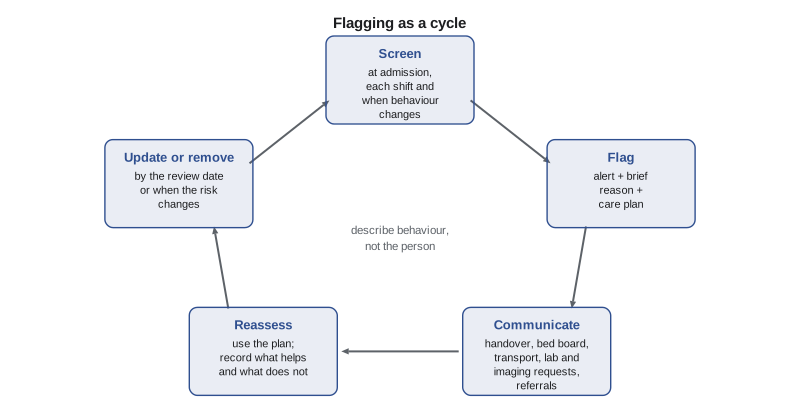
A flag is an alert in the patient's record, and sometimes in other places such as the bed board or the referral form, that tells staff the person has a history or a current risk of violence and what precautions to take. It is the practical way of meeting the duty to share information about people with a history of violence. A good flag has three parts:
- The alert itself: a clear, consistent symbol or banner that staff recognize, visible wherever staff look before care: the electronic record, the handover sheet, the bed board, the referral.
- The reason, briefly: for example, "struck staff during IV start, 2026-03-14" or "threatens staff when told no; calms with a single consistent caregiver".
- The care plan: what to do differently, such as entering with two staff, approaching from the front, explaining before touching, avoiding certain topics, offering pain relief first, keeping the door clear, or having security nearby.
Flags raise real concerns, and a system that ignores them will not be trusted by patients or used well by staff:
- Stigma. A flag can follow a person for years and lead to poorer care: staff may avoid the room, delay pain relief or treat every complaint as manipulation. Flags must describe behaviour and precautions, not label the person.
- Privacy. The flag should share only what staff need. A diagnosis of schizophrenia is not a reason for a flag; a recent assault is. Public signs that name the patient or the risk are not appropriate. A discreet symbol on the bed board, explained in the record, is.
- Accuracy. A flag based on one misunderstood incident, or one that is never reviewed, is worse than none, because staff stop believing flags.
- Telling the patient. Many hospitals tell patients, where it is safe and clinically appropriate, that a flag has been placed and why, and how it can be removed. This can itself reduce violence, because it makes expectations clear.
Northbridge's flagging procedure, developed with the JHSC and the privacy office, follows the PSHSA flagging toolkit. Any nurse can place a flag when a patient has been violent or meets the high-risk threshold, and the charge nurse confirms it within the shift. Flags carry a review date, 90 days for inpatients and 12 months for repeat emergency or home care clients, and lapse unless a clinician renews them. The privacy office audits a sample each quarter for wording and for disclosure beyond what is needed.
Passing on the information
A flag in the record does nothing if no one reads it. The most common failure Joanne finds when she reviews incidents is not a missing assessment but information that existed and did not reach the person who got hurt. The night nurse knew the patient was confused; the porter who took him to imaging did not. The day nurse knew a resident hated being bathed by men; the float personal support worker did not. Northbridge tackled this in several ways:
- A one-line risk item in every handover, spoken and written: "violence risk: none, moderate or high, and why".
- The flag symbol printed on transport requests, lab requisitions and imaging orders, so that staff in other departments see it.
- A flag field on referrals to home care, so that community staff know before the first visit.
- A rule that anyone who sees a flag on a patient they are about to care for reads the care plan first.
Worked problem
Flagging the patient in room 412
On 4 West, the patient in room 412 scored 3 on the checklist at 2300: confused, irritable and boisterous. At 0130 he grabbed the wrist of the nurse who was checking his IV and twisted it. He has no previous flag. What should the team do?
Show solution
- Immediate safety: the nurse steps back out of reach, calls for help, and the team does not restart the IV until two staff are present and the patient is calmer.
- Assess why: the team checks for causes of delirium, including fever, pain, a full bladder, low oxygen and new medicines, and asks the physician to review.
- Place a flag: "grabbed and twisted staff wrist during IV check, 0130; newly confused", with a care plan: two staff for hands-on care, explain each step, approach from the front, offer the urinal and pain relief before procedures, keep the door clear.
- Communicate: the flag goes on the bed board and the handover sheet, and the day charge nurse is told in person. The incident is reported.
- Review: when the delirium clears and the patient is calm for 48 hours, the nurse reviews the flag and updates or removes it.
Answer: A flag with a short reason and a clear care plan, passed on at handover and reviewed when the delirium resolves, together with an incident report and treatment of the cause.
Common mistakes
MistakeDoing an organizational assessment from incident reports alone.
InsteadCombine incident data with staff input, a walkthrough on several shifts and a look at the tasks.
MistakeUsing a risk tool as a substitute for judgment.
InsteadUse the tool for consistency, and act on threats and other information it does not capture.
MistakeWriting flags that label the person, such as "aggressive psych patient".
InsteadDescribe the behaviour, the date and the precautions.
MistakeLeaving flags in place forever.
InsteadGive every flag a review date and remove or update it when the risk changes.
MistakeKeeping the flag in the chart where only nurses see it.
InsteadShow it wherever staff look before care: handover, bed board, transport and lab requests, referrals.
Summary and key terms
- Risk assessment works at two levels: the organization and each unit, and the individual patient.
- Unit assessments use incident data, staff input, walkthroughs on several shifts and a look at the tasks.
- A history of violence, current state, warning behaviours and the situation are the main predictors.
- Short tools such as the Broset Violence Checklist make bedside assessment consistent; judgment still applies.
- A flag has an alert, a brief reason and a care plan.
- Flags must avoid stigma, share only what is needed, stay accurate and be reviewed.
- Information must reach everyone who will care for the patient, including other departments and community staff.
- Organizational risk assessment
- A review of the risks of violence arising from the workplace, the work and its conditions, done for the whole facility and each unit.
- Individual risk assessment
- An assessment of whether a particular patient is likely to become violent and what precautions are needed.
- Broset Violence Checklist
- A six-item tool scoring confusion, irritability, boisterousness, verbal threats, physical threats and attacks on objects.
- Flag
- An alert in the record and elsewhere that tells staff a patient has a history or risk of violence, with a reason and a care plan.
- Review date
- The date by which a flag must be reconsidered and either renewed, changed or removed.
Practice problems
Work each problem on paper first, then reveal the answer to check.
What four sources does a unit assessment draw on at Northbridge?
Show answer
Incident data, staff input, a walkthrough on several shifts, and a look at the tasks that put staff at risk.
What is the strongest single predictor of future violence?
Show answer
A history of violence, especially recent violence.
A patient is irritable and making verbal threats. What is the Broset score and level?
Show answer
2, a moderate risk calling for preventive measures.
What three parts should a flag have?
Show answer
The alert, a brief reason, and a care plan.
Why should flags have a review date?
Show answer
Because risk changes, and flags that are out of date are inaccurate, stigmatizing and stop being trusted.
Give two ways to make sure flag information reaches staff outside the unit.
Show answer
For example: the flag symbol on transport, lab and imaging requests, and a flag field on home care referrals.
Lesson quiz · 5 questions
Score 60% or more to complete this lesson.
Create a free account to save your progress, take quizzes and earn a certificate.