
HSE-393 · Lesson 7 of 12 · 22 min
Security and emergency responses to violence
▶ Video coming soon A video version of this lesson is on the way.
When a patient or visitor becomes violent and de-escalation has not worked, the hospital needs a fast, organized, trained response. In Ontario hospitals, that response is usually called a Code White, one of the standard emergency codes used across the province's hospitals. This lesson covers how a Code White works, the roles on the team, the rules around physical intervention and restraint, what happens when someone has a weapon, and how the team learns from each event.
When to call
Any staff member can call a Code White, and the threshold should be low. Staff should call when a person is violent or is threatening violence and the situation is beyond what the people present can safely manage, or when they believe it is about to become so. It is far better to call a team that turns out not to be needed than to wait until someone is hurt. At Northbridge, a Code White can be called by personal alarm, by panic button, or by dialing the emergency number from any phone and giving the location.
The response team
A Code White team is not a crowd. Ten people rushing into a room frighten the patient and get in each other's way. A good team has a small number of trained people, each with a clear role, and everyone else stays back. At Northbridge, the team for an inpatient unit includes security, the unit's charge nurse, two or three trained staff from the unit or a neighbouring unit, and, at night, the nursing supervisor. In the emergency department and the mental health unit, a physician also attends.
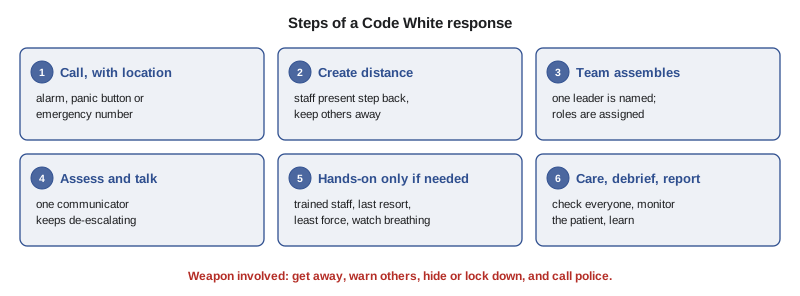
The roles on the team are:
- Team leader: usually the charge nurse or a senior security officer. Takes charge, assesses the situation, decides on the plan and gives clear instructions. Only one leader.
- Communicator: the one person who talks to the patient, continuing de-escalation. Often the person the patient trusts most. Everyone else stays quiet.
- Physical intervention members: if hands-on intervention is needed, trained staff each have an assigned role, so that the person is held safely and evenly.
- Clinician: the nurse or physician responsible for the patient's medical needs, including any medication, and for monitoring breathing and circulation.
- Support: someone clears the area, moves other patients and visitors away, brings equipment and records times and actions.
The leader's first question is whether the situation can still be resolved without hands-on intervention. Often the arrival of a calm, organized team, with one person continuing to talk, is enough. A patient who sees several staff standing quietly at a distance, and hears one person offering choices, will often settle. Physical intervention is never used to punish, to force compliance with routine care, or because staff are frustrated.
Physical intervention
Physical intervention means using bodily force to move, hold or restrict a person. It carries real risks for both the patient and the staff: fractures, head injuries, joint injuries and, in the worst cases, death of the patient from restricted breathing. For that reason:
- It is a last resort, used only when there is an imminent risk of serious harm to the person or others and less restrictive measures have failed or are not possible.
- It is done only by staff trained in the hospital's approved techniques, who practise them regularly.
- It uses the least force needed, for the shortest time.
- The person is never held face down with weight on their back, chest or neck, because that can stop them breathing. Staff watch the person's breathing, colour and responsiveness the whole time, and one team member's only job is to do that.
- Anyone held is checked afterwards for injury, and their care is reviewed.
Staff who are not trained in physical intervention do not attempt it. Their role is to get away, call for help, keep others away and support the team. The same applies to breakaway techniques, simple ways of getting out of a grab or a hold, which many hospitals teach to all frontline staff. They are taught hands-on, in a training room, by qualified instructors, and practised, not learned from a description.
Restraint and seclusion
Restraint, whether physical, mechanical or chemical, and seclusion are among the most serious things a hospital can do to a patient. In Ontario, the Patient Restraints Minimization Act, 2001 requires hospitals and long-term care homes to have policies to minimize restraint, and allows restraint without consent only in an emergency, when there is a serious risk of bodily harm and other measures have failed, with monitoring and documentation. The Mental Health Act sets separate rules for restraining involuntary patients in psychiatric facilities. Every use of restraint must be ordered or approved according to hospital policy, monitored closely, documented and ended as soon as it is no longer needed.
Medication given to calm a severely agitated patient is a clinical decision made by the physician or nurse practitioner, ideally offered to the patient as a choice before the situation reaches a crisis. When it is given in an emergency without consent, the same principles of last resort, documentation and monitoring apply.
Training and practice for the team
A response team works only if its members have practised together. At Northbridge, every security officer, every charge nurse and the staff on high-risk units complete a full day of training in de-escalation, team roles and the hospital's approved physical techniques when they start, and a half-day refresher every year. Other frontline staff complete a shorter course covering warning signs, de-escalation, breakaway techniques and how to call and support the team.
Units also run short mock codes, about four a year on each high-risk unit. A trainer plays an agitated patient, the alarm is pressed, and the team responds as it would for real, but without physical contact. The exercise is timed and debriefed. Mock codes find problems that training rooms do not: a radio that does not work in a stairwell, a door that sticks, a new nurse who does not know where the panic button is, or two people who both think they are the leader.
Other patients and visitors
A violent incident frightens everyone nearby. Other patients may be confused, frail or unable to move, and visitors may try to help or start filming. Part of the support role is to protect them: close room doors, move patients who can be moved, ask visitors calmly to wait in another area, and keep the corridor clear for the team. Afterwards, a nurse checks on the patients who saw or heard the incident and explains, without breaching privacy, that the situation is over and everyone is safe. On a dementia unit or a mental health unit, an incident can unsettle other patients for hours, so the team plans for a quieter evening and watches for signs of distress.
When there is a weapon
A person with a weapon is a different emergency. Ontario hospitals use Code Silver for a person with a weapon or an active attacker. Staff do not try to de-escalate at close range, disarm the person or detain them. The priorities are to get away, warn others, hide and lock down if escape is not possible, and call 911 as well as the hospital's emergency number. Police lead the response. Security staff follow the hospital's procedure, which focuses on directing people away from the danger and guiding police.
Lower-level weapon concerns are more common: a visitor with a knife in a bag, a patient who has hidden a razor, a person who brings a firearm into the emergency department. Hospitals manage these with clear policies on weapons, signs at entrances, screening where the risk warrants it (often with metal detectors at the emergency department entrance), safe storage of patients' belongings and searches carried out by security according to policy and law.
Police involvement
Police are called when a crime is being committed, when someone has a weapon, when the situation is beyond what hospital security can manage, or when a worker wishes to report an assault. Staff who are assaulted have the right to report it to the police. The hospital's role is to support them: help them make the report, preserve evidence such as video, and give them time to meet with officers. Some hospitals have agreements with local police on how to handle reports from staff, so that assaults by patients are taken seriously while recognizing when a patient lacked the capacity to understand what they were doing.
After the code
Every code is followed by a short debrief, ideally before the team disperses, and a fuller review for serious events. The quick debrief asks four questions: What happened? What went well? What could be better? Is everyone all right? The last question is not a formality. Staff who were involved may be shaken even if they were not hurt, and they need a chance to say so and to be offered support, as Lesson 10 describes.
Northbridge records each code with the times of the call, arrival of the first responder and the full team, whether physical intervention or restraint was used, and any injuries. A script summarizes the quarter for the JHSC:
codes = [  # (unit, minutes to full team, hands-on used, staff injured, patient injured)
    ("Emergency", 2, False, False, False), ("4 West", 5, True, True, False),
    ("Mental health", 2, True, False, False), ("Emergency", 1, False, False, False),
    ("Birch", 3, False, False, False), ("4 West", 4, False, False, False),
    ("Emergency", 2, True, False, True), ("Mental health", 1, False, False, False),
]
n = len(codes)
hands = sum(c[2] for c in codes)
staff_hurt = sum(c[3] for c in codes)
pt_hurt = sum(c[4] for c in codes)
slow = [c[0] for c in codes if c[1] > 3]
print(f"codes: {n}, resolved without hands-on: {n - hands}")
print(f"staff injured: {staff_hurt}, patients injured: {pt_hurt}")
print("team slower than 3 minutes:", ", ".join(slow))codes: 8, resolved without hands-on: 5 staff injured: 1, patients injured: 1 team slower than 3 minutes: 4 West, 4 West
Five of eight codes were resolved without hands-on intervention, which the committee sees as a sign that the teams are using de-escalation first. The two slow responses were both on 4 West, the same problem the alarm drills in Lesson 6 found, and the one staff injury was in one of them. The change to the night response zone is meant to fix it.
Worked problem
A code on 4 West
At 0300, a patient in alcohol withdrawal on 4 West throws a water jug at a nurse, pulls out his IV and stands by the door shouting that he is leaving. Amira presses her alarm. Five people arrive within three minutes. What should the team do?
Show solution
- The charge nurse takes the lead and says so. She asks other patients' doors to be closed and sends one person to clear the corridor.
- Amira, whom the patient knows, acts as communicator from a safe distance, at an angle, with the door clear: she acknowledges that he wants to leave, says that he is shaking and unwell, and offers medicine that will help.
- The team stays back and quiet. Security positions near but not blocking the exit. The physician is called to assess capacity and withdrawal.
- The patient accepts the medicine and sits on the bed. No hands-on intervention is needed. The IV is restarted later with two staff present.
- The team debriefs for five minutes, checks on the nurse hit by the jug, reports the incident and updates the flag and care plan.
Answer: One leader, one communicator, a quiet team at a safe distance and an offer of treatment resolved it. Hands-on intervention was ready but not needed.
Common mistakes
MistakeWaiting until someone is hurt before calling for help.
InsteadCall early; an unneeded team costs little, a late one can cost a great deal.
MistakeEveryone who arrives talking to the patient.
InsteadOne communicator talks; the leader directs; others stay back and quiet.
MistakeUntrained staff joining a physical hold.
InsteadOnly trained team members intervene physically; others keep the area clear and support.
MistakeHolding a person face down with weight on their back.
InsteadNever; watch breathing, colour and responsiveness at all times.
MistakeTrying to disarm a person with a weapon.
InsteadGet away, warn others, hide or lock down, and call police.
Summary and key terms
- A Code White brings a trained team to a violent or threatening situation; anyone can call it.
- The team has one leader, one communicator, trained intervention members, a clinician and support roles.
- The arrival of a calm, organized team often resolves the situation without hands-on intervention.
- Physical intervention is a last resort, by trained staff only, with the least force for the shortest time.
- Never hold anyone face down with weight on the back, chest or neck; monitor breathing throughout.
- Restraint is governed by the Patient Restraints Minimization Act and hospital policy, with monitoring and documentation.
- With a weapon, staff get away, warn others, hide and call police; they do not try to disarm.
- Every code ends with a debrief that asks whether everyone is all right.
- Violence response code
- The standard Ontario hospital code for a violent or behavioural emergency.
- Team leader
- The one person who directs the response team.
- Communicator
- The one team member who talks with the person, continuing de-escalation.
- Physical intervention
- Using bodily force to move, hold or restrict a person, as a last resort.
- Positional asphyxia
- Death or injury from being unable to breathe because of body position, such as being held face down with weight on the back.
Practice problems
Work each problem on paper first, then reveal the answer to check.
Who can call a code for a violent situation?
Show answer
Any staff member.
Name the roles on a response team.
Show answer
Team leader, communicator, physical intervention members, clinician, and support (clearing the area, equipment, recording).
When may physical intervention be used?
Show answer
Only as a last resort when there is an imminent risk of serious harm and less restrictive measures have failed, by trained staff, with the least force for the shortest time.
Why must a person never be held face down with weight on their back?
Show answer
Because it can stop them breathing and cause death.
What should staff do when someone has a weapon?
Show answer
Get away, warn others, hide or lock down if needed, and call police; never try to disarm.
What four questions does the quick debrief ask?
Show answer
What happened? What went well? What could be better? Is everyone all right?
Lesson quiz · 5 questions
Score 60% or more to complete this lesson.
Create a free account to save your progress, take quizzes and earn a certificate.