
HSE-393 · Lesson 1 of 12 · 22 min
Violence in healthcare: what the data show
▶ Video coming soon A video version of this lesson is on the way.
On a Tuesday night on 4 West, a man in his seventies who had been admitted with pneumonia pulled out his IV, swung at the nurse who came to help him and struck her on the cheek. He was confused, frightened and running a fever. Amira Haddad, the nurse, was not badly hurt. She finished her shift, said nothing to anyone outside the unit, and did not fill in a report, because, as she put it later, "he didn't mean it, and nothing would change anyway."
That one sentence holds most of what this course is about. Violence against healthcare workers is common, it often comes from patients who are ill rather than malicious, and it is badly under-reported, partly because staff come to see it as part of the job. This course treats it the way the rest of the healthcare safety series treats needlesticks, lifting injuries and chemical exposures: as a workplace hazard that can be assessed, controlled and reduced. HSE-390 introduced Northbridge Community Hospital and its workplace safety program. This course follows the same hospital, the same people and the same committee as they build a violence prevention plan that actually works.
What counts as workplace violence
In Ontario, the Occupational Health and Safety Act defines workplace violence as the exercise of physical force by a person against a worker, in a workplace, that causes or could cause physical injury to the worker. It also includes an attempt to use physical force that could cause injury, and a statement or behaviour that it is reasonable for the worker to interpret as a threat to use physical force. The definition does not depend on the intent of the person: a confused patient who strikes out is using physical force, even if they do not understand what they are doing. Workplace harassment, including sexual harassment, is defined separately in the Act and is covered in Lesson 9.
Researchers and safety agencies usually sort workplace violence into four types, based on the relationship between the person who is violent and the workplace:
| Type | Who is violent | Healthcare example | How common in healthcare |
|---|---|---|---|
| 1. Criminal intent | A stranger with no legitimate business there | A robbery at the outpatient pharmacy, a car break-in in the parking garage | Uncommon, but can be severe |
| 2. Client or patient | A patient, resident, client or their family or visitor | A confused patient strikes a nurse; a visitor threatens a clerk about wait times | By far the most common |
| 3. Worker on worker | A current or former employee | A staff member threatens a colleague after a dispute | Less common; overlaps with harassment |
| 4. Personal relationship | Someone with a personal relationship to the worker | A former partner comes to the unit looking for a nurse | Uncommon, but often the most dangerous |
This course concentrates on type 2, violence from patients, residents and visitors, because it is the type healthcare workers meet most often and the one healthcare employers can do most to prevent. Types 1, 3 and 4 still matter. A good violence prevention plan covers security of the building, bullying and harassment among staff, and what to do when a worker is being followed or threatened by someone from their private life.
How common it is
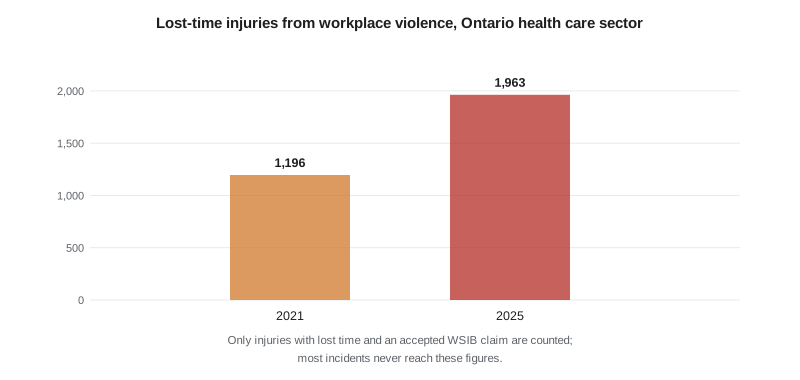
Healthcare is one of the most dangerous sectors for violence at work. In Ontario, lost-time injuries from workplace violence in the health care sector rose from about 1,200 in 2021 to almost 2,000 in 2025, according to the Ministry of Labour, Immigration, Training and Skills Development. Those are only the injuries serious enough to keep a worker off beyond the day of the injury and accepted by the WSIB. They are a small fraction of all incidents. Surveys of nurses and personal support workers in Ontario and across Canada have repeatedly found that most frontline staff have experienced physical violence at work, and that many have experienced it more than once in the past year.
Violence is not spread evenly across healthcare. Some settings and jobs carry much higher risk than others:
- Emergency departments, where people arrive in pain, frightened, intoxicated, in mental health crisis or after long waits, and where staff have little information about them.
- Inpatient mental health units, especially when patients are admitted involuntarily or are acutely psychotic.
- Long-term care and dementia care, where residents with cognitive impairment may strike out during personal care, often many times a week.
- Medical and surgical units with older patients, where delirium from infection, surgery, drugs or alcohol withdrawal is common.
- Home care and community care, where staff work alone in homes they do not control.
- Security staff, porters, and staff who work at registration desks and in waiting rooms.
The people most often hurt are those who spend the most time in close physical contact with patients: nurses, personal support workers, and mental health workers. In long-term care, much of the violence happens during bathing, dressing and toileting, when a resident with dementia may not understand what is happening and experiences care as an attack. In emergency departments, verbal threats and abuse are almost constant, and physical assaults are frequent.
Why it is under-reported
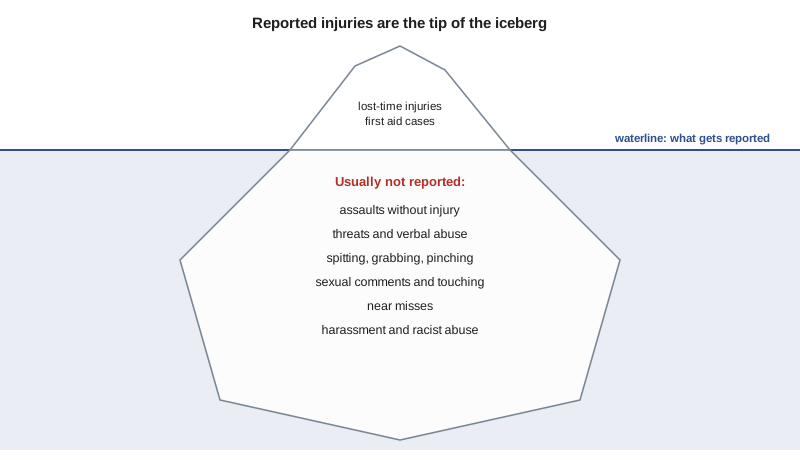
Almost every study of violence in healthcare finds the same thing: most incidents are never formally reported. Estimates vary, but surveys commonly find that only a minority of physical assaults, and a much smaller share of threats and verbal abuse, make it into the incident reporting system. There are several reasons, and each one points to something a violence prevention program has to change:
- It is part of the job. Staff, and sometimes managers, believe that violence from patients is unavoidable, especially from patients who are confused or ill.
- The patient did not mean it. Workers feel that reporting a patient with dementia or delirium would be unfair or pointless.
- Nothing changes. If past reports led to no visible action, staff stop reporting.
- No time. The report form is long, and the shift is busy.
- Fear of blame. Some workers worry that a report will suggest they caused the incident or handled it badly.
- No injury, no report. Workers often report only when they need first aid or time off, so threats and near misses are lost.
Under-reporting matters because the hospital cannot fix what it does not know about. If 4 West records three violent incidents a year, it looks like a safe unit, and the resources go elsewhere. If it records thirty, the pattern becomes visible: most incidents happen at night, involve confused older patients, and occur during care such as IV restarts and repositioning. That pattern can be addressed.
Northbridge's numbers
In HSE-390, Joanne Pelletier, the Occupational Health and Safety manager, showed the JHSC the hospital's injury data for the past year. Violence was the second largest category after patient handling: 47 reports, 12 claims and 7 lost-time cases. Joanne was certain the true number was far higher, because almost all of the reports came from Maple Court and the emergency department, and almost none from 4 West, 3 East or diagnostic imaging, where she knew from talking to staff that violence happened.
In month 7, the hospital ran a short campaign. Managers told staff that every incident of violence should be reported, including threats and incidents without injury; the report form was shortened to one screen; and Joanne promised that every report would get a reply. Reports of violence in the next six months more than doubled, from 15 to 32. Nothing about the patients had changed. The hospital was simply seeing more of what was already there.
Joanne uses a short script each quarter to compare reports with what staff say in the hospital's anonymous safety survey. The survey asks staff whether they have been physically assaulted, threatened or verbally abused at work in the past three months, and whether they reported it.
# Quarterly check: reported incidents compared with survey answers
survey = {   # unit: (staff who answered, assaulted, reported assault)
    "Emergency": (54, 21, 9),
    "4 West":    (48, 14, 3),
    "3 East":    (41, 6, 1),
    "Birch":     (22, 15, 8),
    "Imaging":   (30, 4, 0),
}
print("unit        assaulted   reported  reported per 10")
for unit, (n, hit, rep) in survey.items():
    per10 = 10 * rep / hit if hit else 0
    flag = "  <- follow up" if per10 < 4 else ""
    print(f"{unit:<10} {hit:>4} of {n:<4} {rep:>6}       {per10:4.1f}{flag}")
total_hit = sum(v[1] for v in survey.values())
total_rep = sum(v[2] for v in survey.values())
print(f"overall: {total_rep} of {total_hit} assaults reported")unit assaulted reported reported per 10 Emergency 21 of 54 9 4.3 4 West 14 of 48 3 2.1 <- follow up 3 East 6 of 41 1 1.7 <- follow up Birch 15 of 22 8 5.3 Imaging 4 of 30 0 0.0 <- follow up overall: 21 of 60 assaults reported
The output shows the gap at once. Fewer than half of the assaults staff describe in the survey reached the reporting system, and on 4 West and in imaging the share is very low. Joanne does not treat this as a failure by staff. She treats it as a measure of how well the hospital has convinced them that reporting is worthwhile, and she takes the results to the unit managers.
The cost of violence
Violence harms workers in ways that go far beyond the injury that appears on a claim form. Physical injuries range from bruises, scratches and bites to fractures, concussions and, rarely, deaths. Many workers who are assaulted have lasting psychological effects: fear when caring for similar patients, trouble sleeping, anxiety, depression and, after serious incidents, post-traumatic stress disorder. Some leave their unit, their employer or the profession altogether. Repeated exposure to threats and abuse, even without physical harm, wears people down and contributes to burnout.
Violence also harms patients and the organization. Staff who are afraid of a patient may avoid the room, delay care or rush through it. Units with frequent violence have more sick time, more turnover and more vacancies, which leave fewer experienced staff on each shift and make violence more likely. Every lost-time injury has direct costs in compensation and replacement staff, and indirect costs in overtime, training and lost productivity.
Violence can be prevented
It is easy to conclude from the numbers that violence is simply part of healthcare. The evidence says otherwise. Units that assess their risks, identify patients at risk of violence, train staff in de-escalation, design their spaces with safety in mind, make sure help can be summoned quickly and learn from every incident have reduced violence substantially. The approach is the same hierarchy of controls used for every other hazard in HSE-390:
- Eliminate or reduce the hazard at its source: treat pain, infection and delirium early; reduce waiting times and noise; manage alcohol withdrawal.
- Engineering controls: room layout, secure areas, controlled access, personal alarms, cameras, safe rooms in the emergency department.
- Administrative controls: screening and flagging, care plans, staffing, working-alone procedures, policies on visitors and weapons, training.
- Personal protective equipment: in a few settings, items such as bite-resistant sleeves or protective clothing, used alongside the other controls, never instead of them.
The rest of the course goes through these controls one at a time, starting in Lesson 2 with the laws that require them.
Worked problem
Amira's report
After the campaign, Amira decides to report the incident on 4 West in which a confused patient with pneumonia struck her on the cheek. She is not injured. Her manager, Sarah MacLeod, asks what the report should include and what the unit can learn from it.
Show solution
- What happened: the time (about 0230), the place (room 412), what the patient did (pulled out his IV and swung at her), and that there was no injury beyond brief pain.
- Context: the patient was febrile and newly confused, had no history of violence, and was alone; Amira entered quickly because the IV pump was alarming.
- What helped and what did not: there was no information in the handover about his confusion, and the call bell was out of his reach.
- What could prevent a repeat: screening for delirium at admission and each shift, treating the fever sooner, approaching a confused patient slowly with a second person, and passing on new confusion at handover.
Answer: A short, factual report with the context and the lessons. Sarah adds delirium screening to the night checklist, and the report becomes one of several that show a pattern of night-time incidents with newly confused patients on 4 West.
Common mistakes
MistakeTreating violence from confused patients as part of the job.
InsteadTreat it as a workplace hazard to be assessed, reported and controlled, whatever the patient's intent.
MistakeReporting only incidents that cause injury.
InsteadReport threats, near misses and incidents without injury; they show the pattern before someone is hurt.
MistakeJudging a unit as safe because it has few reports.
InsteadCompare reports with surveys and conversations; a low number may mean under-reporting.
MistakeAssuming that intent matters to whether something is violence.
InsteadUse the definition: physical force or a threat of force against a worker, whatever the reason.
MistakeExpecting training alone to solve the problem.
InsteadCombine controls at every level of the hierarchy, from treating delirium to alarms and room design.
Summary and key terms
- Under the OHSA, workplace violence is physical force, an attempt at it, or a threat of it against a worker, whatever the intent of the person.
- There are four types of workplace violence; violence from patients and visitors is by far the most common in healthcare.
- Healthcare workers face much higher rates of violence than workers in most other sectors.
- Risk is highest in emergency departments, mental health units, long-term care, delirium-prone medical units and home care.
- Most incidents, especially threats and incidents without injury, are never reported.
- Under-reporting hides patterns that could be fixed; a reporting campaign at Northbridge more than doubled reports.
- Violence harms workers physically and psychologically, and harms patient care and staffing.
- The hierarchy of controls applies to violence just as to other hazards.
- Workplace violence
- Physical force, attempted force or a threat of force against a worker at work, whatever the intent of the person.
- Type 2 violence
- Violence by a patient, resident, client, family member or visitor against a worker.
- Under-reporting
- The gap between incidents that happen and those recorded in the reporting system.
- Delirium
- A sudden state of confusion caused by illness, drugs, surgery or withdrawal, often fluctuating and often worse at night.
- Lost-time injury
- An injury that keeps a worker off work beyond the day of the injury.
Practice problems
Work each problem on paper first, then reveal the answer to check.
A resident with dementia scratches a PSW during bathing. Is this workplace violence?
Show answer
Yes. It is physical force against a worker that caused injury; the resident's intent does not matter to the definition.
Name the four types of workplace violence.
Show answer
Criminal intent, client or patient, worker on worker, and personal relationship.
Give three reasons why healthcare workers do not report violence.
Show answer
Any three of: they see it as part of the job; the patient did not mean it; nothing changes; no time; fear of blame; no injury.
Why did Northbridge's violence reports double after the campaign?
Show answer
Staff started reporting incidents that were already happening, because the form was shorter, all incidents were included and reports got replies.
Which settings have the highest risk of violence?
Show answer
Emergency departments, mental health units, long-term care, medical units with delirium, home care, and front-desk and security roles.
Give one example of a control at each level of the hierarchy for violence.
Show answer
For example: treating delirium early (source), a personal alarm or room layout (engineering), flagging and training (administrative), bite-resistant sleeves (PPE).
Lesson quiz · 5 questions
Score 60% or more to complete this lesson.
Create a free account to save your progress, take quizzes and earn a certificate.