
HSE-393 · Lesson 10 of 12 · 22 min
After an incident: reporting and support
▶ Video coming soon A video version of this lesson is on the way.
What happens in the hours and days after a violent incident shapes whether the worker recovers well, whether the unit learns anything, and whether staff report the next incident. A worker who is checked on, given time, listened to and told what changed is far more likely to stay in their job and to report again. A worker who is sent back to the same patient with a shrug, or asked what they did to provoke it, learns that reporting is pointless. This lesson follows an incident from the immediate aftermath through reporting, investigation, support and return to work.
Immediately after
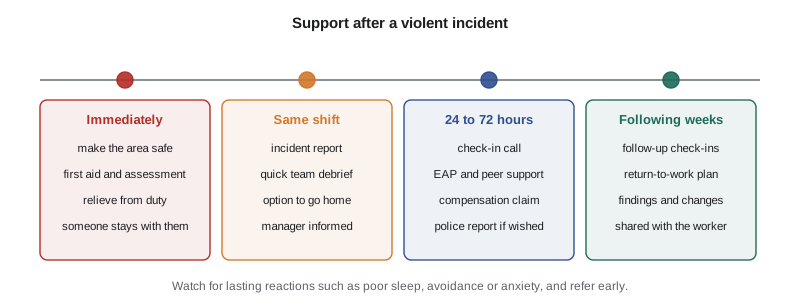
The first priorities are safety and care:
- Make the area safe. The person who was violent is settled or contained, other patients are protected, and the injured worker is out of the room.
- First aid and medical assessment. Injuries that look minor can be serious: blows to the head can cause concussion, and twisted wrists and shoulders can hide ligament damage. The worker is assessed by Occupational Health and Safety, the emergency department or the nursing supervisor, according to the injury and the time of day.
- Bites and scratches that break the skin, and spitting into the eyes or mouth, are treated as possible exposures to blood or body fluids and follow the post-exposure procedure from HSE-392, with first aid, an immediate report and assessment of the source patient.
- Relief from duty. The charge nurse arranges for someone else to take over the worker's patients so that they can sit down, get care and collect themselves. No one should go straight back into the room with the patient who hurt them.
- Someone stays with them. A colleague or the charge nurse stays with the worker for the first while. Being alone after an assault is hard.
Reporting
Reporting serves the worker and the organization. For the worker, a report creates a record that may be needed for a compensation claim, especially if an injury or psychological effects appear later. For the organization, each report is information about where, when and how violence happens, and the basis of every improvement in this course. At Northbridge, the worker or the charge nurse completes the incident report before the end of the shift. The report is short and factual: what happened, where and when, who was involved, any injury, what led up to it and what might prevent a repeat. It never asks the worker to say what they did wrong.
Some incidents also have to be reported outside the hospital:
- Critical injuries and deaths: if a worker is critically injured or killed by workplace violence, the employer must notify a Ministry of Labour inspector, the JHSC and the union immediately, and send a written report within 48 hours (section 51 of the OHSA). The scene must not be disturbed without permission, except to save life or relieve suffering.
- Medical attention or time off: when a worker is disabled from doing their usual work or needs medical attention because of an act of workplace violence, the employer must give written notice to the JHSC and the union within 4 days (section 52), and to the Director if an inspector requires it.
- The WSIB: an injury that needs health care beyond first aid, or causes time off or lost earnings, is reported on the Form 7 within 3 days of the employer learning about it.
- Police: the worker decides whether to report an assault to police, as Lesson 7 described, and the hospital supports them.
Investigating to learn, not to blame
Every report gets a response, and serious incidents get an investigation. At Northbridge, the unit manager reviews each incident within a week, with the worker if they wish, and incidents with injury or a pattern are reviewed with a member of the JHSC. The questions are about the system, not the individual:
- What was the patient's state and history? Was there a flag or a risk score, and did the worker know about it?
- What were the warning signs, and when did they appear? Was there a chance to intervene earlier?
- Was the room set up safely? Did the alarm work, and how quickly did help arrive?
- Was staffing adequate? Was a second person available when the care plan called for one?
- What was happening on the unit at the time: a code elsewhere, a shift change, an admission?
- Has something similar happened before, on this unit or elsewhere?
The investigation ends with actions: a change to the care plan, a fix to the alarm, a different staffing pattern at night, training for a particular situation. The worker is told what was found and what changed. That last step is the one most often missed, and the one that most affects whether staff report next time.
Psychological effects
Being assaulted at work, or seeing a colleague assaulted, affects people in different ways. Common reactions in the first days and weeks include replaying the event, trouble sleeping, irritability, anxiety when caring for similar patients, feeling numb, guilt or self-blame, and anger at the patient or the organization. For most people these reactions ease over a few weeks, especially with support. For some, they persist or worsen into anxiety, depression or post-traumatic stress disorder, which need professional help.
Repeated lower-level incidents can cause harm too. A personal support worker in dementia care who is scratched and hit several times a week, or an emergency nurse who is threatened every shift, may never have a single dramatic event but can become exhausted, cynical and detached, the signs of burnout.
What support helps
Research on the best way to support staff after traumatic events has changed over time. Single, compulsory group sessions in which everyone retells the event in detail are no longer recommended as a standard response, because they do not prevent post-traumatic stress and can make some people worse. What helps is practical, voluntary, ongoing support:
- Psychological first aid: in the first hours, colleagues and managers offer comfort, practical help, information, and connection to others, without pushing the person to talk about the event.
- A check-in: the manager or Occupational Health and Safety contacts the worker within a day or two, asks how they are, and repeats the check-in over the following weeks.
- Peer support: trained colleagues who have had similar experiences offer confidential support. Many workers find this easier than talking to a manager or a counsellor.
- The employee and family assistance program: confidential, free counselling for the worker and their family, with the number given in writing.
- Professional care: referral to a physician or mental health professional for anyone whose reactions are severe or last more than a few weeks.
- Practical help: time off if needed, a change of assignment, help getting home after the shift, help with the compensation claim or a police report.
The team also needs support. A quick team debrief after a code, as Lesson 7 described, covers what happened and how everyone is, and is followed where needed by a facilitated session for the unit after a serious event, offered to those who want it.
Compensation and return to work
Physical injuries from workplace violence are covered by the WSIB like any other work injury. Mental health effects can also be covered: the WSIB accepts claims for traumatic mental stress from a sudden, frightening event at work, such as an assault or a threat of serious harm, and, since 2018, for chronic mental stress caused by a substantial work-related stressor such as repeated harassment. Workers are often unaware of this, and Occupational Health and Safety makes sure they know.
Returning to work after an assault can be hard, especially to the same unit or the same patient. A return-to-work plan, agreed with the worker, may include modified duties, a gradual return, a different assignment for a time, a buddy for the first shifts back, and a check that the controls identified in the investigation are in place. A worker who comes back to find nothing has changed is unlikely to stay.
What managers say matters
Staff who have been assaulted remember what their manager said afterwards, sometimes for years. Northbridge's managers are coached to use a few simple messages and to avoid a few others. Helpful: "I'm sorry this happened to you. Are you hurt? What do you need right now? Thank you for reporting it. Here is what we will do, and I will get back to you by Friday." Harmful, even when meant kindly: "It comes with the job", "He didn't mean it", "Did you follow the care plan?" asked in the first minutes, or silence.
Managers also watch for workers who are struggling but not saying so: someone who starts calling in sick on the days the same patient is on the unit, who avoids a particular room, or who becomes short-tempered with colleagues. A private conversation and an offer of support, rather than a performance discussion, is the right first step.
Tracking follow-up
Follow-up is easy to forget once the shift is over and the next crisis arrives. Joanne's office keeps a simple tracker that lists, for each worker involved in a reported incident with injury or significant distress, when each step is due:
from datetime import date, timedelta

STEPS = [(1, "check-in by manager or occupational health"),
         (7, "unit review of the incident shared with the worker"),
         (14, "second check-in"),
         (30, "final check-in; refer if reactions persist")]

def plan(incident_day, done):
    for days, step in STEPS:
        due = incident_day + timedelta(days=days)
        mark = "done" if step in done else ("OVERDUE" if due < date(2026, 3, 20) else "due")
        yield due, step, mark

done = {"check-in by manager or occupational health"}
for due, step, mark in plan(date(2026, 3, 4), done):
print(due.isoformat(), f"{mark:<8}", step)2026-03-05 done check-in by manager or occupational health 2026-03-11 OVERDUE unit review of the incident shared with the worker 2026-03-18 OVERDUE second check-in 2026-04-03 due final check-in; refer if reactions persist
For an incident on 4 March, the first check-in was done, but by 20 March the unit review and the second check-in are overdue. The tracker sends a reminder to the manager, and the JHSC sees the overdue items each month.
Worked problem
After the code on 4 West
During the code in Lesson 7, a nurse on 4 West, Hannah Lee, was hit on the shoulder by a water jug thrown by a patient in alcohol withdrawal. She is bruised but says she is fine and wants to finish her shift. She has been hit twice before this year. What should the charge nurse and the hospital do?
Show solution
- Immediately: relieve Hannah of her patients for a while, have her shoulder assessed, and stay with her or ask a colleague to. Offer her the option of going home.
- Same shift: complete the incident report with her, noting the two earlier incidents; brief the night supervisor; give her the EAP number and information on peer support.
- Next days: her manager calls within a day to check on her; the shoulder is reviewed; the incident is reported on the Form 7 because she needed health care, and the JHSC and union get written notice within 4 days.
- Over the following weeks: follow-up check-ins; the unit review looks at the withdrawal protocol, the slow response and her repeated injuries, and she is told what changed; she is watched for signs of lasting stress and referred if needed.
Answer: Care and relief right away, a report that captures the pattern, a check-in within a day, the required external reports, and follow-up that tells her what changed.
Common mistakes
MistakeSending a worker straight back to the patient who hurt them.
InsteadRelieve them, get them assessed, and let them choose about returning to that patient.
MistakeAsking the worker what they did to provoke the patient.
InsteadInvestigate the system: information, warning signs, room setup, alarms and staffing.
MistakeTreating bites and spitting as minor.
InsteadFollow the post-exposure procedure for blood and body fluids.
MistakeRequiring everyone to attend a group session to retell the event.
InsteadOffer voluntary, ongoing support: psychological first aid, check-ins, peer support and the EAP.
MistakeClosing the report without telling the worker what changed.
InsteadAlways feed back the findings and actions to the worker.
Summary and key terms
- After an incident: make the area safe, give first aid and assessment, relieve the worker from duty and stay with them.
- Bites, scratches and spitting that may expose staff to body fluids follow the post-exposure procedure.
- Every incident is reported; some must also be reported outside the hospital within set deadlines.
- Critical injuries are reported immediately; medical attention or lost time from violence needs written notice to the JHSC and union within 4 days.
- Investigations look at the system and end with actions that are fed back to the worker.
- Psychological reactions are common; most ease with support, some need professional care.
- Voluntary, ongoing support works better than compulsory single debriefing sessions.
- Compensation can cover mental health effects, and return to work should be planned with the worker.
- Psychological first aid
- Early, practical support offering comfort, information and connection without pressing the person to retell the event.
- Peer support
- Confidential support from trained colleagues who have had similar experiences.
- Burnout
- Exhaustion, cynicism and detachment from work caused by long-term stress.
- Return-to-work plan
- An agreed plan for coming back after an injury, such as modified duties or a gradual return.
- Post-traumatic stress disorder
- A mental health condition after a traumatic event, with intrusive memories, avoidance, negative changes in mood and heightened arousal lasting more than a month.
Practice problems
Work each problem on paper first, then reveal the answer to check.
What are the immediate priorities after a worker is assaulted?
Show answer
Make the area safe, first aid and assessment, relief from duty, and someone staying with the worker.
A patient bites a nurse and breaks the skin. What else must happen?
Show answer
It is treated as a possible blood and body fluid exposure and follows the post-exposure procedure.
When must the JHSC and union get written notice after an act of workplace violence?
Show answer
Within 4 days, when a worker is disabled from usual work or needs medical attention.
Name four questions an investigation should ask.
Show answer
Any four about the patient's state and flag, warning signs, room setup, alarms and response time, staffing, unit activity, and earlier similar incidents.
Why are compulsory group retelling sessions no longer recommended as standard?
Show answer
They do not prevent post-traumatic stress and can make some people worse; voluntary, ongoing support is better.
What should a return-to-work plan include?
Show answer
For example: modified duties, a gradual return, a different assignment for a time, a buddy, and a check that the agreed controls are in place.
Lesson quiz · 5 questions
Score 60% or more to complete this lesson.
Create a free account to save your progress, take quizzes and earn a certificate.