
HSE-393 · Lesson 5 of 12 · 22 min
De-escalation and therapeutic communication
▶ Video coming soon A video version of this lesson is on the way.
Most violence is preceded by warning signs, and most people who are becoming agitated can be helped to calm down if someone notices early and responds well. De-escalation is the set of skills staff use to do that: reading the signs, managing their own reactions, talking with the person in a way that lowers the temperature, and knowing when talking is no longer enough. It is the most important skill in this course, and like any clinical skill, it improves with practice.
De-escalation is not a technique for winning an argument, and it is not about letting people do whatever they want. It is about helping a person who is frightened, angry, in pain or confused regain enough control to make choices, while keeping everyone safe. It works best as part of a system: a patient who is waiting in pain for four hours, with no information, in a crowded room, is going to escalate no matter how skilled the staff are. The earlier lessons and the later ones deal with those systems. This lesson is about what happens in the moment.
The escalation cycle
Escalation usually follows a predictable path. Recognizing where a person is on that path tells staff what kind of response will help:
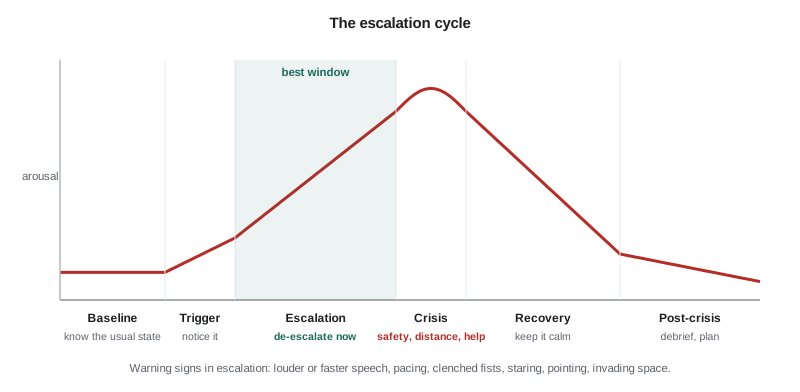
- Baseline. The person's usual state. Knowing it matters: some people are always loud; for others, raising their voice is a big change.
- Trigger. Something upsets them: pain, a long wait, being told no, bad news, a perceived insult, a noise, a procedure.
- Escalation. Arousal rises. Signs of trouble appear: louder or faster speech, swearing, pacing, clenched fists, a red face, staring or refusing eye contact, invading personal space, pointing, standing up quickly, slamming things. This is the window in which de-escalation works best.
- Crisis. The person loses control. They may shout threats, throw things or strike out. Reasoning with them is no longer possible; the priority is safety: create distance, call for help, protect others.
- Recovery. Arousal falls, but slowly, and it can rise again quickly with a new trigger. Staff keep things calm and avoid going back over what happened too soon.
- Post-crisis. The person may be exhausted, tearful or ashamed. This is the time to talk about what happened, what helped and how to prevent it next time, and for staff to debrief.
The most common mistake is waiting until the crisis to act. A patient pacing at the nursing station and demanding to see a doctor is at the escalation stage. Fifteen minutes of attention now, a clear explanation and a realistic time, will often prevent a crisis that takes six staff and security an hour to resolve.
Start with yourself
De-escalation begins with the staff member's own state. Faced with someone shouting at them, most people feel a surge of adrenaline and want either to argue back or to get away. Both reactions are natural, and both can make things worse. Before engaging, take a moment:
- Breathe slowly. Lower your shoulders. Unclench your hands.
- Remind yourself that the anger is usually not about you, even when it is aimed at you.
- Decide whether you are the right person. If you are the target of the anger, or you are tired and upset, another colleague may do better.
- Check your safety: where is the exit, who else is nearby, how would you call for help?
Positioning and body language
Much of what calms or provokes is not in the words. Staff can use their body to signal that they are not a threat while keeping themselves safe:
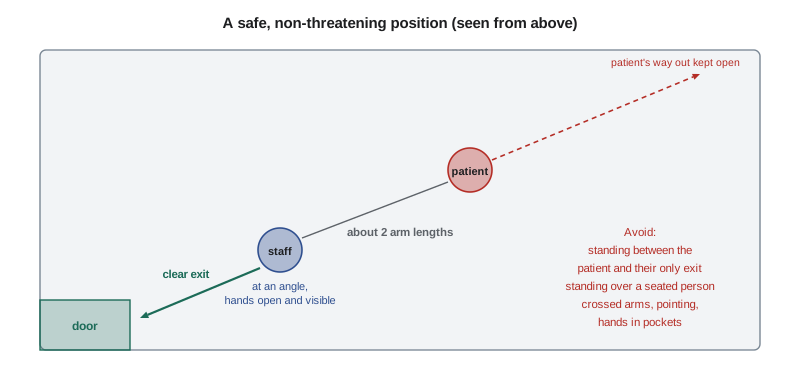
- Distance. Stay about two arm lengths away, more if the person is very agitated. Approaching closer feels threatening and puts you within reach.
- Angle. Stand at an angle of about 45 degrees rather than squarely face to face, which feels confrontational and presents a larger target.
- Hands. Keep them visible, open and relaxed, in front of your body at about waist height. Avoid crossed arms, hands on hips or in pockets, and pointing.
- Exits. Keep a clear path to the door for yourself. Do not block the person's exit either: someone who feels trapped is more likely to fight.
- Height. If the person is sitting, consider sitting too, at a safe distance, rather than standing over them.
- Face and voice. A calm, concerned expression. A low, slow, steady voice, a little quieter than usual, which often leads the other person to lower theirs.
What to say
One widely used framework, from Project BETA in the United States (Best practices in Evaluation and Treatment of Agitation), sets out ten domains of verbal de-escalation that apply far beyond emergency psychiatry. In plain terms:
- Respect personal space and keep your distance, as above.
- Do not be provocative: no sarcasm, arguing, threats or orders.
- Establish verbal contact: one person leads the conversation. Introduce yourself by name and role.
- Be concise: short sentences, simple words, and repeat yourself if needed. Agitated people cannot process long explanations.
- Identify wants and feelings: "It sounds like you're worried about your mother. You want to know what's happening."
- Listen closely: let the person talk; reflect back what you hear so they know you understood.
- Agree, or agree to disagree: find something true to agree with, such as "You're right, it has been a long wait", without agreeing to things that are not true.
- Set clear limits: calmly state what behaviour is not acceptable and what will happen, without threatening: "I want to help you, and I can't do that while you're shouting at me. Can we sit down and talk?"
- Offer choices and optimism: realistic options give back a sense of control: "Would you like to wait here, or in the quiet room? I'll come back in 15 minutes with an update."
- Debrief: afterwards, talk with the person and the team about what happened.
Some phrases reliably make things worse. "Calm down" tells the person their feelings are wrong. "That's the policy" sounds like you do not care. "You need to" sounds like an order. "I know how you feel" usually is not true. Better alternatives acknowledge the feeling and move to a solution: "I can see you're upset. Let's see what I can do."
| Instead of | Try |
|---|---|
| Calm down. | I can see you're really upset. I want to help. |
| That's the policy. | I understand that's frustrating. Here's what I can do. |
| You have to wait like everyone else. | I know it's been a long time. The doctor is with someone very sick; I'll check how long it will be. |
| If you don't stop, I'll call security. | I want to keep talking with you. I need you to lower your voice so we can do that. |
| Why are you being like this? | What's worrying you most right now? |
Therapeutic communication with patients who are confused or in crisis
De-escalation looks different with a patient who is delirious, intoxicated, psychotic or has dementia, because they may not be able to follow reasoning at all. The principles still apply, but staff lean more on tone, simplicity and the environment:
- Reduce stimulation: lower lights and noise, fewer people in the room, one person speaking.
- Orient gently and briefly: "You're in the hospital. I'm Amira, your nurse. You're safe."
- Do not argue with delusions or try to prove that a frightening belief is wrong. Acknowledge the feeling: "That sounds frightening. I'll stay with you."
- Meet basic needs: pain relief, the toilet, water, warmth, glasses and hearing aids.
- Offer medication voluntarily, as a choice, when it is clinically indicated, before the situation reaches a crisis.
When talking is not enough
De-escalation does not always work, and staff should never feel they have failed because a patient became violent anyway. Know your limits and the signs that it is time to step back and get help:
- The person has a weapon or an object that could be used as one.
- They are threatening specific harm, or have begun to strike out or throw things.
- They are not responding at all to verbal engagement, or are getting worse despite it.
- Your own safety, or that of other patients or visitors, is at risk.
At that point, staff leave or create distance, call for help using the alarm or Code White, and keep others away. Physical intervention is a last resort, carried out only by trained staff, in teams, as Lesson 7 describes.
Does early intervention work?
After Northbridge introduced de-escalation training and a rule that any staff member who sees early warning signs should call the charge nurse, Joanne compared incidents where staff had intervened during the escalation phase with those where they had not acted until the crisis. Her script shows how often each group of incidents ended in physical violence.
incidents = [  # (phase when staff first intervened, ended in physical violence?)
    ("escalation", False), ("escalation", False), ("crisis", True),
    ("escalation", True), ("crisis", True), ("escalation", False),
    ("crisis", False), ("escalation", False), ("crisis", True),
    ("escalation", False), ("crisis", True), ("escalation", False),
    ("escalation", False), ("crisis", True), ("escalation", False),
]
for phase in ("escalation", "crisis"):
    group = [hurt for p, hurt in incidents if p == phase]
    violent = sum(group)
print(f"first response at {phase:<10}: {violent} of {len(group)} ended in physical violence")first response at escalation: 1 of 9 ended in physical violence first response at crisis : 5 of 6 ended in physical violence
The numbers are small, but the pattern matches the research: responding early, while the person is still escalating, prevents a large share of assaults. Joanne used the results to argue for more training time and for a second charge nurse on nights in the emergency department.
Practising the skills
Reading about de-escalation is not enough, any more than reading about CPR prepares someone to do it. Northbridge's training uses short role plays: a staff member plays an angry visitor or a frightened patient, another responds, and the group discusses what helped. Staff practise the first sentence they will say, the stance, the limit and the choice until they come without thinking. The sessions also cover cultural differences in eye contact, personal space and tone, and how to work with interpreters when a patient's first language is not English, since misunderstanding is a common trigger.
Units also rehearse as teams. In a short huddle, the charge nurse may ask: if the patient in the end room becomes agitated tonight, who will lead, who will call for help, and where will the others stand? Ten seconds of planning makes the response faster and calmer when it is needed.
Worked problem
A son at the nursing station
At 2100, the son of a 4 West patient arrives at the nursing station, red-faced, loudly demanding to know why his father has not been seen by a doctor all day and why nobody called him. He jabs his finger at the unit clerk. Amira walks over. What should she do?
Show solution
- Check herself and the setting: she slows her breathing, notes that the clerk is the target and steps in to lead, stays two arm lengths away at an angle, and keeps the hallway behind her clear.
- Make contact: "I'm Amira, I'm your father's nurse tonight. I can see you're worried and upset."
- Listen and acknowledge: she lets him explain, then reflects: "You expected a call and didn't get one, and you don't know what the plan is. That would worry me too."
- Set a limit and offer choices: "I want to go through everything with you. Can we go into the family room, where it's quieter? Or I can bring a chair here."
- Follow through: she checks the chart, explains the plan, arranges for the physician to call him, and documents the conversation. The clerk is checked on and the incident is reported as a threat.
Answer: Early engagement by one calm person, acknowledging the worry, setting a respectful limit and offering a choice, turns a likely confrontation into a conversation.
Common mistakes
MistakeWaiting until someone is out of control before responding.
InsteadRespond during the escalation phase, at the first warning signs.
MistakeTelling an upset person to calm down.
InsteadAcknowledge the feeling and move to a solution.
MistakeStanding face to face, close, with arms crossed.
InsteadStand about two arm lengths away, at an angle, with open hands and a clear exit.
MistakeSeveral staff talking to the person at once.
InsteadOne person leads the conversation; others stay back and ready to help.
MistakeKeeping on talking when the person has a weapon or starts to strike out.
InsteadCreate distance, call for help and protect others.
Summary and key terms
- Escalation follows a cycle: baseline, trigger, escalation, crisis, recovery and post-crisis.
- De-escalation works best during the escalation phase, at the first warning signs.
- Manage your own reactions first and check your safety and exits.
- Keep about two arm lengths away, stand at an angle, keep hands open and visible, and never block exits.
- One person leads; be concise, listen, acknowledge feelings, set clear limits and offer choices.
- Avoid phrases such as calm down and that's the policy.
- With confused or psychotic patients, reduce stimulation, keep it simple and do not argue with beliefs.
- When there is a weapon, a threat of specific harm or violence, step back and get help.
- De-escalation
- Using communication, body language and the environment to help an agitated person regain control and avoid violence.
- Escalation cycle
- The usual pattern of rising and falling arousal: baseline, trigger, escalation, crisis, recovery and post-crisis.
- Early signs of agitation
- Behaviours such as raised voice, pacing, clenched fists and staring that often come before violence.
- Limit setting
- Calmly stating what behaviour is not acceptable and what will happen, without threatening.
- Project BETA
- An American consensus on best practices for agitation, including ten domains of verbal de-escalation.
Practice problems
Work each problem on paper first, then reveal the answer to check.
At which phase of the escalation cycle does de-escalation work best?
Show answer
The escalation phase, when warning signs appear but before a crisis.
Name four warning signs of escalating agitation.
Show answer
Any four of: raised or fast speech, swearing, pacing, clenched fists, red face, staring, invading space, pointing, slamming things.
How far away should you stand from an agitated person, and at what angle?
Show answer
About two arm lengths away, at an angle of about 45 degrees rather than face to face.
Rewrite "That's the policy" in a more helpful way.
Show answer
For example: "I understand that's frustrating. Here's what I can do."
How does de-escalation change with a delirious or psychotic patient?
Show answer
Reduce stimulation, keep messages short, orient gently, do not argue with beliefs, meet basic needs and offer medication as a choice.
When should staff stop trying to talk and get help?
Show answer
When there is a weapon, a threat of specific harm, violence has started, the person is getting worse, or safety is at risk.
Lesson quiz · 5 questions
Score 60% or more to complete this lesson.
Create a free account to save your progress, take quizzes and earn a certificate.