
HSE-393 · Lesson 12 of 12 · 21 min
Capstone: a unit violence prevention plan
▶ Video coming soon A video version of this lesson is on the way.
The hospital-wide plan sets the rules, but violence happens on units, and each unit's patients, layout and work are different. In this capstone, Sarah MacLeod, the manager of 4 West, works with Amira Haddad, Tom Bergstrom from the JHSC and Joanne Pelletier to write a violence prevention plan for her unit. Lesson 2 found that the 4 West unit assessment had never been done; Lessons 3, 6 and 7 found slow alarm responses, missed handover of confusion and a pattern of night-time incidents. The plan brings all of it together. The same structure works for any unit.
The structure of a unit plan
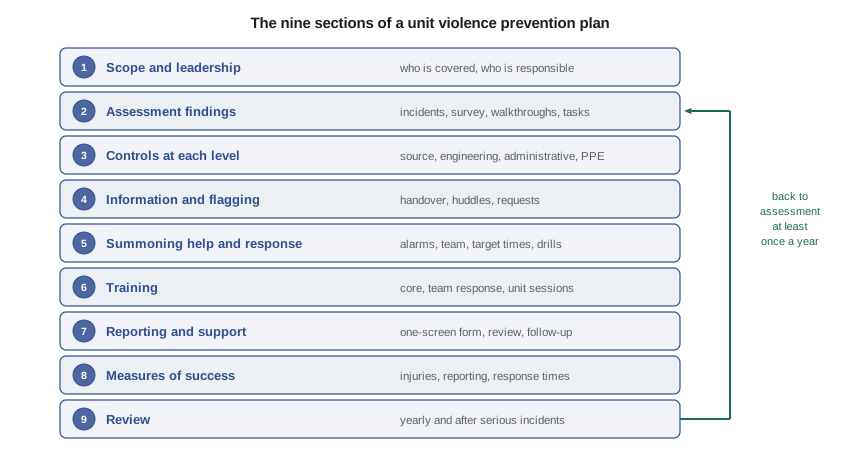
Section 1: scope and leadership
The plan names the unit (4 West, a 32-bed medical unit with about 70 staff), who it covers (all staff who work on the unit, including float and agency staff, physicians, students, porters, environmental services and volunteers), who is responsible (Sarah, as manager, with the night charge nurses responsible on their shifts), and who helped write it (Amira and another staff nurse, a PSW from nights, Tom as committee representative, Joanne, and the security supervisor). It states the unit's commitment in plain words: violence is not part of the job; the hospital provides controls, training and support; staff use them and report what happens.
Section 2: assessment findings
The team summarizes the unit assessment it carried out using the method in Lesson 3: a year of incident reports, a staff survey and staff meeting, walkthroughs on day and night shifts, and a look at the tasks. The main findings:
- 31 reported incidents in the past year, after the reporting campaign; the staff survey suggests the true number is at least three times higher.
- 22 of the 31 happened between 2300 and 0600, and 19 involved patients who were newly confused, mostly older adults with infection or after surgery, and patients in alcohol withdrawal.
- Most incidents happened during hands-on care: IV restarts, repositioning, toileting and stopping patients from leaving.
- Rooms 409 to 416 are out of sight of the station; bathrooms have no staff alarm; there is one exit at the far end of the corridor.
- Information about new confusion was often not passed on at handover; flags rarely reached porters or imaging.
- Alarm drills showed the full team arriving late in half of the drills at night.
- Two staff members had been injured more than once.
Section 3: controls at each level
The team works through the hierarchy, as in Lesson 1, choosing controls that match the findings:
| Level | Control | Finding it addresses |
|---|---|---|
| Source | Delirium screening on admission and every shift, with a delirium order set; alcohol withdrawal screening and protocol; pain assessment before procedures | Night incidents with confused and withdrawing patients |
| Source | Family presence encouraged at night for confused patients; consistent caregivers where possible | Fear and disorientation at night |
| Engineering | Staff alarm buttons in bathrooms; personal alarms for all staff, tested each shift; alarms also alert 4 East | No bathroom alarms; slow response |
| Engineering | Convex mirrors and a camera view of the far corridor at the station; confused patients placed nearer the station | Rooms out of sight |
| Administrative | Two staff for hands-on care of patients scoring moderate or higher on the checklist; a night resource nurse shared with 4 East | Injuries during care |
| Administrative | 4 West joins the emergency department response zone at night | Late team in drills |
| Administrative | Stop and come back: permission to delay non-urgent care for distressed patients | Injuries during care |
Section 4: information and flagging
The plan adopts the hospital's flagging procedure from Lesson 3 and adds unit-specific steps: a spoken and written violence-risk line in every handover; the flag printed on transport, lab and imaging requests; a two-minute safety huddle at the start of each shift naming any patient with a flag or a moderate or higher score and who will help with their care; and a rule that float and agency staff are briefed on flagged patients before taking their assignment.
Section 5: summoning help and response
The plan sets out how to call for help (personal alarm, bathroom button, or the emergency number for a Code White), who responds (security, the 4 West charge nurse, 4 East's charge nurse and, at night, the emergency department's response team), and the target times: a first responder within 1 minute and a full team within 3. It includes monthly alarm tests in every room and four mock codes a year.
Section 6: training
Every staff member completes the hospital's core training in warning signs, de-escalation, breakaway techniques and reporting within their first month, with a yearly refresher. Charge nurses and two staff per shift complete the full team response course. The unit adds two short sessions of its own: recognizing and managing delirium, and approaching confused patients for hands-on care, both taught on the unit with role play.
Section 7: reporting, investigation and support
The plan restates the reporting procedure from Lesson 10, with the one-screen form and a promise that every report gets a reply within a week. Incidents with injury are reviewed with a committee member. Every injured or distressed worker is checked on before the end of the shift, contacted within a day and followed up at 2 and 4 weeks, using the hospital's tracker. Workers injured more than once are offered a meeting with Sarah and Occupational Health and Safety to look at what more can be done.
Section 8: measures of success
A plan without measures cannot be evaluated. The team chooses a small set of indicators, some that should go up and some that should go down:
- Injuries from violence per 10,000 hours worked (should go down).
- Reports of all incidents, including threats (should go up at first, as reporting improves, then level off).
- The share of assaults described in the staff survey that were reported (should go up).
- Full-team response time in drills and real events (should meet the 3-minute target).
- Delirium screening completed on admission and each shift (should be near complete).
- Follow-up check-ins completed on time (should be near complete).
- Staff who say in the survey that they feel safe at work (should go up).
Prioritizing the actions
Not everything can be done at once. The team scores each action on how much risk it reduces and how hard it is to put in place, and starts with those that give the most benefit for the least effort. Joanne's script ranks them:
actions = [  # (action, risk reduced 1-5, effort 1-5)
    ("delirium screening each shift",        5, 2),
    ("bathroom alarm buttons",               4, 3),
    ("join ED response zone at night",       4, 1),
    ("two staff for moderate or higher",     5, 3),
    ("handover violence-risk line",          4, 1),
    ("camera view of far corridor",          2, 4),
    ("night resource nurse with 4 East",     4, 5),
]
ranked = sorted(actions, key=lambda a: (a[1] / a[2], a[1]), reverse=True)
for i, (name, benefit, effort) in enumerate(ranked, 1):
    when = "month 1" if i <= 3 else ("months 2-3" if i <= 5 else "months 4-6")
print(f"{i}. {name:<36} benefit {benefit}, effort {effort} -> {when}")1. join ED response zone at night benefit 4, effort 1 -> month 1 2. handover violence-risk line benefit 4, effort 1 -> month 1 3. delirium screening each shift benefit 5, effort 2 -> month 1 4. two staff for moderate or higher benefit 5, effort 3 -> months 2-3 5. bathroom alarm buttons benefit 4, effort 3 -> months 2-3 6. night resource nurse with 4 East benefit 4, effort 5 -> months 4-6 7. camera view of far corridor benefit 2, effort 4 -> months 4-6
The first month brings the quick wins: joining the emergency response zone at night, adding the violence-risk line to handover and starting delirium screening each shift. Two staff for higher-risk care and bathroom alarms follow in months two and three. The camera and the shared night resource nurse, which need budget approval, are planned for the second half of the year, and Sarah takes the case for the resource nurse to the hospital's operations committee using the incident data.
Involving patients and families
A violence prevention plan is about staff safety, but most of its controls also improve care, and patients and families can help. The 4 West team asked the hospital's patient and family advisers to review the draft. Their suggestions were practical: a short leaflet for families of confused patients explaining delirium and how they can help, such as bringing glasses, hearing aids and familiar objects and staying at night if they can; a clear, friendly sign at the unit entrance stating that abuse of staff is not acceptable and that everyone, patients, visitors and staff, deserves respect; and an explanation to patients who are flagged of why, and how the flag can be removed. The advisers also pointed out that some patients and families feel threatened by security officers, and asked that officers be introduced by name and explain why they are there.
Putting the plan to work
A plan that lives in a binder does nothing. Sarah launched it at three short staff meetings, one for each shift, walked through the changes, and asked staff what they thought would get in the way. She put a one-page summary on the wall of the staff room: how to call for help, the four-question check before entering a flagged patient's room, the handover line, and who to call for support after an incident. Each week for the first two months, the huddle included one item from the plan, such as testing alarms or practising the handover line, until the changes became routine.
Section 9: review
The plan is reviewed at least once a year with the committee, and sooner after any serious incident, a change in the unit's patients or layout, or a rise in incidents. The review asks whether each control was put in place, whether the indicators moved, what the staff survey and incident reviews say, and what to change next. The results go to all unit staff and to the committee.
Worked problem
The six-month check
Six months after the plan began, Sarah and the team review the indicators. Reports of all incidents have risen from about 15 to 26 for the six months. Injuries from violence have fallen from 6 to 3. The share of surveyed assaults that were reported rose from about 2 in 10 to about 5 in 10. Night drills now meet the 3-minute target. Delirium screening is done for about 9 in 10 admissions but only about 6 in 10 on nights after the first day. How should the team read these results?
Show solution
- More reports with fewer injuries is the hoped-for pattern: staff are reporting more of what happens, while the controls reduce harm.
- The rise in the reported share confirms that reporting has improved rather than violence increasing.
- The response time target is now met, which means the change to the response zone worked.
- Night-time delirium screening is the weak point, and nights are when most incidents happen. The team adds the screen to the night charge nurse's checklist and reviews it at each morning huddle.
- The team reports the results to unit staff, thanks them, and sets the next review.
Answer: The plan is working: reporting is up, injuries and response times are down, and the gap in night-time delirium screening is the next thing to fix.
Common mistakes
MistakeCopying the hospital plan without a unit assessment.
InsteadStart from the unit's own incidents, survey, walkthroughs and tasks.
MistakeChoosing only training as the response.
InsteadUse controls at every level of the hierarchy, starting at the source.
MistakeMeasuring success by fewer reports.
InsteadExpect reports to rise at first; measure injuries, the reported share, response times and staff feeling safe.
MistakeWriting the plan and never reviewing it.
InsteadReview at least yearly, and after serious incidents or major changes, and act on the results.
MistakeLeaving out float, agency and support staff.
InsteadCover everyone who works on the unit, including porters, students and physicians.
Summary and key terms
- A unit plan applies the hospital's rules to the unit's own patients, layout and work.
- It has nine sections: scope and leadership, assessment findings, controls, information and flagging, help and response, training, reporting and support, measures and review.
- The 4 West assessment found night incidents with confused and withdrawing patients, out-of-sight rooms, missed handover and slow responses.
- Controls were chosen at each level of the hierarchy to match the findings.
- Indicators include injuries, reporting, the reported share, response times, screening and staff feeling safe.
- Actions are ranked by benefit and effort so that quick wins come first.
- Reports rising while injuries fall is the expected sign of a working plan.
- Review at least yearly and after serious incidents, and share the results with staff.
- Unit violence prevention plan
- A written plan that applies the organization's violence program to one unit's risks.
- Indicator
- A measure used to judge whether the plan is working.
- Safety huddle
- A short meeting at the start of a shift to share risks and plan help.
- Response zone
- The area a response team covers, which sets who responds to an alarm.
- Quick win
- An action that reduces risk substantially with little effort or cost.
Practice problems
Work each problem on paper first, then reveal the answer to check.
List the nine sections of a unit violence prevention plan.
Show answer
Scope and leadership; assessment findings; controls; information and flagging; summoning help and response; training; reporting, investigation and support; measures of success; review.
What were the main findings of the 4 West assessment?
Show answer
Night incidents with newly confused and withdrawing patients, injuries during hands-on care, rooms out of sight, no bathroom alarms, missed handover of confusion and slow responses at night.
Give one source, one engineering and one administrative control from the 4 West plan.
Show answer
For example: delirium screening each shift; bathroom alarm buttons; two staff for hands-on care of higher-risk patients.
Why might reports go up after a plan starts, and why is that not bad?
Show answer
Because staff report more of what was already happening; it means the hospital sees the problem better.
How did the team decide which actions to do first?
Show answer
By ranking them on risk reduced compared with effort, starting with the most benefit for the least effort.
What weakness did the six-month check find, and what was done?
Show answer
Night-time delirium screening was incomplete; it was added to the night charge nurse's checklist and reviewed at huddles.
Lesson quiz · 5 questions
Score 60% or more to complete this lesson.
Create a free account to save your progress, take quizzes and earn a certificate.