
HSE-383 · Lesson 8 of 12 · 17 min
Working late, closing and cash handling
▶ Video coming soon A video version of this lesson is on the way.
Last autumn, a restaurant three blocks from Juniper Street was robbed at closing. Two staff were counting the till in the back office when a man came in through the back door, which had been propped open while they took out the garbage. He took the cash, nobody was hurt, and the police caught him two weeks later. The next morning Daniel Okafor called a meeting. Juniper's own closing routine had grown up by habit, and when the safety committee looked at it honestly, the back door was propped open most nights too, the till was counted at the bar in full view of the windows, and on quiet Sundays one person sometimes closed alone. This lesson covers the hazards of the late shift and the close, the rules for working alone, and how to handle cash so that a robbery is unlikely and, if it happens, nobody gets hurt.
Why the late shift is different
The risks of the late shift come from several things at once. There are fewer staff, and they are tired after a long shift. The last guests are often the most intoxicated. The street outside is quieter, so there are fewer witnesses and less help nearby. There is cash from the day's business in the building. Doors are opened for garbage and deliveries. And the walk to the car or the bus happens in the dark. Juniper's customer incident log showed most incidents after 9 p.m., and the robbery down the street happened at closing, the classic time for restaurant robberies.
Working alone
Section 4.20.1 of the BC Regulation defines working alone or in isolation as working in circumstances where assistance would not be readily available if there were an emergency or the worker were injured or ill. Before assigning that work, the employer must identify the hazards and eliminate or minimize them. Section 4.21 requires a written procedure for checking the well-being of a worker who works alone: a designated person checks in at set intervals and at the end of the shift, the intervals are developed with the joint committee and the worker, and the procedure says what happens if the worker cannot be reached, including emergency rescue. Workers and the people who check on them must be trained, and the procedure must be reviewed at least once a year. Section 4.22.1 adds stricter rules for gas stations and late-night retail stores open between 11 p.m. and 6 a.m.; those do not apply to restaurants, but Juniper borrowed several of their ideas.
Juniper's rule is now simple: nobody closes alone, ever. On quiet nights the schedule still has two people until the last door is locked, usually the manager on duty and a server or the bartender. Opening is similar: whoever opens in the morning texts the manager on arrival, and the manager calls if there is no text by a set time. The few tasks that are done alone, such as an early delivery or a manager doing paperwork on a day off, follow a check-in procedure.
The closing routine
The committee rewrote the closing routine as a checklist in the order the tasks happen. The point of putting it in order is that the riskiest tasks, such as opening the back door and handling cash, happen when the building is secure and there are two people present.
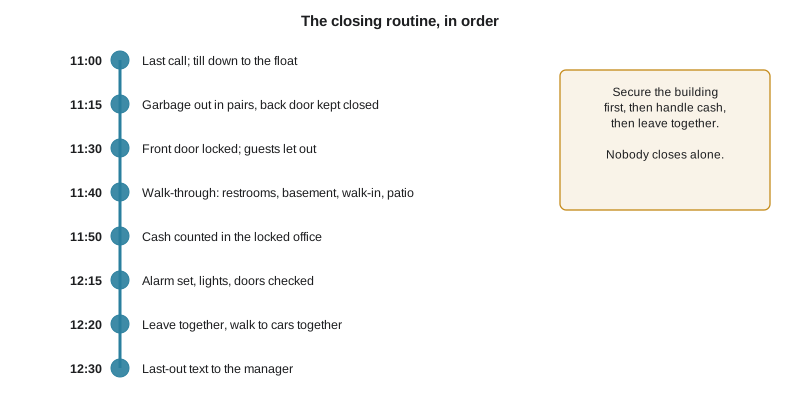
- Take out garbage, recycling and used oil early and in pairs. Juniper moved the last garbage run to 11:15 p.m., while the lane is still lit and busy, and two people go out together. The back door is never propped open; it is closed and checked between trips.
- Lock the front door at closing time and let remaining guests out one at a time, rather than leaving the door open while staff clean.
- Walk through the whole building before handling cash: restrooms, the basement, the walk-in, the patio and any closets. People do hide in restaurants at closing.
- Keep the back door locked. The back door is opened for nobody after dark except a known, expected person, and staff check the camera screen or the peephole first.
- Count cash in the locked office, away from windows, and never at the bar or the host stand.
- Set the alarm, check every door and leave together. Staff walk to their cars or the bus stop together, with keys in hand, and nobody leaves until everyone's car has started.
- The last person out sends a text to the manager on duty. If the manager does not receive it within half an hour of the planned closing time, the manager calls, and if there is no answer, follows the procedure for a worker who cannot be reached.
Cash handling
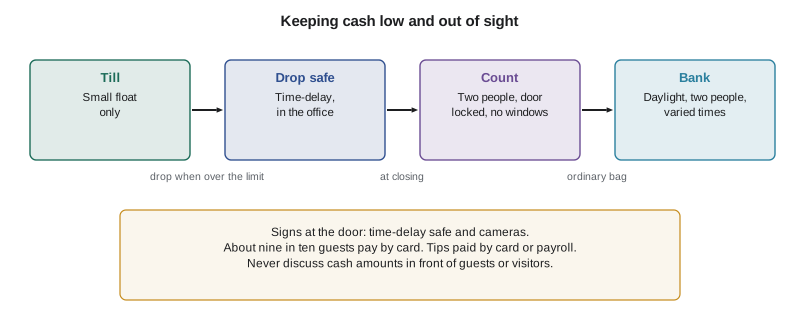
Cash is what most robbers want, and the less cash there is, and the more obvious it is that there is little, the less attractive the restaurant is as a target. About nine in ten of Juniper's guests now pay by card, which helps.
- Keep a small float in the till, and drop any cash over the limit into a drop safe during the shift. Juniper's limit is a few hundred in the till, and anything above that goes into the drop safe in the office.
- Use a time-delay drop safe that staff cannot open on demand, and post a sign at the entrance and by the till saying so. A robber who knows the safe takes 10 minutes to open is less likely to try.
- Count and prepare the deposit in the locked office, out of sight, with two people present.
- Make bank deposits during daylight, at varied times and by varied routes, with two people. Do not carry deposit bags that look like bank bags; use an ordinary backpack or shopping bag.
- Never discuss cash amounts in front of guests, delivery people or anyone else who does not need to know.
- Tips are paid out by card or through payroll wherever possible, so servers do not walk out with large amounts of cash late at night.
If a robbery happens
Training for a robbery is about one thing: getting everyone through it alive and uninjured. Money can be replaced; people cannot. Police and security experts give the same advice:
- Stay calm and do exactly what the robber asks. Hand over the money without argument. Do not try to stall, bargain or trick them.
- Do not resist, fight or chase. Do not try to grab a weapon. Most injuries in robberies happen when someone resists.
- Keep your hands visible and tell the robber before you move: "I'm going to open the till now." Avoid sudden movements.
- Do not stare, but notice what you can safely notice: height, build, clothing, voice, anything unusual, and the direction they leave in.
- Press the panic button only if it is silent and you can do it without being seen.
- Tell the robber about anyone else in the building who might surprise them, such as a cook in the walk-in, so nobody is startled.
After the robber leaves:
- Lock the doors and call 911. Stay on the line.
- Look after anyone who is hurt or badly shaken.
- Do not touch anything the robber touched, and keep everyone out of the area until police arrive.
- Ask each witness to write down what they saw on their own, without discussing it first, because memories quickly blend together.
- Do not discuss the amount taken with anyone except the police and the manager.
- Write up the incident and arrange support. A robbery is frightening even when nobody is hurt, and staff may need time off, counselling through the employee assistance plan, or a few shifts away from closing.
Check-ins that work
A check-in procedure only works if someone notices a missed check-in and acts. The short program below is the logic Juniper's manager phone app follows each night: it compares the planned closing time with the time of the last-out text and raises an alert if the text is overdue.
# Check that the last-out text arrived on time after each close.
from datetime import datetime, timedelta

GRACE = timedelta(minutes=30)
nights = [   # (date, planned close, last-out text or None)
    ("Fri 4 Sep", "00:30", "00:22"),
    ("Sat 5 Sep", "00:30", "00:41"),
    ("Sun 6 Sep", "23:30", "23:18"),
    ("Mon 7 Sep", "23:00", None),
    ("Tue 8 Sep", "23:00", "23:52"),
]

def t(hm):
    return datetime.strptime(hm, "%H:%M")

for day, planned, text in nights:
    if text is None:
        print(f"{day}: NO TEXT. Call the closers now; if no answer, follow the missed check-in procedure.")
        continue
    late = (t(text) - t(planned)) % timedelta(days=1)
    if late > timedelta(hours=12):
        print(f"{day}: OK, out early at {text}")
    elif late > GRACE:
        print(f"{day}: text {late.seconds // 60} min after planned close, follow up")
    else:
print(f"{day}: OK at {text}")Fri 4 Sep: OK, out early at 00:22 Sat 5 Sep: OK at 00:41 Sun 6 Sep: OK, out early at 23:18 Mon 7 Sep: NO TEXT. Call the closers now; if no answer, follow the missed check-in procedure. Tue 8 Sep: text 52 min after planned close, follow up
Monday's missing text turned out to be a dead phone battery, which is why the procedure says to call rather than assume. The Tuesday text was late because a guest stayed past closing. Both were followed up the same night, which is the habit the procedure is meant to build.
The walk to the car
Lesson 9 covers the parking lot in detail, but the end of the shift deserves its own reminder. Staff leave together, walk to cars together, and wait until everyone's car has started. Anyone taking the bus walks to the stop with a colleague or gets a ride. Workers under 19 never leave alone after dark, and Juniper schedules them to finish well before closing. If anyone feels unsafe on the way out, such as a person waiting near the cars, they go back inside, lock the door and call the manager or the police.
Summary and key terms
- The late shift combines fewer and tired staff, intoxicated guests, quiet streets, cash and open doors.
- BC sections 4.20.1 to 4.23 require hazard controls, a written check-in procedure, training and yearly review for anyone working alone; Juniper's rule is that nobody closes alone.
- Close in a fixed order: garbage early and in pairs, front door locked, building walked through, cash counted in a locked office, alarm set, leave together.
- Keep the till low, use a time-delay drop safe with signs, and deposit in daylight with two people at varied times.
- In a robbery, comply, do not resist or chase, keep hands visible; afterward lock up, call 911, protect the scene and support staff.
- Working alone
- Working where help would not be readily available in an emergency or if the worker were injured or ill.
- Check-in procedure
- A written system in which a designated person checks on a lone worker at set times and acts if there is no answer.
- Float
- The small amount of cash kept in the till for making change.
- Time-delay drop safe
- A safe that accepts cash at any time but takes a set delay to open, deterring robbery.
- Last-out text
- The message sent to the manager by the last person to leave, confirming everyone is out safely.
Doors and keys
Control of keys and codes is part of closing safely. Only managers and designated closers have keys to the back door and the office, and the alarm code is changed whenever someone with the code leaves the job. Lost keys are reported the same day and the lock is rekeyed. Deliveries after dark are not accepted at the back door; the few late suppliers are asked to come before 9 p.m. or the next morning. Staff do not let anyone in through the back door after closing, including people who say they are former staff, contractors or friends of a manager, unless the manager on duty has confirmed it in advance.
Opening in the morning
Opening has its own risks: one person arriving alone, often early, to a building that has been empty all night. Juniper's opening routine mirrors the closing one. The opener checks the outside of the building and the back door before going in; if anything looks wrong, such as a broken window, a forced door or someone waiting nearby, the opener stays in the car, calls the manager and the police, and does not go in. Once inside, the opener disarms the alarm, locks the door behind them and texts the manager. The kitchen staff and the second front-of-house worker arrive within half an hour, so the time alone is short.
After the robbery down the street
Two months after the neighbouring restaurant was robbed, Juniper's committee checked whether the new routine was being followed. The back door had been found propped open once, on a hot night when the kitchen was trying to cool down; the fix was a screen door with a lock, so the kitchen could get air without leaving the building open. The cash had been counted in the office every night. And one quiet Sunday close had been scheduled with only one person; the schedule template was changed so that two closers are filled in automatically.
Common mistakes
MistakeProp the back door open while the garbage goes out, to save time.
InsteadKeep the back door closed between trips, take garbage out early and in pairs.
MistakeCount the till at the bar where there is good light.
InsteadCount cash in the locked office, away from windows, with two people.
MistakeIn a robbery, stall for time until the police come.
InsteadComply calmly and quickly; resisting or stalling is how people get hurt.
Practice problems
Work each problem on paper first, then reveal the answer to check.
Put these closing tasks in a safe order: count the cash, walk through the building, take the garbage out, lock the front door, leave together.
Show answer
Take the garbage out (early, in pairs), lock the front door, walk through the building, count the cash in the locked office, set the alarm and leave together.
The manager has not received a last-out text 40 minutes after the planned close. What should happen?
Show answer
Call the closers; if there is no answer, follow the missed check-in procedure, such as calling the other closer, going to the restaurant with someone else, or calling police.
Why does Juniper post signs about its time-delay safe and cameras?
Show answer
Visible signs make the restaurant a less attractive target, because robbers know there is little cash available and that they will be recorded.
Lesson quiz · 5 questions
Score 60% or more to complete this lesson.
Create a free account to save your progress, take quizzes and earn a certificate.