
HSE-383 · Lesson 5 of 12 · 16 min
Responsible alcohol service
▶ Video coming soon A video version of this lesson is on the way.
Alcohol is part of what Juniper Street sells, and the bar brings in a good share of the restaurant's revenue. It is also the single biggest factor behind the incidents in the last two lessons, behind many slips and falls in the dining room, and behind the most serious harm a restaurant can contribute to: an intoxicated guest who leaves and drives. Serving alcohol responsibly protects the guests, the public, the staff and the business. This lesson covers the training and permits servers need, how alcohol affects the body, how to check age, how to pace service and how to recognize intoxication. The next lesson covers refusing service and the legal consequences of over-service.
Training and permits
In British Columbia, the Liquor Control and Licensing Act and its regulations are enforced by the Liquor and Cannabis Regulation Branch (LCRB). Every licensee, manager and server in a licensed restaurant or bar must hold a Serving It Right certificate, the province's responsible beverage service program, and so must anyone who delivers liquor for the restaurant. The course covers the law, checking ID, recognizing intoxication, refusing service and preventing problems. Juniper requires every new server and bartender to complete it before their first shift serving liquor, and Olivia keeps copies of each certificate in the staff file. Other provinces have similar programs, such as Smart Serve in Ontario and ProServe in Alberta. The legal drinking age in British Columbia is 19.
Training is the minimum. What makes service responsible is a house policy that everyone follows, a manager who backs staff up, and a bar and dining room set up to make good choices easy: food available until the bar closes, non-alcoholic drinks that are as appealing as the cocktails, water on every table, and no promotions that push guests to drink quickly.
What a standard drink is
Guests and staff talk about "a drink", but a pint of strong craft beer, a generous pour of wine and a double martini contain very different amounts of alcohol. Health agencies use the idea of a standard drink, a fixed amount of pure alcohol, to compare them.
In Canada, a standard drink contains 13.45 g (0.47 oz) of pure alcohol, which is about 17 mL. That is a 341 mL (12 oz) bottle of 5% beer, a 142 mL (5 oz) glass of 12% wine, or a 43 mL (1.5 oz) shot of 40% spirits.
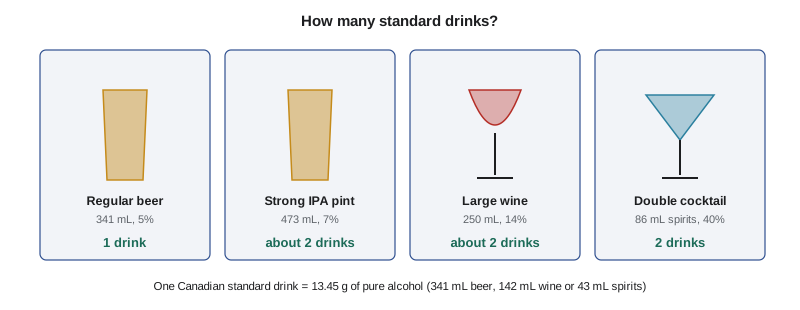
Many popular drinks are more than one standard drink. A 473 mL (16 oz) pint of 7% IPA is about two. A cocktail with two shots of spirits is two. A large glass of 14% wine poured to 250 mL (8.5 oz) is about two. Servers who count glasses rather than standard drinks will underestimate how much a guest has had.
How alcohol affects the body
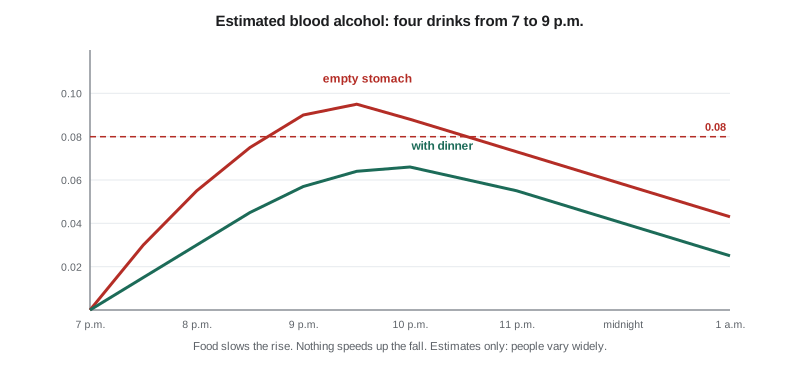
Alcohol is absorbed into the blood through the stomach and small intestine, mostly the small intestine. Food in the stomach slows absorption, which is why guests who eat drink more safely than guests who drink on an empty stomach. Once in the blood, alcohol reaches the brain within minutes. The liver breaks it down at a roughly fixed rate, on average about one standard drink an hour, and nothing speeds that up: not coffee, not cold showers, not fresh air. Only time lowers blood alcohol.
Blood alcohol concentration (BAC) depends on how much alcohol a person drinks, how fast, their body size and composition, whether they have eaten, and other factors such as medications, fatigue and illness. For the same number of drinks, a smaller person, a person who has not eaten, or a person who drinks quickly will reach a higher BAC. On average, women reach a higher BAC than men of the same weight, because of differences in body water.
As BAC rises, the effects follow a familiar order. Inhibitions drop first: people get louder, more talkative and more confident. Judgment goes next: they make poor decisions, such as ordering another round or deciding to drive. Then reaction time slows, and finally coordination fails: slurred speech, stumbling, spilled drinks. Servers are trained to notice the early changes, in inhibitions and judgment, because by the time coordination fails, the guest has usually had too much.
For driving, the Criminal Code makes it an offence to drive with a BAC of 80 mg of alcohol in 100 mL of blood (0.08) or more, and British Columbia's immediate roadside prohibition program penalizes drivers in the warn range from 0.05. New drivers in the Graduated Licensing Program must have zero alcohol.
Estimating, carefully
Bartenders sometimes ask how many drinks it takes to reach a given BAC. The honest answer is that it varies too much between people to count on. The Widmark formula, used by toxicologists, gives a rough estimate from the amount of alcohol, body weight, a body water factor and the time since drinking began. Juniper uses it only in training, to show how quickly a guest can reach the legal driving limit, never to decide whether a particular guest is safe to drive.
# Rough blood alcohol estimate (Widmark formula). Training use only: people vary widely.
GRAMS_PER_DRINK = 13.45      # Canadian standard drink
ELIMINATION = 0.015          # BAC units per hour, a typical average

def bac(drinks, body_kg, hours, r):
    grams = drinks * GRAMS_PER_DRINK
    peak = grams / (body_kg * 1000 * r) * 100
    return max(0.0, peak - ELIMINATION * hours)

for label, kg, r in [("guest A, 90 kg, r=0.68", 90, 0.68), ("guest B, 60 kg, r=0.55", 60, 0.55)]:
    print(label)
    for drinks in (2, 3, 4, 5):
print(f" {drinks} drinks over 2 h: about {bac(drinks, kg, 2, r):.3f}")guest A, 90 kg, r=0.68 2 drinks over 2 h: about 0.014 3 drinks over 2 h: about 0.036 4 drinks over 2 h: about 0.058 5 drinks over 2 h: about 0.080 guest B, 60 kg, r=0.55 2 drinks over 2 h: about 0.052 3 drinks over 2 h: about 0.092 4 drinks over 2 h: about 0.133 5 drinks over 2 h: about 0.174
On these assumptions, the lighter guest passes 0.08 after three drinks in two hours, and the heavier guest reaches it at about five. Even these rough numbers make the point for new servers: a guest can be over the driving limit long before looking drunk. That is why a server's job is to watch the pace and the early signs, and why Juniper never tells a guest that they are safe to drive.
Checking age
Serving a minor is one of the most serious violations in liquor law, for the licensee and for the server. Juniper's rule is to ask for ID from anyone who looks under 30. Acceptable ID is an official, government-issued primary ID with a photo and date of birth, such as a driver's licence, a BC Services Card with photo, a BCID card or a passport. Digital ID on a phone is not accepted. Staff check that the photo matches, that the ID is not expired, and that the date of birth makes the guest 19 or older. If there is any doubt, the server can ask for a second piece of ID or refuse service, and the LCRB recognizes the right of licensees to set their own stricter policies, such as refusing a whole group if one member has no ID.
Checking ID is also a common trigger for arguments, especially with groups. Servers ask politely and consistently, explain that it is the law and the house policy, and never make exceptions for regulars, friends or people who seem offended. Refusing to serve a guest who cannot prove their age is always the right call.
Pacing and preventing intoxication
The easiest guest to deal with is one who never becomes intoxicated in the first place. Juniper's servers and bartenders use a few simple habits that slow the pace without lecturing anyone:
- Offer food with drinks, especially to guests who are drinking before or instead of eating.
- Bring water to every table and refill it without being asked.
- Serve one drink at a time per guest; no doubles of the same drink lined up, and no shots for large groups without the manager's approval.
- Count standard drinks, not glasses, and keep track of what each guest at the bar has had.
- Slow down service to a guest who is drinking quickly: clear the empty glass first, check in before offering another round, and suggest a non-alcoholic option.
- Pass information along at shift change, so the next bartender knows who has had several drinks.
Recognizing intoxication
There is no single sign that proves a person is intoxicated, but several signs together are a strong indication. Servers watch for changes from how the guest was when they arrived.
- Lowered inhibitions: louder, overly friendly, telling inappropriate jokes, using bad language.
- Impaired judgment: ordering more and faster, buying rounds for strangers, arguing, complaining about drink strength.
- Slowed reactions: slow responses, losing track of the conversation, forgetting what they ordered.
- Loss of coordination: slurred speech, stumbling, swaying, dropping money or keys, spilling drinks, difficulty picking up change.
When a server notices early signs, the right move is to slow service and tell the bartender and the manager, not to wait until the guest is visibly drunk.
Summary and key terms
- Every server, bartender and manager needs Serving It Right before serving liquor in British Columbia, and the drinking age is 19.
- A standard drink is a fixed amount of pure alcohol; many popular drinks contain two or more.
- Food slows the rise in blood alcohol, but only time lowers it, at roughly one standard drink an hour.
- Check ID for anyone who looks under 30 and refuse service when in doubt.
- Pace service with food, water and one drink at a time, and act on the early signs of intoxication.
- Standard drink
- A fixed amount of pure alcohol used to compare drinks of different sizes and strengths.
- Blood alcohol concentration (BAC)
- The amount of alcohol in the blood, written for example as 0.08, meaning 80 mg in 100 mL.
- Responsible beverage service
- Training and practices that prevent intoxication, service to minors and impaired driving.
- Widmark formula
- A formula that estimates blood alcohol from alcohol consumed, body weight, body water and time.
- Primary ID
- Official, government-issued photo identification showing a date of birth.
Non-alcoholic drinks
A well-made non-alcoholic option is one of the easiest ways to help guests pace themselves, and it gives designated drivers and guests who have had enough something better than a soda. Juniper's bar keeps three alcohol-free cocktails on the menu, made with the same care and glassware as the others, plus non-alcoholic beer. Servers offer them without making a point of it, especially when a guest slows down or says they are driving. Nadia's rule is that nobody should ever feel singled out for ordering one.
Medications, fatigue and other factors
Alcohol does not act alone. Many common medications, including some antihistamines, sleeping pills, pain medications and anxiety medications, make the effects of alcohol much stronger. Fatigue, illness, dehydration and cannabis do the same. Servers cannot know what a guest has taken, which is one more reason to judge by behaviour rather than by the number of drinks, and to slow down at the first signs rather than waiting for a count to be reached. Guests who arrive already showing signs of intoxication, perhaps after drinking elsewhere, are not served alcohol at all under Juniper's policy, however few drinks they have had at Juniper.
Promotions and specials
Drink specials can encourage rapid or heavy drinking, and BC liquor rules restrict them: prices may not fall below the minimum prices the province sets, and licensees may not run promotions that encourage excessive consumption. Juniper's specials are built around food pairings rather than volume, and there are no all-you-can-drink offers.
Water on every table
Water does not lower blood alcohol, but it slows drinking by giving guests something else to sip, and it reduces dehydration. Servers bring water to every table when guests sit down and keep refilling it, and bartenders put a glass of water next to every second drink at the bar.
Bartender standards
Consistent pours make counting standard drinks possible. Juniper's bartenders use measured jiggers or a calibrated pour spout for spirits, standard pour lines for wine, and set glass sizes for beer, so a cocktail, a glass of wine or a pint always contains the amount the menu says. Free pouring, where a bartender guesses the amount, makes drinks stronger and less predictable and is not allowed at Juniper.
Common mistakes
MistakeCoffee or fresh air will sober a guest up before they leave.
InsteadOnly time lowers blood alcohol; coffee just makes an intoxicated person more awake.
MistakeCount glasses to know how much a guest has had.
InsteadCount standard drinks; a strong pint or a double cocktail can be two or more.
MistakeA regular does not need to show ID.
InsteadCheck ID consistently for anyone who looks under 30, with no exceptions.
Practice problems
Work each problem on paper first, then reveal the answer to check.
How many Canadian standard drinks are in a 473 mL can of 7% beer? (Alcohol density is 0.789 g per mL.)
Show answer
473 x 0.07 x 0.789 = about 26 g of alcohol, divided by 13.45 g = about 1.9 standard drinks.
A guest at the bar has become much louder and is buying shots for people he does not know. What stage of intoxication do these signs suggest, and what should the bartender do?
Show answer
Lowered inhibitions and impaired judgment; slow service, offer food and water, tell the manager and watch closely.
Why does Juniper never use the Widmark formula to decide whether a guest can drive?
Show answer
It gives only a rough average; individuals vary widely, and a server cannot know a guest's true BAC.
Lesson quiz · 5 questions
Score 60% or more to complete this lesson.
Create a free account to save your progress, take quizzes and earn a certificate.