
HSE-383 · Lesson 12 of 12 · 16 min
Capstone: a closing-shift safety plan
▶ Video coming soon A video version of this lesson is on the way.
Every lesson in this course has touched the closing shift. The last two hours of the night bring together the most intoxicated guests, the refusals of service, the harassment that gets bolder as the room empties, the cash, the garbage run through the back door, the patio heaters and umbrellas, the delivery drivers' last trips, the walk to the car and the check-in text. In September 2026, Juniper Street's safety committee asked Olivia Brooks and Nadia Haddad to pull all of it into one written plan for the closing shift. This capstone follows how they built it, tested it and put it into use. By the end, you should be able to write the same kind of plan for any restaurant or bar.
Step 1: Decide what the plan covers
Olivia and Nadia started by defining the closing shift precisely: from two hours before the bar closes until the last person out has sent the check-in text. On Friday and Saturday nights that is 10 p.m. to about 12:30 a.m.; on other nights, 9 p.m. to about 11:30 p.m. The plan covers everyone working in that window, front of house and kitchen, plus the delivery drivers' last trips.
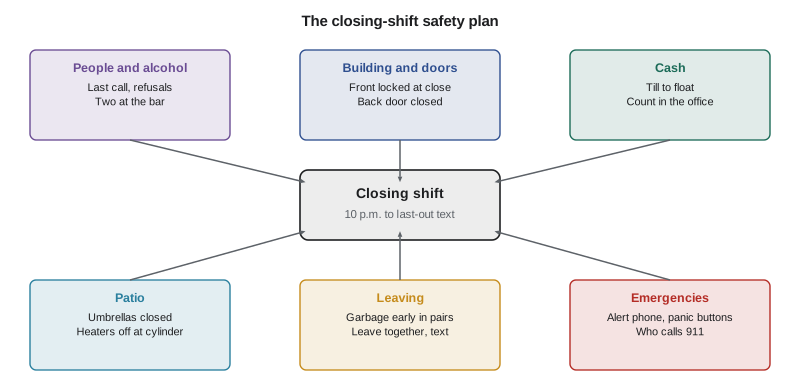
They then listed every hazard in that window, using the lessons of this course and the incident log as a checklist. The list had 18 items, which they grouped under six headings: people and alcohol, the building and doors, cash, the patio, leaving and the parking lot, and emergencies.
Step 2: Set the staffing and roles
The single most important control is people. The plan sets minimum staffing for the closing window and gives each closer a named role, so nothing depends on who happens to be there.
- At least two staff in the building until the last door is locked, always: the manager on duty and one other closer.
- From 10 p.m. on Friday and Saturday, a second bartender, because most refusals and incidents happen at the bar in the last two hours.
- No workers under 19 after 10 p.m., and young workers leave with a parent, a ride or a colleague.
- The manager on duty carries the phone that receives panic-button alerts and check-in texts for the whole window.
- Named closing roles: manager (cash, alarm, check-in), closing bartender (bar, last call, refusals), closing server (dining room and patio), kitchen closer (kitchen, back door, garbage with a partner).
Step 3: Write the alcohol rules for the last two hours
The incident log showed that the last two hours produced most of the problems, so the plan tightened service in that window rather than relying on each bartender's judgment alone.
- Last call 30 minutes before the bar closes, announced once by the bartender and by servers at their tables. No last-call doubles, shots or rounds for large groups.
- Food available until last call, with a short late menu.
- Any guest who has been refused service, or who is showing clear signs of intoxication, is checked by the manager before leaving: how is he getting home? The taxi number is at the bar, and Juniper pays for the taxi if needed.
- Guests are not asked to leave the building intoxicated and alone into the street. A guest who must be asked to leave is asked by the manager, with a second staff member present, following Lesson 4.
- Every refusal and every ejection is written in the incident log before the shift ends.
Step 4: Write the building, cash and patio routine
This part of the plan is the closing timeline from Lesson 8, extended to include the patio and the delivery drivers, and turned into a checklist that the closers complete on a tablet. Each item has an owner and a time.
- 10:30 p.m.: patio umbrellas closed; heaters off at the cylinder unless guests are still seated outside; last patio delivery orders accepted.
- 11:00 p.m.: last call; till reduced to the float and excess cash into the drop safe.
- 11:15 p.m.: garbage, recycling and used oil out in pairs, back door closed and checked between trips.
- 11:30 p.m.: front door locked; remaining guests let out by staff; drivers' last trips ended in the app.
- 11:40 p.m.: walk-through of restrooms, basement, walk-in, patio and closets, two people together.
- 11:50 p.m.: cash counted in the locked office by two people; deposit into the drop safe.
- 12:15 a.m.: alarm set; lights; all doors checked.
- 12:20 a.m.: everyone leaves together, walks to cars together, waits for cars to start.
- 12:30 a.m.: last-out text to the manager on duty; follow-up if it is missing.
Step 5: Emergencies and incidents during the close
Emergencies do not wait for opening hours, and at closing there are fewer people to help. The plan answers the questions that would otherwise be decided in a panic.
- The manager on duty is the person who calls 911 for any emergency, and if the manager is involved, the closing bartender does.
- The panic buttons stay armed until the alarm is set, and the monitoring company has the manager's number.
- If a guest who was refused or banned is waiting outside at closing, staff stay inside, lock the doors and call the police; nobody walks out past him.
- If a staff member is hurt or threatened, the incident is recorded that night and the general manager is told before the next shift.
- Robbery: comply, do not resist, lock up afterward, call 911 and protect the scene, as in Lesson 8.
Step 6: Test the plan
A plan on paper is not a plan until people have used it. Olivia and Nadia ran it for four weekends in September before the committee approved it, with the closers completing the tablet checklist each night and noting anything that did not work. The checklist marks some items as critical, such as two people present, the back door closed, cash counted in the office, heaters off at the cylinder and the last-out text; missing any critical item is followed up the next day. The program below scores the test nights.
# Score closing-shift checklists from the test weekends.
CRITICAL = {"two staff present", "back door closed", "cash in locked office",
            "heaters off at cylinder", "walk-through done", "last-out text"}
TASKS = CRITICAL | {"umbrellas closed", "last call announced", "garbage in pairs",
                    "front door locked", "alarm set", "left together"}

nights = {
    "Fri 4 Sep": TASKS - {"umbrellas closed", "heaters off at cylinder"},
    "Sat 5 Sep": TASKS - {"garbage in pairs"},
    "Fri 11 Sep": TASKS - {"walk-through done"},
    "Sat 12 Sep": set(TASKS),
    "Fri 18 Sep": set(TASKS),
    "Sat 19 Sep": TASKS - {"left together"},
    "Fri 25 Sep": set(TASKS),
    "Sat 26 Sep": set(TASKS),
}

for night, done in nights.items():
    missed = sorted(TASKS - done)
    crit = sorted(CRITICAL - done)
    score = 100 * len(done) // len(TASKS)
    note = "CRITICAL MISSED: " + ", ".join(crit) if crit else ("missed: " + ", ".join(missed) if missed else "complete")
print(f"{night}: {score:3d} {note}")Fri 4 Sep: 83 CRITICAL MISSED: heaters off at cylinder Sat 5 Sep: 91 missed: garbage in pairs Fri 11 Sep: 91 CRITICAL MISSED: walk-through done Sat 12 Sep: 100 complete Fri 18 Sep: 100 complete Sat 19 Sep: 91 missed: left together Fri 25 Sep: 100 complete Sat 26 Sep: 100 complete
The first weekend showed that the patio items were being forgotten because they were scheduled before the patio guests had left; the fix was to move them to the closing server's list with a time of "when the last patio guest leaves". The skipped walk-through on 11 September happened because one closer went home early, leaving a single closer and the manager to do everything; the plan now says the manager may not release a closer until the walk-through is done. The miss on 19 September, when two closers walked out separately, was talked through at the next pre-shift meeting. By the final weekend, the checklists were complete.
Step 7: Communicate, train and review
The final plan is four pages long. The first page is a one-page summary posted in the staff area and by the office door; the rest sits in the manager's closing binder and on the tablet. Every front-of-house and kitchen worker reviewed it with Olivia, and new hires read it on their first closing shift with an experienced closer.
The plan is reviewed every year by the joint health and safety committee, and sooner after any serious incident, a change to the building, a change in hours or a change in the law. That annual review also meets the BC requirement to review the working-alone check-in procedure at least once a year, even though the plan's two-person rule means nobody normally works alone.
What the plan changed
In the six months after the plan was adopted, Juniper's customer incident log showed fewer incidents in the last two hours than the same months a year earlier, and no incident at all after the front door was locked. The back door has not been propped open since. Marcus, Jenna and the closers say the walk out together and the lit parking row are the changes they notice most. Nobody pretends that a written plan prevents everything, but the closing shift now runs the same way every night, whoever is working, and the things that matter most are done every time.
Writing your own plan
If you are asked to write a closing-shift plan for your own workplace, follow the same steps: define the window, list the hazards from your own records and walks, set minimum staffing and named roles, write the specific rules for alcohol, doors, cash, outdoor areas and leaving, decide in advance who does what in an emergency, test the plan with the people who will use it, fix what does not work, and review it every year. Involve the workers who close; they know where the plan will fail before anyone else does.
Summary and key terms
- The closing shift brings together the course's hazards: intoxication, refusals, harassment, cash, the back door, the patio, the drive home and working with few people.
- Define the window, list its hazards, set minimum staffing with named roles, and keep young workers off the late shift.
- Tighten alcohol service in the last two hours, and follow a timed checklist for the patio, garbage, doors, walk-through, cash, alarm and leaving together.
- Decide emergency roles in advance, test the plan with the closers, mark critical items, and follow up every miss.
- Post a one-page summary, train everyone on it, and review the plan every year and after any serious incident.
- Closing window
- The period covered by the closing plan, from two hours before the bar closes until the last-out text.
- Critical item
- A checklist task whose omission creates serious risk and is followed up the next day.
- Named role
- A specific job in the plan assigned to a position, such as closing bartender, rather than to whoever is available.
- Last call
- The final opportunity for guests to order alcohol, announced before the bar closes.
- Plan review
- A regular check that the plan still matches the workplace, the hours, the incidents and the law.
The one-page summary
The summary posted in the staff area fits on a single page so that it can actually be read. It lists the minimum staffing, the named closing roles, the last-call rule, the timed checklist in eight lines, the three emergency rules (who calls 911, never walk out past someone who has threatened you, comply in a robbery), and the last-out text. Everything else, such as the details of the cash procedure and the patio close, is in the binder for the people who need it. Olivia tested the summary by asking two new servers to explain the closing routine back to her after reading it once.
How the plan fits with the rest of the program
The closing-shift plan does not replace Juniper's other safety documents; it pulls the relevant parts of them into one place. The fire safety plan from HSE-382 still governs evacuation, the food safety plan from HSE-381 still governs the kitchen close, and the violence and harassment policies from Lessons 3 and 7 still apply all day. Where the closing plan repeats a rule from another document, it uses the same words, so that staff never see two versions of the same instruction.
Measuring whether it works
The committee chose three simple measures to track: the number of customer incidents in the closing window each month, the number of critical checklist items missed, and the number of missed or late last-out texts. All three are reported at the monthly committee meeting, and any rise is discussed with the closers who were working. Measures that are easy to collect are measures that actually get collected, and these three told the committee most of what it needed to know.
A note on young workers
Workers under 19 are scheduled to finish by 10 p.m. under the plan, and the manager confirms how each young worker is getting home before they leave. If a young worker's ride is late, they wait inside with a staff member, not alone in the lot.
Common mistakes
MistakeA closing plan is something the manager writes alone.
InsteadWrite it with the people who close, test it with them and fix what they find.
MistakeIf the checklist is mostly complete, the close went fine.
InsteadSome items are critical; missing any one of them is followed up, however high the overall score.
MistakeOnce written, the plan is finished.
InsteadReview it every year and after any serious incident or change in the building, hours or law.
Practice problems
Work each problem on paper first, then reveal the answer to check.
List the six parts of Juniper's closing-shift plan.
Show answer
People and alcohol; building and doors; cash; the patio; leaving and the parking lot; emergencies.
A closing checklist scores 92 but shows the back door was not checked. What should happen?
Show answer
It is a critical item, so the manager follows up the next day: find out why, fix the cause and remind the closers, whatever the overall score.
Why did the plan's test find the patio items being missed, and how was it fixed?
Show answer
They were scheduled before patio guests had left; they were moved to the closing server's list, timed for when the last patio guest leaves.
Lesson quiz · 5 questions
Score 60% or more to complete this lesson.
Create a free account to save your progress, take quizzes and earn a certificate.