
HSE-383 · Lesson 1 of 12 · 17 min
Hazards in the dining room and bar
▶ Video coming soon A video version of this lesson is on the way.
Most restaurant safety training is about the kitchen, and for good reason: fryers, knives, slicers and hot oil cause the most serious injuries. But half of Juniper Street's staff never work a shift on the cooking line. Servers, bartenders, hosts, bussers, barbacks, delivery drivers and the front-of-house manager spend their shifts in the dining room, at the bar, on the patio, in the parking lot and on the road. Their hazards are different, they change through the night as the room fills and the drinks flow, and many of them involve other people rather than equipment. This course covers that side of the restaurant, from the first table set at 11 a.m. to the last door locked after midnight.
This first lesson looks at who works front of house, what hurts them, and how to look at a dining room and bar the way a safety lead does. The rest of the course takes each hazard in turn: trays and broken glass, difficult and aggressive customers, de-escalation, responsible alcohol service and refusing service, harassment, closing and cash, delivery driving, the patio, emergencies with a full room, and finally a written safety plan for the closing shift.
Who works front of house
At Juniper Street, front of house is run by Olivia Brooks, the front-of-house manager. On a busy Saturday night the team looks like this:
- Three to five servers, including Chloe Martin and Sam Patel, each covering a section of about 20 to 28 seats in the dining room or on the patio.
- Nadia Haddad behind the bar, with a second bartender on Friday and Saturday nights, and Rafael Silva, 19, as barback, restocking ice, glassware, kegs and bottles.
- A host at the front door, often Maya Singh, 16, who seats guests and manages the waiting list.
- Bussers clearing and resetting tables, including Ethan Clarke, 15, on weekend lunches.
- Two delivery drivers, Marcus Bell and Jenna Ruiz, who take Juniper's own delivery orders in their own cars within about 6 km (4 mi) of the restaurant.
- A manager on duty, usually Olivia or the general manager, Daniel Okafor, who handles complaints, comps, cash, incidents and the close.
The young workers matter here as they did in the kitchen. In British Columbia, nobody under 19 may serve liquor, and Maya and Ethan never take drink orders or carry drinks to tables. Juniper's house rule goes further: workers under 19 are never the last people in the building at night, and they finish before the bar's late hours begin.
What hurts front-of-house workers
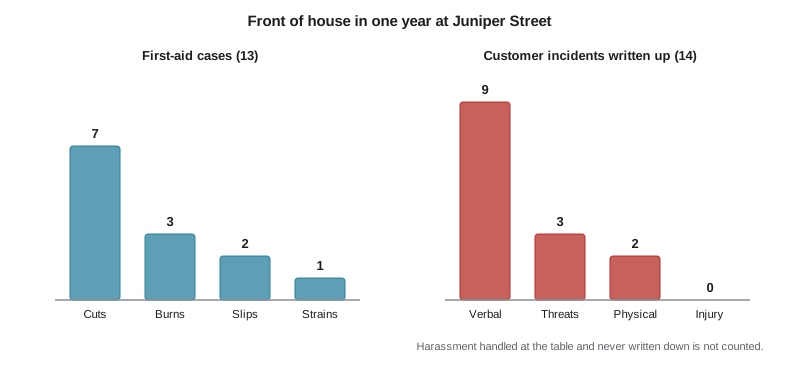
The kitchen produces more serious injuries, but the front of house produces a steady stream of smaller ones, and a few kinds of serious events that the kitchen rarely sees. Aisha Rahman, the restaurant's safety lead, went back through the injury records from the injury year used in the earlier courses and separated out everything that happened outside the kitchen. Of the 41 first-aid cases that year, 13 happened front of house:
- 7 cuts, almost all from glassware: a wine glass that snapped while being polished, a beer glass broken in the bar ice well, a chipped rim at the dish return, and a glass fragment in a bus tub.
- 3 burns: a plate handed straight from the salamander without a warning, a coffee pot knocked over at a server station, and steam from a just-opened dish machine rack of glasses.
- 2 slips: one on ice melt behind the bar, one on a spilled drink near the patio door.
- 1 strain: a server's shoulder after carrying a heavily loaded tray up the two steps to the patio.
The records also showed something the first-aid log does not capture well. Over the same year, Olivia had written up 14 incidents involving customers: 9 cases of verbal abuse or swearing at staff, 3 threats, and 2 cases of physical contact, when a guest grabbed Chloe's arm to get her attention and when a guest who had been cut off shoved Rafael at the bar. There had been several cases of customers making sexual comments to servers that were handled at the table and never written down at all. None of these produced a first-aid case, but every one of them was a hazard, and some of them could easily have produced a serious injury.
Five groups of hazards
Looking across those records and the rest of the shift, the front-of-house hazards fall into five groups. Each gets its own lessons later in the course.
- Physical handling: carrying trays and plates, hot food and drinks, broken glass, ice wells, kegs and cases of bottles, moving tables and chairs, and the stairs and steps between the dining room, the patio and the basement.
- Floors and movement: spills, ice, rain tracked in at the door, worn rugs, crowded aisles, swinging kitchen doors and dim lighting late at night.
- People: impatient, difficult, intoxicated, aggressive or harassing customers, and the occasional person who comes in from the street in crisis.
- Alcohol: the legal duties of serving it, and the way intoxication raises every other risk in the room.
- Late hours, money and the road: closing at night, carrying cash, walking to cars, delivery driving, and weather on the patio.
These hazards interact. A slip on a spilled drink is more likely at 11 p.m., when the room is crowded, the lights are low and the guest who spilled it has had four cocktails. A difficult customer is more dangerous when he is intoxicated, when the server is alone at closing, and when there is cash on the counter. The safety program has to deal with the combinations, not just each hazard on its own.
Looking at the room
Aisha and Olivia walked the front of house together one quiet Tuesday afternoon, using a floor plan to mark everything they found. They walked it in the order a server moves through a shift: front door and host stand, the dining room aisles, the server stations, the bar, the kitchen doors and pass, the patio, the restrooms, the basement stairs, the back door and the parking lot.
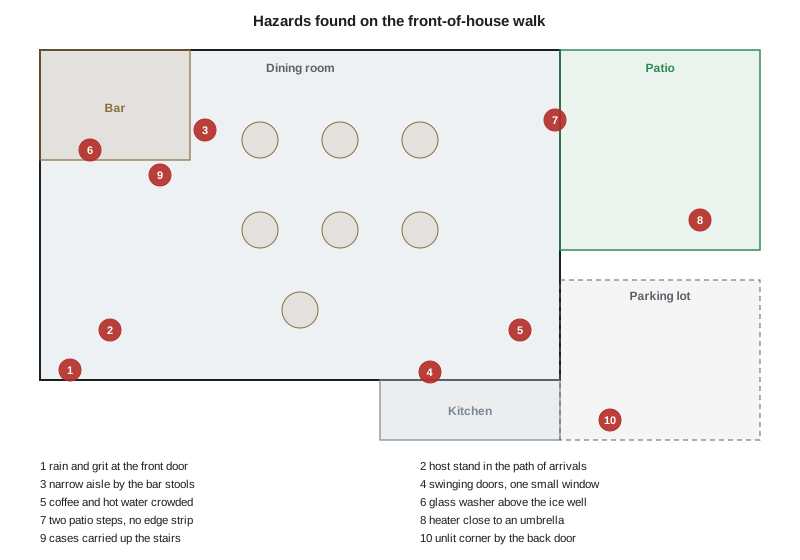
Some of the hazards were obvious once they looked. The two steps from the dining room down to the patio had no contrasting edge, so in evening light the second step disappeared, and the strain injury had happened there. The kitchen doors had a single small window, and servers coming out with full trays could not see someone coming in. The server station packed the coffee machine and the hot water tower into a corner where two people often worked back to back.
Others needed staff to point them out. Chloe showed them the narrow aisle between the large booths and the bar stools, where on busy nights guests standing at the bar backed into servers carrying plates. Nadia pointed out that the bar's glass washer sat right above the ice well, so a glass dropped while unloading could fall straight into the ice. Marcus mentioned that the corner of the parking lot by the back door had no light, and that he and Jenna parked there because it was closest to the kitchen pickup window.
Rating what they found
Juniper uses the same scoring method for every safety walk: each finding gets a severity score from 1 to 5 and a likelihood score from 1 to 5, and the product sets the timeline. A score of 15 or more is fixed today, 10 to 14 this week, 6 to 9 this month, and anything lower is noted and monitored. The front-of-house walk produced ten findings. The patio steps scored highest because they had already caused an injury and the likelihood was high on every busy evening.
Ratings are judgments, and the conversation about them is useful in itself. Olivia rated the unlit parking-lot corner as low, since nothing had happened there. Marcus disagreed: he walked through it alone at the end of every delivery shift, sometimes after midnight, often carrying cash from the few customers who still paid that way. They agreed on severity 4 and likelihood 3, a score of 12, fixed within the week with a motion-sensor light. That kind of disagreement is exactly why the people who do the work belong on the walk.
The program below
Aisha keeps the walk findings in a simple list, and the short program below sorts them by score and assigns each a deadline. The same few lines of code work for any walk, and Lesson 12 uses an extended version for the closing-shift plan.
# Score the front-of-house walk findings and sort them by priority.
findings = [
    ("patio steps, no contrasting edge", 4, 4),
    ("kitchen doors, one small window", 3, 4),
    ("server station crowded, hot water tower", 3, 3),
    ("glass washer above bar ice well", 3, 3),
    ("parking lot corner unlit", 4, 3),
    ("narrow aisle by bar stools", 2, 4),
    ("front door mat soaked in rain", 2, 3),
    ("basement stairs carrying cases", 3, 2),
    ("host stand in path of arrivals", 1, 3),
    ("patio heater close to umbrella", 4, 2),
]

def deadline(score):
    if score >= 15:
        return "today"
    if score >= 10:
        return "this week"
    if score >= 6:
        return "this month"
    return "monitor"

ranked = sorted(findings, key=lambda f: f[1] * f[2], reverse=True)
for name, sev, like in ranked:
    score = sev * like
print(f"{score:2d} {deadline(score):10s} {name}")16 today patio steps, no contrasting edge 12 this week kitchen doors, one small window 12 this week parking lot corner unlit 9 this month server station crowded, hot water tower 9 this month glass washer above bar ice well 8 this month narrow aisle by bar stools 8 this month patio heater close to umbrella 6 this month front door mat soaked in rain 6 this month basement stairs carrying cases 3 monitor host stand in path of arrivals
The output gives the order of work. Two items scored 16 and 12 and had to move fast; most of the rest were handled within the month. Not every fix cost money. The kitchen doors got a rule that you always come out through the right-hand door and go in through the left, plus a second, larger window ordered for the next door replacement. The host stand was moved about 60 cm (2 ft) to the side of the entrance. The patio steps got a bright, slip-resistant edge strip on each nose and a small sign, and the strain injury did not repeat.
The law behind front-of-house safety
In British Columbia, the Workers Compensation Act and the Occupational Health and Safety Regulation apply to the whole restaurant, not just the kitchen. The employer must identify and control hazards, train and supervise workers, and involve the joint health and safety committee. Several parts of the Regulation are written with the front of house in mind: the sections on workplace violence (sections 4.27 to 4.31), on working alone or in isolation (sections 4.20.1 to 4.23), and WorkSafeBC's policies on bullying and harassment. Liquor service adds a second set of rules under the Liquor Control and Licensing Act, enforced by the Liquor and Cannabis Regulation Branch, and Lessons 5 and 6 cover those.
Whatever the law, the most important tool is the same: a manager and staff who notice hazards, talk about them, and fix them. Juniper's joint committee in British Columbia, and its voluntary safety committee in Savannah, both include Nadia as the front-of-house member, so servers and bartenders have someone to raise concerns with who works the same shifts they do.
Summary and key terms
- Front-of-house workers face hazards that are different from the kitchen's: handling, floors, people, alcohol, late hours, cash and the road.
- At Juniper Street, 13 of 41 first-aid cases happened front of house, mostly glass cuts, and the manager wrote up 14 customer incidents in the same year.
- The hazards interact: crowding, low light, intoxication, working alone and cash on hand make each one worse.
- A walk of the front of house in the order a server moves, with staff who work there, finds hazards a manager alone will miss.
- Findings are scored by severity times likelihood, and the score sets the deadline: today, this week, this month or monitor.
- Front of house
- The parts of a restaurant open to guests, and the staff who work there: dining room, bar, patio, host stand and delivery.
- Customer incident
- An event in which a guest abuses, threatens, harasses or uses force on a worker, whether or not anyone is hurt.
- Safety walk
- A planned walk through the workplace to find and record hazards, usually with a manager and workers together.
- Risk score
- Severity multiplied by likelihood, each on a 1 to 5 scale, used to rank findings and set deadlines.
- Manager on duty
- The person in charge of a shift, who handles complaints, incidents, cash and the close.
Pre-shift meetings
Juniper's front-of-house team meets for ten minutes before every dinner service. Olivia covers the reservations, large parties, specials and anything the kitchen is short of, and then spends a minute or two on safety: a hazard someone noticed yesterday, a reminder about the code word, the weather for the patio, a guest who was banned last week. Servers can raise anything they have seen. Over a year those few minutes add up to more safety discussion than any single training day, and they keep hazards in front of people while they are still fresh.
Common mistakes
MistakeSafety training is for the kitchen; servers and bartenders only need customer service training.
InsteadFront-of-house workers have their own injuries and their own serious risks, especially from people, alcohol and late hours, and need their own safety training.
MistakeIf nobody filled in a first-aid report, nothing happened.
InsteadCustomer threats, harassment and near misses rarely produce first-aid cases but are hazards that must be recorded and dealt with.
MistakeThe manager can rate the hazards alone.
InsteadThe people who work in an area know where things go wrong; include them in the walk and in the ratings.
Practice problems
Work each problem on paper first, then reveal the answer to check.
Name three ways a busy Saturday night makes front-of-house hazards worse than a quiet weekday lunch.
Show answer
Crowded aisles and bar, lower lighting, more intoxicated guests, more rushing, more broken glass and spills, and staff working later and more tired.
A finding has severity 3 and likelihood 4. When must it be fixed?
Show answer
The score is 12, so it must be fixed this week.
Why did Marcus rate the unlit parking-lot corner higher than Olivia?
Show answer
He walks through it alone late at night, sometimes with cash, so he knew the exposure and the potential for serious harm better than someone who rarely goes there.
Lesson quiz · 5 questions
Score 60% or more to complete this lesson.
Create a free account to save your progress, take quizzes and earn a certificate.