
HSE-383 · Lesson 2 of 12 · 16 min
Trays, hot plates and broken glass
▶ Video coming soon A video version of this lesson is on the way.
A server on a busy shift covers a long distance on foot, carries hundreds of plates and glasses, and spends much of the night with one arm holding weight away from the body. Most of the time nothing goes wrong. When something does, it is usually one of three things: a tray or a stack of plates that is too heavy or badly balanced, something hot that the server did not know was hot, or glass. At Juniper Street those three caused 11 of the 13 front-of-house first-aid cases in the injury year. This lesson covers how to carry safely, how hot plates and drinks burn people, and how to handle glass from the rack to the recycling bin, including the one situation every bartender dreads: glass in the ice.
How much weight is on a tray
A large oval serving tray, about 70 by 55 cm (27 by 22 in), is designed to carry a full table's mains in one trip. Loaded, it can weigh far more than most people expect. A dinner plate weighs about 0.8 kg (1.8 lb) empty and 1.2 to 1.5 kg (2.6 to 3.3 lb) with food. Six plates and the tray itself come to roughly 9 kg (20 lb), held at shoulder height on one hand and balanced over a crowd of chairs. A bar tray of eight pints is lighter but less stable: each full pint weighs about 0.7 kg (1.5 lb), and liquid slops when the server turns.
The weight on its own is not usually what injures people. It is weight held away from the body, at shoulder height, repeated dozens of times a night, often while twisting to set plates down or stepping through a crowd. That combination strains the shoulder and wrist. The patio strain at Juniper happened when a server carried a fully loaded oval tray up the two steps from the patio while turning sideways to get past a guest.
Carrying trays well
Good tray technique is mostly about keeping the load close and centred.
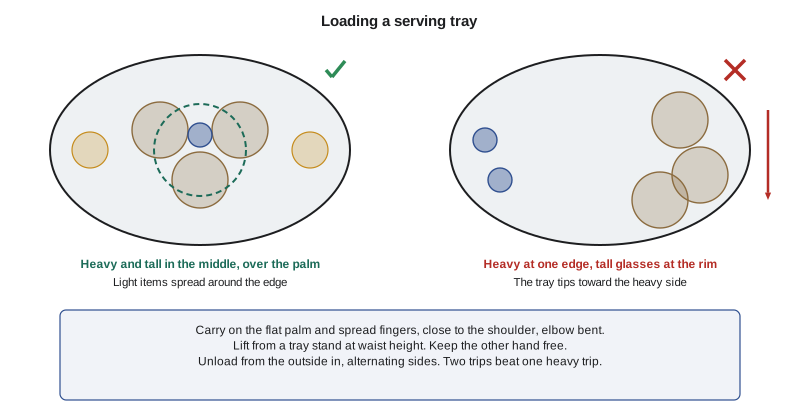
- Load the heaviest items and the tallest glasses in the centre, over the hand. Spread the rest evenly around them. Unload from the outside in, alternating sides, so the balance shifts gradually.
- Carry on the flat of the palm and spread fingers, not on the fingertips. Keep the tray close to the shoulder with the elbow bent, so the weight sits over your own centre of gravity rather than out at arm's length.
- Lift a loaded tray from a tray stand or a counter at waist height, never from the floor. Bend your knees and bring your shoulder under the tray before you lift.
- Keep the other hand free to open doors, steady yourself on steps and warn guests.
- If the load is too heavy, take two trips or ask a busser to carry the second tray. Juniper sets a house limit of six mains on the large tray.
- Say where you are. A quiet "behind you" or "coming through" at a guest's shoulder prevents most collisions.
Plates carried by hand follow the same logic. Most servers carry two or three plates, with the third balanced on the forearm. Carrying four or five at once looks impressive and causes most of the dropped plates in the dining room. Juniper trains servers to carry three plates at most, with a runner for larger tables.
Hot plates
A dinner plate that has been under the salamander or in a plate warmer can be 70 to 90 °C (160 to 195 °F) at the rim, hot enough to burn skin in a few seconds of contact. Cast iron skillets, sizzling platters and stone bowls are hotter still, sometimes well above 200 °C (390 °F) when they leave the kitchen, and they stay dangerously hot for many minutes.
The burn at Juniper happened when a cook slid a plate of gratin straight from the salamander onto the pass without saying anything. The server picked it up bare-handed and burned three fingers. The fix was simple and has stuck: anything that came out of the salamander or the oven, or anything on cast iron, goes to the pass on a liner plate or with a folded service cloth under it, and the cook says "hot plate" as it goes up. The server says "hot plate" again at the table and warns the guest not to touch the dish.
- Use a dry service cloth, folded twice, to pick up hot plates and skillets. A wet cloth conducts heat and turns to steam in your hand.
- Put cast iron and sizzling platters on wooden or heat-resistant underliners, never directly on the table, and set them down in front of an adult, never a child.
- Warn every guest at the table, not just the one who ordered.
Hot drinks and the server station
Coffee in a pot on a warmer is around 80 to 85 °C (175 to 185 °F), and tea water from the hot water tower can be close to boiling. A spilled pot causes a scald over a large area of skin, and spills onto guests, especially children, are among the most serious burns a restaurant causes. Juniper's server station packs the coffee machine and the hot water tower into a corner, and the coffee pot burn happened when two servers turned at the same moment.
The fixes included moving the hot water tower to the far end of the station, a rule that only one person works at the coffee machine at a time, and pouring coffee and tea at the station rather than carrying full pots through the dining room. Servers never pour hot drinks over a guest's shoulder or reach across a child, and teapots go down with the handle toward the guest and the spout away.
Glassware
Glass caused seven of the thirteen front-of-house first-aid cases, and every one of them happened in a predictable place: polishing, the glass washer, the ice well, the bus tub and the dish return.
- Inspect glasses as you polish or stock them. A chip on a rim cuts lips and fingers; a crack in the bowl lets a wine glass snap in the hand. Discard any damaged glass straight into the broken glass container, never back on the shelf.
- Hold wine glasses by the base and bowl when polishing, never by twisting the bowl against the stem, which is how the stem snaps.
- Let racks from the glass washer cool for a minute before unloading. Hot glass is more likely to crack when it touches cold ice or cold liquid, and the steam that escapes when the door opens can scald.
- Never stack glasses inside each other. Tumblers jam and break when pulled apart.
- Bus glasses upright in a separate rack or tub, not mixed with plates and cutlery, so nobody reaches blindly into a tub of broken glass.
When glass breaks
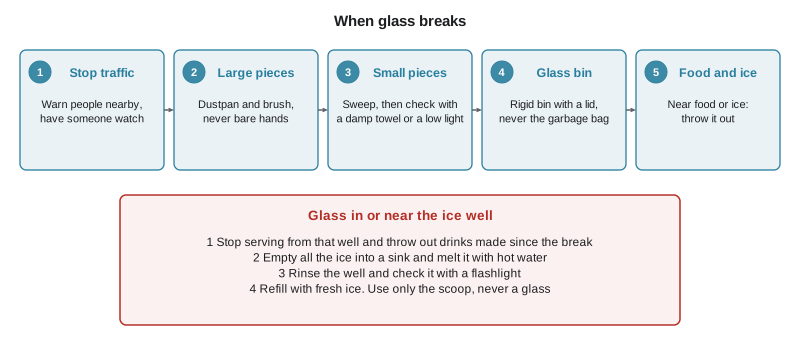
When a glass breaks on the floor or a table, the response has a fixed order. First, stop people walking through it: warn the guests nearby and tell another staff member to watch the area. Then pick up the large pieces with a dustpan and brush, never with bare hands, and sweep the small fragments. Use a damp paper towel or a flashlight held low across the floor to find the slivers that the brush misses. Put everything in the broken glass container, a rigid, labelled bin with a lid that is kept separate from the garbage so that nobody tying up a garbage bag gets cut.
Glass in the ice well
The worst glass breakage in a bar is in the ice well. Ice is clear, glass is clear, and a sliver of glass scooped into a drink can cut a guest's mouth or be swallowed. There is no safe way to pick glass out of ice. If a glass breaks in or over the ice well, or if anyone thinks it might have, the bartender stops serving from that well immediately, empties all of the ice into a sink and melts it with hot water, which bartenders call burning the ice, then rinses the well, checks it with a flashlight, and refills it with fresh ice. Any drinks made from that well since the breakage are thrown out.
Nadia's bar had two habits that made glass in the ice more likely, and both were changed. Glasses were scooped into the ice to chill them, and the glass washer was right above the well. Now the bar uses only the metal ice scoop, never a glass, and the scoop is stored in a holder outside the ice, and racks of clean glasses are unloaded onto the back counter, never over the well.
Tracking tray loads
To set the house limit for the large tray, Aisha weighed the plates and glasses in the kitchen and wrote a short program that adds up the load for a typical order. The program below uses Juniper's measured weights.
# Estimate the weight of a loaded serving tray (kilograms).
weights = {
    "tray (large oval)": 1.4,
    "main course plate": 1.3,
    "pasta bowl": 1.1,
    "side plate": 0.5,
    "pint of beer": 0.7,
    "wine glass, poured": 0.35,
}

order = [("main course plate", 6), ("side plate", 2)]
total = weights["tray (large oval)"]
for item, count in order:
    total += weights[item] * count
print(f"Loaded tray: {total:.1f} kg")

limit = 10.0
for mains in range(4, 9):
    load = weights["tray (large oval)"] + mains * weights["main course plate"]
    status = "OK" if load <= limit else "too heavy, use two trays"
print(f"{mains} mains: {load:.1f} kg {status}")Loaded tray: 10.2 kg 4 mains: 6.6 kg OK 5 mains: 7.9 kg OK 6 mains: 9.2 kg OK 7 mains: 10.5 kg too heavy, use two trays 8 mains: 11.8 kg too heavy, use two trays
Six mains on the large tray stays under Juniper's limit; seven does not. The limit is a house rule based on the weights and the shoulder injury, not a legal number. Ergonomics research does not give a single safe tray weight, because it depends on the server, the distance, the stairs and how many times a night the lift is repeated, so the house limit is a reasonable line that the team agreed on.
Kegs, cases and the basement stairs
Rafael, the barback, does the heaviest lifting in the front of house. A full standard keg weighs about 73 kg (160 lb), a case of 24 bottles about 16 kg (35 lb), and a bin of ice about 15 kg (33 lb). Juniper's kegs live in the walk-in cooler, so they are moved on a keg dolly and never carried. Cases of bottles come up the basement stairs, and the rule is one case at a time, held close, with one hand free for the handrail. Ice is carried in buckets filled half full rather than in full bins, and never carried up the patio steps in the dark.
Summary and key terms
- Trays, hot plates and glass cause most front-of-house first-aid cases.
- Load the heaviest and tallest items in the centre of the tray, carry it close to the shoulder on the flat palm, and take two trips rather than overload it.
- Hot plates, cast iron and sizzling platters are announced by the cook and the server, carried with a dry cloth and set down in front of adults.
- Inspect glassware as you handle it, discard chipped or cracked glasses, and keep glass out of bus tubs mixed with plates.
- Broken glass is cleared with a dustpan and brush into a rigid broken glass bin; glass in or near the ice well means the whole well is emptied, melted and refilled.
- Burning the ice
- Emptying an ice well and melting the ice with hot water after a possible glass breakage.
- Broken glass container
- A rigid, labelled, lidded bin kept separate from the garbage for broken glass.
- Liner plate
- A plate or board placed under a hot dish so it can be carried and set down safely.
- Tray stand
- A folding stand that holds a loaded tray at waist height for loading and unloading.
- Ice scoop
- The metal or plastic scoop used to fill glasses with ice; glasses are never used as scoops.
Footwear and the floor
Most of what a server carries ends up on the floor at some point: ice, drinks, sauces, butter, water from the dish return. Juniper requires closed, slip-resistant shoes for every front-of-house shift, the same rule as the kitchen, and the managers check new hires' shoes on their first day. Spills are cleaned or guarded immediately by whoever sees them, not left for the busser; a server who cannot stop puts a chair or a wet-floor sign over the spill and tells the nearest colleague. Behind the bar, rubber mats with drainage holes keep the bartender's feet out of standing ice melt, and they are lifted and cleaned at every close.
Common mistakes
MistakeScooping ice with a glass is faster on a busy night.
InsteadA glass can chip or break in the ice; always use the scoop and store it outside the ice.
MistakeIf a small piece of glass falls in the ice well, pick it out and carry on.
InsteadYou can never be sure you found every piece; stop serving from that well, empty it, melt the ice and refill.
MistakeA wet cloth protects your hand from a hot plate.
InsteadA wet cloth conducts heat and can turn to steam; use a dry cloth folded twice.
Practice problems
Work each problem on paper first, then reveal the answer to check.
How should a server load a tray with four mains, two tall cocktails and two side plates?
Show answer
Mains and the tall cocktails in the centre over the palm, side plates spread around the edge to balance, and unload from the outside in, alternating sides.
A glass slips while Nadia is unloading the glass washer and she hears it hit the edge of the ice well. What does she do?
Show answer
Stop serving from that well, throw out any drinks made since, empty all the ice into the sink and melt it with hot water, rinse and inspect the well with a light, and refill with fresh ice.
Why must broken glass go in a separate bin rather than the garbage?
Show answer
Glass in a garbage bag cuts whoever ties, carries or compresses the bag; a rigid, labelled bin keeps it contained.
Lesson quiz · 5 questions
Score 60% or more to complete this lesson.
Create a free account to save your progress, take quizzes and earn a certificate.