
HSE-383 · Lesson 10 of 12 · 16 min
Patios, heaters and outdoor service
▶ Video coming soon A video version of this lesson is on the way.
Juniper Street's patio seats 48 guests from May to September, and on a warm evening it is the busiest section of the restaurant. It is also the part of the restaurant most exposed to things nobody controls: sun, heat, wind, rain, lightning, wasps and the dark. On a windy evening last spring, a gust caught a patio umbrella that had been left open, lifted it out of its base and pushed one of the propane heaters over onto the paving. The heater's tip-over switch shut off the gas, the umbrella landed on an empty table, and nobody was hurt. It was a near miss, and it led to the patio rules in this lesson.
The patio as a workplace
Servers on the patio carry trays farther, often over uneven paving and up or down steps, and in and out of a door that guests also use. They work in direct sun at midday and in the dark at night. The server station outside is smaller than the one indoors, with less room to set down a tray. Lesson 1's walk found three patio hazards: the steps from the dining room with no contrasting edge, a heater placed too close to an umbrella, and an extension cord for the patio lights that ran across a walkway. The steps got edge strips, the heater was moved, and an electrician installed a weatherproof outdoor receptacle with ground fault protection so the cord was no longer needed.
- Keep aisles at least wide enough for a server with a tray to pass a seated guest, and keep chairs from creeping into them as the evening goes on.
- Check the paving each morning for loose or lifted stones, puddles and debris, and report anything that needs repair.
- Use the patio door marked for staff when it is busy, and never prop the door open with a chair.
- Carry fewer plates per trip when the route includes steps, and never carry a full tray up or down the steps with both hands.
Sun and heat
On a summer afternoon the patio can be several degrees hotter than the shade, and the paving radiates heat back up. HSE-380 used the humidex to show how heat stress builds in the kitchen; on the patio, the same reading on a sunny July afternoon was 27 °C at 55% humidity, a humidex of about 32, enough to cause discomfort and to need water and breaks over a long shift. Sun adds UV exposure: servers spend hours outside in the strongest sun of the day.
- Water at the patio server station, and a rule that servers drink regularly, not only when thirsty.
- Shade over the server station, and the option to rotate servers between the patio and indoor sections on the hottest days.
- Sunscreen provided by the restaurant, and hats and sunglasses allowed as part of the uniform on the patio.
- Light, breathable uniform shirts for patio shifts.
- Watching each other for the signs of heat illness: heavy sweating, dizziness, headache, nausea, confusion. Anyone with those signs goes inside to a cool place, drinks water and tells the manager; confusion or collapse means calling 911.
Wind, rain and storms
Weather changes fast, and the patio needs clear rules so nobody has to make a judgment call in the middle of a rush. Juniper's rules, written after the umbrella incident, are posted at the patio server station and in the manager's closing binder.
- Umbrellas are closed whenever the patio is not being used, and every umbrella sits in a weighted base rated for its size.
- When sustained wind reaches about 30 km/h (20 mph), or gusts reach about 40 km/h (25 mph), umbrellas are closed and the heaters are turned off, whatever the guests prefer.
- Rain makes the paving and the steps slippery. Mats go down at the patio door, and servers slow down.
- Thunder means lightning is close enough to strike. When thunder is heard, the patio is cleared: guests are offered tables inside or a place to wait, and staff go inside too. Nobody goes back out until 30 minutes after the last thunder. The saying is simple: when thunder roars, go indoors.
Victoria's weather is milder than most of Canada's, but strong winds come off the water, especially in spring and autumn, and the patio's open position makes it windy even on calm days.
Olivia checks the forecast before each patio shift, and the manager on duty checks a weather app with radar on any evening when storms are possible. The program below is the simple decision rule Juniper uses.
# Patio decision: close umbrellas and heaters for wind, clear the patio for thunder.
def patio_status(wind_kmh, gust_kmh, minutes_since_thunder, raining):
    if minutes_since_thunder is not None and minutes_since_thunder < 30:
        return "CLEAR THE PATIO: everyone inside until 30 min after the last thunder"
    actions = []
    if wind_kmh >= 30 or gust_kmh >= 40:
        actions.append("close umbrellas, heaters off")
    if raining:
        actions.append("mats at the door, slow down on steps")
    return "; ".join(actions) or "normal service"

checks = [
    ("6:00 p.m.", 12, 20, None, False),
    ("7:30 p.m.", 28, 42, None, False),
    ("8:15 p.m.", 18, 25, None, True),
    ("9:00 p.m.", 22, 35, 5, True),
    ("9:40 p.m.", 15, 22, 45, False),
]
for when, wind, gust, thunder, rain in checks:
print(f"{when}: {patio_status(wind, gust, thunder, rain)}")6:00 p.m.: normal service 7:30 p.m.: close umbrellas, heaters off 8:15 p.m.: mats at the door, slow down on steps 9:00 p.m.: CLEAR THE PATIO: everyone inside until 30 min after the last thunder 9:40 p.m.: normal service
The 7:30 p.m. gust was enough on its own to close the umbrellas, even though the average wind was below the limit. At 9:00 p.m., thunder five minutes earlier overrode everything else, and the patio stayed closed until well after the storm had passed.
Propane patio heaters
Juniper uses four tall propane patio heaters on spring and autumn evenings. Each one runs on a 9 kg (20 lb) propane cylinder in its base, the same size used for barbecues. They are safe when they are used as designed, and dangerous when they are not.
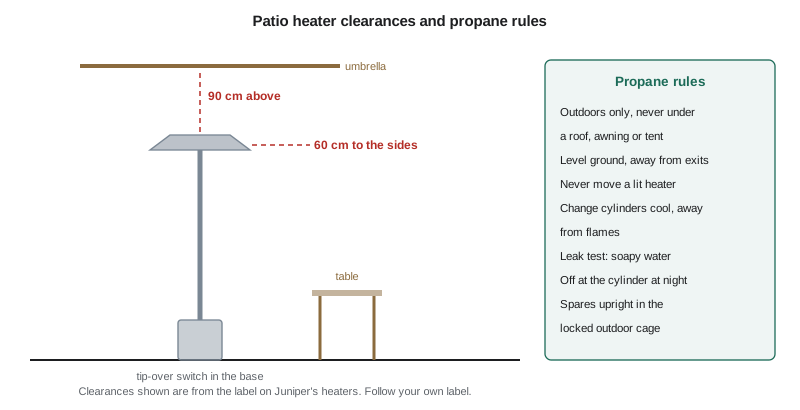
- Outdoors only. Propane heaters burn fuel and produce carbon monoxide; they are never used indoors, in a tent, or under a roof, awning or enclosure that traps the exhaust.
- Clearances. Each heater has a label giving the minimum distances to anything that can burn. For Juniper's model, that is about 90 cm (3 ft) above the top reflector and about 60 cm (2 ft) to the sides. Umbrellas, awnings, tablecloths, menus and guests' coats must stay outside that space.
- Level and stable. Heaters stand on level paving, away from doorways, exits and busy walkways, and are never moved while lit. Each has a tip-over switch that shuts off the gas if it falls; that switch is tested each spring.
- Lighting and shutting off. Only trained staff light or turn off heaters, following the instructions on the unit. At the end of the night the valve on the cylinder is closed, not just the heater control.
- Changing cylinders. Cylinders are changed with the heater off and cool, outside and away from any flame. After connecting a new cylinder, the connection is checked with soapy water: bubbles mean a leak, and the cylinder is closed and the connection redone or the heater tagged out of service. Nobody uses a flame to check for leaks.
- Storage. Spare cylinders are stored upright in the locked, ventilated propane cage outside, away from exits and doors, never inside the building, in the basement or in a car.
In British Columbia, propane storage and appliances are covered by the CSA B149 codes adopted under provincial regulation, and the BC Fire Code limits how and where cylinders are stored. The Victoria Fire Department can inspect the patio and the propane cage, and the restaurant's insurer asked to see the cage and the heaters' certification labels after the umbrella incident.
Candles, insects and smoking
Three smaller hazards round out the patio. Candles on tables are in enclosed holders that will not spill, and are kept away from menus, napkins and umbrellas; the patio candle that started a small tablecloth fire last year is in the fire log from HSE-382. Wasps and bees are attracted to sweet drinks and food on summer afternoons; staff clear plates and spilled drinks quickly, keep garbage bins covered, and any staff member or guest with a known sting allergy should tell the manager and keep their epinephrine auto-injector close. Juniper's patio is non-smoking and non-vaping.
British Columbia's tobacco and vapour law bans smoking and vaping on restaurant patios and within 6 m of doors, open windows and air intakes, so the rule is the law as well as house policy.
Darkness
As the evening goes on, the patio gets darker than the dining room. String lights and low path lights now light the steps and the aisles, and the steps' edge strips help. Servers carry a small flashlight for reading tabs and checking the paving, and the last patio walk at closing, to collect glasses and turn off the heaters, is done by two people, as Lesson 8 requires.
Summary and key terms
- The patio adds longer carries, uneven paving, steps, a shared door and exposure to sun, heat, wind, rain, lightning and darkness.
- Provide water, shade, sunscreen and rotation for heat, and watch for the signs of heat illness.
- Close umbrellas and turn off heaters in strong wind or gusts, and clear the patio at the first thunder until 30 minutes after the last.
- Propane heaters are used only outdoors, with the label clearances, on level ground, with tip-over switches tested; cylinders are changed cool and leak-checked with soapy water, and stored upright in an outdoor cage.
- Candles in enclosed holders, quick clearing for wasps, a non-smoking patio and good lighting finish the job.
- Tip-over switch
- A safety device that shuts off the gas if a heater falls over.
- Clearance to combustibles
- The minimum distance between a heater and anything that can burn, given on the heater's label.
- Soapy water leak test
- Brushing soapy water on a gas connection; bubbles show a leak.
- Propane cage
- A locked, ventilated outdoor enclosure for storing propane cylinders upright.
- Thirty-minute rule
- Staying indoors until 30 minutes after the last thunder is heard.
Children and pets on the patio
Patios attract families and, in many places, guests with dogs. Children run between tables, and dogs lie in aisles where servers walk with hot plates. Juniper seats families with young children away from the patio steps and the heaters where possible, asks guests to keep dogs under their table on a short leash, and never lets a heater stand where a child could reach it or knock it. Hot drinks and sizzling dishes go down in front of adults, as in Lesson 2. Water bowls for dogs are placed at the edge of the patio, not in the walkway.
Smoke and air quality
In recent summers, wildfire smoke has drifted over southern Vancouver Island on some days, sometimes for a week or more. Juniper checks the air quality health index on smoky days, closes the patio when the index reaches the high-risk range, and lets any server with asthma or another breathing condition work indoors. The same reasoning applies to heat: the patio is a workplace, and on some days the right decision is to close it.
Closing the patio at night
At the end of the night the patio is closed in a fixed order: guests are moved inside or settled up, heaters are turned off at the control and then at the cylinder, umbrellas are closed and tied, cushions and menus are brought in, candles are put out and collected, and glasses and garbage are cleared so they do not attract animals or blow around overnight. Two people do the patio close together, and the patio gate is locked behind them.
Inspecting the patio each season
Before the patio opens for the season, the safety committee walks it with a short checklist: paving and steps, railings, lighting, umbrellas and their bases, heaters and their tip-over switches, the propane cage, the outdoor receptacle and its ground fault protection, first-aid supplies at the patio station and the route to the nearest exit. Anything found is fixed before the first guests sit down.
Insects and stings
A staff member stung on the patio removes the stinger by scraping it out with a fingernail or card, washes the area and applies a cold pack. Signs of a serious allergic reaction, such as swelling of the face or throat, trouble breathing or widespread hives, mean calling 911 and using an epinephrine auto-injector if the person has one, as Lesson 11 describes.
Common mistakes
MistakeMove a lit heater a little closer to a cold table.
InsteadNever move a lit heater; turn it off, let it cool, then move it to a safe spot.
MistakeUse a lighter to find a propane leak.
InsteadUse soapy water; never a flame.
MistakeGuests can finish their drinks outside if the thunder is far away.
InsteadIf thunder can be heard, lightning can strike; clear the patio until 30 minutes after the last thunder.
Practice problems
Work each problem on paper first, then reveal the answer to check.
A guest asks for a heater to be moved under the awning because it is raining. What should the server say and do?
Show answer
Explain politely that heaters cannot be used under the awning because of the fire and carbon monoxide risk, and offer a table inside or a spot under the awning without a heater.
What three things does a staff member check after connecting a new propane cylinder?
Show answer
That the heater was off and cool before changing, that the connection is tight, and that a soapy water test shows no bubbles; then the heater can be lit following the instructions.
Why are umbrellas closed whenever the patio is not in use?
Show answer
An open umbrella can be lifted by a gust, injure people, knock over heaters and start a chain of damage, as happened in the near miss.
Lesson quiz · 5 questions
Score 60% or more to complete this lesson.
Create a free account to save your progress, take quizzes and earn a certificate.