
HSE-361 · Lesson 7 of 12 · 20 min
Wood dust, noise, fumes from 3D printers and laser cutters, and shop housekeeping
Not every shop hazard is as obvious as a spinning blade. Fine wood dust drifting through the air, the steady noise of a planer, and the faint smell from a row of 3D printers can harm health slowly, over months and years, without a single dramatic incident. Teachers who spend their careers in shops are especially exposed, because they breathe the air and hear the noise for six hours a day, every school day, for decades. This lesson covers these health hazards and the housekeeping that keeps a shop safe and healthy.
Wood dust
Sawing, sanding, routing and planing wood produce dust in a range of sizes. Larger chips fall to the floor quickly, but the finest particles stay in the air for a long time and can be breathed deep into the lungs. Wood dust can cause:
- Irritation of the eyes, nose and throat, and nosebleeds.
- Skin rashes and allergic reactions, especially from some tropical hardwoods.
- Asthma and other breathing problems, which can develop after months or years of exposure and then be triggered by small amounts.
- Cancer of the nose and sinuses. Wood dust is classified as a known human carcinogen by the International Agency for Research on Cancer, with the strongest evidence for hardwood dust.
Sanding produces the finest dust and is often the biggest source of exposure in a school shop, especially hand-held power sanding. Medium-density fibreboard (MDF), popular in school projects because it is cheap and easy to cut, produces very fine dust and contains resins, so it needs the same or better dust control as hardwoods.
Wood dust is also a fire and explosion hazard. Fine dust that builds up on ledges, light fixtures and inside ducts can burn rapidly if it is disturbed and ignited, and dust collectors are a known site of fires in woodworking shops.
Controlling dust
The hierarchy of controls applies directly:
- Choose materials and processes that make less dust, such as softwoods and sheet goods that cut cleanly, and avoid sanding where a hand plane or scraper will do.
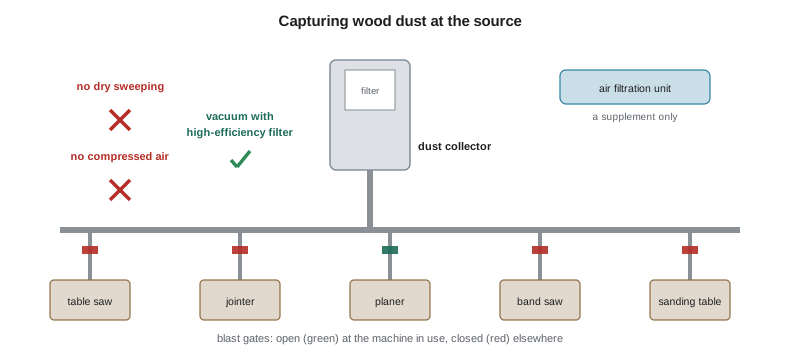
- Capture dust at the source with local exhaust: a dust collection system with hoods or ports on every major machine, and sanders connected to a shop vacuum or dust extractor.
- Make sure the collection system works: blast gates open at the machine in use and closed elsewhere, ducts free of leaks and blockages, bags or filters emptied before they are full, and airflow checked regularly.
- Use air filtration units to catch fine dust that escapes, as a supplement, not a replacement, for collection at the source.
- Clean with a vacuum fitted with a high-efficiency filter or by wet methods, never by dry sweeping or blowing dust off with compressed air, which puts fine dust back into the air.
- Use respirators, such as a fitted N95-type or better, for short tasks where dust cannot be controlled otherwise, with a proper respiratory protection program for staff.
Ontario sets occupational exposure limits for wood dust, with a lower limit for certain hardwoods, and the board has arranged air sampling in its shops to check exposures. When sampling at Pinecrest Secondary School showed that sanding in the wood shop pushed exposures close to the limit, the board added downdraft sanding tables connected to the dust collector and replaced two old sanders with models that connect to extractors.
Noise
Shop machines are loud. Planers, table saws, routers and some sanders commonly produce noise levels above 90 decibels (dBA) at the operator's position, and a room with several machines running at once can be loud even for people standing away from them. Long-term exposure to noise above about 85 dBA causes permanent hearing loss and tinnitus, a ringing in the ears that may never go away. Students in shop classes are exposed for shorter periods, but teachers are exposed for their whole careers.
Ontario's noise regulation sets a limit of 85 dBA averaged over an 8-hour day, with a 3 dB exchange rate, which means that each increase of 3 dBA halves the allowed exposure time. Employers must reduce noise with engineering controls where they can and provide hearing protection where exposures exceed the limit.
The program below estimates how long a person could work near a machine at different noise levels before reaching the daily limit, using an 85 dBA limit and a 3 dB exchange rate.
# Allowed daily exposure time at different noise levels (85 dBA criterion, 3 dB exchange rate).
def allowed_hours(level_dba, criterion=85, exchange=3):
    return 8 / 2 ** ((level_dba - criterion) / exchange)

for name, level in [("shop with no machines running", 70), ("band saw", 88), ("table saw", 94),
                    ("thickness planer", 100), ("router", 103)]:
    h = allowed_hours(level)
    t = f"{h:.1f} h" if h >= 1 else f"{h * 60:.0f} min"
print(f"{name:30} {level:3d} dBA -> {t}")shop with no machines running 70 dBA -> 256.0 h band saw 88 dBA -> 4.0 h table saw 94 dBA -> 1.0 h thickness planer 100 dBA -> 15 min router 103 dBA -> 8 min
At the levels typical of a planer or router, the daily allowance is measured in minutes, not hours. That is why hearing protection is worn whenever those machines run, by everyone near them, not just the operator.
Noise controls include choosing quieter machines and blades, maintaining machines so they do not rattle or squeal, enclosing or isolating the loudest machines, running the loudest machines one at a time, and keeping the doors to adjoining classrooms closed. Hearing protection, earplugs or earmuffs, is required where noise cannot be reduced enough, and students need to be shown how to insert earplugs properly, since a poorly fitted plug may give little protection.
Fumes from 3D printers and laser cutters
Desktop 3D printers that melt plastic filament release ultrafine particles and volatile organic compounds (VOCs), with emissions varying by filament type and temperature. ABS filament, which prints at higher temperatures, generally releases more than PLA. Research on the long-term health effects is still developing, but organizations such as NIOSH have recommended that printers be used in well-ventilated areas, ideally with enclosures and local exhaust, that people not sit beside running printers for long periods, and that lower-emitting filaments be chosen where they meet the project's needs.
Laser cutters vaporize the material they cut, producing smoke and fumes that must be exhausted outdoors or through a filter system designed for the materials. Some materials must never be cut with a laser: PVC and vinyl, for example, release corrosive and toxic chlorine compounds when cut. A posted list of approved and banned materials beside every laser cutter is a simple and effective control.
At Pinecrest Secondary School, the 3D printers were originally lined up along the back of the library. After staff complained of headaches and a smell, the board moved them into an enclosed cabinet with exhaust in the technology wing and switched to PLA filament for general use.
Finishes, adhesives and solvents
Shop projects are often finished with stains, varnishes, lacquers and paints, and assembled with adhesives. Many of these contain solvents that are flammable and can cause headaches, dizziness and, with repeated exposure, longer-term health effects. Water-based finishes and adhesives are available for most school uses and are much safer. Where solvent-based products are used, they need good ventilation or a spray booth, no ignition sources nearby, and storage in a flammables cabinet. Rags soaked in some oil-based finishes, such as linseed oil, can heat up and catch fire on their own as the oil dries, so they must be laid flat to dry outdoors or stored in a closed metal container filled with water, then disposed of safely.
Housekeeping
A clean shop is a safer shop. Offcuts and sawdust on the floor cause slips and trips, clutter around machines crowds the operator, and dust on ledges feeds fires. Good housekeeping in a school shop means:
- Clear, marked aisles and work zones around each machine.
- Offcuts removed from machine tables and the floor throughout the class, with a scrap bin near each machine.
- Cleanup time built into every class, done with vacuums rather than brooms or compressed air.
- Material stored in racks, not leaning against walls where it can fall.
- Regular cleaning of high ledges, light fixtures and ductwork to remove settled dust.
- Spills of oil or finish cleaned up immediately.
Victor's custodial crew does the deep cleaning of high surfaces and floors on a schedule agreed with the shop teachers, and they use a vacuum with a high-efficiency filter, not the brooms they use elsewhere in the school.
Worked problem
Dust in the air at the end of class
Greg notices a haze of fine dust in the wood shop near the end of a class where students have been sanding MDF with hand-held sanders. Some students are coughing. What should he do now and in the longer term?
Show solution
- Stop the sanding, open the blast gate to the downdraft table, and switch on the air filtration unit if it is not already running.
- Have students clean up with the shop vacuum rather than brushing dust off their projects with their hands or compressed air.
- Check the dust collector bag and filter: a full bag or clogged filter reduces suction at every machine.
- For future classes, connect the hand sanders to an extractor, move sanding to the downdraft table, and limit how many students sand at once.
- Ask Daniel to arrange air sampling to measure exposure, and keep a note of the coughing in case any student has asthma.
Answer: Stop the dust source, turn on capture and filtration, clean with a vacuum, check the collector, and redesign sanding with extraction and a downdraft table, then measure exposures.
Handling materials and vibration
Shop work also brings ergonomic hazards that are easy to overlook. Full sheets of plywood and MDF are heavy and awkward, and carrying one alone, especially in a crowded shop, strains backs and shoulders and can knock into other people or machines. Sheet goods should be carried by two people or moved on a panel cart, and breaking them down into smaller pieces with a track saw or panel saw near the storage rack reduces how often full sheets are moved. Lumber racks should be at a height that does not require lifting long boards overhead, and heavy items should be stored between knee and shoulder height.
Hand-held power tools such as sanders, grinders, jigsaws and impact drivers transmit vibration into the hands and arms. Long-term, frequent use can cause hand-arm vibration syndrome, with numbness, tingling and blanching of the fingers, and it is a recognized occupational disease. Students rarely use these tools long enough to be at risk, but teachers who demonstrate and work with them every day may be. Choosing low-vibration tools, keeping them maintained and sharp, limiting continuous use and keeping hands warm all help.
Standing on hard concrete floors for most of the day is another quiet strain on shop teachers. Anti-fatigue mats at the teacher's main work areas, supportive safety footwear and short breaks from standing make a difference over a career.
Teachers' long-term exposure
Because teachers are in the shop for every class, every day, their exposures to dust, noise and fumes add up far more than any student's. A shop teacher with a thirty-year career may spend more time in a wood shop than many professional woodworkers. That is why air sampling and noise surveys should focus on the teacher's exposure over a full day, and why controls that seem excessive for a single class are justified. Teachers should also be offered hearing tests where noise is high, and should report any breathing problems, skin rashes or hearing changes early, so they can be investigated while they are still reversible.
Common mistakes
MistakeSweeping sawdust with a broom or blowing it off with compressed air.
InsteadUse a vacuum with a high-efficiency filter or wet cleaning.
MistakeRelying on an air filtration unit instead of dust collection.
InsteadCapture dust at the source; filtration is a supplement.
MistakeWearing hearing protection only when operating a machine.
InsteadEveryone near loud machines wears hearing protection.
MistakeCutting vinyl or PVC in a laser cutter.
InsteadUse only approved materials; PVC releases toxic and corrosive fumes.
MistakeThrowing oily finishing rags into the garbage.
InsteadDry them flat outdoors or store them in a closed metal can with water.
Summary and key terms
- Wood dust causes irritation, allergies, asthma and nasal cancer, and is a fire hazard.
- Sanding and MDF produce the finest dust and need the best controls.
- Capture dust at the source with a working collection system; clean with vacuums, not brooms or compressed air.
- Shop noise often exceeds 90 dBA; reduce it at the source and use hearing protection.
- 3D printers and laser cutters release particles and fumes and need ventilation and approved materials.
- Use water-based finishes where possible and handle oily rags safely.
- Good housekeeping prevents slips, trips and dust fires.
- Local exhaust ventilation
- A system that captures contaminants at their source before they spread into the room.
- Blast gate
- A sliding gate in a dust collection duct that opens or closes the branch to a machine.
- Exchange rate
- The increase in noise level, in decibels, that halves the allowed exposure time.
- Ultrafine particles
- Very small airborne particles, such as those released by 3D printers.
- Spontaneous combustion
- Self-heating of material, such as oily rags, to the point of catching fire.
Practice problems
Work each problem on paper first, then reveal the answer to check.
Which shop activity usually produces the finest wood dust?
Show answer
Sanding, especially hand-held power sanding.
Why should compressed air not be used to clean sawdust?
Show answer
It puts fine dust back into the air where it can be breathed.
Using an 85 dBA limit and 3 dB exchange rate, how long is allowed at 94 dBA?
Show answer
About 1 hour.
Which material must never be cut in a laser cutter?
Show answer
PVC or vinyl.
How should oily finishing rags be handled?
Show answer
Dried flat outdoors or kept in a closed metal container filled with water before disposal.
Lesson quiz · 5 questions
Score 60% or more to complete this lesson.
Create a free account to save your progress, take quizzes and earn a certificate.