
HSE-361 · Lesson 5 of 12 · 20 min
Biological materials, dissection and living things in the classroom
Biology classes bring their own set of hazards into the lab: preserved specimens and the chemicals they are stored in, sharp dissection tools, microorganisms grown on agar plates, human cells and body fluids in some activities, and live animals and plants kept in classrooms. Most of these hazards are low when handled well, and the learning value is high, which is why they remain part of the curriculum. This lesson covers how to manage them, from choosing specimens to cleaning up after a class.
Preserved specimens
Dissection of preserved specimens, such as earthworms, frogs, fetal pigs, sheep hearts, eyes and brains, remains common in secondary biology. Specimens were historically preserved in formaldehyde solutions, which give off a sharp, irritating vapour and are classified as a carcinogen. Most suppliers now offer specimens preserved in lower-hazard solutions and shipped with only a small amount of fluid, but schools should still check the SDS that comes with each order, because the preservative can vary.
Controls for dissection include:
- Buying specimens in lower-hazard preservatives, and rinsing them in water before use if the supplier recommends it.
- Good general ventilation, and opening specimen containers in a fume hood or a well-ventilated area.
- Gloves suitable for the preservative, usually nitrile, and eye protection, since preservative can splash when specimens are opened or cut.
- Dissection trays that contain fluids, and paper towels or absorbent pads under the tray.
- Washing hands thoroughly after the class, even when gloves were worn.
- Disposing of specimens and preservative as the supplier's SDS and local rules require, not by pouring preservative down the drain.
Students with allergies, asthma or sensitivities to preservatives may need an alternative activity, and some students object to dissection on ethical or religious grounds. Many schools offer alternatives such as virtual dissection software, models or detailed diagrams, and teachers should know the school's approach before the unit begins.
Sharps
Scalpels and dissecting needles are a common cause of cuts in biology classes. Disposable scalpels with retractable blades, or blade handles that let blades be changed without fingers touching the edge, reduce injuries. Students should be taught to cut away from themselves and others, to keep the specimen pinned rather than holding it with their fingers near the blade, and never to walk around the room with an open blade. Used blades go into a rigid sharps container, never the garbage. Scissors with blunt tips are often enough for younger students and many dissections.
Microorganisms
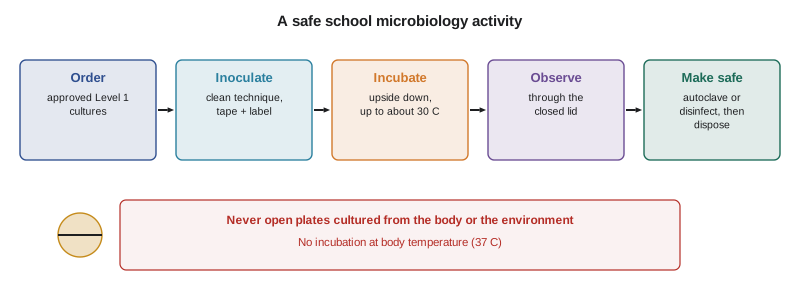
Growing bacteria and fungi on agar plates teaches students about microbiology, hygiene and antibiotics, and it can be done safely in a school with simple precautions. The key principle is that school activities should use only organisms that are not known to cause disease in healthy people, obtained from reputable educational suppliers, and that students should never culture samples from the human body or the environment in a way that could grow unknown, potentially harmful organisms and then open the plates.
Biosafety is usually described in levels, from Biosafety Level 1, for organisms not known to cause disease in healthy adults, upward to levels for dangerous pathogens. School activities should stay at Level 1. Good practices at this level include:
- Washing hands before and after work, and no eating, drinking or touching the face in the lab.
- Wiping benches with a suitable disinfectant before and after work.
- Taping agar plates closed after they are inoculated, labelling them, and incubating them upside down at temperatures that do not favour organisms that grow at body temperature, usually around room temperature to about 30 °C.
- Not opening plates once cultures have grown, particularly for any plate inoculated from the environment or from a person; students observe through the lid.
- Making plates safe before disposal, usually by autoclaving or a pressure cooker used only for this purpose, or soaking in an appropriate disinfectant, following the school's procedure.
Ontario's STAO guidance and similar resources set out which microorganisms and activities are suitable for schools. Hannah keeps a list of approved cultures for the biology teachers and orders only from it.
Human cells and body fluids
Some biology activities involve students' own cells or fluids, such as cheek cell swabs for microscopy or DNA extraction, or blood typing. Activities with blood carry a risk of bloodborne infection, and many schools and associations recommend that students do not test their own or each other's blood, using simulated blood kits instead. Cheek swabs and saliva are lower risk, but each student should handle only their own sample, and all materials should be disposed of as biological waste. Staff who could be exposed to blood or body fluids should follow the routine practices or bloodborne pathogens training described in HSE-360.
Live animals in the classroom
Classroom animals, such as fish, insects, reptiles, small mammals and birds, can help students learn about life cycles and responsibility. They also bring hazards: bites and scratches, allergies, and diseases that animals can pass to people. Reptiles and amphibians, including turtles, frogs and lizards, commonly carry Salmonella bacteria even when they look healthy, and public health agencies advise that young children should not handle them. Rodents and birds can trigger allergies and asthma.
Before bringing an animal into a classroom, the teacher should check the school or board policy, find out whether any students have allergies or medical conditions that make contact unsafe, plan for care over weekends and holidays, and arrange for hand washing after every contact. Animals should be obtained from reputable sources, not caught in the wild, and their enclosures cleaned in an area away from food preparation. Wild animals that wander into a school, such as bats or birds, should not be handled by staff or students; bats in particular should be handled only by animal control staff because of the risk of rabies.
Plants and soil
Plants are generally low risk, but some common houseplants and garden plants are toxic if eaten, and some cause skin irritation. Schools growing plants with young children should choose non-toxic species. Garden soil and compost can contain bacteria, fungi and sometimes sharp objects, so gloves and hand washing are sensible. Soil and potting mixes can also be dusty, and some contain fungi that can cause problems for people with weakened immune systems.
Cleaning up and biological waste
Biological waste from schools, such as used cultures, specimen material, swabs and contaminated gloves, needs to be separated from ordinary garbage and made safe before disposal. The details depend on local rules, but the usual approach is: cultures are sterilized first, specimen material and preservative go back to the supplier or to a licensed waste contractor as directed by the SDS, sharps go into a rigid sharps container, and lightly contaminated paper towels and gloves can usually go into ordinary waste once the hazardous material has been dealt with. Custodians should never be asked to handle unlabelled biological waste.
Kevin uses a simple checklist at the end of every biology lab to make sure nothing is missed.
# End-of-lab biology checklist with a simple count of open items.
items = [
    ("all culture plates taped, marked and in incubator or autoclave bag", True),
    ("benches wiped with disinfectant", True),
    ("scalpel blades in sharps container (count matches issued)", False),
    ("specimens bagged for supplier return", True),
    ("preservative collected, not poured down drain", True),
    ("students washed hands before leaving", True),
]
issued_blades, returned_blades = 24, 23
open_items = [name for name, done in items if not done]
print(f"Blades issued {issued_blades}, returned {returned_blades}")
if issued_blades != returned_blades:
    print("Missing blade: search benches, floor and trays before the next class.")
for name in open_items:
    print("OPEN:", name)
print("Lab ready for next class" if not open_items else f"{len(open_items)} item(s) to close")Blades issued 24, returned 23 Missing blade: search benches, floor and trays before the next class. OPEN: scalpel blades in sharps container (count matches issued) 1 item(s) to close
Counting scalpel blades out and back in sounds fussy, but it is the simplest way to make sure a blade is not left in a tray, on the floor or in a student's pocket, where the next class or a custodian could be cut.
Worked problem
The plate that came back from home
A Grade 10 student brings an agar plate to class that she swabbed from her kitchen sink at home and left in a warm cupboard for a week. The colonies have spread across the plate, and she wants to open it to look under the microscope. What should the teacher do?
Show solution
- Keep the plate closed, and have the student put it down on a tray rather than passing it around.
- Explain why: environmental samples incubated warm for a week can grow organisms that cause disease, and opening the plate releases spores and bacteria.
- Let the class observe it through the closed lid, which still shows the variety of colonies.
- Tape it shut, bag it and make it safe through the school's sterilization procedure before disposal.
- Use it as a teaching moment about safe microbiology, and remind students that cultures are only grown and handled under the teacher's direction.
Answer: Keep it closed, observe through the lid, tape and sterilize it before disposal, and explain why environmental cultures are never opened.
Allergies and sensitivities in the biology lab
Biology labs bring students into contact with materials that can trigger allergic reactions. Latex gloves were once common in schools and can cause skin reactions and, in sensitized people, severe allergic reactions; most schools now use nitrile gloves instead. Animal dander, insects such as crickets kept as feeder animals, pollen from plants grown in the classroom, and some preservatives can all trigger asthma. Food-based activities, such as testing foods for starch or extracting DNA from fruit, can expose students with food allergies to their allergens. The teacher should know which students have allergies or asthma, plan activities with that in mind, and have a clear route to the student's emergency medication. HSE-363 covers allergies and anaphylaxis in more depth.
Biology equipment
Some biology hazards come from equipment rather than living things. Microscopes with built-in lamps get hot, and mirrors on older microscopes should never be used to reflect direct sunlight, which can damage the eye. Centrifuges must be balanced, with tubes of equal mass placed opposite each other, and the lid must stay closed until the rotor has stopped completely; an unbalanced centrifuge can walk across a bench or break tubes. Water baths and incubators should be checked for frayed cords and kept away from sinks. Ultraviolet lamps used to show fluorescence or to sterilize surfaces can burn the eyes and skin, so students should never look at an unshielded UV source, and UV sterilizing cabinets should have interlocks that switch the lamp off when the door opens.
Gel electrophoresis, increasingly common in senior biology for DNA activities, combines electricity and buffer solutions. Power supplies should have interlocked lids so the current cuts out when the lid is lifted, and students should be taught to switch off the power before touching the gel box. Older DNA stains were mutagenic and need special handling; most schools now use safer stains sold for education, and teachers should check the SDS of whatever stain they use.
Outdoor sampling and field work
Collecting pond water, soil, insects or plants on the school grounds or in a nearby park extends biology beyond the lab, and it brings outdoor hazards with it: water hazards near ponds and streams, ticks in long grass, poison ivy and other irritating plants, broken glass and needles in some public spaces, and weather. Students should wear gloves when handling pond water and soil, keep away from deep or fast water, and wash hands before eating. Teachers should walk the site beforehand, check for ticks after work in long grass, and follow the school's field trip procedures, which HSE-363 covers in detail.
Common mistakes
MistakeOpening plates of cultures grown from the environment or the body.
InsteadObserve through the closed, taped lid and sterilize before disposal.
MistakeIncubating student cultures at body temperature.
InsteadIncubate at room temperature to about 30 °C to avoid favouring disease-causing organisms.
MistakeHolding a specimen with fingers near the blade.
InsteadPin the specimen and cut away from yourself and others.
MistakeLetting young children handle turtles and lizards.
InsteadReptiles commonly carry Salmonella; young children should not handle them.
MistakePouring preservative down the drain.
InsteadDispose of preservative as the SDS and local rules require.
Summary and key terms
- Buy specimens in lower-hazard preservatives, ventilate, and wear gloves and eye protection.
- Use safer scalpels, teach safe cutting, count blades and use sharps containers.
- School microbiology should stay at Biosafety Level 1 with approved cultures.
- Tape plates closed, incubate below body temperature and never open environmental cultures.
- Use simulated blood rather than real blood in student activities.
- Classroom animals need policies, allergy checks and hand washing; reptiles commonly carry Salmonella.
- Separate and make biological waste safe before disposal.
- Biosafety Level 1
- The lowest level of biological containment, for organisms not known to cause disease in healthy adults.
- Autoclave
- A device that sterilizes materials with high-pressure steam.
- Sharps container
- A rigid, puncture-resistant container for blades and needles.
- Preservative
- A chemical solution used to keep biological specimens from decaying.
- Zoonosis
- A disease that can pass from animals to people.
Practice problems
Work each problem on paper first, then reveal the answer to check.
What biosafety level should school activities stay at?
Show answer
Biosafety Level 1.
Why are cultures incubated below body temperature?
Show answer
To avoid favouring organisms that grow at body temperature, which include many that cause disease.
What should be used instead of real blood in student activities?
Show answer
Simulated blood kits.
Why should young children not handle turtles and lizards?
Show answer
Reptiles commonly carry Salmonella.
Why count scalpel blades out and back?
Show answer
To make sure no blade is left where someone could be cut.
Lesson quiz · 5 questions
Score 60% or more to complete this lesson.
Create a free account to save your progress, take quizzes and earn a certificate.