
HSE-361 · Lesson 2 of 12 · 21 min
The science lab: layout, ventilation and emergency equipment
A well-designed science lab does a lot of safety work before anyone picks up a beaker. Its layout keeps people moving without collisions, its ventilation carries vapours away, its benches resist chemicals and heat, and its emergency equipment is within reach in the seconds that matter after a splash or a fire. A poorly designed or poorly maintained lab does the opposite: it makes every activity riskier and forces teachers to compensate with rules students will not always follow. This lesson looks at the lab as a room, and at the emergency equipment that every lab using chemicals needs.
Layout and space
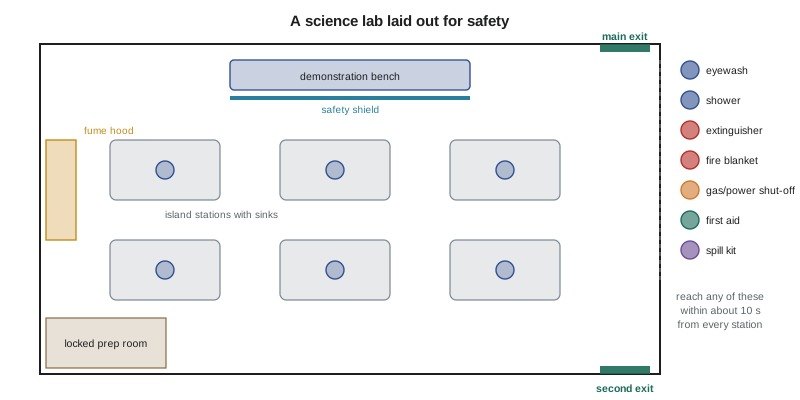
The ideal lab has clear aisles wide enough for two people to pass, workstations arranged so the teacher can see every student from one position, and at least two exits so a fire at one end does not trap anyone. Coats, backpacks and stools belong out of the aisles; backpacks on the floor are one of the most common trip hazards in school labs. Fixed benches should have chemical-resistant tops, and gas and water taps should be easy to reach and easy to shut off.
Many school labs were not designed this way. Pinecrest Secondary School's Lab 206 dates from 1968, with long benches in rows, a single exit at the front and a prep room door at the back that is often locked. When the board renovated Lab 204 in 2011, it changed to island stations with sinks, a teacher demonstration bench at the front with a safety shield, a second exit, and an emergency shut-off for gas and electricity beside the main door. Hannah prefers teaching chemistry in 204, and the department schedules the higher-risk senior labs there when it can.
Combination rooms are common in schools: a room used for both lectures and labs, with desks at the front and benches at the back. These can work, but they need a clear rule that food, drink and personal belongings stay in the desk area, and that chemicals stay in the lab area.
Ventilation and fume hoods
Good general ventilation dilutes the small amounts of vapour released during most school experiments. Many school labs are designed to have more air changes per hour than ordinary classrooms, and the air from a lab should not be recirculated to other parts of the building. If a lab smells of chemicals at the start of the day, or students complain of headaches, the ventilation should be checked.
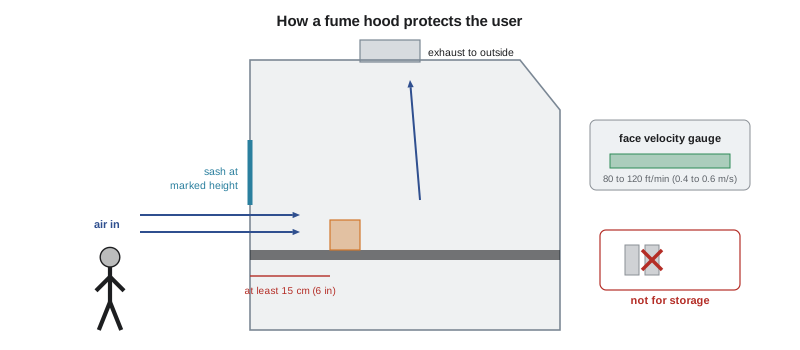
A fume hood is the main engineering control for any work that gives off hazardous vapours, gases or fumes, such as working with concentrated acids, volatile solvents or reactions that release gases. Air is drawn in through the front opening, past the person working, and carried away through ductwork to the outside. Three things decide whether a hood protects the user:
- The face velocity, the speed of air moving in through the opening. A value of roughly 0.4 to 0.6 m/s (80 to 120 feet per minute) is commonly recommended for chemical fume hoods. Too slow, and vapours escape; too fast, and turbulence can pull vapours back out.
- The sash position. The sash is the sliding front window. Most hoods are tested at a marked sash height, and working with the sash lower than that mark improves protection and acts as a shield.
- How the hood is used. Equipment should be at least 15 centimetres (6 in) back from the front edge, the hood should not be crowded with stored bottles, and people should not put their heads inside it.
Fume hoods should be tested when installed and at regular intervals afterwards, usually once a year, with the date and the measured face velocity on a label on the hood. Many newer hoods have an airflow monitor that sounds an alarm if the flow drops. Hannah checks the label and the monitor at the start of each term, and Kevin does a simple check before each use by holding a strip of tissue at the sash opening to confirm it is drawn inward. A hood with an expired test date or a failed monitor is taken out of use until it is retested.
Ductless hoods, which filter air and return it to the room, are sold to some schools. They can work for a narrow range of chemicals that their filters are designed to capture, but they are not a general replacement for a ducted hood, the filters must be changed on schedule, and they offer no protection against chemicals the filter does not capture. A school that has one should know exactly which chemicals it is approved for.
Eyewash stations and safety showers
Chemical splashes to the eyes are among the most serious injuries in school labs, and the first few seconds decide how much damage is done. An eyewash station delivers a gentle, steady flow of tempered water to both eyes at once, leaving the hands free to hold the eyelids open. A safety shower drenches the whole body after a large splash or when clothing has caught fire.
The standard most often used for this equipment, ANSI/ISEA Z358.1, is widely referenced in Canada as well as the United States. Its key points for schools are:
- Location: the equipment should be reachable within about 10 seconds from any point where a chemical splash could happen, on the same level, with no doors or obstacles in the way, and clearly signed.
- Flow: an eyewash should deliver enough flow for at least 15 minutes, and a shower should drench the person, both with water at a tepid temperature so the person can stand under it for the full time.
- Testing: plumbed units should be activated weekly to flush the lines and confirm they work, and inspected in full once a year.
- Plumbed, not bottles: squeeze bottles of eyewash solution are useful for a first rinse while moving to a station, but they do not replace a plumbed station.
Weekly activation matters more than many people realize. Water sitting in a pipe for weeks can grow bacteria and collect rust, and an eyewash that delivers brown water, or nothing at all, is worse than useless in an emergency. At Pinecrest Secondary School, Kevin activates every eyewash and shower in the science wing each Monday morning and initials a tag on each unit. The board added the shop and art room eyewash stations to his rounds after an audit found one in the metal shop that had not been run in over a year.
Teachers and students need to know how to use the equipment before they need it. That means showing students on the first lab day where the eyewash and shower are, how to activate them, and how to help a classmate: guide the person to the station, hold their eyelids open, keep flushing for at least 15 minutes, and send someone for help. Contact lenses should be removed as soon as possible during flushing, but flushing should not be delayed to do it.
Fire equipment
Every lab using flammable materials or open flames needs a fire extinguisher suitable for the materials in the room, mounted near the exit, inspected monthly and serviced yearly. Teachers should be trained in its use, but the priority is always getting students out. Many labs also have a fire blanket, which can smother a small fire in a container or help put out burning clothing, although stop, drop and roll, or the safety shower, is usually faster for clothing. A small fire in a beaker can often be put out by covering it with a watch glass or a larger beaker to cut off the air.
The emergency shut-off for gas and electricity is one of the most useful controls in a lab. It lets the teacher cut all burners and outlets at once if there is a fire, a gas smell or a student playing with a gas tap. It should be near the main exit, clearly labelled, and tested, and teachers should know how to reset it. A master gas valve that is left off when the lab is not in use prevents a common problem: students opening gas taps during a class that is not using burners.
First aid and spill kits
A first aid kit suited to the hazards of the room, a spill kit with neutralizers and absorbents for the chemicals used, and a broken glass container are standard lab equipment. Spill kits are covered in Lesson 11. Broken glass belongs in a puncture-resistant box labelled for glass only, never in the ordinary garbage, where it can cut custodians.
Utilities and electrical safety
Labs combine water and electricity in close quarters. Outlets near sinks should be protected by ground fault circuit interrupters (GFCIs), which cut power within a fraction of a second if current leaks to ground. Extension cords and power bars daisy-chained across benches are a common problem in older labs that were built with too few outlets; the fix is more outlets, not more cords. Hot plates should be the type with enclosed elements and should never be left unattended, and equipment with damaged cords should be taken out of service.
Checking the room
The program below turns the room check into a simple scored list. Each item is checked weekly or at the start of each term, and anything failed is fixed before the lab is used for chemical work.
# Weekly lab check: which items failed, and is the lab fit for chemical work?
checks = {
    "eyewash activated, clear water": True,
    "safety shower activated": True,
    "fume hood test label in date": False,
    "hood airflow monitor normal": True,
    "extinguisher tag checked this month": True,
    "gas/power shut-off tested": True,
    "aisles and exits clear": False,
    "spill kit complete": True,
}
critical = {"eyewash activated, clear water", "safety shower activated",
            "fume hood test label in date", "aisles and exits clear"}
failed = [k for k, ok in checks.items() if not ok]
for k in failed:
    print("FAILED:", k, "(critical)" if k in critical else "")
if any(k in critical for k in failed):
    print("Lab not to be used for chemical work until critical items are fixed.")
else:
print("Lab fit for use; fix minor items this week.")FAILED: fume hood test label in date (critical) FAILED: aisles and exits clear (critical) Lab not to be used for chemical work until critical items are fixed.
In this example, the fume hood's test date has passed and the aisles are blocked. The aisles can be cleared in minutes. The hood needs a retest, and until then any work that needs a hood is moved to another lab or postponed.
Worked problem
The eyewash nobody had run
During her first week at Willow Park, a new Grade 8 science teacher finds an eyewash fitting on the classroom sink. When she turns it on, rusty water spits out for about twenty seconds, then the flow drops to a trickle. What should she do?
Show solution
- Stop any chemical activity that could cause an eye splash until the eyewash works.
- Report it to the principal and the custodian, and put a sign on the unit saying it is out of service.
- Ask for a work order to flush and repair the line, and for the unit to be added to the weekly activation list.
- In the meantime, plan activities that do not involve splash hazards, and keep sealed eyewash bottles only as a first rinse while getting to a working station in another room.
- Raise the gap with the joint health and safety committee, since other elementary science rooms may have the same problem.
Answer: Stop splash-risk activities, report it and tag the unit out of service, get it repaired and added to the weekly flush list, and flag the issue for the whole board.
Common mistakes
MistakeStoring bottles and equipment inside the fume hood.
InsteadKeep the hood clear; clutter disrupts the airflow.
MistakeTesting the eyewash only when it is needed.
InsteadActivate plumbed eyewash stations and showers weekly.
MistakeRelying on squeeze bottles instead of a plumbed eyewash.
InsteadBottles are only for a first rinse; a plumbed station is needed.
MistakeLeaving the master gas valve on all day.
InsteadTurn gas on only for classes that need it.
MistakeAdding power bars to cope with too few outlets.
InsteadAdd outlets, with GFCI protection near water.
Summary and key terms
- Lab layout should give clear aisles, two exits and a clear view of every station.
- Fume hoods work when face velocity is right, the sash is at or below the mark, and the hood is not cluttered.
- Hoods are tested at least yearly and checked before use.
- Eyewash stations and showers must be reachable in about 10 seconds, deliver tepid water for at least 15 minutes, and be activated weekly.
- Students need to be shown the emergency equipment on the first lab day.
- Emergency shut-offs, extinguishers, fire blankets, first aid and spill kits complete the lab.
- Outlets near sinks need GFCI protection.
- Fume hood
- A ventilated enclosure that draws vapours away from the user and exhausts them outside.
- Face velocity
- The speed of air moving in through the front opening of a fume hood.
- Sash
- The sliding front window of a fume hood.
- Eyewash station
- A plumbed fixture that flushes both eyes with tepid water for at least 15 minutes.
- GFCI
- A ground fault circuit interrupter, which cuts power quickly if current leaks to ground.
Practice problems
Work each problem on paper first, then reveal the answer to check.
What face velocity is commonly recommended for a chemical fume hood?
Show answer
Roughly 0.4 to 0.6 m/s, or 80 to 120 feet per minute.
How far back from the front edge should equipment sit in a hood?
Show answer
At least 15 cm, or about 6 in.
How quickly should an eyewash be reachable?
Show answer
Within about 10 seconds, with no obstacles.
How often should plumbed eyewash stations be activated?
Show answer
Weekly.
Why is an emergency shut-off for gas and power useful?
Show answer
It lets the teacher cut all burners and outlets at once in a fire, gas leak or misuse.
What do outlets near lab sinks need?
Show answer
Ground fault circuit interrupter (GFCI) protection.
Lesson quiz · 5 questions
Score 60% or more to complete this lesson.
Create a free account to save your progress, take quizzes and earn a certificate.