
HSE-361 · Lesson 12 of 12 · 20 min
Teaching safe practices: rules, safety contracts, supervision and the yearly room check
Everything in this course depends, in the end, on what happens between a teacher and a class. Guards, fume hoods and spill kits only work if students know why they matter and use them, and if a teacher is watching closely enough to catch the moment a student reaches toward a moving blade or forgets their goggles. Teaching safe practices is not a separate topic added to the start of a lab or shop course; it is part of teaching the subject itself. This final lesson covers how to teach safety, how to supervise, how to deal with substitutes and special situations, and how to bring the whole course together into a yearly check of every specialized room in a school.
Safety as part of the curriculum
Ontario's curriculum documents for science, technological education and the arts include expectations that students learn and apply safe practices, use equipment and materials safely, and understand the health and safety issues of the fields they study. Safety knowledge can be taught, practised and assessed like any other learning, and doing so signals to students that it matters.
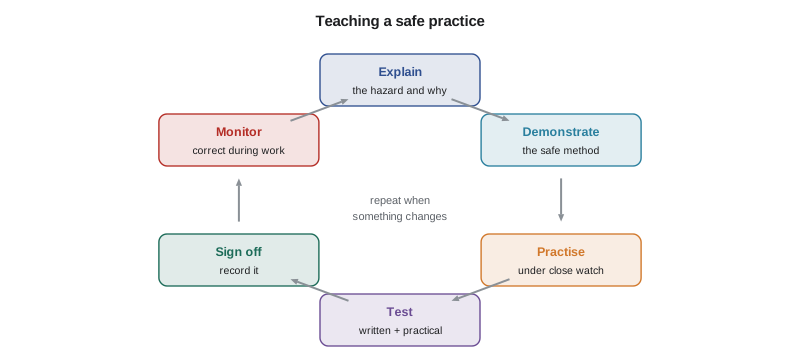
Effective safety teaching has a few features in common:
- It explains why, not just what. A student who understands that wet oven mitts conduct heat into the hand is more likely to grab a dry one than a student who has simply been told to.
- It is specific to the task. General rules matter, but students learn most from safety instruction attached to the activity they are about to do.
- It is shown, not just told. Teachers model every rule, every time: goggles on before the first student enters, guards in place for every demonstration.
- It is practised. Students rehearse using the eyewash, shutting off the gas and responding to a spill before they need to.
- It is checked. Written and practical tests confirm understanding before students use machines or chemicals on their own.
Safety rules and safety contracts
Most labs and shops have a short set of posted rules that apply every day, such as eye protection at all times, no food or drink, report all injuries and spills, no unauthorized experiments or machine use, and follow instructions. Rules work best when they are few, clear, explained and enforced consistently.
Many schools also use a safety contract or agreement, which students and parents sign at the start of the course. A good contract lists the key rules, explains the consequences of breaking them, and asks about medical conditions, allergies and contact lens use that the teacher should know about. A signed contract does not transfer responsibility from the school to the student, but it is a useful record that the rules were explained, and it opens a conversation with parents. Hannah's department reviews its contract each year and translates it into the most common home languages of Pinecrest Secondary School's families.
Supervision
Supervision in a lab or shop is active, not passive. The teacher circulates, positions themselves to see the whole room, and keeps their attention on the students rather than marking or paperwork while hazardous work is going on. Some principles:
- Position: stand where the whole room is visible, ideally with your back to a wall, and move toward the highest-risk activity.
- Pacing: schedule higher-risk activities, such as machine use or heating, for when the teacher can give them full attention, and stagger them so only a few students do them at once.
- Never leave the room while hazardous work is going on. If the teacher must leave, the activity stops, machines are switched off, burners are turned off, and students wait.
- Watch for fatigue, distraction and horseplay, which precede many incidents, and stop them early.
- Match supervision to the student. Students with less experience, younger students and students who need extra support may need closer supervision or adapted tasks.
Students with disabilities and students who need additional support have the right to take part in practical classes, and with planning most can do so safely. That might mean adapted equipment, a workstation with more space, a support worker who has also been trained in the room's safety rules, or written instructions in a clearer format. The planning should happen before the activity, with the student, the family and the school's support team.
Substitutes, after-school clubs and other users
Specialized rooms are often used by people other than the regular teacher. Each needs a clear rule:
- Substitute or occasional teachers: unless they are qualified in the subject and familiar with the room, practical activities involving machines or hazardous chemicals should not take place. The regular teacher's emergency plans should include alternative work.
- After-school clubs, such as robotics, art or cooking clubs: the same rules apply as in class, with a qualified supervisor present and only signed-off students using equipment.
- Night school, community and summer users: the board should agree in writing which equipment they may use and who is responsible.
- Custodians and maintenance staff: they need to know which equipment and chemicals they must not touch, how to report a problem they find, and that tagged equipment stays off.
- Students working on projects at lunch or after school: only with a qualified teacher present in the room.
The yearly check of specialized rooms
The course has covered labs, prep rooms, shops, art rooms and food rooms, each with its own checks. A school can bring them together into one yearly review, done before classes start in the fall and updated through the year. At Pinecrest Secondary School, Marion asked Daniel, Hannah and the other department heads to build a single plan that the joint health and safety committee could track. The plan scores every room on the four questions from Lesson 1, the room, the equipment, the people and the procedures, and uses the scores to set priorities for the year.
# Yearly check of specialized rooms: score each area 0-3 (0 = serious gaps, 3 = good) and rank priorities.
rooms = {
    "Lab 204":    {"room": 3, "equipment": 3, "people": 3, "procedures": 2},
    "Lab 206":    {"room": 1, "equipment": 2, "people": 3, "procedures": 2},
    "Prep rooms": {"room": 2, "equipment": 2, "people": 3, "procedures": 3},
    "Wood shop":  {"room": 2, "equipment": 2, "people": 3, "procedures": 2},
    "Metal/auto": {"room": 2, "equipment": 1, "people": 2, "procedures": 2},
    "Art/kiln":   {"room": 2, "equipment": 2, "people": 2, "procedures": 1},
    "Food room":  {"room": 3, "equipment": 2, "people": 3, "procedures": 3},
}
ranked = sorted(rooms.items(), key=lambda kv: sum(kv[1].values()))
for name, s in ranked:
    total = sum(s.values())
    weakest = min(s, key=s.get)
print(f"{name:11} total {total:2d}/12 weakest: {weakest} ({s[weakest]})")Metal/auto total 7/12 weakest: equipment (1) Art/kiln total 7/12 weakest: procedures (1) Lab 206 total 8/12 weakest: room (1) Wood shop total 9/12 weakest: room (2) Prep rooms total 10/12 weakest: room (2) Lab 204 total 11/12 weakest: procedures (2) Food room total 11/12 weakest: equipment (2)
The scores are judgements, not measurements, but they force a conversation about each room and produce a ranked list. At Pinecrest Secondary School, Lab 206 ranks lowest because of its layout and single exit, which supports the case for renovation in the board's capital plan and, in the meantime, moving higher-risk labs to 204. The metal and automotive shops are next because of the welding extraction capacity found in Lesson 8, and the art room's procedures, especially for kiln firings and studio cleaning, need writing down.
From the ranking, the team builds a plan with specific actions, owners and dates:
| Area | Action | Owner | By |
|---|---|---|---|
| Lab 206 | Move senior chemistry labs to Lab 204; submit renovation request | Hannah, Marion | September |
| Metal/auto | Test extraction capacity; limit booths in use until upgraded | Tom, Daniel | October |
| Art/kiln | Write kiln firing and studio cleaning procedures | Lucia | October |
| All rooms | Weekly eyewash flush added to custodial and technician rounds | Kevin, Victor | September |
| All rooms | Check timetabled class sizes against room capacity | Department heads | Each term |
| Prep rooms | June inventory count and clear-out | Kevin | June |
| All rooms | Review incident data at JHSC meetings | JHSC co-chairs | Quarterly |
Keeping hands-on learning
A risk in any course about safety is that the conclusion becomes 'do less'. Some activities should indeed stop, such as the methanol rainbow demonstration or welding galvanized steel. But the purpose of this course is the opposite: to make it possible for students to keep doing real science, real building, real art and real cooking, because the hazards are understood and controlled. Students who learn to work safely in school carry those habits into apprenticeships, labs, kitchens and studios for the rest of their lives. That may be the most valuable safety outcome of all.
Worked problem
Planning a new course
Pinecrest Secondary School plans to add a new senior course in electronics and robotics that will use soldering stations, a laser cutter, 3D printers and lithium battery packs, in a former classroom next to the wood shop. Marion asks Daniel and Greg to plan the safety side before the course starts. What should they include?
Show solution
- Check the room: ventilation for soldering, the laser cutter and printers, enough outlets with GFCI protection where needed, a fire extinguisher, and space and layout for the planned class size.
- Check the equipment: lead-free solder and fume extractors at soldering stations, an exhausted, interlocked laser cutter with a posted list of approved materials, enclosed printers, and safe charging and storage for lithium batteries.
- Prepare the people: training for the teacher on each machine, and a student sign-off sequence for soldering, the laser cutter and battery handling.
- Write the procedures: room rules, a safety contract, procedures for laser cutter fires and battery incidents, and waste disposal for batteries and electronic scrap.
- Add the room to the yearly check and the joint health and safety committee inspection route, and review it after the first term.
Answer: Plan the room, equipment, people and procedures before the course starts, then add the room to the yearly check and review it after the first term.
Building a safety culture in a department
The safest departments are not the ones with the longest rule books but the ones where safety is part of how people talk and work every day. In Hannah's department, the first agenda item at every meeting is a quick round of near misses and fixes from the past month. New teachers are paired with an experienced colleague for their first practical units. Anyone, including a student, can stop an activity they think is unsafe, and nobody is criticized for doing so. When something goes wrong, the question is what in the system allowed it, not who to blame. And the department head takes problems such as the fume hood test dates, the class sizes and the old lab's single exit to the principal and the board until they are fixed.
Principals play a large part too. They approve timetables and class sizes, budgets for equipment and repairs, and time for teachers to train and maintain their rooms. A principal who walks through the labs and shops regularly, asks about the eyewash log and the machine sign-off charts, and acts quickly on reported problems sends a clear message that these rooms matter.
Common mistakes
MistakeTreating safety as a one-day lecture at the start of the course.
InsteadBuild safety into every activity, with explanation, demonstration, practice and testing.
MistakeLeaving the room briefly while students use machines.
InsteadStop hazardous work and switch machines off before leaving.
MistakeLetting a substitute run a machine-based shop class.
InsteadPlan alternative work unless the substitute is qualified and familiar with the room.
MistakeAssuming a signed safety contract shifts responsibility to students.
InsteadThe contract records that rules were explained; the school's duties remain.
MistakeResponding to hazards by dropping all hands-on work.
InsteadControl the hazards so students can keep doing real practical work.
Summary and key terms
- Safety is part of the curriculum and can be taught, practised and assessed.
- Effective safety teaching explains why, is task-specific, is modelled, practised and checked.
- Keep posted rules few and clear, and use safety contracts to record that rules were explained and to gather medical information.
- Supervision is active: position, pacing, never leaving during hazardous work, and stopping horseplay early.
- Plan for students who need extra support, substitutes, clubs and other users of specialized rooms.
- A yearly check scores each room on the room, equipment, people and procedures and sets priorities with owners and dates.
- The goal is to keep hands-on learning by controlling its hazards.
- Safety contract
- A signed agreement listing lab or shop rules and recording that they were explained.
- Active supervision
- Supervision in which the teacher watches, circulates and intervenes, rather than doing other work.
- Sign-off
- A record that a student has passed the tests needed to use a machine or do an activity.
- Yearly room check
- A planned review of every specialized room to set safety priorities for the year.
- Modelling
- A teacher demonstrating safe behaviour consistently so students copy it.
Practice problems
Work each problem on paper first, then reveal the answer to check.
Name three features of effective safety teaching.
Show answer
Explaining why, being task-specific, modelling, practising and checking.
Does a signed safety contract transfer responsibility to the student?
Show answer
No; it records that the rules were explained, and the school's duties remain.
What should a teacher do before leaving a room where students are using machines?
Show answer
Stop the activity and have the machines switched off.
What four areas does the yearly room check score?
Show answer
The room, the equipment, the people and the procedures.
What should happen in a shop class when a substitute is not qualified in the subject?
Show answer
Alternative work that does not involve machines or hazardous materials.
Lesson quiz · 5 questions
Score 60% or more to complete this lesson.
Create a free account to save your progress, take quizzes and earn a certificate.